Garald
-
Posts
1113 -
Joined
-
Last visited
Everything posted by Garald
-
This is extremely valuable advice, and I would have certainly used it if it had been available at the time (I used acetone because that was the piece of advice I could quickly find online when searching with sticky fingers). It's a shame that acetone is much easier to get (supermarket). I'll ask the people at the paint shop where to dispose of the canister.
-
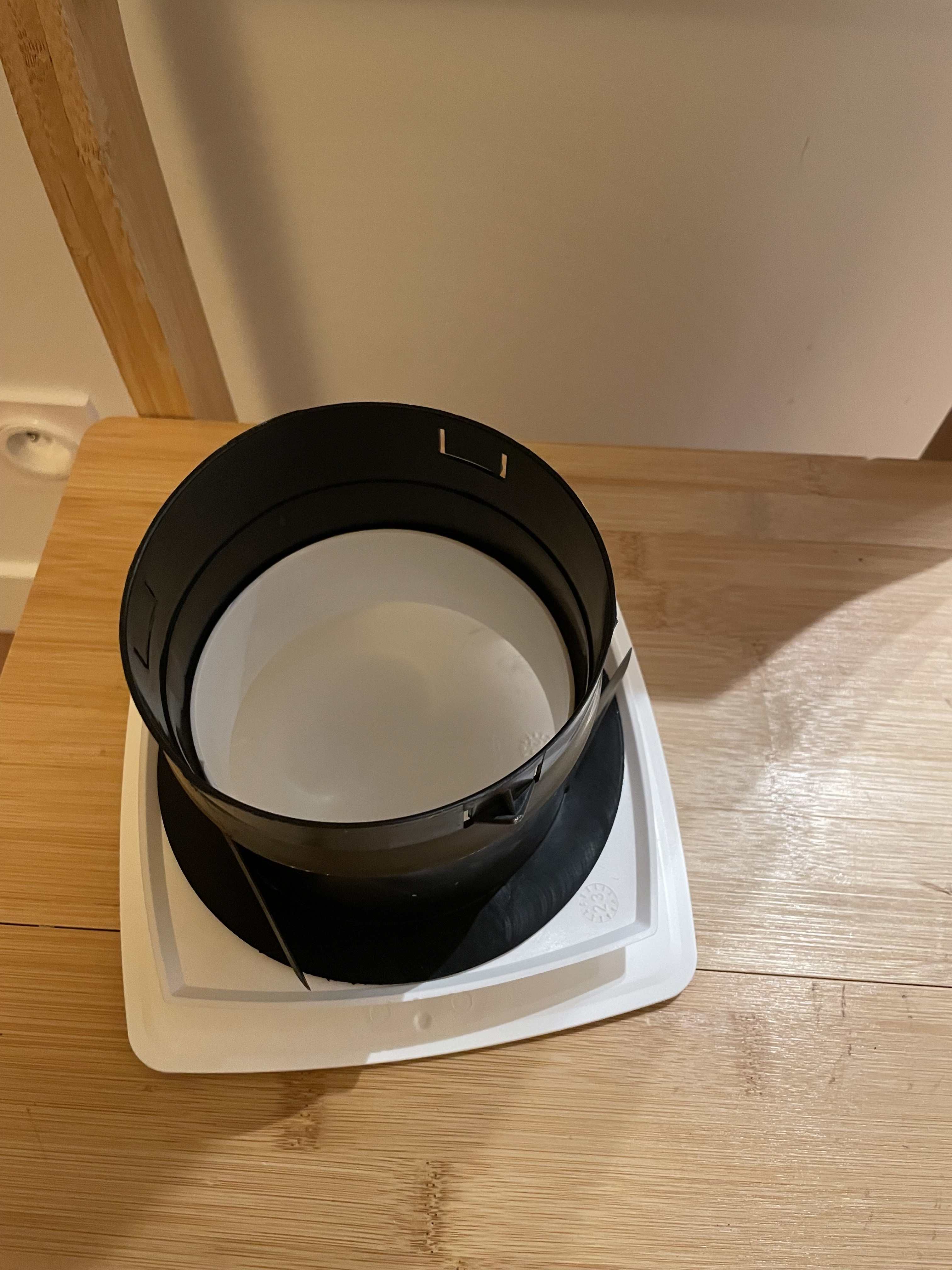
I have a stupid and trivial question. A ventilation cover keeps falling every time I close a door. (I have positive-input ventilation; does this make a difference?) I got a new cover, thinking the old one must be broken, but the same happens with the new cover. What to do? I am not supposed to seal it with acrylic or what have you, am I?
-
Not exactly. As I said: I bought a large cannister online, went to a local shop to get an extension hose, was told that I did not have the equipment, that they did not have in stock, that it would cost a fair bit, and that they would rather gift me a canister for which I didn't need equipment. I guess it did not contain an enormous amount (is that what you mean by "all or nothing"?). It does not make a noise when I shake it, so I figure it's really empty.
-
Well, that was quick and messy. What took much more time was cleaning my hands until they were no longer sticky. (I used a microfibre cloth soaked in acetone, and then washed my hands with plenty of soap - actually, I repeated that a couple of times.) I hope I can now prepare dinner without poisoning myself. (I know what acetone tastes like (badly, even in tiny traces) but I have no idea of whether polyurethane can be detected so easily.) Can I put the can in the trash, or will that extinguish all life in a large radius?

-
Went to the local paint shop to get 400mm of water pipe. I was told, not only that they did not have any pipe that would do, but that the kind of foam container I got (FM330 ILLBRUCK) required a fairly expensive foam gun (50 eur or so) and that I would be better off with foam that didn't require such a foam gun. Their card reader was down, so the vendor just decided to gift me a can of Sika Boom 107 (with the semi-explicit message that it was an inducement to keep buying from him and be warier of things sold on the Internet). Hopefully it will be just as good? At any rate, he also told me to get some plastic pipe from a random bazar and use it to extend the can's pipe (by first heating the latter a little). Let us see.
-
I take that's some sort of self-referential Welsh joke? At any rate, my girlfriend was aghast at the William-Morris pattern, so I expected at least a cheer on that (or a mumble of agreement with her).
-
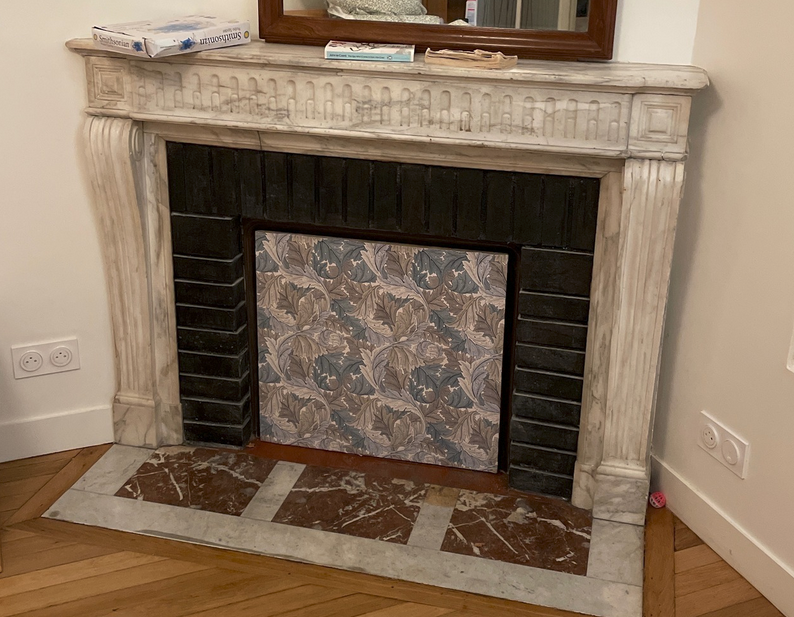
Oh, understood: I should remove some of that haphazardly laid insulation if necessary for an even finish. Then I'll insulate the exposed pipework. Ufff. May I get out on a technicality? The garage is not a separate shed - it's inside the house, and it has a wooden door, so it's never nearly as cold as the outside. If I don't get out, then distribution may be a bit of a problem. Are there real-life BuildHub get-togethers? Getting a keg (or homebrewing) would be feasible. I've been going systematically through all the air-leaks detected in the house - this was just the next-to-last item (which I decided to do myself because I couldn't find a mason to cut some drywall to measure). Here is the antepenultimate item - I covered an unused fireplace in pine with 2cm of cork backing: I also stuffed two of those plugs made out of British sheep up the chimney. Once this is done, the only thing detected by the fan test that will remain to be done will be to replace some non-airtight access hatches. I think some hatches are rated passivhaus. Is that the sort of thing I should be able to install myself.
-
Wait, so I shouldn't get the pipe insulation at all? Yes, only a short segment is uninsulated, but I take it would still help. What is true is that I can also do it later.
-
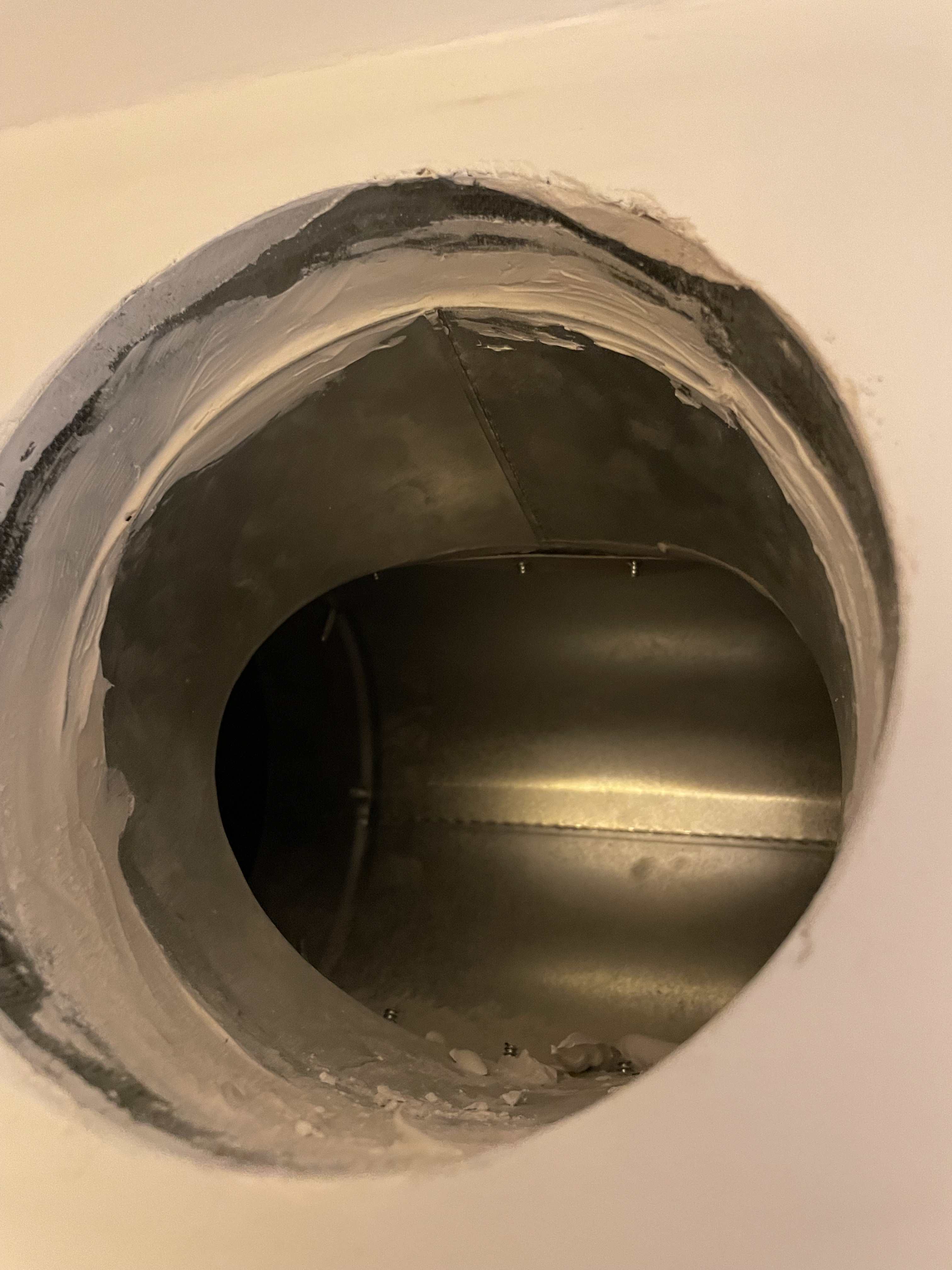
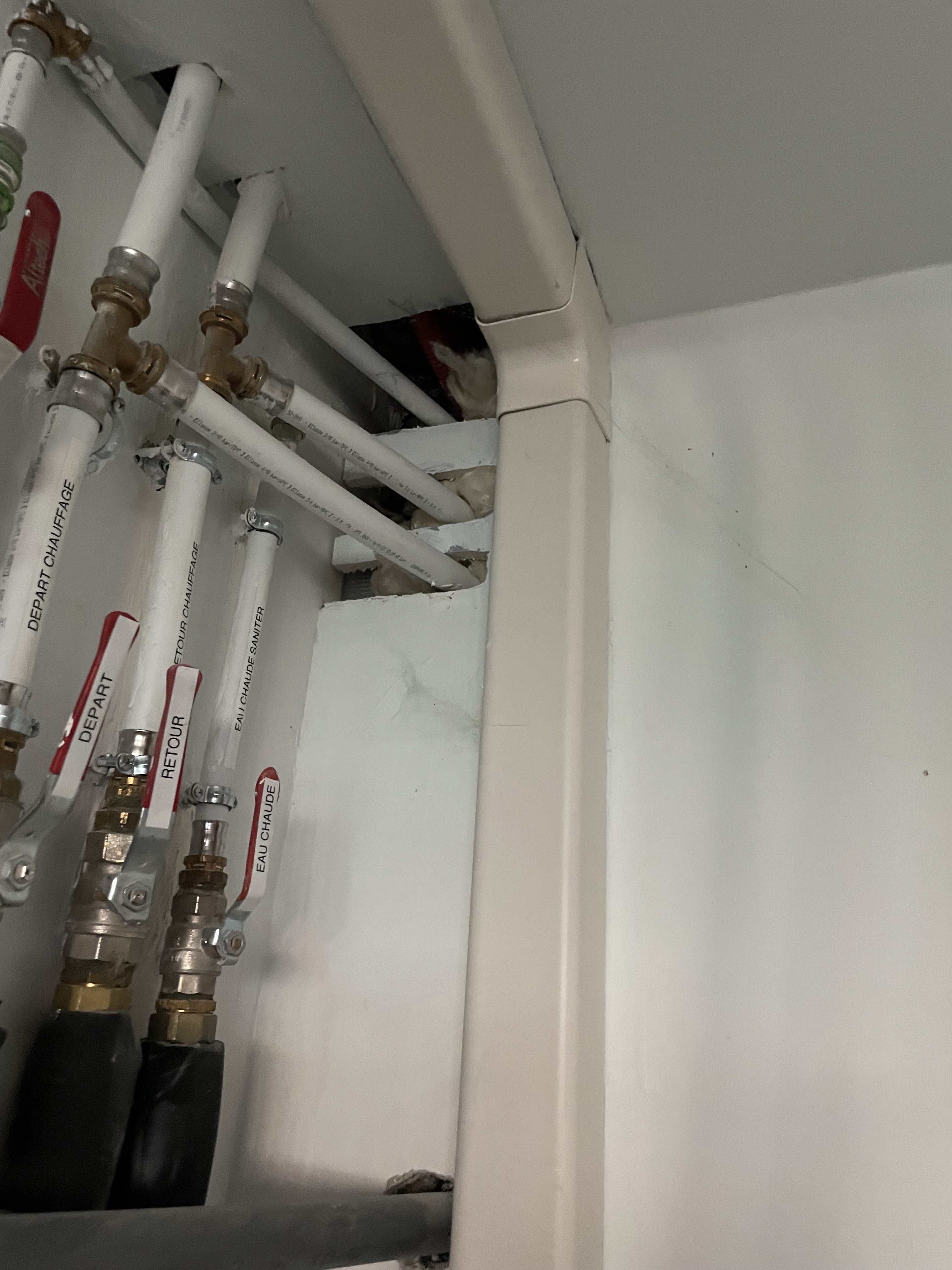
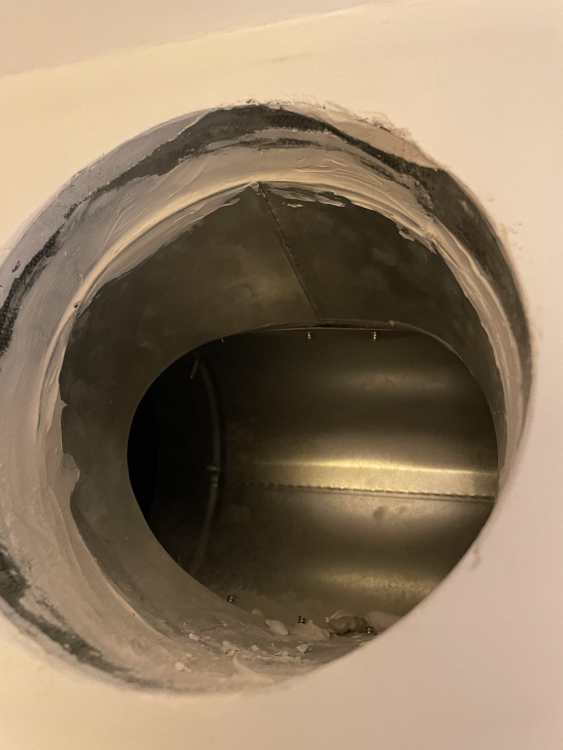
Will do. I take that there must be some kind of pipe insulation that wraps around and seals around pipes that have already been installed. Something like this? https://www.castorama.fr/manchon-de-protection-pour-tuyaux-noma-22-mm-l-1m/5413257000634_CAFR.prd?storeId={store_code}&srsltid=AfmBOorSdsIovuzJZC5bpFTE_ibzN9R7T8C2U-50UU8JbZfBrFOWBFyGgH4 The funny thing is that there's already some insulation (rockwool maybe? Or polyurethane?) just inside the hole, laid in any which non-airtight wave. Let me share a better picture. See attached. Sounds like good ideas! I'll go to the local paint shop first to see whether they can sell me a more "official" attachment (or some water pipe!).

-
Here is the space I plan to fill in with FM330 ILLBRUCK foam. (It's in an unheated if not very cold garage inside the house; cold air goes in here and makes the entire space above the ground-floor false ceiling cold - that does not help with the hot-water pipes and who knows what else.) Is there any reason why I should *not* do it? These are pipes coming in from the heat-pump.

-
Are we targeting ASHP's at the wrong market?
Garald replied to ProDave's topic in Air Source Heat Pumps (ASHP)
The argument should be 'your place should be insulated enough that you can find a working arrangement in which the flow temperature is low-ish, preferably <= 45 C or so'. I guess that's always the case if you have central heating in which air gets heated centrally and pumped, American-style? (I just found out that my parents have had a heat pump since 2009 and barely knew it - they just knew that their heating bills were surprisingly reasonable.) -
Are we targeting ASHP's at the wrong market?
Garald replied to ProDave's topic in Air Source Heat Pumps (ASHP)
I'm scratching my head. Does the UK have cheap gas and expensive electricity (relative to France)? -
OK. This is not really a math paper as such - it is written in the hope that the "general professional public" (meaning members of a maths-and-engineering society) understands it. Here is my attempt at a summary/commentary. Most things are linear if you look closely, in the sense that the graph of a differentiable curve looks more and more like a line the more you zoom in. There are cases, however, where a linear approximation will not do: 1. because of the material - for some materials, Hooke's law (which is linear) is a very good approximation; for others, not so much. 2. because of the geometry (so to speak). This is the focus of the text. Here's a classic example of 2 (not given in the text). You've heard of Galileo discovered that the time a pendulum takes to swing is independent of how wide the oscillation is. Well, this is only truish. It would be true if we had sin alpha = alpha (where alpha is an angle measured in radians), but this is of course only approximately true, and only for small alpha; more precisely, \sin \alpha = \alpha - \frac{\alpha^3}{6} + ... There you see how the approximation sin alpha = alpha is very good for alpha tiny, and less so for larger alpha. The same approximation alpha to sin alpha lies beneath some approximate estimates in engineering that becoming less exact as alpha gets larger. Non-linearity is particularly important when we talk about equilibria. Whether an equilibrium is stable or unstable depends on second derivatives - the first derivatives are all zero, that's why we are at equilibrium. In general, when linear terms vanish, the quadratic and higher terms become much more important. Things buckle after reaching a critical stress? If the resulting situation is a stable equilibrium, breathe a sigh of relief. If the resulting equilibrium is unstable, oopsie. There's an important made at the end of page 105/beginning of page 106: if buckling results in a stable equilibrium, that also means, in general, that impurities and imperfections will not result in much of a change; if it results in an unstable equilibrium, imperfections will lower the critical load considerably. This is not just empirical - there's an actual mathematical reason, which I wish were explained at greater length (it was new to me - I know nothing). The last section is about *how* things buckle - what sort of shape they tend to take. Here I think you need a mathematician other than me (one who knows much more than what the article gives away) to summarize and frame things nicely and answer your questions. You need someone from dynamical systems.
-
Cool, thanks - let me see! In the meantime: my girlfriend just raised the difficulty level - she asks whether I can request an aerial rig on the top beam.
-
Wait, SE is about the last field in which I would think of using AI. The main advance in AI in the last few years is that it has got really, really good at bullshitting. It can write an Op-Ed for a major newspaper, yes, but designing a roof that will not fall? Finite elements was a legitimate revolution in its own bounded field back in the day.
-
PS. I just have a regular wooden staircase going up to the first floor and then a *really* narrow staircase going up to the attic. I would have thought there would have to be a way to extend the first staircase instead of cramming a narrow staircase in what must have once been a closet, but hey, I don't want to change something that works!
-
CPD = Continuing Professional Development?
-
Right, I'm afraid I'll have to hire someone local (and an architect to sign off on things! brrr!) when I actually go through with this. Still, I'm very grateful for all advice I can get here. One of many reasons to find out which possibilities are possible and sensible is that I will need to ask for permission from townhall. I think they care mainly about the external look of things. (Or possibly structural work is the business of another department within townhall?) Wouldn't be fun if I hired an SE first, paid them to do plenty of work, and then found out townhall does not like how it would look from the street.
-
By all means do!
-
Since the system apparently deleted the photos in my original post, let me add a couple here, to make clear what things look like now - the attic has already been renovated, and it's a nice space; it's just that there's not a lot of head room and the insulation is very middling. Attic with cat: (There's also a bathroom and a bedroom/second office.) Here's what the area in the second picture looked like when the two skylights where about to be opened; the insulation material in that bit of the ceiling had been removed and was about to be replaced (by rockwool I think). There's still an issue with cold air circulating within the ceiling.
-
I'll be glad to pay an SE - and the joiners, and other people doing the physical work. As for some of the people that get in the middle... Of course part of the idea of reusing the existing structure is to reduce waste (it seems a bit to scrap something that has lasted almost 100 years and that looks rather nice in my view) and also to reduce labour (and material) costs by avoiding *unnecessary* manual labour.
-
Completely agreed. I won't be looking for the cheapest - I'll be looking for an SE who besides doing a good job will not be annoyed by @Garald always asking why. (Oh, and will actually be interested in not doing things in the most standard, boring way. Plenty of people in the Paris area just scrap everything in the attic and build something very standard from scrap, I take. My feeling is that if the task actually forces the engineer to put serious thought into the issue, the end product will be much better.) > An Architect with 40 years experience behind them will save you piles of cash too! Well, it seems that due to legal requirements I'll need to go through an architecture studio no matter what. I suppose the algorithm is to ask around for an SE that works in an architecture studio, and choose the studio in which that SE works?
-
Otherwise put: OK, maybe there is no such thing as engineering books written for mathematicians, since perhaps not enough mathematicians are curious about statistics. But what is the statistics equivalent of Feynman's lectures or the Berkeley Physics Course? (On these two examples: neither is ideal for me *now*, since they assume less mathematical maturity than I have, but they can be very good fun.)
-
OK. So, open challenge: recommend books that are reasonably concise and heavy on the reasons behind things; mathematical content a big plus (goes together with being concise).
-
You mean for us to adapt to it, or for someone to work on it and make it suitable?