Garald
-
Posts
1113 -
Joined
-
Last visited
Everything posted by Garald
-
With all the work I'm doing in insulation, and a low-temperature heat-pump, I suspect PV would be mostly an eco-gesture of my part at the end, if I have any money left (hint: I won't). Perhaps I can leave it for later? Or is it the sort of thing I should take care of now, or rather at the end of the project? I've been messaging a local PV company repeatedly, but they haven't got back to me yet.
-
How many (low-temperature) radiators are enough?
Garald replied to Garald's topic in Central Heating (Radiators)
Right, I was wondering about that. Excellent question. My tiny Grotrian-Steinweg upright has a Dampp-Chaser system installed. -
How many (low-temperature) radiators are enough?
Garald replied to Garald's topic in Central Heating (Radiators)
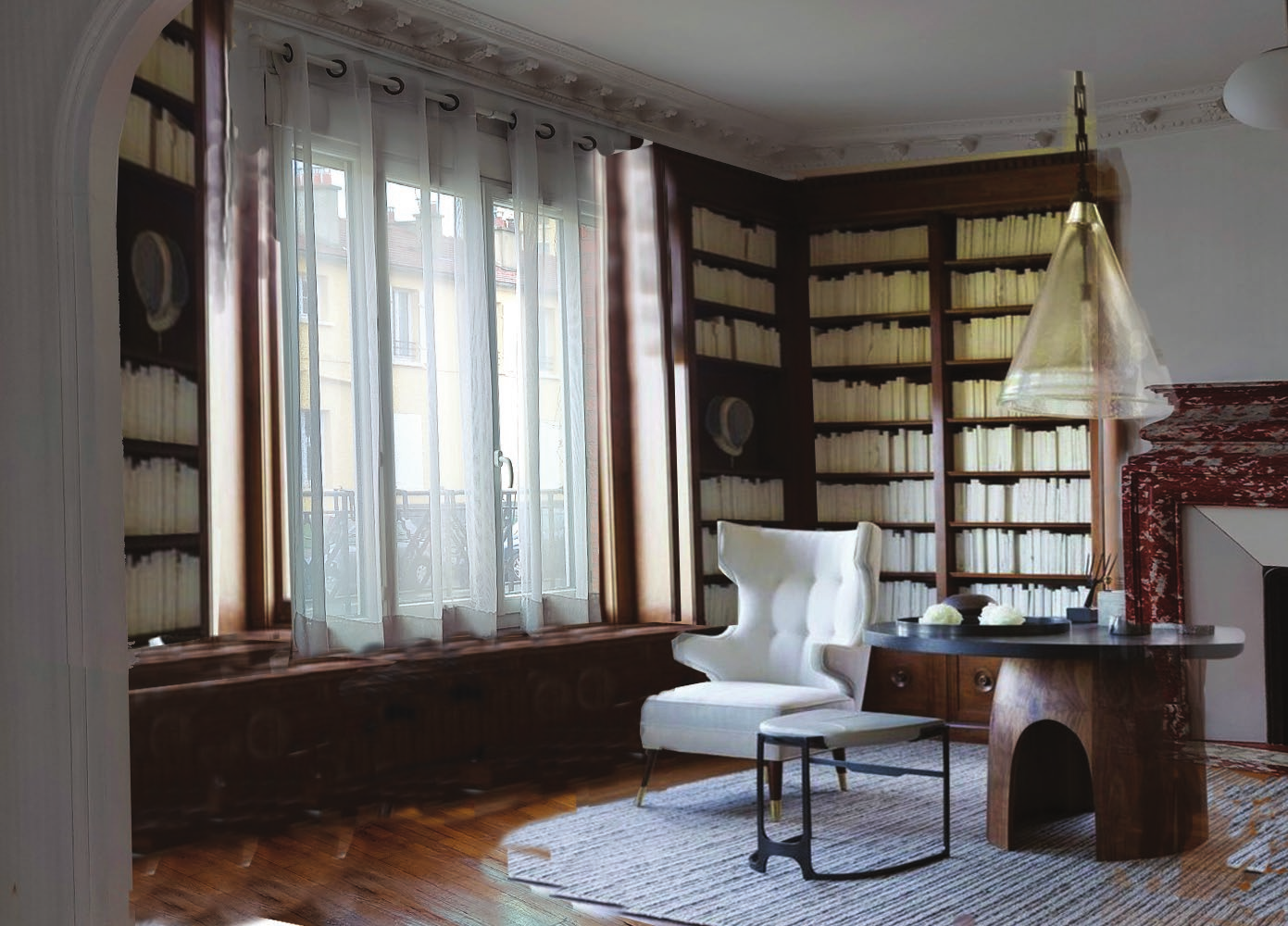
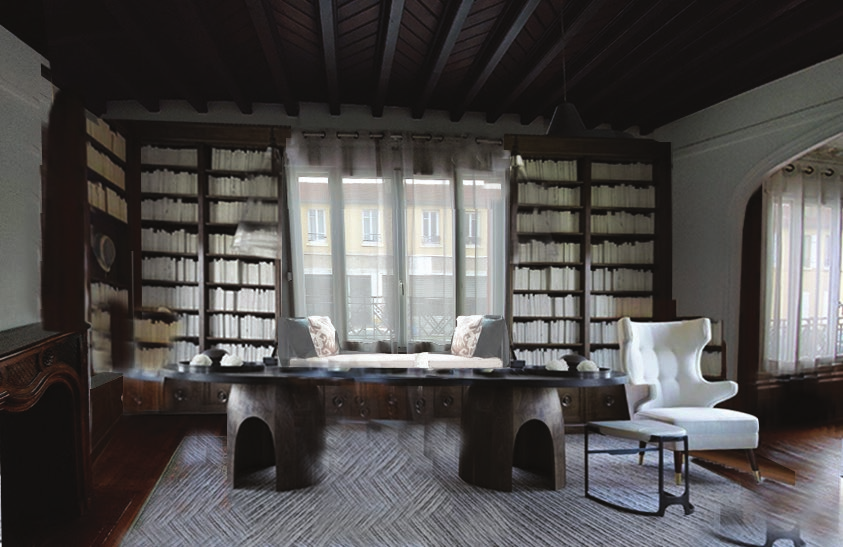
I think it started out as a very basic brick-and-masonry place in what was then (1930) the working-class outskirts (and still sort of is, though it would be "outskirts" only in the pedantic Parisian sense of being just outside the Périphérique - 10 min walking). Then successive owners have improved it, while neglecting to do anything about insulation, and leaving a gas heater that you run by sacrificing infants to Putin, a bit like in Salammbô. It's not every attractive on the outside - I'll do a bit of work so that it reaches "nicely inconspicuous" levels. Most of the ground floor is occupied by a GP. >(And on the topic of triple panel radiators you've effectively got them already dimensions wise so I think they'd be a good idea if required) You mean they are fat? Here are some more pictures of existing radiators, with views of the greengrocer in front: And here are our plans for what the library (aka the one important room) will look like (though my girlfriend would prefer lighter wood): Ignore the James-Bond-villain furniture, which was the architect's idea and won't become reality. (We'll put some of that money into good shutters and awnings instead, to avoid heat gain.) BTW, the architect is a bit anxious about losing wall space in the library. Maybe the radiators can be put on the lighter, IKEA-hack side that you don't see here. At any rate, any help on how to choose new radiators for efficiency, size, shape, etc., and price are welcome, as is advice on whether 14 radiators is too many.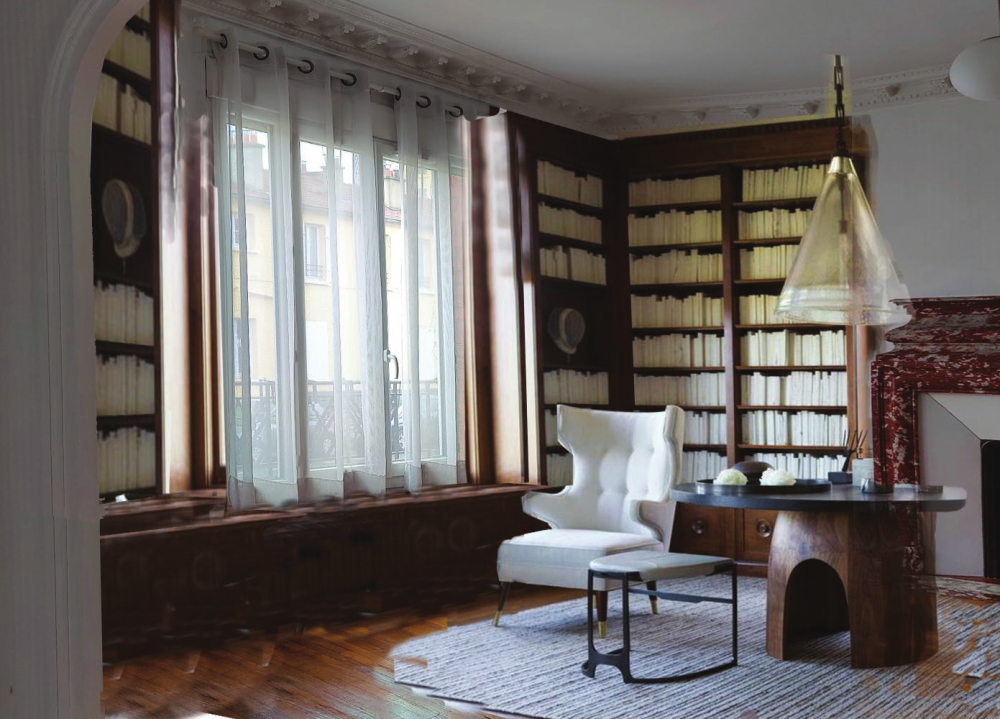
-
How many (low-temperature) radiators are enough?
Garald replied to Garald's topic in Central Heating (Radiators)
Tried to edit to show only a close-up, but for some reason I can't edit my previous post.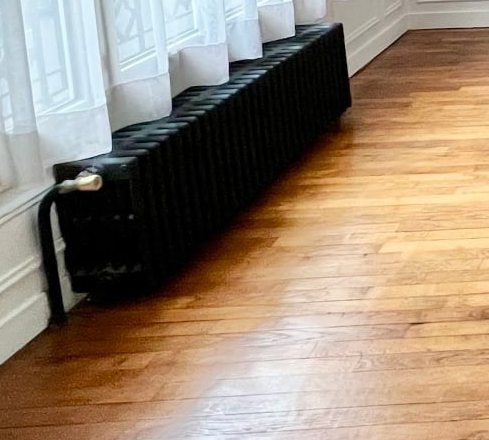
-
How many (low-temperature) radiators are enough?
Garald replied to Garald's topic in Central Heating (Radiators)
Old, I take. Hopefully not from the 1930s, but old. > Do they have internal fins to increase the effective surface area? Uh... see pictures. (I'm not currently there - otherwise I could take close-ups.) >Could you cope with "fat" radiators that protrude almost 20 cm off the wall? Why not? Would fit nicely between bookshelves! >I ask because some of my new "low temperature" radiators occupy less area than the old ones they replaced. The old ones were were just double panel (c 1980) and my new >ones are mostly double panel double fins with a couple of "fat" triple panel tripe convector types. Sounds like a good idea. The architect made it sound like low-temperature radiators that fit under my (low) window-sills would be extremely expensive - is that really the case? Of course they don't have to fit there - tall, fat and narrow would also be very good. -
How many (low-temperature) radiators are enough?
Garald replied to Garald's topic in Central Heating (Radiators)
There are years without snow. -5C is normal for a particularly cold winter night, but temperatures under -10C are a rarity - I'm not sure that has happened in the last 10 years. December 2009/January 2010 was cold (record: -13.3C, the Internet tells me). -
How many (low-temperature) radiators are enough?
Garald replied to Garald's topic in Central Heating (Radiators)
I agree I must have made a mistake. Let us try to find it. I understood "floor area" to be "area of floor above the ground or unheated space". This is a roughly 8mx12m structure, so 76m^2 should be right. (I will put some insulation on the ground-floor floor, but not that much - can't raise the floor by much without making incomers trip. The ceiling of the garage and of the co-op's corridor will be insulated, but the spreadsheet doesn't know that.) Let me see. First-floor inner walls: (12+8+12+8)*2.8 = 112m^2. Ground-floor walls: about (8+5+8+5)*3 = 78m^2 (the garage doesn't count). The attic has just the walls on the sides (the rest is ceiling), which are about 1.2m tall on average; hence (8+8)*1.2 = 19.2m^2. So, a total of about 210m^2, whereas I keyed in 200m^2. Let me put 220m^2. The internal roof area should be sqrt(2.4^2 + 4^2)*12*2 = about 112m^2. Yes, that's what was much too low. New version attached. The total volume should be closer to 500m^3 than to 400m^3. Other than that: am I interpreting things correctly? Heat loss calculator - Master (1).xls -
How many (low-temperature) radiators are enough?
Garald replied to Garald's topic in Central Heating (Radiators)
PS. Yes, I did do the heat-loss spreadsheet, but I must have input something wrong, as I am getting unrealistically small values. Here it is. Heat loss calculator - Master (1).xls -
Right, I was suspecting that - I must have made a mistake. Let me find the sheet.
-
Here is the new thread:
-
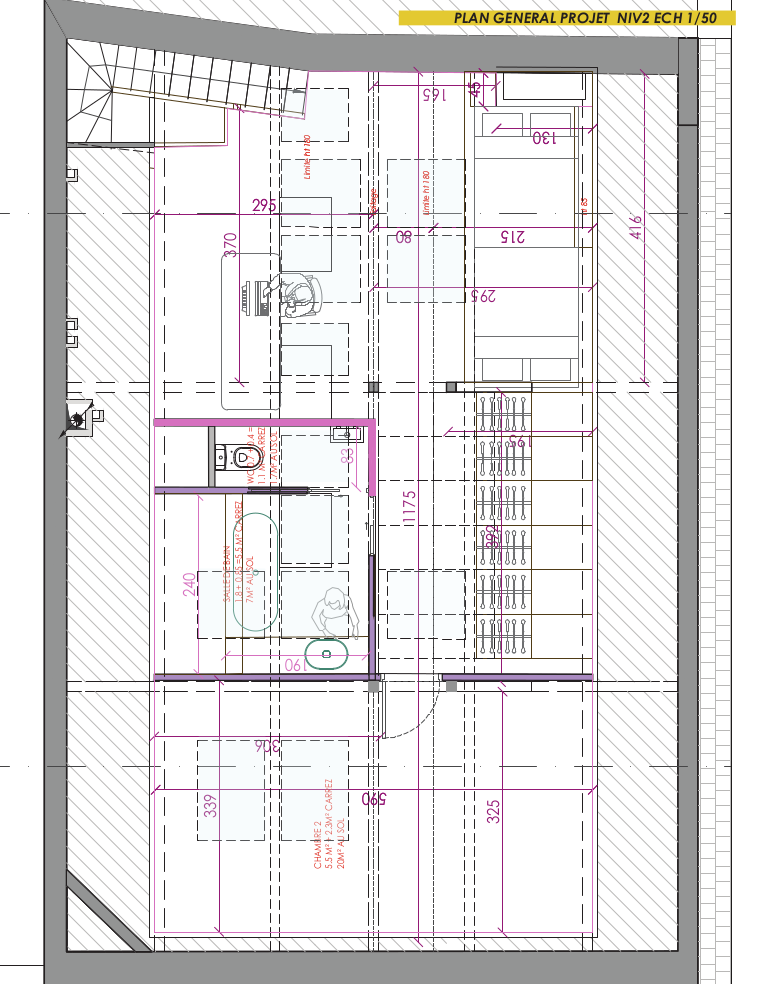
[Preface: as quite a lot of people here know by now, I am doing a large renovation job on a place I bought in a near suburb of Paris earlier in the year. This is the last moment to make big decisions - work (demolition of some walls) should start this week. The place will be very well-insulated (for renovation standards) - 18cm cellulose on most walls, 11cm of cellulose+reflective insulation on the courtyard wall] So, (a) I am finally considering seriously installing a low-temperature heat pump, with low-temperature radiators, rather than simply switch over from a gas boiler to a HT heat pump. If I keep the number of radiators the same (14 radiators, for a place that will be about 120m^2 loi Carrez (= inhabitable area you can stand in, not counting staircases) and 180m^2 non-loi Carrez)), the net cost would be about 5800eur, including 800eur in increased work for the contractor and the architect. (Low-temperature heat-pumps are not just better, they are cheaper; however, low-temperature radiators are expensive - 650 eur a piece); (b) a friend who advises me (N. the Philanthropic Flipper) was telling me: insist on having fewer radiators; the architect finds their number to be right, but N. says architects and contractors always overestimate the number of radiators needed, at least in the Paris area. (c) the architect is a bit bothered by the possibility of a switch to low-temperature simply because low-temperature radiators are large, and we need wall space for bookshelves (I have about 1500 volumes currently, besides a vinyl collection, and the number of books seems to double every ten years) In short: how many low-temperature radiators are likely to be enough? It's a place with high ceilings on the ground floor and first floor (270cm to 290cm). Only the central part of the attic will be above 180cm. Here are the plans (already showing the insulation and the work that will be done): Presumably I want narrow, tall radiators, so as to use space efficiently (putting books right above a radiator is not necessarily a great idea in the long term, is it?). There are currently radiators under the windows, but it is very doubtful that low-temperature radiators will fit in there. For a climate table for Paris, see https://en.wikipedia.org/wiki/Climate_of_Paris Attention: the table there gives the average for 1991-2020. The climate is getting noticeably hotter in summer and milder in winter.
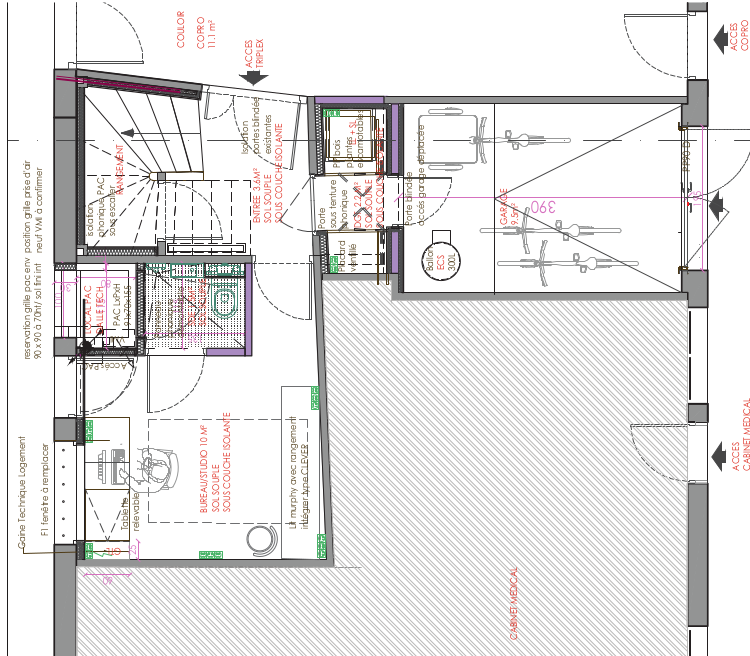
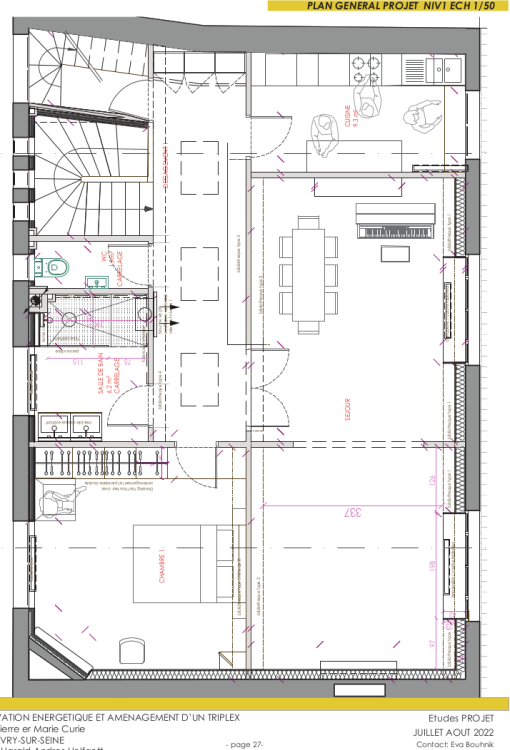
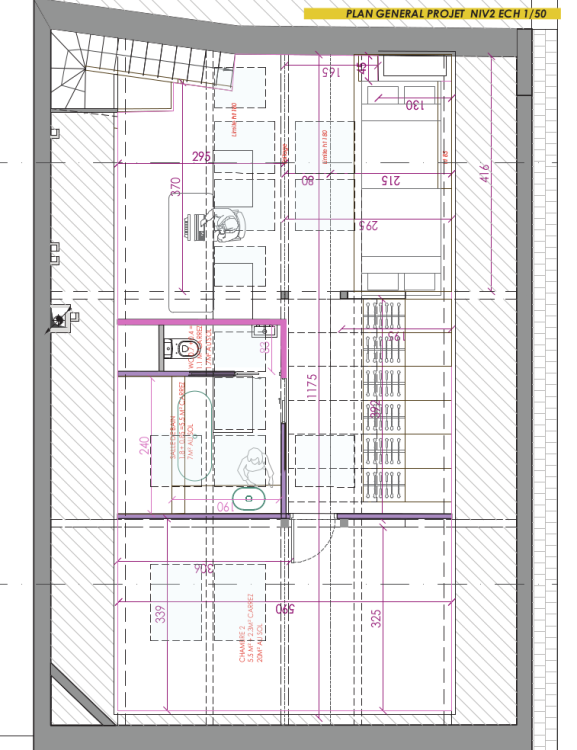
-
Let me post detailed plans on a new thread. The R values will be >= 3.8 (+ the brick walls' intrinsic R) everywhere. Double-glazing with good thermal performance; I'm replacing the big library windows to better double-glazing (mainly to increase sonic performance). Outside steel doors; I'm replacing the indoor doors.
-
Then I must be inputting something wrong. Paris is a bit warmer than the south of England, but it's not like it's a tropical island either. When I lived in 23m^2, I had two small electric panel heaters set on medium-low and found that was quite enough, but friends sometimes said I didn't use enough heating for their taste. Also, I had a friend who lived in 40 m² in an attic - his place was a temple of the winds - it was not just uninsulated, it leaked air. He was cold in winter, even after he installed electric heaters with fans. Of course I will be in a different situation - I'm doing a very thorough insulation job - but it's definitely not a heating-optional climate. The coldest place I've been to where anybody thought a small electric panel heater would heat an entire house is Santiago de Chile, and that's (a) significantly warmer, (b) peopled by Spartans.
-
(I don't yet know whether I'll install PV panels, at least for now, given that my budget is strained.)
-
New input from the architect on the low-temperature possibility: Long story short, we are seriously considering switching to low-temp. (This is a dramatic-intervention-of-a-guest-who-decided-not-to-remain-silent-forever-at-the-wedding sort of thing; work on the site is scheduled to start this week.) The difference in price between 200L and 300L is 620€ for the low-temperature arrangement we are considering. (It is 520€ for high-temperature.) So: is 300L worth it? Notice that, in low-temperature, it's all monobloc - the tank is part of the heat-pump cabinet. The question is really: is 300L more efficient - enough to justify the difference in price? (I don't think I'll ever be short of water with 200L, not unless I invite many particularly cold-blooded amphibian guests for a sleepover.) Here's the link to the heat pump's specs: https://www.amzair.eu/wp-content/uploads/dlm_uploads/2015/04/pac-amzair-optimduo-dossier-technique-20211125.pdf
-
All right - new input from the architect! TL;DR - the net cost of switching to low-temperature would be about 5700 eur. (14 radiators (the number we now have?) at 650 eur = 9100 eur, but we'd be saving 4100 on the heat pump and water tank (the low-temperature monobloc is cheaper by that much than the high-temperature monobloc from the same company); she estimates the cost of fiddling around with other things would be 700 or 800 eur.) I suspect this may be an overestimate: do we really need 14 radiators? Recall this is a place that will be about 122m^2 loi Carrez (inhabitable space you can stand on), plus ca. 50m^2 non-Carrez attic space, plus 10m^2 unheated space (garage + heat-pump closet);, plus staircase taking high ceilings in the ground floor and first floor into account, we are talking about some 400m^3. Inconveniences of low-temperature: need larger radiators that won't fit under the window sills; will have to sacrifice some wall space that could be used for books. Further pluses of low-temperature: the low-temperature heat-pump we are looking should permit cooling (the architect is checking whether it is compatible with the positive-pressure ventilation system she is installing). Opinions (on low- vs high-temperature at this price, and on the number of radiators)? Here is a link to the heat pump she is proposing: https://www.amzair.eu/wp-content/uploads/dlm_uploads/2015/04/pac-amzair-optimduo-dossier-technique-20211125.pdf
-
... and inputting also the temperature data for Paris for Wikipedia (an underestimate: it's averages for 1990-2020, and of course temperatures are rising), I get the following. Conclusion? Total daily heat loss power for average OAT (W) = 808 739 507 286 77 -108 -242 -236 2 292 605 785 Total daily heat loss power for minimum OAT (W) = 1064 1058 924 791 605 425 309 321 495 675 890 1029 Monthly heat energy input (kWh) for average OAT = 601 496 377 206 58 -78 -180 -176 1 217 436 584 Monthly heat energy input (kWh) for minimum OAT = 791 711 688 570 450 306 230 239 356 502 641 766
-
Inputting the following *very* rough values (please check for sanity; remember this is a duplex/triplex (part of ground floor, 1st floor (roughly 8m x 12m), attic)) MVHR efficiency = 85% Internal wall area = 200.00 m² Internal roof area = 80.00 m² Internal floor area = 76.00 m² Total wall and roof heat loss area = 280.00 m² Floor fixed heat loss = 89 W House total volume = 400 m³ Heat capacity of air = 1210 J/m³.K Heat capacity of air in house = 409283 J/m³.K
-
I liked some (solid) oak samples and I liked some bamboo samples. It's also the case that a friend with experience in the area tells me that nothing resells as well as oak hardwood (even if it is engineered) in the Paris area. All of that is preferences - I was checking in here really to learn more about differences in durability and other objective aspects of performance (e.g., intrinsic sound insulation).
-
Because this is a renovation job, and I do not want to rip out every single thing. Of course, now it turns out that some work *will* be needed on the radiators and heating ducts, so I am asking myself whether it wouldn't be better to shift to high-temperature. See the thread Right - let's discuss this in the other thread. My architect estimates the short-term net costs (work - (the savings that come from the fact that low-temperature heat pumps are actually cheaper)) would be in the order of 5k eur. Not trivial given the circumstances. I wouldn't be too worried about that. I think I (still) trust her with sound insulation. The heat pump will be in its own tiny room (half of an outhouse I just bought from the co-op).
-
It will be installed in what is now a disused, broken outhouse, which I have just bought from the co-op. There will be an opening onto the courtyard. (Proper sound insulation all around.) I know - that's why I am asking.
-
[Preface: I bought a duplex/triplex in a near suburb of Paris (most of a small house from 1930) a few months ago. I've been planning a major renovation with an architect since then. Work is about to start - and the contractor my architect favors has just given us quotes that are much, much higher than what was initially foreseen. So, time to make some economies.] Yes, I will still remove that pretty awful floor in the attic (where most of the sleeping space will be), but the dream of replacing it with solid hardwood may be something to give up on (even though what really seems objectionable to me is the cost of laying the floor (52.5 eur/m^2, apparently) more than the price of the solid hardwood (80 eur/m^2)). It's then a choice between bamboo flooring (40ish eur/m^2) and engineered hardwood (50 eur/m^2). What are the advantages of one vs. the other? All I know is that bamboo may be eco-friendlier and engineered oak hardwood may be better for resale value in the area. PS. We will buy a little more that we will lay now, just in case I ever raise the roof (in which case I would have to lay flooring on the part that is now hidden in the eaves). What is likely to have greater differences in discoloration (on the floor vs. in storage in the bike shed)?
-
How do I compute my heat load? The place (a duplex/triplex) is 184m^2 counting the attic (low but inhabitable and heated) and the garage (unheated). I am very satisfied with the job the architect has done so far on the insulation. For those who are following the saga - we are doing 18cm of Biofib (celullose-based insulation: hemp/linen/cotton) on most surfaces, and 11cm of combined Biofib+reflective insulation on the (northern) courtyard wall (where we don't have much space, and where do we do not need much soundproofing). You can see some of the plans at
-
PS. Here is the high-temperature heat pump we would be installing: https://www.amzair.eu/nos-pompes-a-chaleur/pompe-a-chaleur-renov-ht/ Not cheap and not ultra-efficient, but it's compact and indoors (important so as not to annoy the neighbors; the courtyard is shared).
-
[Preface: work is about to start in my major renovation project. I am trying to do everything possible to *bring down* costs at this stage. At the same time, I should consider the following question, because it is now or never.] As some people here know, I've bought most of a small house from 1930 (Paris area), and I plan to switch over to a high-temperature heat-pump. The rationale was not having to change the current radiators. Now the contractor (who does have heating as his specialty) is insisting that we do need to do work on the conduits, move some radiators, etc. Hence, I am asking myself whether it wouldn't be better to switch over to low temperature. The architect says that the net cost ( = price of switching the network to low temperature, minus a certain amount coming from the fact that low-temperature heat pumps are lower-cost) would be about 5k eur. (I doubt she's taking into account that, if the network is high-temperature, a smaller hot-water heater is needed; for some reason she has put a 300L heater in the plans.) Is it worth it? The architect seems to be taken aback mostly by the fact that it would be more work for her (but it's not as if I am not paying her enough), and that low-temperature heat pumps take a lot of wall space (I've got only about 1500 books currently, but libraries grow). (For further reference: the previous owners had no problem heating the place with their old gas heater set on "medium" (about 50deg?), even though the place had essentially no insulation. We are installing plenty of insulation, obviously, as some very long threads here attest; thanks to everybody.) (Another factor in favor of low-temperature: the city heat network might reach our block some day (it's 100m away, currently) and joining it might then become possible (though the town says that our co-op is too small for that on its own). That network works only with low-temperature systems.)