Garald
-
Posts
1113 -
Joined
-
Last visited
Everything posted by Garald
-
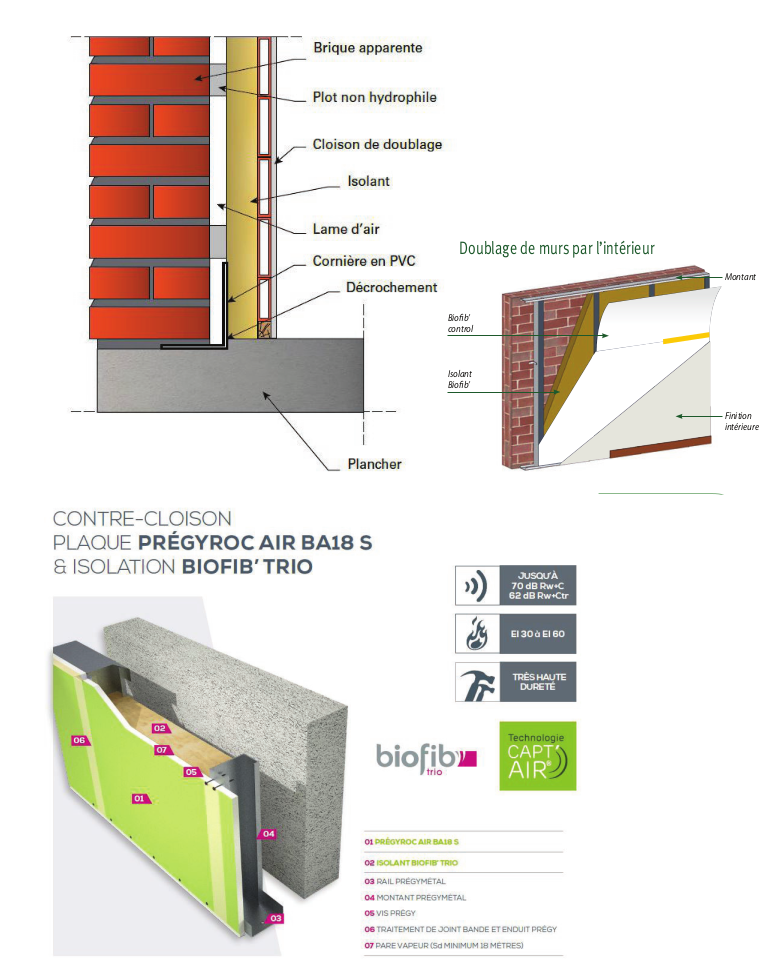
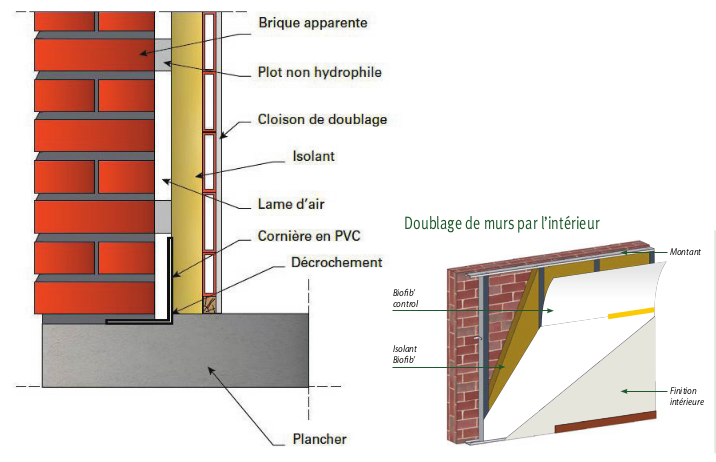
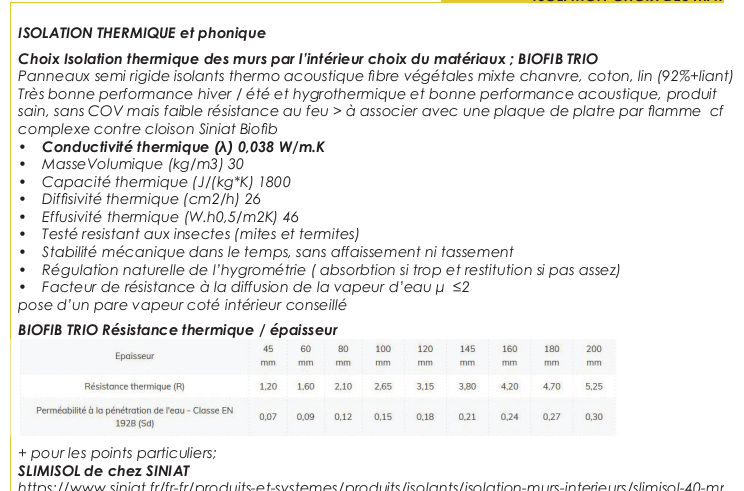
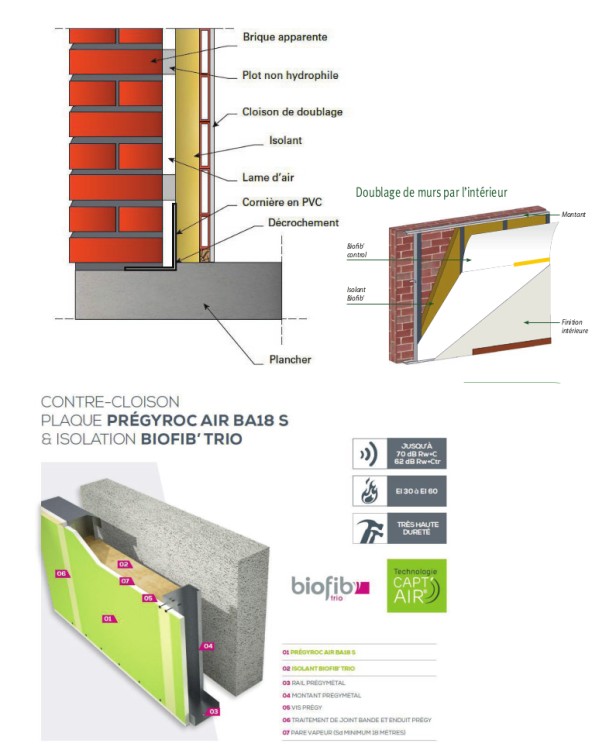
So, in summary, the advice would be to - see Actis Hybris's total R results as being inflated, but not grotesquely so - assume one can get as much gain from air layers in the case of BioFib trio as for Actis Hybris - *not* bother to use reflective surfaces on both sides of the air gap for BioFib trio? Or bother (what kind of reflective surface should we use?) and just be realistic about its helping only a little? An off-the-shelf thickness of 120mm of BioFib Trio gives us an intrinsic R=3.15, which, when taken together with an air layer, would give us R=3.8 (a threshold level in French regulations), assuming the air layer works as for Actis Hybris and assuming also that an air layer helps as much as Actis Hybris's documentation implies.... something that is not necessarily very likely. Of course BioFib Trio is meant to be installed with *two* layers of air, as the diagram above shows.
-
Yes, it's obvious that the thickness->R relation is linear for Biofib. Good call. Now I wonder about my other questions: on
-
Heat pumps: how much efficiency is enough?
Garald replied to Garald's topic in Air Source Heat Pumps (ASHP)
I've considered PV, and will probably install them, though my architect says she doesn't know what I will do with all that electricity on sunny days (selling it back to the grid is not as profitable as it used to be). Come to think of it, powering a reversible Stiebel-Eltron would be a worthwhile use. It's mostly that low-temp radiators would require a lot of space (and a significant additional expenditure, once one considers the entire system,though we may have got that wrong). Let me live in the place once it's finished, and I'll see how low I can set the temperature with the old radiators (55? 50? 45?). Then I can see what decision to take on that matter in the middle run. -
Hm, but one has the same set of walls for summer and winter! Does having reflective surfaces (what kinds?) on both sides of the gap help? Surely one can pull that same trick with the same effectiveness with other products, e.g., Biofib? Or are there issues with having an unventilated airspace, e.g., humidity? Do they depend on the product one uses?
-
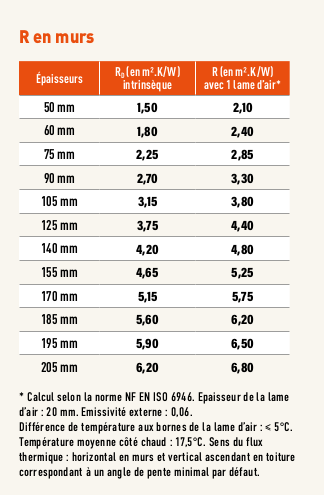
I am trying to compare two insulation products. One of them (https://www.actis-isolation.com/documents/hybris-125mm-fdes/) gives the following data: There are are some things one could comment here in terms of assumptions (17.5 C would do for a bedroom, but not, in my opinion, for a study or living room), but let us leave those aside. What really interests me is: a) does this estimate of the effects of an air layer appear to be reasonable? b) are the effects of an air layer on other insulating materials similar? If not, how should find out the R value of (insulation material + air layer), given the R value of the material (and whatever other data is needed)? The point is that there are other materials where an air layer is strongly advised, for various reasons (soundproofing, moisture, fire protection). Take, for instance, the other product under comparison, BIOFIB Trio (https://www.biofib.com/biofib-trio/ ) : If this is what the manufacturers of the other product called the "intrinsic R" (how to check? write to the manufacturers?) and the effect of the air layer is similar, then 120mm of material (R=3.15), together with the two air layers involved in a proper installation as above, should be enough to give R=3.8. (The first product claims the same performance with 105mm of material.) Am I understanding things correctly?

-
While we are at it: I suppose the Biofib technical specifications in https://www.biofib.com/biofib-trio/ are really about what the Actis brochure (see website above) calls "R intrinsèque"? If that is the case, and performance increases as for Hybris when one adds air on both sides (as we plan to, in part for soundproofing) then 120mm of Biofib -> intrinsic R = 3.15 -> (R taking air into account)=3.8 or thereabouts. Then 120mm of Biofib (+ air on both sides) should be enough (that's what my architect seemed to prefer the next to last time we talked).
-
But we are leaving an air gap on either side in any event, for multiple reasons (see the diagram above). Given that that is the case, why would Actis Hybris (an "alveolar isolator") not be worth considering? It is not vacuum-packed, it is not prodigiously expensive (see above for budget considerations), it does not have fume-emitting issues that I know of - and 105mm + air gaps gives an R of 3.8; considered without air gaps, 125mm give R=3.75, whereas you need 145mm of BIOFIB to get to R=3.8 (interpolating, one can estimate that about 143cm of BIOFIB are necessary for R=3.75). That's a smallish but very real difference. 2cm, in places with nearly 3m height, give you a gain of (0.02/3) m^2 of surface per m^2 of insulation, meaning 40 eur per m^2 of insulation; that would be the price difference that would be justified (assuming that the performance of BIOFIB and Actis Hybris is similar in other respects - that I do not yet know). Perhaps the idea of using BIOFIB on the SWS side and side walls and Actis Hybris on the south wall makes some sense, then - at the very least I would learn more in the long run. (One could of course also do it the other way around - though I'd certainly want BIOFIB on the western side wall: it apparently regulates humidity very well - and the neighbor's garden has vines that climb all the way up that wall, and seem to have affected the humidity of at least part of it.) One would still need to compare other aspects of the performance of BIOFIB and Actis Hybris in wet rooms (WC, bathroom), however; I have those rooms on the NWN side.
-
Or two things: ventilation and sonic insulation, I believe.
-
Speaking of being realistic about the fact that a perfect job is not possible in a partial renovation: the (short) eastern wall (which is partly adjacent to a neighbouring building) will remain uninsulated. The kitchen and the small staircase leading to the attic are there - insulating the wall would involve redoing both from scratch (or at least redoing the kitchen and displacing the staircase, though it's unclear that that's possible) and I am not willing to do that for the moment. That will have to wait for stage 2, a few years down the road, when I raise the roof in the attic (currently a place for a home office and low-ceilinged bedrooms - it's above 180cm only in the most central part).
-
What _are_ intelligent membranes, and what are their advantages relative to the natural materials you just mentioned? (Feel free to point me to a FAQ.) That sounds like something useful - care to elaborate? (Note: I don't have the DIY gene enabled - a link to a good comercial product would be useful.) That sounds interesting and I'll read up on it, but I think the architect has got this one down pat. I get the impression from working with her that a good architect is like a good GP: - there is one thing, their specialty (in her case, ventilation), that they know and understand at a much higher level than you'll ever hope to know, - they know a bit about many things, and are willing to learn more and discuss what you find out, while also having a solid sense of what works in practice. Well, in this nearby suburb of Paris, one m^2 is 6k EUR. (That's presumably in part because it votes Communist - otherwise it would be higher.) Say we are working with 3m ceilings (they are really 2.7m to 2.9m, but they are much higher in the main staircase, obviously). That means then insulating with 10cm rather than 20cm (total, including an air layer on each side) gets you, per m^2 of insulation, a gain of (1/30)th of a m^2, meaning 200 EUR. So that's the maximum difference in price I should be willing to accept for a material that gives me R=3.8 (conventional French boundary value) in 10cm rather than 20cm. That's what she was leaning to for the NWN wall, which has the main bedroom/bathroom/wc/staircases. (We'll go for a thicker layer of insulation in the main room, aka library/dining/music room; she's loath to lose space, but I think we can just install shallow made-to-order bookcases, and then use large side panels and create reading nooks in the now large windowsills. The main room faces SES, which is also a two-way street, and so we need as much summer comfort and sound insulation as we can humanly get.) BIOFIB Trio (which is based on hemp, linen and cotton) is 0.038w/M2K, and seems to have good properties overall: I still haven't given up on getting something that will have a better performance at 10cm than BIOFIB, at least for the main staircase and also for the wc and bathroom (where we don't have much space to work with). I prefer a cooler bedroom anyhow (if anything, I'm more worried about late-afternoon sun exposure during heatwaves). As I computed above, a 100-200 eur/m^2 budget would be fully justified, if one can actually get 10cm total, counting air layers. It looks like it will be advisable to get something other than SLIMISOL for les points particuliers, but it looks like aerogel might do (if they are really particular). Right now the place has an E/F rating (probably an F according to the latest standards, properly computed; we got a second diagnostic that confirmed an E/F, but it was made by optimists, or rather people who type things into optimistic software). An average renovation ends up with a D. It looks fairly certain we will get at least a C. Getting a B (which is what optimists predict) is more of a point of pride than anything else - the additional subsidies are minimal (as of now); my architect is skeptical.
-
Heat pumps: how much efficiency is enough?
Garald replied to Garald's topic in Air Source Heat Pumps (ASHP)
France exports plenty of electricity, but sure, there have to be regulations in plave to make sure local demand is met first. -
I also talked to my architect about insulation materials. In brief: 1. In France, phenolic mousse is used outdoors but never indoors. The reason is presumably that it can emit a lot of gas when heated. She says our contractor would be very reluctant to use it unless perhaps I somehow arranged to get him off the hook for any responsibility. 2. She will read up on aerogel. There do seem to be some French providers, though very few. (Again, the contractor would be loath to use something bought from abroad just like that - for one thing, it would not necessarily come with all the particular technical specifications that he would want or that we might be required to eventually provide.) It's an interesting possibility, particularly for places where we don't have that much space to work with. 3. She's a bit surprised by the negative opinions on https://www.actis-isolation.com/produits/hybris/ - the contractor already installed it at least once, and had had no problems with the product. 4. She was also a bit surprised by the negative opinions on Slimisol Siniat and Isover Isovip (due to their being vacuum packed) - they are apparently well-known products (much less "research-stage" than aerogel) and meet all local regulations.
-
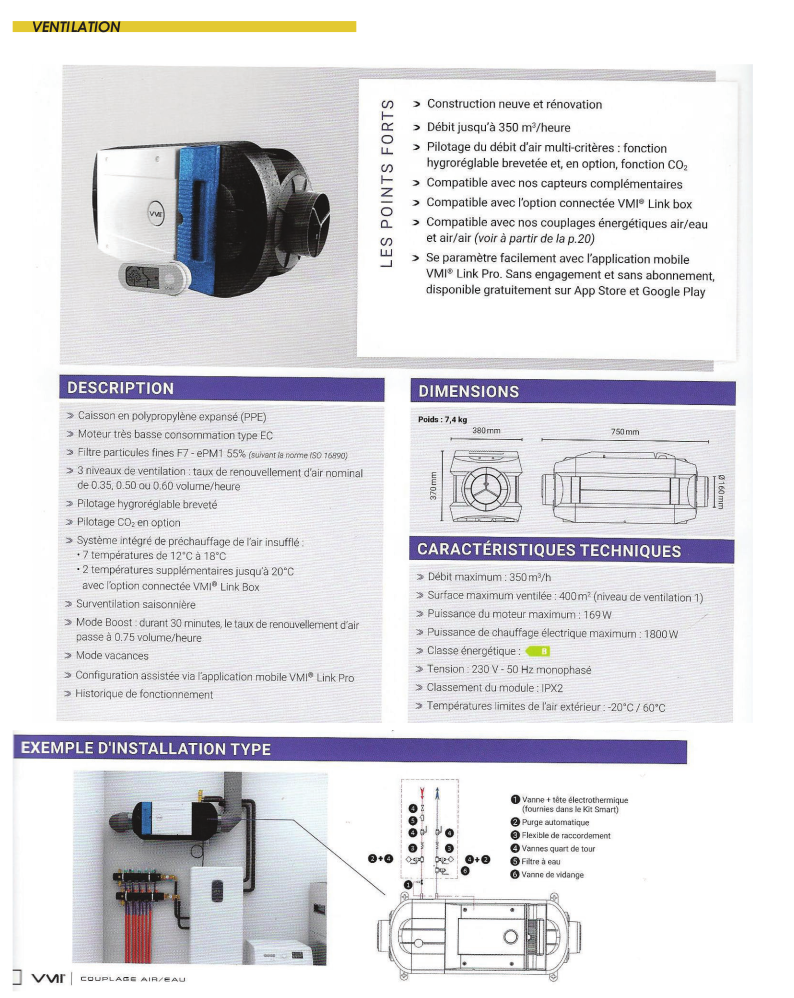
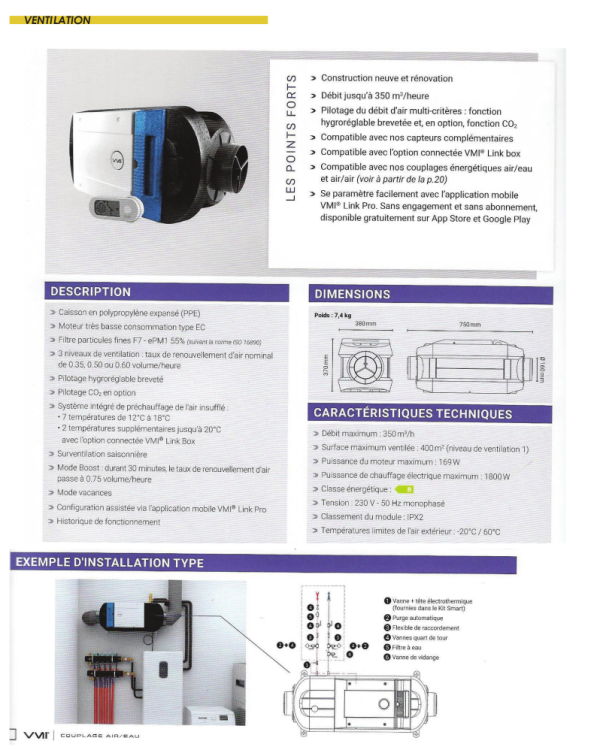
She was also telling me about a way to supplement heating by means of hot air coming ultimately from the heat pump. (She has given up on the idea of putting ducts under the solar panels.) She's shown me a simple and apparently effective device for doing so: https://www.vmi-technologies.com/gamme-vmi/purevent/ It also comes with an air filter.
-
I was just talking to her over Zoom. Summary (to the best of my ability) on what she said on airtightness: 1. Well, of course she has been thinking about airtightness and waterproofing all along. (I'm translating in my head from French; "waterproofing" may not be the right technical term here.) 2. Reasons why we cannot do a perfect job: This is an old building (1930), and a partial renovation project (a pretty thorough one, but it's not as if we were gutting the place; we are even keeping the kitchen and so forth). Brick walls are porous. We need to take into account that they let through not just air but humidity. In the end, it is a matter of controlling air flux and permeability, rather than attempting to forbid the first one entirely. 3. Reasons why people often shoot themselves in the foot while trying to do a perfect job: if you do not take humidity exchange into account, you end up having either moisture problems inside your walls, or a situation where you end up being told "the insulation job was perfect, now open your windows every day". (Actually, I am living right now in an apartment where the landlady told me to do exactly that - in winter.)
-
Heat pumps: how much efficiency is enough?
Garald replied to Garald's topic in Air Source Heat Pumps (ASHP)
Let me work back from the estimates given by the people who just did a somewhat disappointing job on the "audit énergétique". They give two estimates for the energy we will spend on heating depending on how much work we do - one is 7483 kW/year and the other one is 6091 kW/year. (They actually have a little symbol h_{EP} after kW - no idea what that means.) Let us work with 7200 kW/year. We are working with heating alone, neglecting differences in efficiency in heating water for consumption. They are assuming a heat pump with SCOP =3.3. We are then talking about 3.3*7200 = 23760 kW/year. I don't have SCOP data for Amzair or Stiebel Eltron at 55C (other than the labels A+ and A++, respectively). Since, at 35C, Stiebel Eltron has a COP of 4.99 when it is 7C and a COP of 3.32 when it is -7C, and a SCOP of 4.60 overall, I will just estimate that SCOP = (3/4)*(COP at 7C) + (1/4)*(COP at -7C). Then the SCOP of Stiebel Eltron WPL 19 IK at 55 C would be (3/4)*3.3+(1/4)*2.49 = 3.0975, and that of Amzair HT 15M would be (3/4)*2.54+(1/4)*1.93 = 2.3875. So, the energy being used would be (3.3/3.0975)*7200 = about 7670 for Stiebel Eltron, and (3.3/2.3875)*7200 = about 9950 for Amzair; At one-sixth of a euro per kW (current price at Engie, my current supplier), we are talking about a difference of (9950-7670)/6 = 380 euros per year. The difference in price is about 4500 euros. (There's also an additional difference in price, in the same direction, of 1500 euros; it goes into hot water for consumption - we are not taking that into account). It will take then about 12 years for the investment to pay off. That seems about fair value; I imagine an indoors heat pump lasts roughly as much as an indoors cat. ---------------- Of course then there are environmental considerations, which are part of why we bother with all of this to begin with. But strictly in money terms, it seems that the extra efficiency of the Stiebel Eltron is paid for fairly by the extra price, grosso modo, and I should really make my choice based on other considerations. -
Heat pumps: how much efficiency is enough?
Garald replied to Garald's topic in Air Source Heat Pumps (ASHP)
This is Ivry-sur-Seine, just outside Paris city limits. Climate data for Parc Montsouris, in a Paris district close by: hideClimate data for Paris (Jardin du Luxembourg, 1981-2010 normals, elevation: 46m, extremes 1978-present Month Jan Feb Mar Apr May Jun Jul Aug Sep Oct Nov Dec Year Record high °C (°F) 17.5 (63.5) 22.9 (73.2) 25.4 (77.7) 31.5 (88.7) 36.0 (96.8) 37.6 (99.7) 41.9 (107.4) 40.2 (104.4) 35.7 (96.3) 30.7 (87.3) 22.5 (72.5) 17.5 (63.5) 41.9 (107.4) Average high °C (°F) 7.8 (46.0) 9.1 (48.4) 13.0 (55.4) 16.4 (61.5) 20.4 (68.7) 23.5 (74.3) 25.9 (78.6) 25.8 (78.4) 22 (72) 17.2 (63.0) 11.5 (52.7) 8.1 (46.6) 16.7 (62.1) Daily mean °C (°F) 5.4 (41.7) 6.1 (43.0) 9.3 (48.7) 11.9 (53.4) 15.6 (60.1) 18.6 (65.5) 20.8 (69.4) 20.7 (69.3) 17.3 (63.1) 13.5 (56.3) 8.8 (47.8) 5.9 (42.6) 12.8 (55.1) Average low °C (°F) 3.0 (37.4) 3.1 (37.6) 5.5 (41.9) 7.3 (45.1) 10.8 (51.4) 13.7 (56.7) 15.8 (60.4) 15.6 (60.1) 12.7 (54.9) 9.8 (49.6) 6.1 (43.0) 3.7 (38.7) 8.9 (48.1) Record low °C (°F) −13.8 (7.2) −11.6 (11.1) −6.2 (20.8) −2.0 (28.4) 2.3 (36.1) 6.1 (43.0) 8.7 (47.7) 8.6 (47.5) 5.0 (41.0) −1.0 (30.2) −6.3 (20.7) −8.0 (17.6) −13.8 (7.2) Average precipitation mm (inches) 53 (2.1) 43 (1.7) 50 (2.0) 55 (2.2) 68 (2.7) 55 (2.2) 61 (2.4) 57 (2.2) 54 (2.1) 64 (2.5) 53 (2.1) 62 (2.4) 674 (26.5) Average precipitation days (≥ 1.0 mm) 10.5 9.4 10.6 9.3 9.9 8.4 7.9 7.8 8.0 10.1 10.6 11.1 113.6 Source: Meteociel[14] (From Wikipedia) Temperatures rarely reach -7C these days, to the point that I've considered growing a particularly hardy type of bougainvilleas on the southern wall (no success so far). How do I do that calculation? -
I have to make a decision between two indoor, high-temperature air-water heat pumps for a renovation project. See the link below for lots of possibly irrelevant detail. In the end, the choice comes to: a heat pump that fits nicely in some space that I have available, but is somewhat less efficient (option 1) and a heat pump that occupies much more space (to the extent that what is now is a garage would become a small and somewhat inconvenient bike shed), besides being considerably more expensive (35% more) and involving waiting until February - but it is more energy-efficient (option 2). Let's simplify: space vs. energy-efficiency. COP = calorific power/absorbed power (I'm translating French terms - do correct me); higher is obviously better. Option 1 (Amzair RENOV HT 15M): when heating to 55 C 7 C outside: COP = 2.54 -7 C outside: COP = 1.93 Energy label A+ Option 2 (Stiebel Eltron WPL 19 IK): when heating to 55 C 7 C outside: COP = 3.3 -7 C outside: COP = 2.49 Energy label A++ How shall I interpret these figures? Is it reasonable to go for option 1, or would that simply mean that I will be stuck with something that will be considered grossly obsolete and inefficient 5-10 years from now? PS. Once everything is properly insulated, it may be realistic to set the system to 50C or even 45C (the old radiators aren't very small for the most part; the previous owners set their old gas heater to medium and that was quite enough, even though they had no insulation; I was able to test this during a brief cold wave at the end of May). At 45 C, option 1 would give me COP = 3.16 at +7 C and COP = 2.3 at -7 C, but Stiebel Eltron would also increase its efficiency, obviously.
-
Incidentally, do we know enough about the long term effects of phenolic mousse to use it to insulate bedroom walls? If not, a solution may be simply to use a thinner (10cm, say, meaning R=2.65; it would be about 12cm or 13cm once everything is considered) layer of BioFib Trio in the bedroom; a bedroom simply doesn't need to be as warm as other rooms on winter nights, and, since this bedroom faces NWN, it probably won't get all that hot in summer either. (Of course I'd need to see whether having one room with walls at R=2.65 would wreck the energy rating.)
-
As I said in another post: I got a list of suggestions from the "energy audit" (this is a requirement to get subsidies for energy-efficiency improvements in France) and I've gone over it with my architect. One suggestion is to insulate part of the floor in the ground floor. (My apartment is mostly in the first floor and attic; it also contains a chunk of ground floor, but it's almost entirely service rooms at present (garage, laundry) - we will make what is now the laundry into an office/guest bedroom. The insulation suggestion would apply to that office/guest bedroom and to the entryway. They are apparently above a basement that belongs to other people.) More specifically, the suggestion is to add 120mm of expanded polystyrene. My architect says that that's quite mad - we would have to go at it with a jackhammer, with the possible risk of making the ceiling of our neighbours' basement cave in. All we can do is add between 20 and 30mm of insulation before laying on a new floor (our plan is to use hardwood). What would be the best sort of material to use in those 2-3cm? (We are talking about 21m^2. We won't insulate the floor in the garage (= future bike-shed and laundry room) - it is partly earth, and at any rate we will insulate the garage's ceiling instead.)
-
That's pretty much the question. (Longer version: I got a set of energy-efficiency diagnostics done by a company - it's a precondition for getting subsidies for, well, making one's place more energy efficient. What I got states basically nothing that my architect and I didn't know or hadn't considered - except that it also suggests we insulate the heating ducts. My architect says she doesn't see the sense in it, for the kind of heating system and the kind of place I have - whatever heat leaves the ducts heats that which is supposed to be heated by the heating system.)
-
(The attic is already mostly insulated, except for the side walls and some odd corners. I suppose I'll go phenolic for most of the small chunk of ground floor I have (see my post on another thread; link below) - no idea what I should use for the mini-garage/bike-shed).)
-
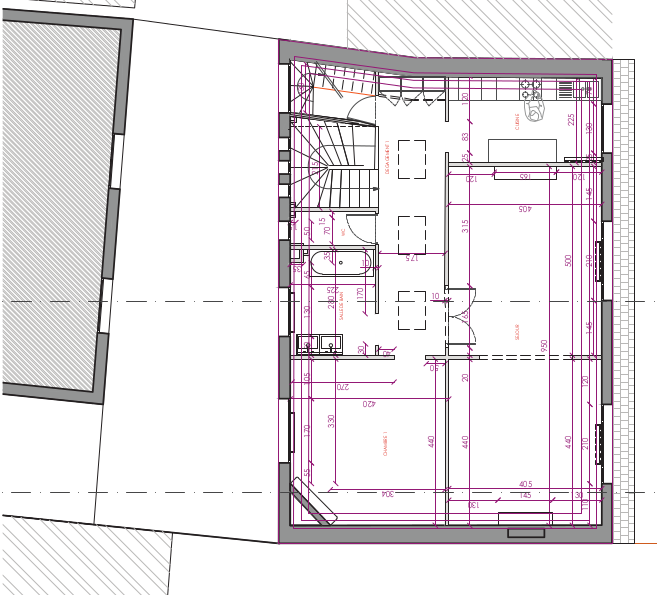
What do you think, then, of the "Solomonic" solution I proposed above - 145mm of natural insulation (Biofib trio) on the southern side (library+piano room; this is where I will presumably spend most of my time), and a thinner (8cm?) layer of phenolic (or what have you) on the northern side (where I have less room to play with)? 145mm is the minimum for obtaining R=3.8 (which is the boundary level for the place being considered well-insulated according to local norms) - it will amount to about 18cm once one adds a fire-proof panel and so forth. Here is a plan of the main (first) floor (left is south-east-south):
-
Well, I hope only a fraction of those ideas will be put into practice!
-
What do you mean?
-
I will ask her, but, believe me, I trust her on ventilation. She has lots of ideas that I have barely been following: "ventilation par insufflation" (no idea what the technical term for that is in English) as an alternative to "ventilation mécanique contrôlée"; leaving open the possibility of an adiabatic cooling system; placing ducts under photovoltaic panels to heat air taken in; using the cold air from the quarries which lie somewhere under the building (as in the case in the entire southern third of Paris and immediate environs)... I am not sure I can keep up, though I am sure that I would learn a great deal by doing so.