


Garald
-
Posts
1113 -
Joined
-
Last visited
Everything posted by Garald
-
The Solomonic solution may be to use: - Biofib trio (145mm, meaning about 18cm total) on the southern, streetside wall, at least for the double library/music room (summer comfort and sound insulation both essential; we can dissimulate a loss of 18cm by creating architectural features (windowsills) and using shallow bookcases); ditto for the library sidewall that has humidity issues; - phenolic panels for the other walls; - aerogel for those odd corners (including those in the library) where we have only 5cm or so to work with. Does this sound like a plan, or is it nonsensical, or inferior to using phenolic everywhere?
-
Fixed price (her decision, so she wouldn't be penalized when trying to save me money).
-
Right, but that commits me to >=18cm of insulation everywhere. Is the fire hazard actually greater for phenolic than for Biofib trio? The fire resistance of Biofib trio is mediocre, like that of any organic material I know - we will need to add fireproofing (which adds to the thickness; that's why it is 18cm and not 14.5cm).
-
Right, she's doing MVHR, from what I understood. We'll get the best library/music-room windows we can - triple glazing if necessary. Is the bottom line that we should consider BIOFIB trio for the wall that has humidity issues, and possibly at some places where we have space to spare (is there such a thing?), but phenolic boards or spacetherm aerogel otherwise?
-
Well, the architect is an expert on ventilation and sound-proofing, so I'll leave those two to her. (She knows sound insulation is particularly important to me.) She'll install something like double-flux ventilation but not quite - I can look up the details.
-
>200mm is loads. are you looking to get the minimum your regulations allow or do you want to go in excess of that? The minimum to get subsidies (not that they amount to a lot...) is R=3.8. For that, if we used BIOFIB TRIO, we would need 145mm, which, once we add a fire-proof panel and possibly some additional soundproofing, would bring us to 18cm. (160mm instead of 145mm would give us R=4.2.) >I would pick a method that allowed for the best continuous airtightness layer, then make sure you have top class windows (great for city noise too) , maybe get those insulating roller >shutters common in France. I take phenolic boards would allow for a continuous airtight layer? I am in fact replacing the street-side windows for the best windows we can get (my piano room/library is street-side); I am keeping the current double-glazing on the courtyard side - it may not be the best it is, but it actually does provide very good thermal insulation - we tested it. We are getting this kind of shutters: >Going from a U value of 0.25 to 0.15 W/M2K with the extra insulation won't make a damnedest difference if you are stuck at 5 ACH. I know I will have to pay special attention to thermal bridges (is that what you mean?). What is best for that?
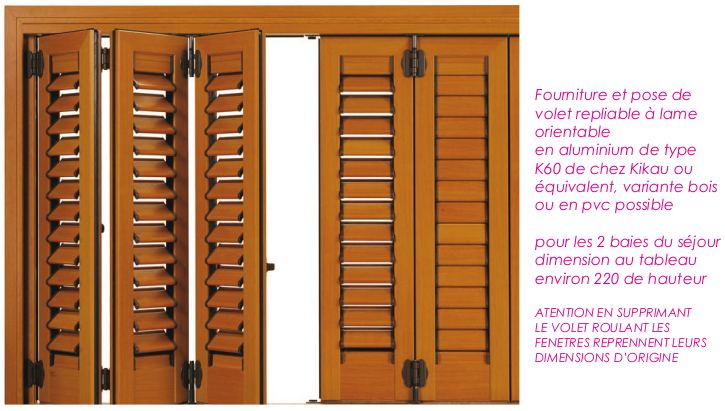
-
I guess I could use phenolic boards and still drill holes in walls like a normal person?
-
On the street side, we could lose 20cm, but would rather lose less; it would detract from the main space - the architect would actually be unhappier than I would be. On the courtyard side, I don't think we even have 20cm to work with - it's smaller rooms, and things could get a bit tight. So, overall, I'd be happy losing only 15cm, and if it were possible to lose only 10-12cm (counting sound insulation and so forth) I would be elated. This makes sense economically as well - in a place where 1 m^2 of surface is 6k, in a place with a ceiling that is 2.7m high, gaining 10cm is justified even if the material you use costs 222 eur/m^2 than the next best material! Hopefully we are not nearly in that range.
-
In the case of the Amzair (plan A), that's easy: as you can see, the unit will open onto a large grille leading directly onto the courtyard. (The red cabinet in plan A actually corresponds roughly to what is currently a broken outhouse I am buying from the coop.) In plan C - Stiebel claims it has some sort of magic. I don't really understand it.
-
I am renovating a small house from 1930 I recently bought (well, I bought most of it) just outside Paris proper. The current energy rating is F, so obviously there's a lot of work to be done on that. I will get to work on the insulation (separate question) and replacing the gas heater by a heat pump. Then there is the question of what kind of heat pump to install, and where to put it. The current heater is in an oversized laundry room that will be turned into an actual room. We will keep the current radiators; they are not designed to work at low temperatures, but they are old-fashioned enough to be pretty large. The previous owners told me they always set the heating on medium and were always warm enough (in spite of their lack of insulation). Unfortunately, I couldn't test things during the winter, but setting the heating on low during a cold wave in June resulted in a nicely heated place (in fact, somewhat overheated). (I couldn't set the exact water temperature, but "low" seems to have corresponded to 40-50C.) The parameters are clear then - I need a heat pump that: * can work reasonably efficiently at moderate temperatures * can be placed indoors (to avoid problems with the neighbors) * is relatively quiet (ditto, and also because I am personally sensitive to noise - of course we will put it inside some soundproofing) * isn't tremendously bulky. Here are two possibilities the architect is proposing. Heat pump elements are marked in red. (Green denotes a bathroom - ignore it.) The south side faces a noisy street (14m wide), and so producing noise that way isn't a concern; the north side faces a small courtyard (4m wide), with neighbors on the other side. Possibility A: Amzair Renov 15 https://www.amzair.eu/nos-pompes-a-chaleur/pompe-a-chaleur-renov-ht/ Advantages: * It is designed to work well up to high temperatures (in fact, it is specifically designed for people doing renovation work on old houses, as the name indicates) * It does not take up that much space; I would still have a large bike shed (large enough to fit an electrical microcar that I will probably never get, in fact) Disadvantages: * It may be noisy (but my architect suspects the manufacturer is just not willing to tell lies with figures (or any good at it), and so it suffers in comparison on paper). * I have not been able to find it in consumer reviews; Google Reviews are mixed/positive (4.0) (but then it is a French manufacturer, and people in France love to complain, especially about whatever is made in France). Price: 13k + 4k (for hot-water container) = 17k eur Possibility C : Stiebel Eltron WPL 19/24 SET https://www.stiebel-eltron.fr/fr/produits-et-solutions/energies_renouvelables/pompes_a_chaleur/pompes_a_chaleuraerothermiquesair-eau/wpl-19-24-i/wpl-19-i-set.html Advantages: * Allegedly relatively quiet (though the single figure the documentation gives (50dB) is suspiciously devoid of context). Hope so - the unit would be just under my library/piano room! * Stiebel Eltron is a brand with a very solid reputation, from what I can tell Disadvantages: * Very bulky (I would not have much of a bike shed left - this is particularly annoying because it will also be my storage space; I do not have a basement) (Notice, however, that because of the exotic way that surface area gets computed in France, the house would be listed as having a little more area than in option A if it ever gets resold: garages aren't counted.) * Isn't built to work with old radiators (though it supposedly goes up to 60C, which should be more than enough) * expensive Price: 15k + 5.5k (for hot-water container) + supplementary equipment = 23k eur Opinions? Are there factors I am missing? Has anybody here heard of Amzair?
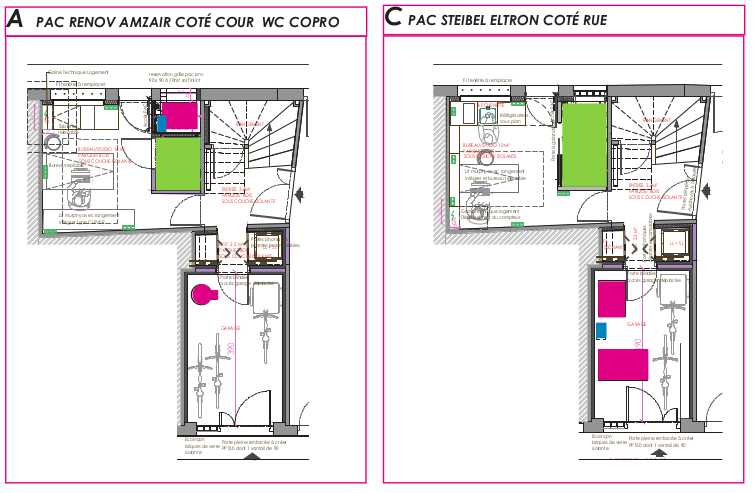
-
The architect also mentioned this one before - how does it compare? https://www.actis-isolation.com/produits/hybris/
-
The green-credentialed material has good moisture-regulating properties. I suspect that the difference in cost between options is dwarfed by the cost of the difference in space used (think 6k eur/m^2).
-
I recently bought my first place - the greater part of a smallish house from around 1930, near Paris. The place has an energy rating of F, so, obviously, I have to do major work on improving its insulation. (I will also replace the gas heater by a heat-pump.) I will be insulating from the inside. Space is at a premium - each m^2 is very expensive (even in a relatively affordable suburb of Paris), and of course I have only so much space to work with. The architect I am working with is proposing the following materials. A. BioFib Trio (https://www.biofib.com/biofib-trio/?gclid=CjwKCAjwwo-WBhAMEiwAV4dybUHVwwtXg1vwFmjzTDYwYp9q0VjYMxsFENAhgB-WO4JO0wfiTSPiUhoCLLMQAvD_BwE) - eco-responsible bio-thingie (hemp-linen-cotton) - pretty good insulation (145mm gives R=3.80, 160mm gives thermal resistance R=4.20; here R=3.8 is the minimum necessary to get subsidies, not that I would get much). Here 160mm would give nearly 200mm=20cm total once one adds an anti-fire plaster panel and so forth. B. Slimisol Siniat (https://www.siniat.fr/fr-fr/actualites-et-evenements/83808/slimisol-techno-isolant-ultra-mince/) Aluminum + polyethylene (vacuum-packed) 40mm (= 60 mm total) gives R=6.3 C. Isover Isovip (https://www.isover.fr/sites/isover.fr/files/assets/documents/dp_isovip.pdf) From the technical specification sheet: very fine silica powder, pressed and vacuum-packed in polyester 56mm (= 86mm total) gives R=6.5 The question is really whether to use mainly A, with B and C to treat thermal bridges and places where there isn't much space, mainly B or C, with A to treat just one humid wall. What to choose? Obviously, it is better to save space, and that should more than compensate for any reasonable additional cost - so that would point towards 2. But what other factors should I be considering? (Are there any known long-term health hazards suspected in B or C? What about durability?)
-
Combining an air-water heat pump and solar thermal
Garald replied to Garald's topic in Solar Thermal (ST)
I'll probably have to do that myself then. I guess all laser thermometers are born equal? -
Combining an air-water heat pump and solar thermal
Garald replied to Garald's topic in Solar Thermal (ST)
Weather Underground states the temperature at a nearby weather station to have been 13C when we got started (8:30am) and about the same when I dropped by, but it peaked at 19C in the afternoon. Really not great, but we did what we could - we'd even programmed things in advance so that we would get a spot of cool weather. The first full week in June will be about the same - that will be our last chance to hire someone to use a thermal imaging camera and not get garbage, I take. Before we tested the walls with a laser thermometer (Wednesday morning) I took care to heat the entire house up to 30C. We did get very different results on different walls. All recent windows were surprisingly good (they were about 29C) but the walls were all over the map, from 20C to 30C, if I remember correctly. (25C seemed typical; only a couple of nasty spots got 20C). -
Combining an air-water heat pump and solar thermal
Garald replied to Garald's topic in Solar Thermal (ST)
Got the keys on Tuesday. The morning of the purchase, I set the heater on low, and set the thermostat to 26C. When I went back in the evening, the house was properly overheated, in spite of its poor insulation, and the heater showed 40C as the water temperature. (Of course it may have gone higher; the heaters felt somewhat warmer than 40C, though not by that much - I could put my hand on them for an arbitrarily long time.) It wasn't a cold day - just a rainy spring day, with sun for a couple of hours in the afternoon. The previous owners told me that they never put the heater at a level beyond medium (which seems to correspond to 60+epsilon), and that seems to have been quite enough even in winter, even though the insulation is quite bad. All in all, I suppose that's evidence that a low-to-medium temperature will suffice, right? The radiators are largeish (except for those in the main library, which also has southern exposure and a chimney). I had a long talk with the architect on Wednesday while she checked every wall with a thermometer. We'll probably choose 15-20cm of alveolar insulation (synthetic), except for a wall with humidity issues, where we plan on using hemp-based insulation, and a few places where we don't have much width to work with and we'll use cork (or something as high-performing as cork). Sounds reasonable? We haven't got thermal images yet - I'm trying to hire a certified technician to do that, so that I can get the subsidies you are supposed to get in France when you undertake major energy-efficiency renovations. -
Combining an air-water heat pump and solar thermal
Garald replied to Garald's topic in Solar Thermal (ST)
Right, I'm going to be working on all three. Or rather, I'll be helping the architect a bit on the first two, and watching her work on the last one; she's a ventilation expert. I'm getting the keys in ten days' time, and then we get started with a thermal camera. -
Combining an air-water heat pump and solar thermal
Garald replied to Garald's topic in Solar Thermal (ST)
Well, but it is becoming the thing - Passivhaus and so forth; the question is whether get any of that to any perceptible extent when renovating an old building. -
Combining an air-water heat pump and solar thermal
Garald replied to Garald's topic in Solar Thermal (ST)
Well, I said it was veering off-topic, but it *is* solar thermal, after a fashion, with a wooden tank full of books instead of water, and serving both as solar panel and as a radiator. -
Combining an air-water heat pump and solar thermal
Garald replied to Garald's topic in Solar Thermal (ST)
Oh. I was assuming 0 light reflectance. So, the conclusion should really be: it is not necessarily stupid of thinking of bookshelves with solid-wood back panels that are relatively dark (varnished, painted, it may not matter)? -
Combining an air-water heat pump and solar thermal
Garald replied to Garald's topic in Solar Thermal (ST)
And on books, right, I would never put them in a basement. Direct sunlight indoors is not that bad - at most, the spines will get discolored over the years. I don't recall that actually happening to me - though come to think of it, my Springer volumes do seem to be of many different shades of yellow now... At any rate, since I've barely noticed, it's not a problem I would think important. -
Combining an air-water heat pump and solar thermal
Garald replied to Garald's topic in Solar Thermal (ST)
Let me see. Consider a fairly sunny winter morning in late December, with sunlight falling head-on to bookcases directly in front of them (this is essentially what the simulation shows), transmitting about 10 W/m^2 to the bookcases. It's actually hard to choose whom to believe about the volumetric specific heat of different kinds of wood - if you believe that, as is often stated online (e.g. https://tinyurl.com/4hmedzr9), the specific heat of pine is 2300J/kg C (at which humidity?) then IKEA pine would have a volumetric specific heat (heat capacity) of 0.92*10^6 J/m^23C - yet, according to https://tinyurl.com/yc72tjhz (which looks like a serious source), even oak barely achieves 0.85*10^6 J/m^2 C at 10% humidity. Well, let us say that we have empty bookcases with backpanels that are made of 2cm of solid wood with volumetric specific heat 0.8*10^6 J/m^3 C. That gives us 16kJ/C per square meter of surface. Since 10 W/m^2 means 36 kJ/hour m^2, we see that the backpanels are getting 2 C warmer every hour, for, say, 2 hours. Surely that's good - that means that the bookshelves are absorbing not so very little heat without breaking a sweat. What difference will they make on the room temperature, or on the energy radiated in the course of the day to someone directly in front of them? I don't know. What is also clear is that a flimsy backpanel would not absorb all that heat (its temperature would change significantly and quickly, and then its heat-absorption properties would change). Of course there are also books, but they don't cover the backpanel entirely. The moral, I guess, is that it is not actually stupid of thinking of having bookshelves with solid-wood back panels, if they are going to have sun shining directly on them on sunny but cold winter mornings, and you'd like the heat back later in the day. Putting 3mm cork sheets on the back of those panels may be overkill (since the temperature of the backpanel will have risen by at most 4C or so) or not - I do not know. Or am I interpreting this wrongly?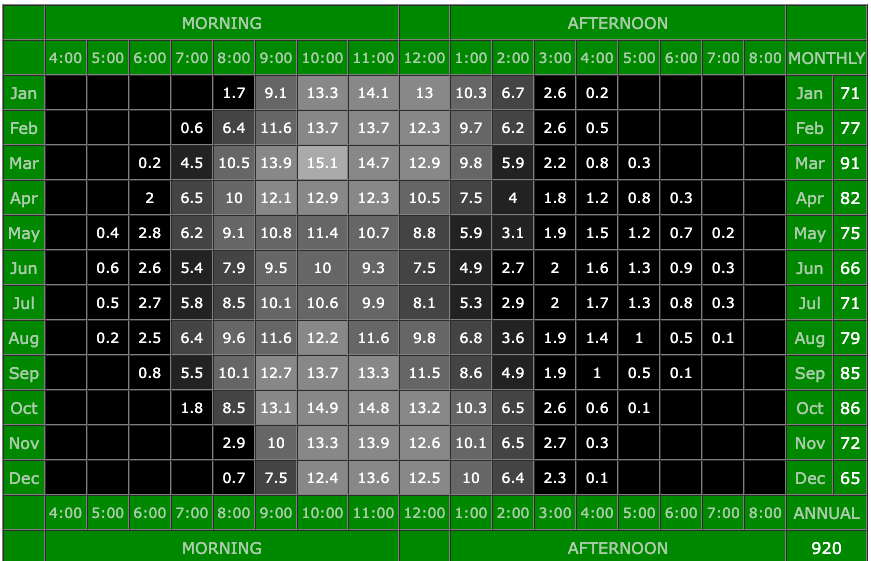
-
Combining an air-water heat pump and solar thermal
Garald replied to Garald's topic in Solar Thermal (ST)
Sorry, winter *morning*. 15 W m^{-2} is slightly optimistic but not wrong, at least not on a sunny day. See http://susdesign.com/windowheatgain/index.php Bit counterintuitive, in that the peaks for March and October are higher than those at other times - why is that? Bit funny that 15 W/m^2 should give very little rise in temperature, given that that's not what it happens in the summer, and, if the app is right, one doesn't get more than 10 W m^{-2} then. Latitude 49 N, orientation SES. -
Combining an air-water heat pump and solar thermal
Garald replied to Garald's topic in Solar Thermal (ST)
I wouldn't be worried about March or October - most people already have their heating on by then - or April, since then only the lowest part of the long wall is exposed. (The left wall is occupied in part by a mantelpiece.) In September, the issue is mainly light falling obliquely between 7:30 and 9:30am, from the right window to the left part of the long wall; heat transfer should be less because of the sharp angle (together with the low altitude), no? Closely related if somewhat off-topic: I am planning on installing floor-to-ceiling built-in bookcases. When I was a few days younger, and even more naive, I went around asking how should I go about choosing the material for the bookcases (and so forth) so that they would absorb a bit of heat during winter mornings (which is when they would be fully exposed to direct light head-on - low-altitude, but still) and release it during the day. I was told that I was being silly, in that it is a better idea to let the sun heat water rather than wood. It didn't seem like an either-or to me (do you make bookcases out of water?), but that obviously pointed me in the direction of solar thermal. Now I'm back to where I started. It's hard to get consistent information on the heat capacity of wood (in part because it depends on several different factors), but apparently it is descent - if I understand correctly, the volumetric heat capacity of oak is somewhere between half that of concrete (http://www.international-agrophysics.org/Thermal-properties-of-wood-and-wood-composites-made-from-wood-waste,142472,0,2.html) or about that of concrete, and the same is true of dense pine (the heat capacity per gram is about the same as that of oak). Of course direct light coming through a window on a winter night just doesn't carry that much power, but even if someone sitting or lying down in the reading nook were to gain 1° C, that would be something. Haven't done any computations that would tell me whether that's the right order of magnitude. At any rate, maybe there's a point to this: bookcases of dense, dark-ish wood, with, say, cork behind the back-panels to provide a bit of insulation. But then perhaps the effect would be negligible, and I might as well choose light-wood bookshelves to get more light in the rest of the room. Can people eyeball this? As I was saying, an order-of-magnitude feeling for things should be enough to tell what makes sense. -
Combining an air-water heat pump and solar thermal
Garald replied to Garald's topic in Solar Thermal (ST)
Oh, I just treated a window as an opening. I'm just showing where direct light falls, not how much of it does! There has to be a tiny error due to refraction, but all mesures were taken by the architect to the nearest 5cm anyhow (the real estate agent was in a hurry), so I was not going to bother. We will probably make an opening at a particular place in the long wall (an opening to be hidden behind a cabinet door, that is) to let direct light into the bedroom on winter mornings. For detailed modelling of light (with serious work on reflection), there are various front-ends using Radiance (https://www.radiance-online.org/). I found all the ones I tried to be kludgy, and the back-end itself a little archaic - there went an evening. I couldn't see whether there was any way to make it do what I wanted it to do (showing where direct light fell). I don't know what sort of professional software there is for thermal modelling. In the end I found it easier to write my own program in Python/SageMath (using the Pysolar library to compute altitude and azimuth as a function of time, and the Three.js library to get the animation running). I put the clock on the wall because the Sagemath-Three.js interface is somewhat incomplete - it wouldn't let me put the time on the corner of the picture, as something extradiegetic, so to speak.