PhilT
-
Posts
502 -
Joined
-
Last visited
Everything posted by PhilT
-
There is also cloud lensing to be aware of, which can briefly increase output to as much as 50% above the pure direct sun/blue sky output https://nmsolargroup.com/effects-clouds-solar-panel/#:~:text=They will see complete direct,than its direct-sun output.
-
Solar+Battery - more PV AC coupled vs less PV hybrid?
PhilT replied to DragonQ's topic in Photovoltaics (PV)
https://lr-renewables.co.uk/product/lux-acs-3600-3-2-greenlinx-storage-bundle-fully-installed/ -
Solar+Battery - more PV AC coupled vs less PV hybrid?
PhilT replied to DragonQ's topic in Photovoltaics (PV)
wow that's some kettle! None of our appliances apart from the heat pump (at start up) draw more than 2kW. I went round the spreadsheet houses for weeks trying to resolve this conundrum. The only solution I could justify on financial grounds was a non hybrid 3kW HD wave to work the optimisers on the panels because of our double gable roof, and a separate 3kW battery+inverter. I get full control of all that using an app, and using Octopus Cosy tariff the small battery fits in really well but it's getting worked extremely hard - on sunny days like today it's fully charging and discharging three times a day. -
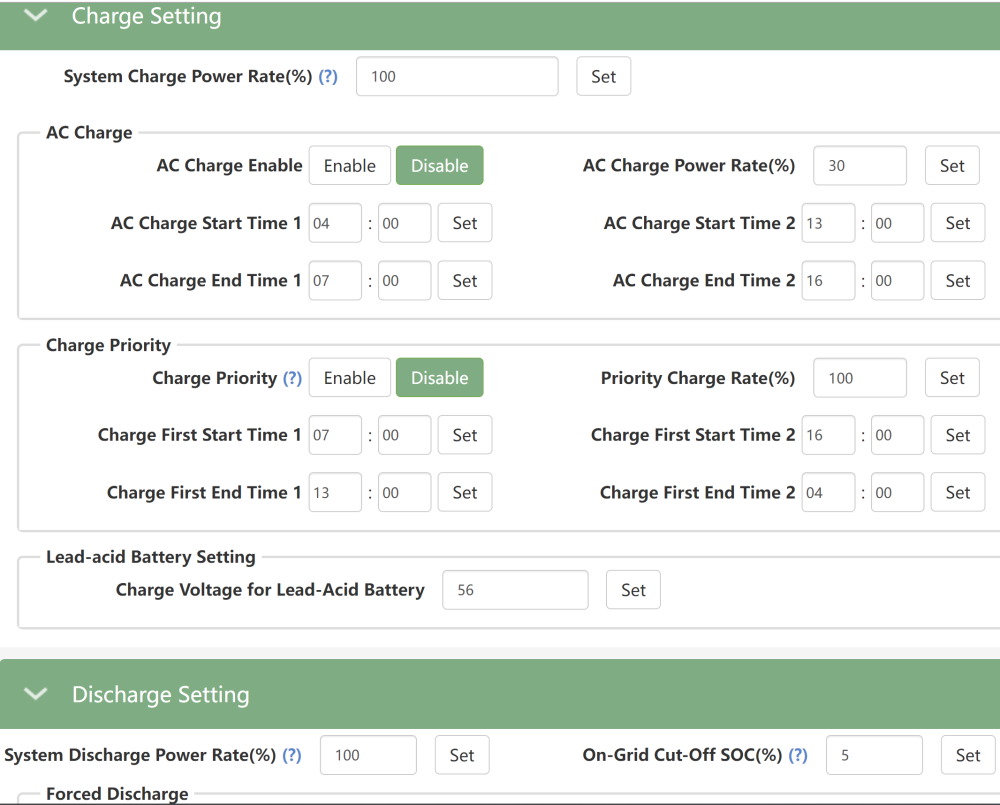
I never touch the inverter, everything is done via an app. Can you not get at the settings via the app from which you took the screenshot in your earlier post?
-
There should be, something like this, which at the moment is in the default self-use state but as you can see almost any combination of Default, AC Priority or System (Panels/battery) Priority, together with time selections, should be possible
-
You should be able to access settings and disable the "charge priority" function, can you check to see if you can do that?
-
Can you use Hybrid battery inverter without solar input?
PhilT replied to BMcN's topic in Energy Storage
yes that's broadly the same setup as I have, and with a few good quality CT clamps and a decent app everything can be monitored and controlled -
With apologies to the OP for diverting (pardon the pun), it depends on the tariff/SEG. So, for an example without a battery, say for my hypothetical day of 12kWh total consumption I get 12kWh of solar, a diverter does all the water heating using 6kWh, with the remaining 6kWh used elsewhere, net running cost impact for the day = 0. Alternatively my heat pump would use only 2kWh to heat the same water requirement, leaving 4kW exported, net running cost impact @ 15p = 60p (credit). Not forgetting the up front cost of the diverter, would any combination of circumstances and tariff/SEG calculation make one financially justified?
-
Good point and I must confess I haven't yet completely ruled out the idea of a solar diverter. One other element in the mix is the viability of a battery, mentioned earlier, as an alternative to a diverter in being able to mop up excess solar and use it to power the heat pump to heat the water later on. You can't do that with gas. But I still haven't got my mind around all of these kind of logical issues yet which is one of the reasons why this forum is so useful.
-
A solar immersion diverter is hard to justify if you have a heat pump which uses one third of the electricity and you get 15p for export - it could COST you (15-33/3)=4p for every kWh solar you divert to the immersion heater
-
Solar+Battery - more PV AC coupled vs less PV hybrid?
PhilT replied to DragonQ's topic in Photovoltaics (PV)
It does indeed, that's good. I have a system like your quote 1, using the much less expensive non-hybrid SolarEgdge inverter for the panels/optimisers and a dedicated battery+inverter. It works really well for me. Is the multiple AC/DC conversion really a problem? I'm not sure. So I guess your choice mainly depends on the relative cost for the perfromance on offer, and any space limitations depending on battery pack dimensions and the possibility of having 2 inverters instead of 1. -
Solar+Battery - more PV AC coupled vs less PV hybrid?
PhilT replied to DragonQ's topic in Photovoltaics (PV)
The main issue which springs to mind is backup. I can see what looks like an impressive automatic backup feature on the Givenergy system but can't see anything for the StorEdge system although possibly that link you quoted doesn't mention it? -
Solar+Battery - more PV AC coupled vs less PV hybrid?
PhilT replied to DragonQ's topic in Photovoltaics (PV)
I could be wrong but I think this needs the Storedge system for control and monitoring? -
Weather Compensation Modelling and Actual results
PhilT replied to JamesPa's topic in Air Source Heat Pumps (ASHP)
Interested to know if anyone has ever attempted AND achieved this? -
Solar+Battery - more PV AC coupled vs less PV hybrid?
PhilT replied to DragonQ's topic in Photovoltaics (PV)
which makes and models specifically? -
Taking Advantage of Overnight Rate & PV
PhilT replied to Zipp's topic in Air Source Heat Pumps (ASHP)
Have you considered the Octopus Cosy tariff? -
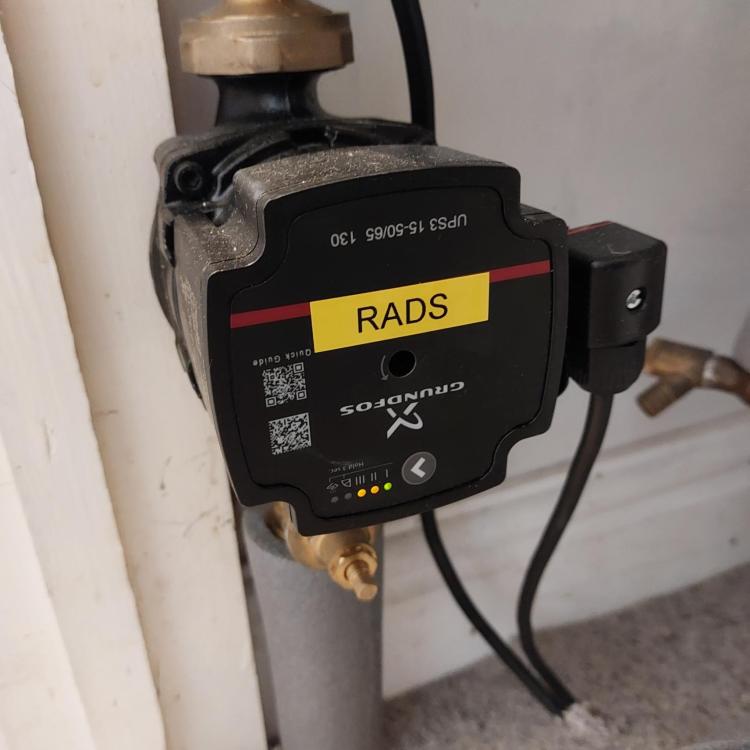
I think mine may be the same - is it this one? Would be interesting to try a lower speed. My flow temp difference is only 3degC at 35 up to 4degC at 50, and it's quite audible, although not excessively
-
thanks for that - the installer told me the LLH and secondary pump (both inside house next to DHW tank) were necessary for my microbore fed rad circuit. It's obviously nothing like the ideal circuit described by Brendon Uys but it's achieving a COP of at least 3.4 which seems quite good under the circumstances although I might try longer WC operation at reduced flow temps.
-
Interesting piece of research by Brendon Uys. Just to clarify does the third option suggest a monobloc ASHP can pump the heating flow by itself? Mine (Ecodan R32) has a pump just inside the house right next to it - is that in addition to it's own pump? There is also another pump near the LLH dedicated to the radiator circuit. Is that a sub optimal config?
-
Commenting on item 4 it should be an objective decision falling somewhere between those two extremes, based both on accurate design calcs and real world experience. From my own, those of two friends with similar installations, and my son's new house, I would say it's better to go for around 30% over the theoretical size ASHP suggested by nominal target parameters eg heat loss quoted at -2 or -3degC, the reasons being:- At some point in the future you may wish to extend your house. This was my main consideration in choosing an 11.2 instead of an 8.5. Heat pump performance, like PVs and batteries, degrades over time even when regularly well maintained. A larger unit working less hard should last longer and require less maintenance. The recent extreme cold has highlighted a real double whammy. Not enough power for an extreme cold spell AND it can take up to 20 minutes for a heat pump to get back up to full power after a defrost cycle which can happen as much as twice an hour in humid (foggy) conditions. It's been suggested that over-sized heat pumps work less efficiently in lower heat demand situations due to cycling. While that may be true in periods of relatively mild temperature (when power consumption is very low anyway), a heat pump sized accurately for nominal parameters will work MUCH less efficiently in extreme cold conditions. There tends to be relatively small differences in price between two adjacent power rated units eg a 5 vs 7kWh or 8.5 vs 11.2kWh. IMO a few hundred pounds is a small price to pay given all of the above.
-
This session has special significance in relation to today's national news features eg https://news.sky.com/story/cold-snap-forces-national-grid-to-put-three-coal-power-plants-on-standby-12792900#:~:text=The UK has broadly phased,raced to replace Russian gas. There's also an email from Greg Jackson going around - "This evening, coal-fired power stations are on standby to deliver extra power, should it be needed to balance the grid. This means every kWh saved in today’s Saving Session from 5-6pm will make a real difference in reducing our need for dirty fuel. On a practical level, this also makes it our most valuable Saving Session yet – offering 2,700 Octopoints per kWh saved: a massive 50% more than usual"
-
There Is one other feature of Auto Adaptation which marks it out from pure load and/or weather compensation modes. If ambient temps mean heat demand is low, depending on the curve you set, WC mode will allow the flow temp to fall below that which corresponds to minium continuous power delivery, so the comprressor switches off occasionally and you see a cycling effect in the flow temp readout. Auto Adaptation, on the other hand, does not allow the flow temp to fall below that which ensures continuous power delivery, even though you can see the power demand fall as the gap between actual and target temp closes, so the flow temp readout is never interrupted by a compressor pause, presumably for efficiency reasons. The flip side of this is that the target room temp is reached more quickly so in warmer ambient temps the heating will simply be off for longer periods.
-
If it helps you get an idea of whether or not your ASHP is performaing as it should, I have an Ecodan R32 11.2 and my installer calculated the following, but note - based on full occupancy. My house is a 30 year old self build of traditional construction. Max heating design flow temp °C 50 Max DHW design flow temp °C 55 EPC space heating kWh p.a. 13,374 EPC hot water demand figure kWh p.a. 2,839 Total 16,213 Indoor average design temp. °C 19.2 House area sq metres 137 Peak power/heat loss kW 8.26 At design temperature °C -2.4 Heat pump energy consumption kWh p.a. 4,971 SCOP 3.26 The FTC estimated data for 2022 gives heat output of 12,616 and input of 3,757 so SCOP of 3.36 My own measurements suggest the consumption is quite accurate - I know everything else except the heat pump averages 6kWh per day and my total annual consumption for 2022 was 6MWh. The output is much lower than the installer's estimate as there are only two of in the house for most of the year, and we generally heat our DHW to only 40 or 42degC.
-
Turning our heat pump off over summer and a general moan
PhilT replied to RogerH's topic in Air Source Heat Pumps (ASHP)
I did give this a lot of though and decided against as I get 15p fixed SEG, my heat pump is doing better than COP of 3 for DHW, so at my current variable electricity rates 33p it would cost me 4p/kWh to use a solar diverter instead of the heat pump, or cost me 8p/kWh assuming "Cosy" rate 21p/kWh, and that's before taking into account the up front cost of the diverter (a few hundred quid?). Have I got that logic correct or am I talking complete cobblers? -
Turning our heat pump off over summer and a general moan
PhilT replied to RogerH's topic in Air Source Heat Pumps (ASHP)
An estimated COP of 2.4 from the controller or MELcloud could be based on bad data. Given this uncertainty I would get a second opinion from Mitsubishi tech, who can see the data remotely if you give them permission, although not sure why the data they see would be any different from what you see, but worth a try anyway!