JamesPa
-
Posts
1899 -
Joined
-
Last visited
-
Days Won
2
Everything posted by JamesPa
-
Insulated flow & return pipe recommendations
JamesPa replied to Post and beam's topic in Air Source Heat Pumps (ASHP)
This https://www.pandhengineering.co.uk/advice/pipe-sizing-the-ciphe-loading-units-method#:~:text=According to figure 4%2C when,excess of 2.5 m%2Fs. seems to suggest up to 2.5m/s is acceptable in noise-insensitive locations, broadly consistent with John Hearfield (apparently) Confusion reigns! 20m of 22mm at 25l/min gives a head loss of 5m according to here https://www.plasticpipeshop.co.uk/Flow-and-Headloss-Calculator_ep_60-1.html So for out and back its 10m head loss; allowing for 5m internally that means a pump capable of sustaining a 15m head is required. 6m seems to be the norm, I wonder if 15 is even obtainable. Can you just run two pumps in series? 'Remoting' heat pumps seems to throw up questions that I haven't really thought about. Hopefully I wont have to if my planning appeal is allowed. -
Insulated flow & return pipe recommendations
JamesPa replied to Post and beam's topic in Air Source Heat Pumps (ASHP)
Heat Geek calculator does indeed say 6kW/22mm/0.9l/s, so pushing the rate to 1.5l/s (which is often recommended as max for Cu) would do 8-9. I wouldn't do this internally because of noise and fittings, but we are talking underground and swept bends so a different set of considerations. 9kW will be rare - never, most of the time more like 4kW. I have so far found little definitive about the max erosion limited rate for plastic pipes, which is disappointing because it has quite an effect if you need to remote a heat pump. Im still hopeful the planning appeal will come out in my favour, but cant resist thinking about a backup plan! -
Insulated flow & return pipe recommendations
JamesPa replied to Post and beam's topic in Air Source Heat Pumps (ASHP)
Thanks I saw somewhere else that pex is more tolerant of flow rate than copper. I'm looking at 8-9kW which is borderline 22/28mm. If I am forced to put the heat pump 20m from the house and could get the externally buried pipe down to 22mm or even 15) the resulting heat loss would feel much more tolerable, to the extent that I might be tempted to go this way even if not forced to. -
Insulated flow & return pipe recommendations
JamesPa replied to Post and beam's topic in Air Source Heat Pumps (ASHP)
Temp drop isn't completely irrelevant because it translates to the need for a higher ft which equals lower efficiency. 2-3% per degree. I have been idly thinking about the optimum strategy if the planners force me to put my heat pump 20m down the garden, which is still possible (planning inspector for my appeal against refusal of permission visited today, couldnt tell from his demeanour what the outcome will be). I have a feeling it's small pipes from heat pump to house, and big water pump at the end. At what point does pipe wall friction causing erosion of the pioe material become a problem in a long straight pipe with a swept bend either end? Obviously in this scenario pipe noise is irrelevant. Are the 'usual' recommendations of 1-1.5 m/s over cautious in this scenario? -
Insulated flow & return pipe recommendations
JamesPa replied to Post and beam's topic in Air Source Heat Pumps (ASHP)
That can't be the case so far as I can see. Consider the limit situation of static water in the pipe ( ie an infinitely large pipe). All the heat will be lost. Speed it up very slightly. Most of the heat will be lost and very little will reach the house. Unless I'm smoking the wrong substance of course. -
Currently running at 10kW for the free session 1-2. Car (limited to 10A as i only have a granny charger), oven, dhw, washing machine, dishwasher. Nothing else to switch on and no battery other than the car. It's an interesting experiment albeit the amount saved isn't life changing!
- 1 reply
-
- 1
-

-
Insulated flow & return pipe recommendations
JamesPa replied to Post and beam's topic in Air Source Heat Pumps (ASHP)
More heat loss because the water spends more time in the pipe -
When the UFH flow Temp is <35C, dhw?
JamesPa replied to Post and beam's topic in Air Source Heat Pumps (ASHP)
Agreed. My boiler actually has two flow temperature knobs, one for ch and the second for dhw. The second is disabled if you don't have their internal diverter valve. Why they couldn't have provided a connection to switch between the two flow temperatures if you have an external valve is anyone's guess. -
When the UFH flow Temp is <35C, dhw?
JamesPa replied to Post and beam's topic in Air Source Heat Pumps (ASHP)
My (early 2000s era) Worcester Bosch gas boiler can cope with separate flow temperatures for CH and DHW, but only if you use their (add-on & overpriced) internal diverter valve. It also does weather compensation with an add on (analog) module - which i don't have, is no longer obtainable and may not have been sold in the UK anyway. A friend of mine has a very recent boiler from another (Dutch or German) company. This has native weather compensation and also depends on the use of an internal, add-on, diverter valve if you want different flow temperatures for DHW vs CH, which obviously you do if using WC. My friend has shunned the over priced diverter valve and instead switches a resistor in/out of the line to the external temperature sensor, thus fooling the unit into thinking that the external temperature is very low when he heats hot water. Is the Volkera the same I wonder? -
When the UFH flow Temp is <35C, dhw?
JamesPa replied to Post and beam's topic in Air Source Heat Pumps (ASHP)
Are plumbers required/encouraged to undertake cpd. If not clearly they should be! -
Quote for ashp - didnt expect that much!
JamesPa replied to TheMitchells's topic in Air Source Heat Pumps (ASHP)
The requirement of you install under permitted development rules is 37dB(A) (this is contained in the 'MCS Planning Standards referenced in the legislation). However my post specifically says "If you apply for pp for an ashp... they require you to achieve 29dBA at the most affected neighbour, or 20dBA if they class the area as 'rural'...A property 20m from a busy a road was classed recently as 'rural'." Im stating (I thought clearly but perhaps not) what my local authority require if you apply for planning permission. In this case the local authority can make their own rules up and are not bound by the national rules. Sometimes its necessary to apply for planning permission for example if permitted development rules have been suspended by an article 4 direction (made by the local authority - which mine has done in some areas) or if, for some reason, you cant meet all the PD rules. For the avoidance of doubt this is not about my site specifically, its a published policy applying to all sites in the local authority area. The property 20m from a major A road that I refer to was not mine! -
Quote for ashp - didnt expect that much!
JamesPa replied to TheMitchells's topic in Air Source Heat Pumps (ASHP)
True unless there is a socket nearby, which with intelligent siting there often is. -
Quote for ashp - didnt expect that much!
JamesPa replied to TheMitchells's topic in Air Source Heat Pumps (ASHP)
The same council has declared a climate emergency. -
Quote for ashp - didnt expect that much!
JamesPa replied to TheMitchells's topic in Air Source Heat Pumps (ASHP)
it was making hot water. prove different. utter nonsense. Actually very believable, and just the sort of thing my lpa would do. If you apply for pp for an ashp they require you to achieve 29dBA at the most affected neighbour, or 20dBA if they class the area as 'rural'. (The national requirement if you instal under permitted development is 37dBA). A property 20m from a busy a road was classed recently as 'rural'. With this approach to pp, I wouldn't want to be on the receiving end of a nuisance complaint. The lpa is run by the Green party. Just saying! -
Are R290 heat pumps permitted beneath/under a window?
JamesPa replied to Dan G's topic in Air Source Heat Pumps (ASHP)
Further to the above I tried to find the source regulations (which seems to me to be the best approach in cases of doubt). I had expected to find UK or EU regulations which govern this and are definitive. Unfortunately I failed. Worse still this link https://internationalfireandsafetyjournal.com/besa-highlights-safety-risks-of-flammable-refrigerant-gases-in-hvac-systems/ suggests there may be no source regulations, at least in the uk It seems nevertheless that somehow the heat pump manufacturers have converged on a set of rules, but their origin remains obscure. Hopefully someone will know what the origin is and will post it, otherwise it really is down to individual heat pump manufacturers (and in practice installers). It is beginning to look like it may be a bit of a mess. -
Are R290 heat pumps permitted beneath/under a window?
JamesPa replied to Dan G's topic in Air Source Heat Pumps (ASHP)
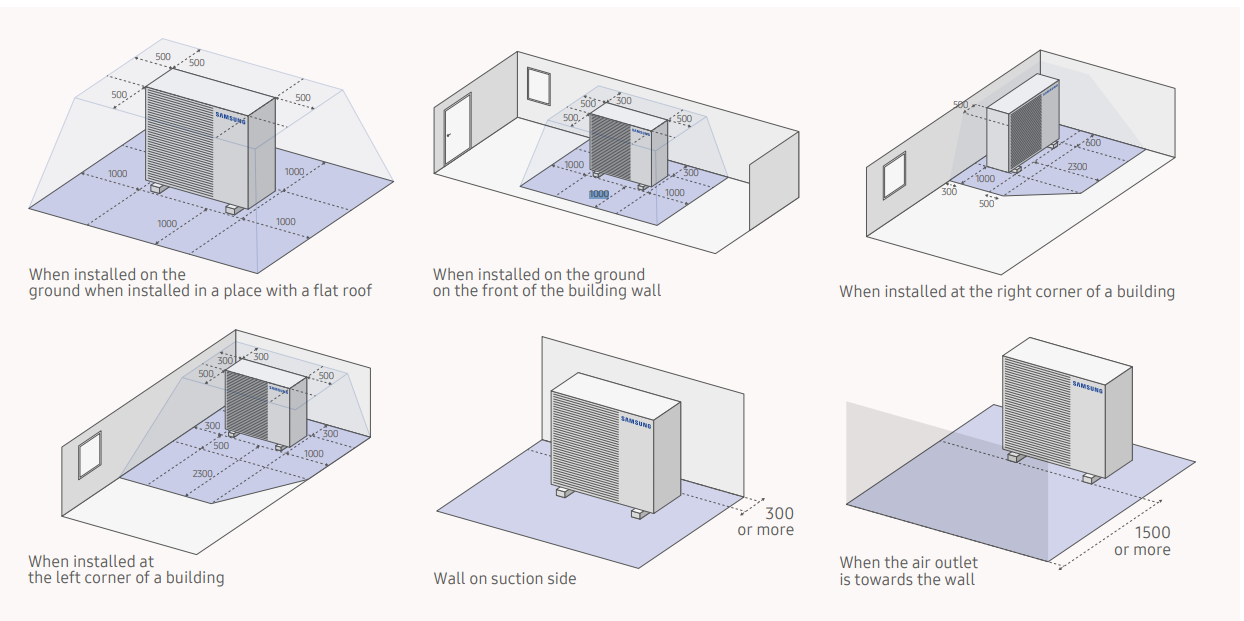
The protected zone as specify by vaillant (as I read their diagram) does not extend above the unit. That's logical too, propane is heavier than air. I'm not sure about @JohnMos second sentence, in my version of the manual this comment is only attached to the instructions for wall mounting not floor mounting - is it an instruction for safety reasons or just a recommendation eg for noise or structural integrity (since wall mounted is more likely to be close to a bedroom in the house they draw/the structural integrity of a wall reduces close to a window). Surely if it's outside the defined protective zone then it's outside it, end of? You could always call tech support if your chosen manufacturer will speak to mortals (some will, some wont, if its Vaillant they will). That should convince your installer (or not depending on what they say) Here is a samsung diagram, again the zone extends below but not above the unit, the dotted lines show that if there is any doubt. Of course what the installer will do (not what the manual says) trumps everything else!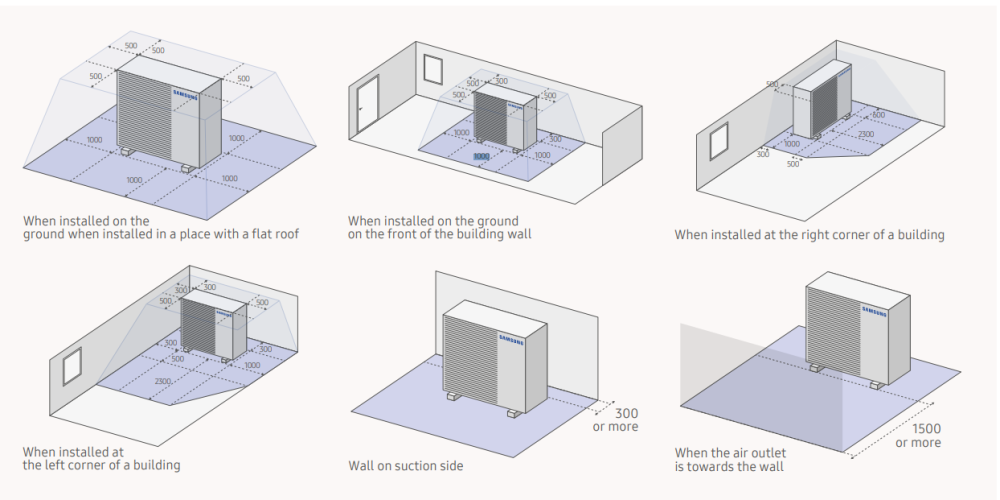
-
Considerations around installing Solar
JamesPa replied to fromdownwest's topic in Photovoltaics (PV)
Couple of points 'So in essence no electricity bill except the standing charge' is unlikely to be true. With batteries you can shift generated capacity by a day or so to match load, but you cant shift it from summer to winter. So you will almost certainly have an electricity bill in winter, particularly if you also have an ASHP. My advice is to do the sums on the battery (and as suggested above consider a cheaper brand). Unlike solar panels there is no material ecological advantage, so you need to be making money on them to justify. Unfortunately many solar installers are just not interested unless they also fit a battery, because that's where the margins currently are! A solar diverter and your DHW tank make a very cheap 'battery', and a 200l tank of hot water heated from 10C to 50C is about 10kWh of storage capacity very cheaply. If you are planning to get an EV and its at home during the day in summer then you will soak up quite a bit with that (weakening the case for a battery). On the other hand if you can use a battery in conjunction with a ToU tariff there is potentially quite a bit to be gained. Basically its worth doing the sums for the mode in which you intend to operate, and of course check that the inverter (and any other relevant controls) are capable of operating in that mode. My consumption is similar to yours. I have 4kWp solar (from 2011) and couldn't make the case for a battery (unless cheapo + self installed) work even before I got an EV. Now I have an EV the case is only getting weaker. -
Quote for ashp - didnt expect that much!
JamesPa replied to TheMitchells's topic in Air Source Heat Pumps (ASHP)
Unfortunately MCS is currently a government sponsored private closed shop, very similar to a Government licenced monopoly. The result is the same as with other private monopolies (did I hear someone say 'Thames Water')? Its inevitable with private monopolies, its just human nature at work! Unlike water supply the fitting of heat pumps is not a natural monopoly, ,its manufactured by humans (ie its avoidable). The MCS monopoly is enforced through the BUS grant and planning permission permitted development rules, which MCS wrote themselves into (!). The former I can just about understand, the latter is scandalous IMHO. Fleix-orb are working up a standard in competition, but as yet have not published a date for go-live. It will be interesting to see how that works out. -
Mini Store - Heat Geek / Newark Cylinders for ASHP
JamesPa replied to Nick Laslett's topic in Air Source Heat Pumps (ASHP)
That's hilarious. Perhaps you need to fit placebo controls -
Mini Store - Heat Geek / Newark Cylinders for ASHP
JamesPa replied to Nick Laslett's topic in Air Source Heat Pumps (ASHP)
And I think that's the point. In many cases it's good enough. Nobody is claiming it's a universal solution and I think we have established that there isn't and won't be one. -
Mini Store - Heat Geek / Newark Cylinders for ASHP
JamesPa replied to Nick Laslett's topic in Air Source Heat Pumps (ASHP)
From a quick scan the cleaning takes place at -5 to -10C. Not sure that will satisfy the MCS installation rules. -
Mini Store - Heat Geek / Newark Cylinders for ASHP
JamesPa replied to Nick Laslett's topic in Air Source Heat Pumps (ASHP)
I imagine capturing and reusing it to avoid a further contribution to global warming might prove tricky. As for dhmo, the arguments seems a bit watered down to me. -
Mini Store - Heat Geek / Newark Cylinders for ASHP
JamesPa replied to Nick Laslett's topic in Air Source Heat Pumps (ASHP)
I think the answer to the first question is probably no, and your comments in the second paragraph equally true. Yet it is what we now apparently are 'expected' to design for if retrofitting a heat pump! So the real problem comes down to expectations. -
Mini Store - Heat Geek / Newark Cylinders for ASHP
JamesPa replied to Nick Laslett's topic in Air Source Heat Pumps (ASHP)
That's an interesting idea. Water of course is also an excellent solvent and does no harm to humans unless the human is submerged. An alternative liquid would need these properties too. Of course we do already have one (sort of), namely aerated water, easily available by changing your shower head! -
Mini Store - Heat Geek / Newark Cylinders for ASHP
JamesPa replied to Nick Laslett's topic in Air Source Heat Pumps (ASHP)
My point is you have to compromise on _something_; there is not likely in the foreseeable future to be a perfect solution of the sort @Beelbeebubis asking for, because the physics/material science doesn't match our (imho unreasonable, but definitely unrealistic) expectations. A better compromise for the planet, than a vast uvc, would be an aerator, 6-8 l/min, and not expecting to have several showers in quick succession. yes indeed... with a bit more capacity squeezed out by doing real time reheat. That's probably why they couldn't patent it, too much prior art. Indeed so