


SteamyTea
-
Posts
23375 -
Joined
-
Days Won
190
Everything posted by SteamyTea
-
Welcome. 8 years into your self build, and not finalised a design yet. You will fit in well.
-

What next for heat pumps after BUS and MCS?
SteamyTea replied to joth's topic in Environmental Building Politics
https://phscom.co.uk/why-has-norway-succeeded-with-air-source-heat-pumps/ -
Another way to think of it is that the government is improving people's quality of life as Nepal moves towards full democracy. (I know nothing about Nepal except the best 'Indian' restaurant I have found in Penzance is seems to have some connection to Joanna Lumley, and that is good enough for me)
-
Large dairy farms already collect waste and process it into methane, that is then injected into the gas grid. It is not as simple as putting it into a container, letting it rot, and piping the gas away. Below is an example of a small scale one in India. https://www.biocycle.net/india-dairy-farmers-install-small-scale-digesters/ Note that they are claiming carbon credits, which is often the main income from them. There were a couple of conmen based in Devon that convinced someone on the Green Building Forum to buy their unproven design. All it was was an underground storage cylinder connected inline with the household sewage. They claimed more energy out than in. I went to see them, on the insistence of Viking House's Seamus and the Architect Tom Foster. The whole setup was a farce. 7 hours of my life I will never get back. Just followed a link in the Indian Article to a smaller bio-digester. https://www.biocycle.net/food-waste-to-biofertilizer-using-home-digesters/
-
Water is a neutron modulator, so a good fluid to use. Why it is used when storing nuclear waste.
-
@Menessis You are getting a new Prime Minister.
-
It is legitimate to do research, research is about answering questions after all. The question I would ask is how long can this 'stuff' be stored reliably. A billion is not enough. Thing is, when the two cheapest new generation systems are, apart from manufacturing, both zero emissions (near enough), why bother to try use others that need secondary processes. There really is not need to use combustion technology these days, and huge parts of the world have better resources than us. The UK is rather fixated with 'reliability and price' while being very scared to try anything new (I still know people that have not tried a curry or a pizza).
-
That would be really useful data. I often think people are over optimistic about the efficiency they can get from almost every bit of equipment they own. Reducing parasitic loads is an area I really focused on a decade ago, it is why I show two different 'means'. In my larger spreadsheet I can look at the half hourly data and see what is happening.
-
That is the borrowings, which are secured by government bonds. Not what we have to instantly pay back. Government book keeping is not the same as your household budgeting. If you want to keep on believing that nuclear and gas is the way forward for energy production, I cannot convince you differently. Thankfully though, we are on a path, all be it too slowly, to decarbonisation, and no amount of tantrums about cost and it not being possible will stop it. But we will not agree on this, so no point carrying on with it.
-
I used to drive past it most mornings on the way to work. Was a huge steelworks next to it that ran all the way up to Midtown where I worked. If you want a good reason to not mine coal, go to Centralia, PA. An underground coal mine fire has been burning since 1962. It is a very strange place to visit.
-
There is a difference between how much was borrowed, and what those borrowings cost us. It is a figure I read on a government report last year, can't be bothered to track it down as it would make no difference to you.
-
Not at all, I quite like nuclear technology. But as a cost effective, reliable and quickly deployable technology, forget it. There is also the global problem of uranium ore supplies. There was a report by David Elliot many years ago about just this problem. David Elliot is a nuclear expert and was very supportive of the industry. If you can deploy 1 MW of wind power for £1.5m, and let us say that can generate 2.6 GWh/year. The initial price of Hinckley C was £18bn back in 2007, 18 years ago. So say we deployed wind power at £1bn a year, that would be 667 MW installed capacity, generating around 1.7 TWh/a year, in 2008, 2009, another 1.7 TWh, total of 3.4 TWh. By now, we would be generating nearly 30 TWh/year. Hinkley with its 3 GW of capacity would, if it was finished, be generating 26 GWh/year. But Hinkley is not ready, and probably won't be until at least 2031, with a price of £40bn (about what COVID cost us). So let us take that difference of £22bn and invest it in some lithium storage at £1.5m/MWh. That is £1000 per kWh, so pricy. That would be about 14.6 TWh of storage, more than enough to store excess and deliver shortfalls. And we could be already doing that. But no, the desperate nuclear industry has proposed that we go for Small Modular Reactors, which like the Hinckley design (EPR0 is unproven. Olkiluoto was 18 years late and only started producing in 2023, Flamanville was connected last year. Nuclear, while technically interesting, is dead in the water. Really is bonkers to support it when there are more viable options. Another way to look at it is how many houses could £18bn have built. Let us say that a developer can build a house for £120,000. It may not be the best house ever, but adequate. 150,000 houses, not far off what we build each year. So if you think that houses are expensive, don't consider the supporting nuclear power, it will come out at twice the price. (expletive deleted)ing bonkers.
-
We have done that for the last 2 decades almost, how much new generation have we achieved? That already happens directly or indirectly. Most industrialised countries already have carbon accounting and taxation system in place. It is only on new vehicles, it is not banning the existing ones. What ELMS is about. There is already a plan down here (Cornwall) for coastal flooding. The plan is abandonment. Inland flooding is the bigger problem. Keeps amazing me that the right wingers, free enterprisers, restrictions reducers cannot see that there is trillions to be made in upgrading the worlds energy infrastructures. Seems the main player in this is China, and they come in for a lot of stick for it.
-
Not me that needs help.
-
Grey, damp and miserable. But I think I prefer that. I spent £3 on keeping warm yesterday.
-
@Marvin I think I have just about done all the reduction measures I can (except baths). I intend to add a bit more insulation here and there, but it will only make a marginal difference. An EV would make the biggest difference, but at the moment it would not be practical (or affordable) for me. I could get a lodger again, which would pay for an EV, but I like living in my own.
-
That is because they are still based on cheapest energy source, be thankful it is not based on the 'too cheap to meter' nuclear prices. It is not the fault of renewable energy supporters that out governments have a crap system of setting taxation on energy. The RE industry has been trying to get this changed for years.
-
So this is a proposal, to do what already happens via a different mechanism.
-
Can you point me to the source of that information. I keep a constant eye on what is happening and not seen those statements.
-
Because of the way it is priced. Been though that. It is not the renewable energy business set government policy on tax and incentives. Considering that electricity from off shore wind is coming in at 5p/kWh or cheaper, it is quite amazing that any money is spent on fossil fuels. But as we have seen over the last few years, our reliance on fossil fuels is rapidly diminishing, regardless of government policies.
-
I think it is much more complicated than that. If a product is traded globally, and locally produced goods cost more, then you loose your business base. We could start paying 'highly skilled' workers minimum wage, let us see how well that goes down.
-
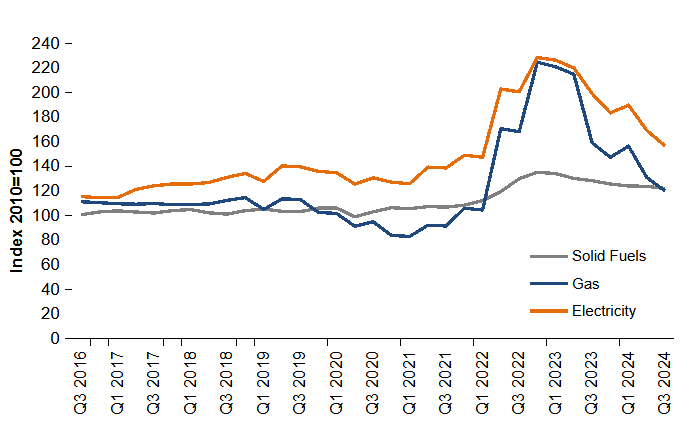
This is from the government website that tracks these sorts of things https://www.gov.uk/government/statistical-data-sets/monthly-domestic-energy-price-stastics
-
I think this is something us 'older ones' know more about as we lived though the Cold War. The turning off of the gas line through Ukraine was one days news, and now chip wrappers. Having grown up around oil refineries, the conversation at home was often the price of oil. If it went down to $20/barrel, the refineries reduced capacity. The refined products then kept their value. A few years back, think it was 2006, we had a spike to $160/barrel, and armchair predictions that the new normal would be $200/barrel. It settled at around the $80/barrel and has been there for ages. Don't confuse local prices with oil prices, one is international trading of a future delivery of a product that is still in the ground, the other is local policies. People down here moan about the cost of petrol and say that the energy companies are ripping us off. I am one of the few people that travel up country on a very regular basis and noticed that our prices are lower than most. Also, it is often claimed it is because we are so far from an oil refinery. Well most of the UK is far from an oil refinery, but out depot is in Plymouth. Not far at all (between 0 miles and 80 miles). I do wish that all energy was taxed on two criteria, the energy content and the CO2e emissions. Then there would be a much more level playing field.
-
Until it costs more, then it is Ed (I assume Milliband) telling you what to do.
-
Not really. That is the maximum efficiency when everything is already up to temperature, the flow temperatures are idea, and the air temperature is high (ambient air temperature affect open combustion). Be better to work on 70% efficiency to take into account cycling.

