
Leaderboard


Popular Content
Showing content with the highest reputation since 08/15/26 in Blog Comments
-
That is for very special circumstances... a bridge, a block of flats. I've not done or seen one for decades.... commercial or home. (on big jobs we had a lab that did slump tests and took cubes for testing, and so did the supplier. The problem will have been the fibres. Adding them to an 'easy flowing' mix will seriously stiffen the whole thing. A vibrating poker would have made it run but obv that wasn't to hand. I've gone off fibres recently because they seem to stick together in great clumps more than they used to, and the handling issue. But it also looks very dry indeed. How did it even reach there? You have nicely laid mesh so cracking shouldn't be a problem... if they get the mix right. In fact your photo is an example of doing things right, apart from the pile of mess in the middle. Cemex you say! Worth noting.3 points
-
Why are you not doing a sump test when the truck arrives one bucket full out the truck, slump test, if it fails it goes back. every video I’ve seen on scc the test it as soon as it turns up.3 points
-
Thanks. It took awhile to choose the tiles as we wanted Grey in an R11 slip rating and for UFH. It’s the same tiles on the walls and floor but the Velux makes them appear slightly different. We got quite a few small samples posted to us then less than two months later the tile we chose which also had an accent tile to match they stopped making the accent tile. Luckily we hadn’t ordered so just went with the plain tile for walls and floor in a size I could pick up and it worked. I will probably choose R11 again as they do feel good underfoot.1 point
-
Only the open plan area got the skim coat of plaster, that was due to its height and it would have taken me forever to tape and joint all on my own. All other rooms are getting tape and joint by me then painted. When I have taped and properly completed all the jointing and sanding stages I think it’s as good a finish as the skim plaster. Not every one will agree with that but I believe in Scotland it’s mostly tape and joint and in other countries particularly Canada that’s pretty much all they do. It’s definitely won’t change the airtightness as we are ICF so our biggest airtight challenges are the eves, service penetrations, doors and windows.1 point
-
This looks like a painting on the wall. I thought this was a modern take on Constable's Haywain when I first saw it.
 1 point
 -
Both have their place - I also do this a lot too!1 point
-
@Great_scot_selfbuild Many thanks for this. That looks very useful. I've been writing everything down old school in a notebook, but your was looks a lot cleaner and easier to search back through. Cheers1 point
-
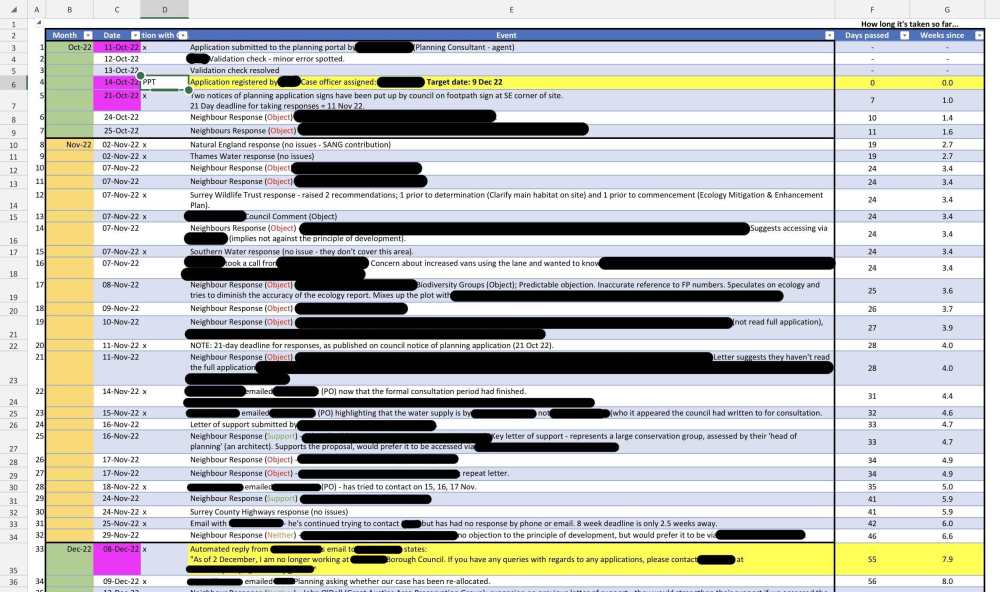
@Square Feet congratulations - what a cracking view! I do hope it all goes well for you in the planning process. A small ‘admin’ tip I would recommend starting as early as possible is to log all your activity and communications. As much as this sounds tedious (which it is), I did ours a bit later in the day, back-dating it with all my emails in the many months of ‘quiet time’ (unresponsive council and sometimes paid professionals on my side). The reason for this was that much later, it became *exceptionally* useful when the council suddenly changed their mind and ultimately refused our first application. This log of activity allowed my planning consultant to easily and quickly reference the specific communications that were relevant (in our case the many broken promises of when a response or decision would be made) and we managed to weave it in to an element of our appeal. My point being that if you populates it as you go from the start it is sooooo much easier. Here’s a screenshot of the format I used (3rd column is ‘Interaction with Council’ - I added later when this became an issue and just put an ‘x’ in so I could filter to compile a shorter extract). Columns: A - numbered rows (in the table) for ease of reference in emails B - Month C - Date D - Interaction with Council E - Event F - Days Passed; Formula: =[@Date]-C$6 G - Weeks since; Formula: =([@Date]-C$6)/7 The splurg of black is just redaction of names / addresses. Rather than share a blank template I thought it would give an idea of how little / much I entered in the summary. Some emails I included an extracted quote if particularly relevant e.g. “I’m minded to recommend for approval”, before then refusing many months later. In this particular extract, the gap between the yellow highlighted lines showed the application being registered on 14 Oct, followed by zero responses from the assigned Planning Officer (PO), before an automated email reply on 8 Dec saying he was leaving the council. I really do hope the Scottish behaviours are better than ours! Best of luck.
 1 point
 -
This is stunning. Great inspiration. Very much like the resin-bound path. 👏🏻1 point
-
This is awful to hear. It should be sophisticated and consistent. I know it is only bits of ground broken up and mixed back together again, but it sounds like that's all they are doing, without testing. Scary to think that these companies supply for bridges and multistoreys.1 point
-
I’ve learnt a great deal. 1) forget ground bearing slabs and go block and beam 2) if going with ground bearing slabs. Get the manpower in and use a conventional concrete mix. Using SCC is like having a partner with a split personality. You never know how it’s going to go. Well. That’s my experience of it.1 point
-
Not sure if your experience is purely domestic or also commercial? Again, just based on reading around, doing it on domestic jobs is relatively less common but almost guaranteed on commercial jobs. But just because it's less common on domestic work doesn't mean it shouldn't be done. Especially on 'technical' work like insulated slabs or for picky self builders who will have to deal with the result (vs a builder who might get a suboptimal slab but not really care and just cover it up asap).1 point
-
Just seconding this. Never done this but all my research has said you absolutely need to test every load if you want a good result. (Not just SCC but concrete* in general). The load gets rejected if it doesn't pass, don't allow water to be added. The drivers and companies are all used to this and it shouldn't be a problem to do as the first thing you do when the truck arrives. Edit: * For anything important1 point
-
Yes, they did.1 point
-
Do you have holcim round there? We have a local quite advanced batching plant. Local businessman set it up and they bought him out. They do it too. Even some of the volumetric boys are doing it round here now but I'd be a bit wary of them.1 point
-
Did they take it back at their cost?1 point
-
So where does that leave you? What's the fix/work-round for the Cemex stuff, and what are you going to use instead of the lump of 'clod'? If all orders are detailed, in writing, then wriggling out would arguably be difficult. OTOH total inactivity/failure to engage works for recalcitrant contractors all the time. Also, it just occurs to me that any 'obvious' description, especially in a product name, probably has to be queried. You said '...there is a clue in the name 'Easyflow', but maybe there simply isn't! 'Oh, we call it that, Sir, but it's stiff - and does not flow easily - when we think it should be.'. I am not sure I'd have queried that either, but it's a Life Lesson... Keep us posted on the next steps and, I sincerely hope, the success thereof.1 point
-
Looks good for haunching up kerbs etc. Tossers.1 point




This leaderboard is set to London/GMT+01:00