


Kelvin
-
Posts
4085 -
Joined
-
Last visited
-
Days Won
48
Everything posted by Kelvin
-
That’s not £6000 it’s about £1800. A good amp as it happens.
-
Which amp? I think the X4800H is the Denon sweet spot. I only bought the X8500HA because I got such a good deal on it. https://hometheaterhifi.com/reviews/receiver-processor/receivers/denon-avr-x4800h-av-receiver-review/
-
PMC are one example. I lived near their Biggleswade factory. A bit dearer than the budget though.
-
Not only is it a function of thoughtful design it’s a function of careful detailed build by everyone that walks through your front door to carry out work in your house. Most trades don’t really understand air tightness. I had a very simple rule no one other me cuts or drills through the big white membrane that lined the interior of our house and any breach of the air tight membrane had to really be justified as in there was no other way to do whatever needed to be done. In the end we had two such breaches and I used the right products to properly seal around the breaches afterwards. Fortunately there are loads of products for every situation.
-
It’s all relatively new technology so companies will come and go and technology will develop at a rapid pace. Therefore there is a degree of risk buying any of it. Look at the Tesla Powerwall 2 for example which is a bit of a dead end and somewhat risky given its battery chemistry and not compatible with Powerwall 3. What attracted me to SigEnergy Sigenstor is its modular so very easy to expand and you can mix and match batteries so it’s as future proofed as it can be. However the risk is that they are a relatively young company so could go pop or get acquired and everything changes. It’s run by ex Huawei execs who ran their renewables business. It’s also rapidly growing so are hopefully building a long term sustainable business.
-
The important speakers in a surround sound system is the centre, sub, front main in that order. Focus the money there. The other speakers are more effects speakers so you can compromise a bit more with these. SVS is American so rules them out
-
Are the speakers a package deal or can you split them? If so consider this sub instead https://www.homecinemachoice.com/content/svs-sb-1000-pro-subwoofer-review-page-2 It’s dearer of course but I think SVS do the best subs pound for pound on the market. I have the SB-3000 and it’s phenomenal. Certainly go listen to them.
-
Structural Warranty for finance and possible resell?
Kelvin replied to flanagaj's topic in New House & Structural Warranties
I agree there isn’t enough data as I know two people that have claimed on their structural warranty and been paid out. One of them twice. -
We have this stuff. Similar to Sarnafil. https://www.alwitra.co.uk/single-ply-membranes
-
On our house with a metal roof the battens run vertically up and down the roof to allow air flow and if any water did get in or condense then yes it will run down the roof. When then fitted plywood to the battens, breather membrane and then the roof.
-
You can buy directly from Loxone’s web shop.
-
I used Monitor Audio Soundframe speakers for the front high, surround, and rear surround. A combination of the SF1,2 and 3. They do both wall mount and in wall mount. I got a proper bargain though as I got all six for 50% off as they were shop returns. It looked like they’d been specced for a dear house build in Yorkshire as the architects drawings were in one of the boxes. One of the speaker drive units was damaged so I called Monitor Audio and they sent me a replacement FoC. Quite nice looking things that disappear a bit as far as speakers can. The 4 ceiling speakers are Bowers & Wilkins CCM382. One pair was an open box and the other new so a reasonable discount on that too.
-
The updated one. I was talked out of it by someone that knows. I’ve yet to sort the gates out. I’ll probably use the Reolink Doorbell as the intercom. It’ll only be us coming through the gates though as we have a guest parking area.
-
Yes you can use an iPad as main console, it’s what we do or set it up as managed tablet although that probably makes more sense in an office environment. We have an iPad on the kitchen counter. The reality is though that once setup you rarely need to look at the Loxone App. The Loxone intercom is stupidly expensive and its IP protection is 34 so I wasn’t convinced it could survive wind driven rain.
-
This is exactly the advantage with Home Assistant as there’s very little you can’t do. They said my Reolink cameras have built in lights that are actually quite powerful so I haven’t bothered with a floodlight. They also have floodlight cameras if that was a requirement.
-
It’s relatively common for amps to process more channels than they can amplify which they do for a few reasons. It gives you some flexibility allowing you to use an existing amp you have or add one later to take advantage of the extra channels without having to replace the AV amp. If also keeps the cost down as it’s cheap enough to process all the channels but dearer to provide discrete amplification for all the channels.
-
Do you need a mortgage, if so what are their terms. Might you sell it over the next few years and therefore the buyer might need a mortgage.
-
How to insulate open ends of the wall which we are due to be capped
Kelvin replied to Mubbashshir's topic in Heat Insulation
Are there any pictures of the insulation being fitted to show if these gaps are running across all the sections. It’s more annoying as that type of insulation is designed to make it easier to make a good fit. -
Wire for that but don’t fit it. I have front high wide speakers and the difference with them switched in and out is noticeable in a slightly more expansive sound stage but that’s all. I assume you found these guides: https://www.dolby.com/about/support/guide/speaker-setup-guides/9.1.4-overhead-speaker-setup-guide It was mentioned above questioning fitting 2 ceiling speakers instead of 4. I disagree with that, definitely fit 4.
-
How to insulate open ends of the wall which we are due to be capped
Kelvin replied to Mubbashshir's topic in Heat Insulation
Yes that’s really poorly fitted unfortunately. You can buy cavity closers but I’d say that might be the least of your problems. Do you have any pictures of this as it was being built. -
I wanted it to be as straightforward as possible and I knew nothing about any of it at the time so this was an easy decision to make. Like you, I read all the threads on here and elsewhere and it was somewhat confusing.
-
Yes pretty much. In my case I’m using the dimmer extensions for a few of the rooms where dimming makes sense and relay extensions for everything else. Mains dimming has its limitations but I only need three settings: full bright, dimmed (about 60%) for more ambience, and night (about 30%)
-
The Loxone PSU is powering all the 24V Loxone devices. The lighting circuits are 230V.
-
Like this. The lighting circuits come back to the panel and are connected to the either relay extensions or dimmer extensions. Power comes from your CU into the panel protection and whichever PSU you decide to use. I used the rather expensive Loxone PSU there are cheaper more flexible ways to do that.
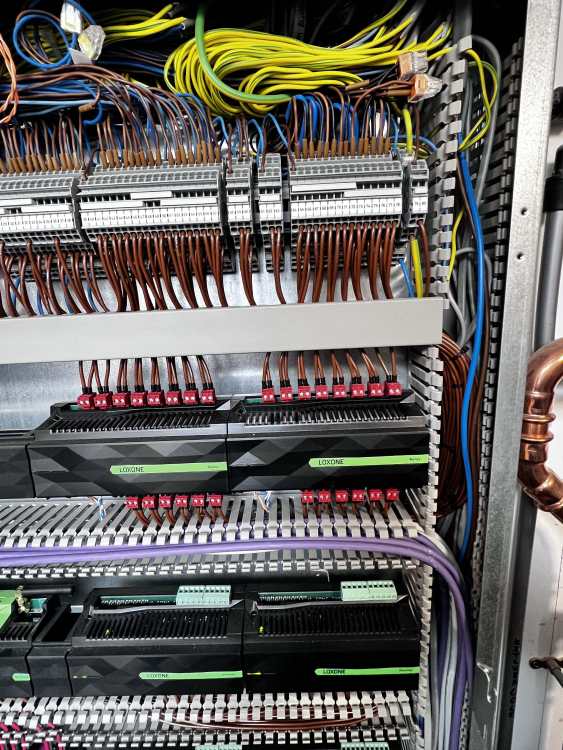
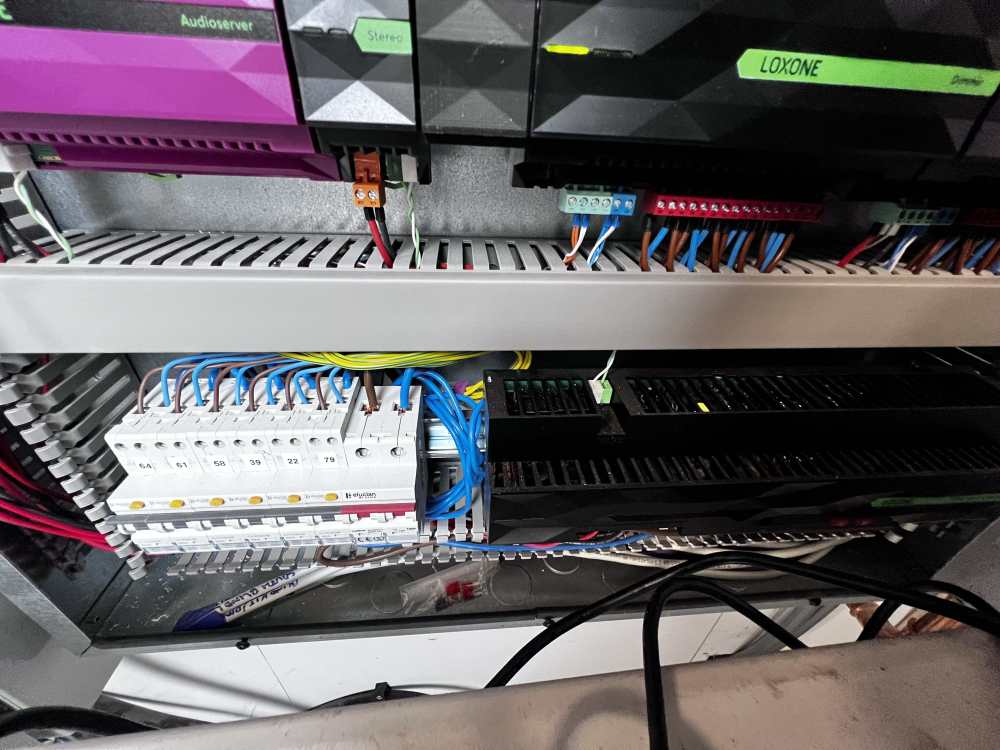
-
You really don’t need to have individually addressable downlights. It might be something you’ll think you’ll use a lot but it’s likely you won’t in reality. We have 16 downlights in the open plan kitchen/dining area plus three pendant lights over the island, one over the dining table and an LED in the long alcove/shelf on the back wall of the kitchen. The 16 downlights are wired as 4 separate groups of 4 and the others are also on their own circuits. This allows us to have a few different ‘moods’ (as Loxone calls it) so for example when the house is in night mode after we’ve gone to bed if you get up and go downstairs only the strip by the island lights up and it’s dimmed, if I’m cooking the two strips above the island can be illuminated at full brightness etc. We have track lighting in our TV room and this is where more individually addressable Loxone lighting would have been more useful. To achieve the same result I re-used several of the Philips Hue GU10 bulbs I already had. It works well with Loxone as we have 4 tracks of lights on separate circuits, and Hue bulbs in the track above the seating position and where my desk is. I’ve set the bulbs to the colour I want above the sofa (very dimmed blue cinema styli) and daylight colour temperature above my desk. I then created a mood in Loxone for cinema and office. I never need to use the Philips Hue app and just use Loxone to control it. Same with the outside lights which are also all Hue GU10 bulbs (16 of them again because I already had them) They are the coloured type but only ever have them at warm white. I find you don’t change the lighting moods/scenes as much as you think you will once you’ve settled on the way you want everything. The Loxone stuff is good and easy to configure once you become familiar with Loxone Config. I especially like the Touch Pure glass fronted switches and we have these in the main living areas and the less expensive somewhat cheap looking Touch switches everywhere else. Overall it is relatively expensive though. Also while you can integrate some third party devices and services with Loxone it is much more limited than say Home Assistant where you can easily update devices as new products become available. Loxone also seem to be slow in developing new products. I chose not extend Loxone into the garage and decided to use what I already had managed by SmartThings but really only because I had a large box of sensors, fire alarms, smoke detectors, lighting relays, leak detectors etc I have sort of connected Loxone and this together using Matter. I will eventually move that over to Home Assistant.


