


saveasteading
-
Posts
11094 -
Joined
-
Last visited
-
Days Won
98
Everything posted by saveasteading
-

Garage floor paint/resin/epoxy resin
saveasteading replied to BotusBuild's topic in General Flooring
Depends. I've had fancy 2 part stuff in commercial garages, specified by well known marques, and it was great but hideously expensive. For family garage businesses we tried the cheapest floor paint from their trade magazines. Tt wore out eventually along the repeat wheel routes, (thousands of passes) and simply needed a local touch up every 5 years. So it saved them thousands. -
No. And crack? It's in the dark, presumably made for the job, and feels flexible still. It would be a lot of work, especially as my improved loft ladder (one that doesn't disappear under me), restricts access for part sizes. I may check again whether there is any problem when the tank is full. Perhaps a leak from the overflow.It occurs to me that this may have been dribbling for a very long time. I had the other tank leak, sorted it, and didn't look again. Maybe this was always adding to it. It hasn't come through the ceiling in that time, but i think it may have mostly evaporated until yesterday..for who knows what reason. Today it is tamed, i've used a hitech system of a bucket under the dripping point, a hole in the ply deck and a string to encourage it to that hole. No ordinary string though.... a piece of fibre optic cable....that's the hitech bit. What is the pressure relief pipe for? the one that loops over the tank. I know what hey do in hot tanks, spluttering and splashing hot water. Is it the same for cold but more as a precaution than ever really spitting water? As a precaution I could bend the float valve down a tad. Does anyone have a clever method of doing that in situ?
-
Was discussed earlier. it is a single brick wall, and no knowledge of foundations, but unlikely to be adequate. Plus the beam would be about 350 deep which isn't wanted. So probably no.
-
Ours was farm accomodation and was free with the building. Using as a site office. So not in great order. When I gutted out the folding bed and some other boxing it showed its years of use by way of dust and droppings. So yes, do a big clear out.
-
So they don't loosen when a joist bounces or rotates. I expect joiners perfer the speed of nails, so must use these. Screws don't pull out. If the joists don't move, due to noggins (or dwangs) I can't see a problem. It might need an Engineer to say so to the bco if questioned....Best ask bco before committing.
-
There is a leak from a big cold tank in the attic. It is all up on a gantry to maximise head, and very difficult to access. I can't definitely see the source, as it spreads over the ply deck, and seems even to be a couple of areas. I can't see any leaks from connections. Annoyingly the drips appear to slow and stop when I am observing....that might be some clue. What I have see is a dribble from the metal strengthening strap. Plus I think I saw a drip from further along that moulding. Do tanks fail? The tank was not full. I perhaps have to stop all household use and check overflows. ( I previously found that the adjacent hot header overflow had never been sealed. Same plumber 30 years ago). The overflow pipes are pointed down into the water. Is that an intentional thing? Photos. 1.The small tank in front is the hot water header. Behind are 2 large cold tanks, linked....one shared float valve, each with an overflow. 2. The linkage between the 2 tanks and the metal strap. Dribble stain visible on the right tank.
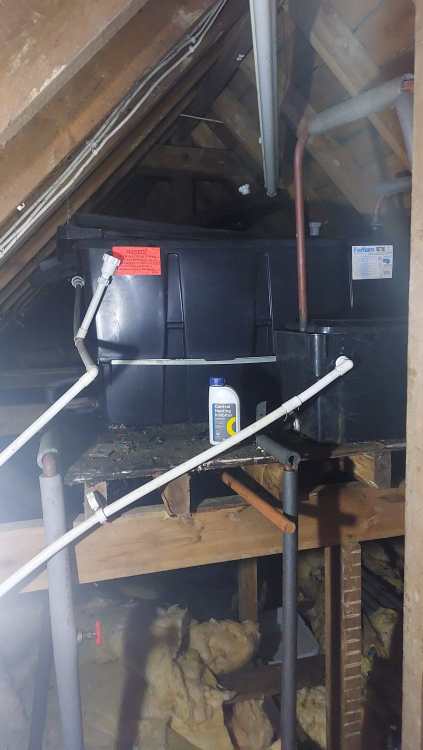
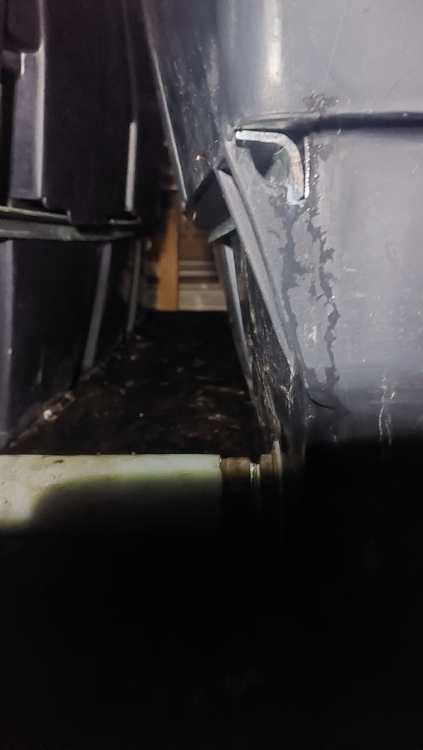
-
Use screws on whatever angle is possible or with a right angle drill attachment. Precut service holes in the joists: mass produced outdoors before lugging them in.
-
No. Not if you keep to the rules of size, position and spacing. Later we can sort that.
-
Are some snots and caps a problem on the inside of a new brick wall?
saveasteading replied to Bounce's topic in Brick & Block
I've checked, and the word seems to be less offensive than I thought, or than it used to be. -
Ask them. it isn't a standard process.
-
245 x 97 @ 300mm cc from john james. They don't show any closer cc.
-
It is almost solid timber!
-
Sand & priming anhydrite screed
saveasteading replied to YorkieSelfBuild's topic in Floor Tiles & Tiling
Noted. It doesn't need that though unless it's a wet mix or not able to dry properly because of conditions. On s and c screed do you cover in polythene to cure first? -
Sand & priming anhydrite screed
saveasteading replied to YorkieSelfBuild's topic in Floor Tiles & Tiling
All very interesting. 75 days is just silly. Based on 1mm per day I think. An industrial slab can be 200mm. I've had client's consultants want 200 days ' drying'. They didn't understand that most of the water becomes chemically incorporated and not much evaporation is necessary. That's unless it is still being rained on. And some of the advice on screeds seems contradictory. "Scrape off laitence because it is loose. But don't wait too long or it gets too hard?" -
Are some snots and caps a problem on the inside of a new brick wall?
saveasteading replied to Bounce's topic in Brick & Block
That's rather extreme. I can't lay bricks well, most bricklayers don't understand structure or insulation. What annoys me is when they are too arrogant, or just dim, to do what they are told. -
As I described above, using joists as the webs of a beam, and ply above and below as flanges. Needs an SE. I've done that to upgrade an old floor that was bouncy, Not very likely. The load is very concentrated so you need a brick pier or steel column, plus extra footing. before going too far...can you get 6m joists in there and up into place?
-
New build designs........ Comments please
saveasteading replied to GK22's topic in New House & Self Build Design
Care to give us any lessons learnt, or an overview? A photo would be great too, but understood if you don't want to. -
My misreading was that clay is rather older than that. 120 year old foundations though. they tend to be about 2 ft deep at most. By the time you do trial pits and check the wall out too, then new foundations etc, I think you might just go with timber or engineered joists. This needs building regulations. With timber onto wall plates the bco might accept it by inspection, plus the load tables for the joist spec. If you have an Engineer then he could look at adding plywood top or bottom to make the floor into one huge slab....and the joists depth would reduce.
-
That would be pretty standard, but the walls need to support the steel. Padstones. Possibly wall reinforcement. Possibly more foundation. Are these existing walls?
-
It reflects energy. It doesn't have to be visible to us for the shinyness to continue. But it needs an air gap...or it is pointless. It doesn't follow that I think this is necessary of a good choice here. @Clennls what is driving you in this direction? There are perfectly well proven mainstream products.
-
Who can dig the trench for my new electrical supply?
saveasteading replied to Bancroft's topic in Electrics - Other
Comes in 100m lengths, so most projects will have 80m left over....I certainly have. -
"Exit interview" with the family. What would you do differently? "No pir between rafters, only mineral wool squeezed in tight." We had already iterated to half and half because 100pir was hopeless. Better 100mm of well fitting fibre than 100pir with lots of gaps.
-
Yes. A straight competition. I've used John James once and it will have been on price. But I remember the service was good too. I think they were 7m or so spans and I compared them also with rolled steel (Z) joists. The video of manufacturing is impressive ...stunningly efficient. Yes. You have to cut holes. Much lighter than a solid timber but still very heavy. The span tables give lots of options on price v depth v weight.
-
Try James Jones. Timber flanges and osb webs. Their website has an interactive span calculator
-
We will regard this as a test. My hunch is of being declined.




