


catrionag
-
Posts
76 -
Joined
-
Last visited
Everything posted by catrionag
-
Thanks! I'd assumed the allowance for door mats would be the height of the doorframe itself (10mm or so I think).
-
Getting our Cemfloor screed poured tomorrow (fingers and toes are crossed that it gets above freezing...) but I'm still not sure how much wiggle room we should be leaving for the install of the engineered wood flooring on top of it. Current available space is roughly 80mm between the top of the insulation layer and the door thresholds. Our engineered wood is 14mm. Currently the plan is to pour 55mm of screed, leaving 11mm of wiggle room for any differences in height & gluing. Would 60mm be a better depth for the screed to avoid too much of a gap at the thresholds? I'm nervous about only leave 6mm of wiggle room for the flooring. Any advice appreciated!
-
Advice on gluing an external concrete sill
catrionag replied to catrionag's topic in Doors & Door Frames
That's something I hadn't considered! We already have the sills so I think I'll try gluing in the first instance but if we do manage to bugger it up then this is an excellent backup solution. Thank you! -
Advice on gluing an external concrete sill
catrionag replied to catrionag's topic in Doors & Door Frames
Thanks Mark - sorry my description wasn't clear but thank you for the product recommendation! Attached a picture of the detail just to clarify for others. Door (green arrow) and blockwork (blue arrow) is already installed. 75mm gap exists. 75mm sill (circled in red) needs to be installed with glue.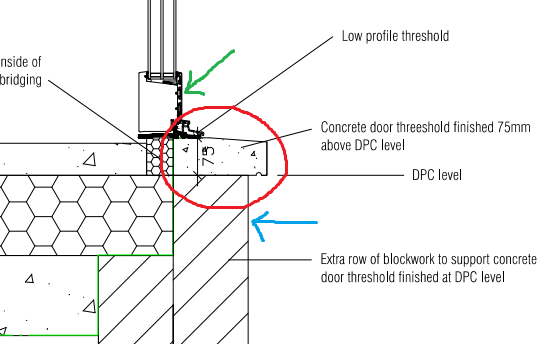
-
Hiya BuildHub - I'm after a bit of advice on gluing a concrete sill onto blockwork at DPC level - and this is the kicker - underneath a door that's already been installed. A bit of background is that there were some timescale and communication issues between the brickie and the kit-builder (who is on site currently) that meant the windows needed to be installed before the sills - obviously not ideal on either side. It was agreed (reluctantly on both sides) that the kit-builder would install the windows with a 75mm packer, so that the 75mm sills could then be slid in afterwards - the foreman and the groundworker talked about this and verbally agreed on using glue for the sills. My groundworker is great, but the brickie he subcontracted made an utter dogs dinner of it. He mortared them in, but obviously the 75mm gap wasn't enough for a 75mm sill + mortar, so he cut the blockwork down past DPC level to get them to fit. On two of the three doors, this is semi-acceptable as they could be either dropped or packed, but the main accessible entrance can't be dropped, and there is now too much of a gap between the bottom of the door and the sill - bigger than the 15mm required from NHBC. My groundworker has told me that he cannot find anyone willing to glue these sills - apparently everyone wants to mortar them. So, long story short, I am asking him to come in to rebuild the Blockwork to DPC and then we are going to glue them in ourselves. Can anyone recommend a glue, and are there any tips for making it easier on ourselves during the install process? I was thinking of using Adiseal and then pointing it up afterwards (the sill is three separate blocks). Any tips on good pointing would also be gratefully received because the original brickie managed to bollox that up as well and now it has to be redone on all of the sills.
-
Size of weatherproof box required for temp supply
catrionag replied to catrionag's topic in Electrics - Other
Thanks all! This is really helpful - much appreciated. -
Size of weatherproof box required for temp supply
catrionag replied to catrionag's topic in Electrics - Other
We're building a temporary kiosk just on the edge of the site. -
Does anyone have an idea what sort of size of weatherproof box would be needed for a temporary electric supply? It needs to house the mains fuse and meter. We're getting hooked up on the 12th September so trying to get all our ducks in a row and making sure we have the right setup for when they come to connect us up. SPEN are being a bit vague about it when asked, but I don't want to end up with a box that's massively over or under-sized.
-
Planning Condition re: site contamination
catrionag replied to catrionag's topic in Planning Permission
Me neither 🙃 it's a greenfield site/ex garden, but it is in an ex mining area so perhaps that's the issue? Although we have already submitted a coal authority report. Thanks for the reassurance - hopefully the desk study will be enough -
Planning Condition re: site contamination
catrionag replied to catrionag's topic in Planning Permission
Hiya Bitpipe, thanks for the reply. Yeah they have chemical analysis from the three trial pits they dug which is documented in the report they gave us. If I'd been a bit more clued up in the beginning on what is 'standard' for an SI report I think I would have picked up on the lack of a desk study earlier & requested one as part of the package, but I was totally clueless and just trusted that the company would give us all the information we needed! Every day is a school day. -
I'm hoping the buildhub hivemind can help with the very last planning condition we're hoping to tick off, and hopefully I don't bore you to sleep before you finish reading this post. In essence, we have one outstanding planning condition to take care of. It reads as follows: 1. The development shall not begin until a scheme to deal with any contamination of the site has been submitted to and approved by the Planning Authority. The scheme shall contain details of the proposals to deal with any contamination and include: i. the nature, extent and types of contamination on the site; ii. measures to treat or remove contamination to ensure that the site is fit for the uses hereby approved, and that there is no risk to the wider environment from contamination originating within the site; iii. measures to deal with contamination encountered during construction work; and, iv. the condition of the site on completion of the specified decontamination measures. 2. On completion of any required decontamination/ remediation works, referred to in Condition 1, and prior to the dwellinghouse on the site being occupied, a validation report shall be submitted to the Planning Authority confirming that the works have been carried out in accordance with the approved scheme. The dwellinghouse on the site shall not be occupied unless or until the Planning Authority have approved the required validation. Reason for conditions 1 and 2: To ensure that any contamination on the site is adequately identified and that appropriate decontamination measures are undertaken to mitigate the identified risk to site users and construction workers, built development on the site, landscaped areas, and the wider environment. We have had a site investigation done that showed no signs of contamination, and our Architect + SE were happy upon submitting the SI that it should satisfy this condition. However, the council weren't happy with the SI and we spent 8 weeks waiting for it to be peer-reviewed, the outcome of which is that they have asked for us to submit a desk study. We're currently getting the desk study drawn up (and it's been confirmed by building control that this will be OK by them & will allow us to get the Building Warrant) What I'm still not sure of is if the desk study should satisfy this last planning condition or if we still need to submit a separate contamination report, even though according to the company who did the SI there are no signs of contamination, and according to BC we'll be all set for the building warrant. We have asked the planners but previously they have taken more than 6 weeks to reply to very straightforward questions with no way of contacting them other than by email, so I'm hoping to avoid a lengthy back-and-forth! Any thoughts/previous experience with similar conditions would be very appreciated!
-
Improving SAP/EPC
catrionag replied to jen and mark's topic in Environmental Materials & Construction Methods
I'm guessing this is for Ecology? We decided to be 'flexible' on how we judged the overshading of our PV panels. The initial SAP had come back as 82 with moderate shading (due to our next door neighbours on the south west side). We changed it to no overshading which immediately bumped it up to 88, with the understanding that Ecology were never going to look that deeply into it & that SAP is a flawed system for judging how 'green' a house is anyway... -
That's excellent to know, thank you!
-
No treatment plant at all! Just SUDS drainage to dispose of rainwater. Sorry if I've been using the wrong terminology, it's all new to me
-
So I'd basically been advised by the bloke that's doing our groundworks that we'd need to use a hardcore infill for the soakaway since the driveway is going to be the only access onto site and will need to take the weight of heavy plant/lorries etc. I hadn't realised they would be available rated for such heavy loads, so I'll check back in with him! Otherwise I guess it would mean we'd just need to dig up the driveway again after the build to put the crates in?
-
Apparently we can't have crates since it's under the driveway - supposedly we need the gravel/hardcore in order to support the weight of vehicles. Unfortunately there is no space for it anywhere else on the plot as it would be too near buildings or boundaries.
-
Thanks so much everyone! I did take a look at the spreadsheets that were available but felt quite out of my depth to be honest - my Higher B in Maths is not serving me well here. The percolation rate from the SI was given as 1.5 x 10⁻⁵ (depth of test hole was 600mm) The Impermeable Area I'm taking to be the roof area? Roof area is 128m2. Footprint of the house is approx 80m2. As mentioned above the available space for the soakaway is 19m2 (underneath the driveway, so it would be filled with hardcore/gravel)
-
We submitted percolation test results, and the architect has submitted his own calculations, but in his words he was 'winging it' a bit having not designed a soakway in a while, so I'm assuming that Building Control want the sign-off of someone suitably competent. I'm just wondering who that is - whether we can do it ourselves since we have all the information, but then who signs it off?
-
Just as I thought we were close to getting our Building Warrant approved, Building Control have said they want signed-off calculations for the soakaway that the architect has designed. Who would do this? Would it be the company we got to do the site investigation? The soakaway we have currently is the maximum size that will fit in the plot while abiding by all the rules about distance from boundaries/roads/buildings (19m2) so I'm really hoping that the findings from the SI support the current size... Alternatively, if anyone can recommend a person/company who would be able to do that sort of thing I would be very appreciative!
-
Intro - New Build in East Lothian, Scotland
catrionag replied to Meabh's topic in Introduce Yourself
Sounds like a great project, and a lovely part of the world too. We are at a similar stage and quite nearby (Midlothian), just waiting for the Building Warrant to be approved so we can get started. If I end up finding any excellent local contractors I'll be happy to share if you promise to do the same!- 1 reply
-
- 1
-

-
Mortgage/Insurance on Timber-frame, timber-clad building.
catrionag replied to catrionag's topic in Self Build Mortgages
Hi madhum, Apologies for not picking this question up until now. In the end, we have decided to clad the eaves walls with cementitious board and render to avoid any problems remortgaging and selling in the future. The gable (street and rear garden facing) walls will still be timber clad, which satisfies the >50% rule that most lenders seem to have now. -
Cost of moving a neighbour's phone line
catrionag replied to catrionag's topic in General Self Build & DIY Discussion
Just updating this in case anyone is searching for advice on something similar in the future. In the end, I paid £336 for a survey for OpenReach to come out and work out how to solve the above issue. It was decided with the contractor (and agreed with the kit-builder) to raise the height of the phone line where it connected to the neighbour's house rather than move it. This meeting was in June, and the additional cost was £812, which I paid in June, the day after receiving the quote (as a side note, the contractors who eventually turned up to do the work pissed themselves when they found out how much we had had to pay for this). The work was eventually completed in late November, 5 months after I had paid, with no update from OpenReach during that time no matter how much I tried to contact them. They are absolutely bloody useless. I eventually had to go through their 'Jeopardy Management' team and threaten to charge back all the costs and remove the line myself to get them to do anything. In hindsight I should have done this a few months earlier. -
Advice welcomed on DHW/Space Heating system
catrionag replied to catrionag's topic in General Plumbing
Thank you both for your perspective! -
Good morning, BH! I'm looking for some advice/thoughts on our proposed space heating/DHW plan. The house isn't built yet and we're currently at Building Warrant stage so now is the time to think about what's going to work best for the space. Some info about the house first of all: Small 1.5 storey new build of approx 120sqm floorspace/300 cubic metres total space. Based in Scotland (Midlothian) Insulated to passive standards No gas 3.7kw PV panels on the roof Room sealed 5kw woodburner in double height living space 2 adults, no kids in terms of DHW requirements. Our initial plan was to have the woodburner as our main source of space heating, with topup from electric radiators in the bedrooms if needed and towel rails in the bathrooms. DHW would be from a Direct Unvented Cylinder (tips on good brands of UVC welcome too!). We're installing UFH pipework as a 'just in case', so that if needed we could easily hook up a heatpump. My partner and I are now of different viewpoints. My thoughts are to keep it simple and stick with the plan above: woodburner + rads for topup and UVC. He thinks that since we are already installing the pipework for UFH we might as well get rid of the downstairs electric rads and get a little direct electric boiler (separate from the UVC?) to run the UFH. His thinking is that the boiler would probably cost about the same as the electric radiators we would plan on getting anyway, so why not just go ahead and hook up the UFH from the get-go. It seems to me that's overcomplicating things, and that for the number of times we would actually use the UFH it's not worth it. Any thoughts/advice/criticism welcomed.
-
Agree. Picture above looks fine to me - just surface rust, and that will eventually form a protective layer that will stop any further penetration unless it's really exposed to the elements or you're right on the coast & getting salt spray
