
Phaedrus
-
Posts
57 -
Joined
-
Last visited
Everything posted by Phaedrus
-
So Series 10 Episode 1 was shown tonight. Below are my show notes. Location: Hertfordshire (Potters Bar) The Self-builders: Bob (retired firefighter) & Wendy (chartered accountant & writer). Experienced with renovations & an extension. Eight children. Setting the Scene: Oct 2016 – Charlie visits to meet the self-builders & review site and plans Secured planning permission for four bedroom chalet bungalow on back garden plot. Nominal value of plot £350k. £350k build budget. £950k expected value for completed house. Targeting completion in 12 months Eco-features: Solar panels and rainwater harvesting Impressive westerly views towards green belt – Charlie suggests changing ground floor layout to take advantage of this with a large kitchen diner with bifolds in west elevation. Suggests replacing two small dormers with large, long dormer clad in zinc The Build: Aug 2017 – Groundworks underway after approval of revised plans. Ridge height too high so site lowered by 2m. Piling and groundbeam (£30k) required. Muckaway cost £10k. Total groundworks cost £50k. Block & beam floor installed. Timber frame (standard 140mm with OSB sheathing) erection commences. Posi-joists. Kingspan Kooltherm insulation, Protect VC foil air-tightness layer, Protect TF200 Thermo external membrane. Sept 2017 – Roof timbers erected. Windows (look like Aluclad uPVC) being installed. Oct 2017 – Charlie returns. Expecting completion June 2018. The Visit to Another Self-build: Larch clad four bedroom barn style home in Loughborough. Double height hallway. Power floated concrete floor. The Build contd: Dec 2017 – Roof tiles & solar panels (12No) installed Feb 2018 – Brick skin has been (miraculously as we never see a single brick being laid) installed. Plasterboarding ongoing. Apr 2018 – Polished porcelain floor tiles being laid. Decorating with help of family & friends (to save v £6k quoted) May 2018 – Plumbing. Kitchen fitting. Self-builders move in in late May. July 2018 – Charlie visits completed home (called Luxton Lodge). Double height hallway with skylight above. The final figures: Actual build costs £350k including VAT but with some landscaping incomplete giving total cost of £700k. Bob put in a lot of work himself (shown fixing cladding and doing plumbing).(However, why does this figure never include design or the other project costs? Actual valuation of £1.2M (2018 prices). Impressive figures but as usual with these backgarden plots, the reduction in value of the original house never seems to get mentioned.
-
Moving Power and Long Connection to Water Main
Phaedrus replied to Cauk's topic in Costing & Estimating
I can imagine it's tremendously exciting to feel your self-build dream is about to be realised. However, I'm a bit puzzled by you submitting an offer before completing your due diligence. What response have you had to your offer? Are you able to exit with dignity if your further investigations show that the purchase/project isn't viable? I would not take much reassurance from the neighbours' arrangements as what was once common is no longer acceptable (e.g. septic tank to ditch). There is a hierarchy of options with connection to mains sewerage being preferred. You have to show that this is completely infeasible before going to an off-mains system. It would appear that someone has done some work to specify a package treatment works. Look into what this would discharge to and get some assurance of feasibility by looking into the soils, groundwater level and depth to bedrock. If this work raises concerns, you really ought to consider some basic site investigation to get comfort over foul and rainwater drainage solutions and costs. I think you're doing all the right things, including speaking with the vendor to get their documentation and assistance. Fingers crossed you make some progress -
Moving Power and Long Connection to Water Main
Phaedrus replied to Cauk's topic in Costing & Estimating
After considerable haggling with the Distribution Network Operator, we're just over £8k for undergrounding 110m of overhead, share of transformer upgrade & house connection Housebuilder's Bible quotes £33/m for service trenches. That's easy digging on your own site so £20k minimum even before any works in road, crossings & connection costs. Over that distance you'll drop about 1bar pressure with 32mm pipe so stepping up to 50mm would be worth considering, particularly if sharing with neighbours. We have the same issue with the water company not wishing to extend their main to allow short connections to multiple properties. They insist on providing the main to the nearest point and then require each owner to connect there even if this means crossing another owner's property. How do you know it will work (e.g. have you or the vendor done a basic drainage strategy study backed up with site investigation?)? What solution are you proposing and have you costed it? -

-
Series 10 was due to start on 24 March but was postponed at the last minute for reasons as yet unexplained. The Facebook page provides some teasers for the new series but no confirmation of new start time. Building the Dream - Home | Facebook
-
Hmmm! Series 10 is no longer showing on the All4 site or the TV schedules. Not sure what's going on?
-
My understanding is that both hydraulic and structural considerations are important for a SUDS compliant driveway. What full make up do you see as being acceptable?
-
I am a big fan of Charlie Luxton's Building the Dream and just noticed that Series 10 is starting on More4 on Weds 24 March at 9:00pm. Building the Dream - Episode Guide - All 4 (channel4.com)
-
Just a dream at the moment - 4 bed timber frame self-build
Phaedrus replied to Rob S's topic in Introduce Yourself
Hi Rob, welcome to the Buildhub site. I am a self-builder in Norfolk who is starting the build of something very similar to your specification (Four bed, 200m2, timber frame, traditional brick exterior). I am new here and a first time self-builder who has learnt a lot since finding this site. Finding the plot may be one of your biggest challenges ? Tips on finding the plot and evaluating its potential would be well worth looking out. Our plot came with full planning permission but it has not been that straightforward getting our minor amendments through planning. The other challenge has been services - we've struggled getting reasonable quotes for electricity/water and commitment to get them installed. The other biggie that catches people out is sloping sites and difficult ground conditions. Finding multiple companies that are prepared to guarantee the performance of the shell could be problematic. There is a lot of attention to detail required to achieve an air-tightness of 0.6 air changes per hour @ 50Pa (Passivhaus standard) compared with 10ach specified in Building Regs. This and the thermal performance of the build have a massive impact on the building comfort and heating load so it is worth looking at the trade-offs. Wall thicknesses will be 300mm+ with basic timber frame/cavity/brick skin so maybe consider other cladding systems or allow for the large difference between external and internal area in your planning. Most will suggest that taking a "Fabric First" approach and building to near Passivhaus standard will not add massively to your build cost and is worth the investment. Many self-builders here have used MBC (based in Gloucester but operate nationally) who provide the foundation/timber frame package you're looking for. Another suggestion for you is Flight Timber Solutions based near Colchester. Good luck with your plot search and self-build planning. -
Many thanks for your replies and suggestions. It's hard to say. Considerable groundworks have been completed on all three plots and my neighbour has house and garage slab laid and timber frame erected. This could work. If I put the UFH in the slab I could gain another 75mm and if I dug out a bit deeper then perhaps I could approach the 300mm EPS I've seen on Passiv slabs. Yes, I'm adding >30m2 with an infill at the rear so losing some floor area with a better wall insulation is ok. Going to a 300mm double wall + 50 cavity and brick skin is probably too much though. This seems more palatable then demolishing the lot!. Thanks, do you have a detail of what that would look like?
-
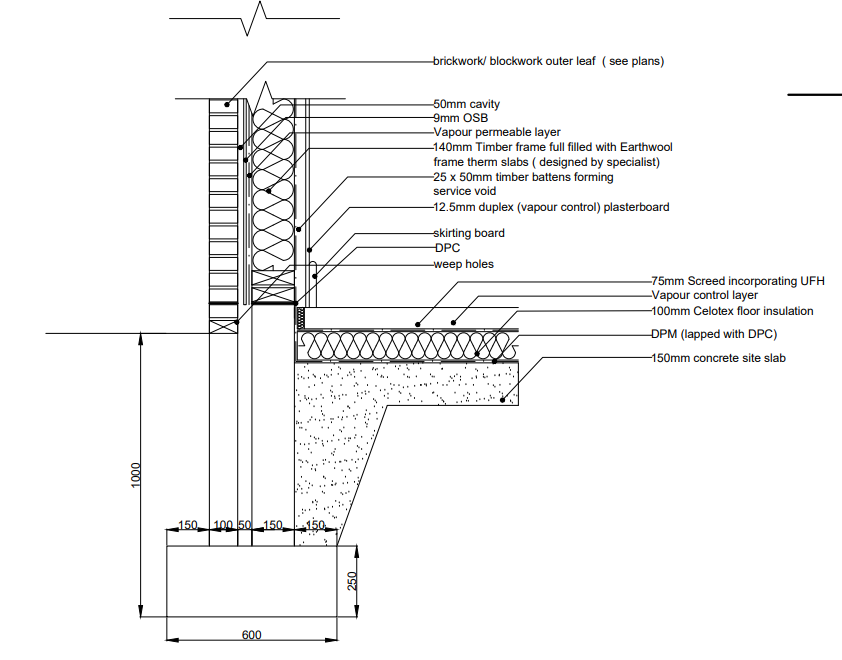
Yes, the brick/block walls originally designed had a 100mm cavity filled with Dritherm32 batts so wall thickness > 300mm. I am prepared to go for 102.5mm brick skin, 50mm cavity, 9mm OSB, 140mm stud + further insulation & service cavity/plasterboard which would be >300mm but <400mm. What concerns me most is the insulation under the floor being only 100mm and the cold bridge at the wall/floor join. Would appreciate advice on how to do better.
-
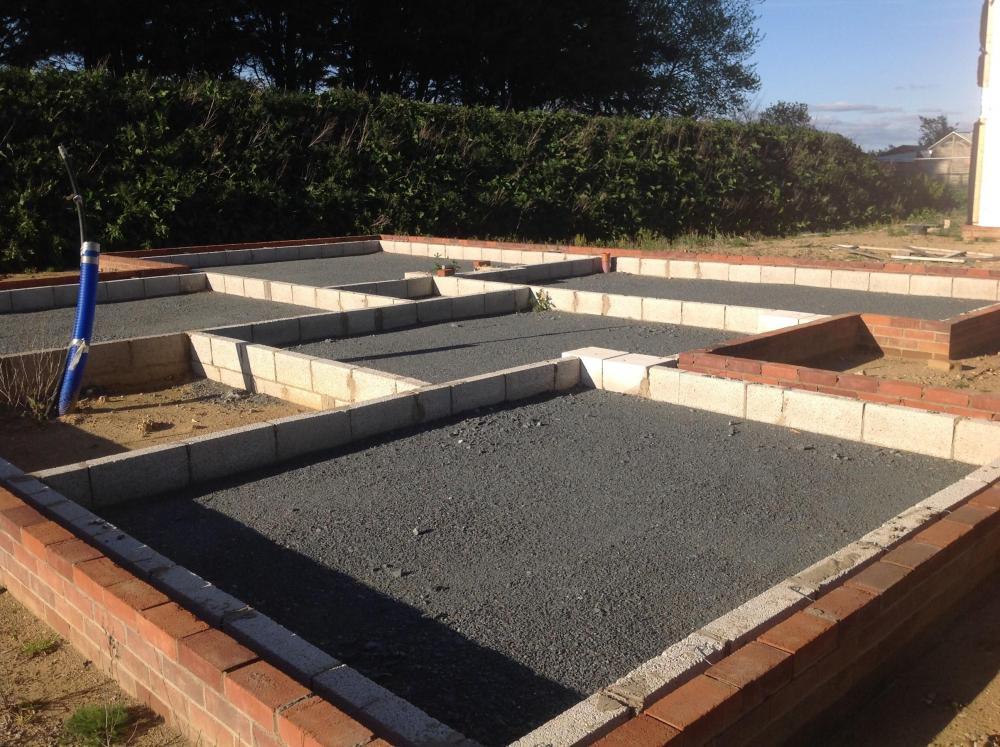
The site I've acquired has construction already started. The picture below shows the footings and blockwork/brickwork to DPM level (150mm above finished ground level). I wish to change the construction to timber frame and have been looking at how to get the best fabric first approach I can within the constraints already imposed. The section below shows what my neighbour who is building in timber frame has specified. I'm concerned that this isn't good enough with insufficient insulation in floor and walls and cold bridging potential. Would appreciate your suggestions on how to get close to Passivehaus standard from here without ripping up the entire building footprint.
-
Yes, many thanks for sharing your criteria and thought process.
-
Thanks. Please could you share the companies you considered and who you ultimately chose and why. What frame and insulation package did you go for and why? Did you choose supply only or supply/install? Did any company offer an air tightness guarantee?
-
I am awaiting approval of my planning amendment so have not selected/purchase/installed the sewage treatment plant yet. Based on my previous experience as a civil engineer working in wastewater treatment for a time and my research since starting on my self-build journey, I would suggest selecting an activated sludge type plant with three chambers (i.e. primary settlement/aeration/clarification) with the blower housed outside the plant. I would avoid plants with mechanicals in the wastewater. I thought you were going for the cheapest septic tank available. Having second thoughts?
-
I am pretty familiar with septic tank/wastewater treatment and drainage fields but I hadn't heard of Ezy Drain. On the face of it, it seems like a great product saving installation time and materials (i.e. no shingle/gravel or separate geotextile membrane). The product itself is not stocked by the usual online discounters and the cheapest I could find online was £49 for 3m length. I spoke to some installers and they didn't use it, presumably because it's not the most cost effective method. Housebuilder's Bible has budget range for drainage field of £2-3.5k FWIW. Septic tank to drainage field may well be the lowest cost solution for both installation and maintenance. Not sure about fitting a filter though as surely that would clog and cause problems? My inherited planning permission requires a sewage treatment plant. This gives the small benefit that the drainage field can be smaller (0.2 factor in the area calculation rather than 0.25) but more importantly the better effluent quality should extend the life of the drainage field. It also mitigates the risk of the rules tightening further, potentially making discharge of septic tank to ground illegal.
-
Thanks for the welcomes, it seems that Norfolk/Suffolk is a hot bed for self-builders on this forum! I think I know where your split plot is ? Seriously I looked through your posts and see you are in the planning stages of an exciting new build. You received some good advice on the foul drainage (defo ? connect to mains sewer imo). Look forward to following your project as it develops. My brother's most recent self-build was a barn conversion is west Norfolk. Much harder than greenfield new build (e.g. underpinning, building in stone etc) but he's made a lovely job of it. I wish you luck.
-
Thanks Andrew, looks good. My ridge height is only 6.3m compared to your 7m approx. Unfortunately if I reduce the roof pitch to 40deg then I'll lose a lot of usable space ☹️
-
This is my planning condition - "The rainwater harvesting system as set out in dwg no. 02 G shall be implemented in full prior to the first occupation of the dwelling. The system shall then be maintained and managed by the occupants of the dwelling hereby approved as set out in the agents e-mail of the 9th November 2018. Reason for the condition: To minimise the possibilities of flooding in accordance with Policy 1 of the Joint Core Strategy." There is also the water use calculation aspect. I have a target of 105l/person/day and when I do the calculation I get 111l/person/day. Rainwater harvesting is calculated to give a reduction of 35l/person/day (i.e. 13l for WC, 17l for washing machine, 5l for outside use) taking the use down to 76l/person/day. Tempting but do not think I'll go down that route. Maybe will install a "Heath Robinson" solution with potential to switch to outside use only if there are problems in operation.
-
We're in discussions with the electricity company at the moment. Overhead LV line goes straight through the plots but the original quote for connection was £13k + our own work to supply and install 125mm ducting for undergrounding the cable. I hadn't considered a full off-grid approach, isn't there a lot more to it than comparing grid connection with solar pv (e.g. battery, back-up power)? Yes, as I've started to look at this I'm amazed how cheap the solar pv panels have become! I have seen some analysis that suggests solar pv inset into the roof is now a competitive roof covering but have yet to prove it with quotes.
-
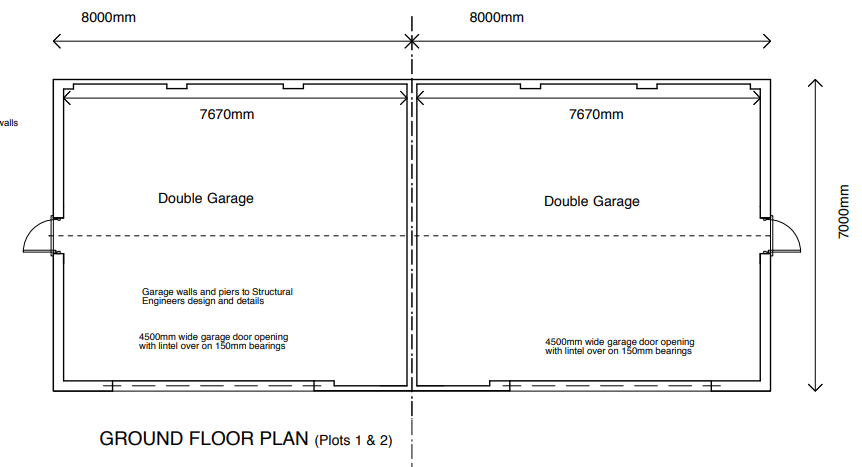
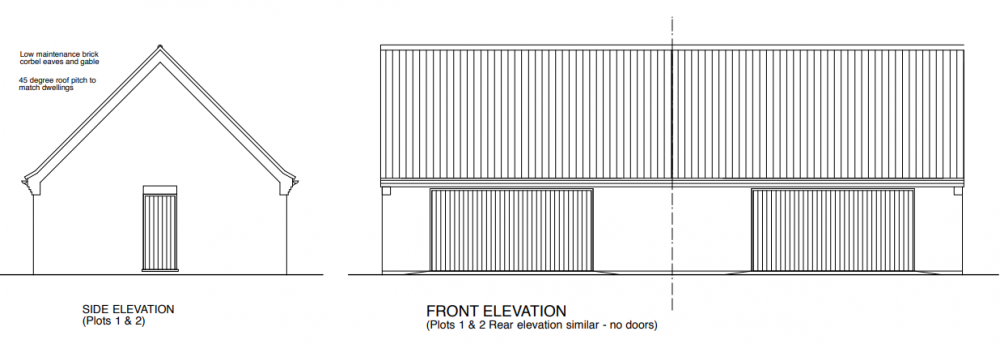
Andrew - Does your garage/studio have a flat roof or is it effectively two-storey? The reason I ask is that I submitted the plans below to allow for flexibility for a storage/games room space and I've just received a negative reaction from planning based on the "overall scale".
-
Thanks. The tanks I've seen from the likes of Rainwater Harvesting have a backflow filter and a submersible pump but none of these disinfection provisions. At >£2k + installation for the 3000l tank, I'm tempted to look at buried IBCs or concrete manholes which are suggested in the other thread.
-
Many thanks for the responses and for challenging my perspective re: looking for a payback v doing the right thing and enjoying the broader benefits that these technologies provide. My parents who were early self-build adopters in the 1960s were also quick to fit solar pv and get a very nice boost to their retirement income from the legacy FIT. The solar pv/ASHP combination is therefore an easy sell for them. The only one that rankles is the rainwater harvesting which offers next to no storm water attenuation; has appalling economics; and the ongoing use of the system to flush toilets and feed the washing machine was strongly questioned in another thread I followed.
-
My planning permission contains commitments for installation of solar PV, air-source heat pump and rainwater harvesting. I'm not wanting to go through another round of planning variations so I will install them. However, I suspect if I'd done a full cost benefit analysis then it would be difficult to justify the rainwater harvesting in particular. The solar PV hardware appears to be getting much cheaper (haven't looked at install yet) but the Smart Export Guarantee tariffs don't look particularly attractive (5.6p/kWh). ASHP makes sense I feel as there is no gas supply available to site although some of the installed prices appear astronomically high (e.g. £11-12k). Does anyone have any evidence that these eco features more than pay for themselves in purchase premium on a house sale making them "no brainer" territory?
-
Thanks for the welcome, good to know there are local self-builders on BuildHub. I looked at your blog posts - the screw piles are a neat solution to your tree constraints. I would be interested in getting more details on the timber frame supplier selection process you used and how it is working out with your selected provider.