


BadgerBadger
-
Posts
182 -
Joined
-
Last visited
Everything posted by BadgerBadger
-
Arched brick lintels: is builder being reasonable ?
BadgerBadger replied to bmj1's topic in Brick & Block
I don't think I'd accept this. The builder has done a good job trying with straight bricks, but it clearly looks wrong. You can get tapered brick specials, and with these as a starting point I'm sure you could get much closer to your architects drawing and at least have consistent mortar joints. How closely are you supervising on-site? If it wasn't specified/discussed closely enough you may have to pay for it to re-done, and lead-time on specials may be difficult. -
Tips for Rigid Full Fill Insulation (yes, I know!)
BadgerBadger replied to BadgerBadger's topic in Brick & Block
I now done a couple of small fiddly areas. It takes time but seems to be going reasonably well, so I'm optimistic we can get a good result! I seem to be getting good results cutting with a fine tooth saw. I've tried one of the glorified bread-knife tools, but as it cuts the insulation it tends to wedge into the cut, becomes very difficult and pushes off course. As the saw removes material it's cut through quite easily, but does make a bit of mess! Some small gaps are pretty inevitable but a can of low-expansion foam seems to be working well and filling them nicely, cut flush and then taped over. -
I'm buying materials largely with merchants and am often paying in advance against proforma invoices. (understandably as a one-off purchaser) Am I able to use these proforma invoices for my VAT reclaim, or should I be chasing up merchants after delivery to issue a final invoice/receipt, even though I've already paid?
-
Right then... I've ignored all advice, and we've specified a full fill rigid insulation (well 15mm residual cavity) using Kingspan Kooltherm for our build. I'm aware this is going to be tricky to get right, but we didn't really have the option of going much wider with the cavity, certainly not wide enough to get the same nominal U values with other options. Of course the actual U value depends on how good the installation is - it's now crunch time and we're about to begin! We have some good brickies who seem to have a good eye for detail, and our plan is to work around them doing the really time consuming bits and spending the extra time to improve their best efforts. So any tips? Specifically: How best to cut the rigid boards, particularly around intricate details like our periscope vents? Inevitably there'll be some gaps between boards in some places, can these be filled with an expanding foam?
-
Soil pipe length, for later connection
BadgerBadger replied to BadgerBadger's topic in Waste & Sewerage
Sounds like plan, I'll get it sorted then - thank you!! -
Our groundworkers have laid soil pipe runs under our subfloor, leaving the pipe sticking up through the beam & block floor for later connection. I'm a bit concerned the stub isn't particularly long, as they likely underestimated the floor build-up thickness. There's a coupler on end, which at the current height would end up embedded in the floor screed. Is this likely to problematic? Thinking it might be worthwhile replacing with a longer length that can be cut down later, whilst it's still reasonable accessible through the floor?
-
One of the pieces in our build jigsaw puzzle is how to handle our roof truss installation. We've split our build into trades and have bricklayers taking us up to wall plate - I'm now working out the most effective way of getting the roof on. We're using pre-fab roof trusses, there's a fair few of them but they're relatively modest in size at max. 6.5m span, and max. 4m height. Max weight of each is ~100kg. Site is a little restricted and we only have a clear working area of about 8m x 10m in front of an L-shaped house. We can comfortably get rigid lorries in but then there's not really space to move a telehandler around to offload them. Across the entrance to the site we have some overhead cables - at a squeeze we have 5m height clearance under some phone cable and then there's some electricity cables above at 8-9m. The road in-front of our site is relatively narrow and if a vehicle is stopped at the entrance others can only just squeeze by, if at all. So not ideal for anything other than very short job. Options in my mind: - See if I can get trusses delivered on a low-bed hiab-equipped lorry to squeeze under overhead cables onto site. Offload trusses to ground, and then hire telehandler/operator to get them up to wall-plate. Or lift ~100kg trusses individually by some other means? - Hire telehandler/operator to offload delivery lorry from the road, and somehow manoeuvre trusses through access onto site under overhead restrictions. This feels like it could be very tight as the access width relatively narrow too so not sure it's realistic. - Contract lift crane setup on site. Lift truss packs from delivery lorry parked on road/neighbouring drive, over the overhead cables and straight onto wall-plate. Likely a 25m reach, so would be a pretty big crane. Or something else - what would you do? I'm quite drawn to the big contract lift option as it gets the complicated bit done in one hit, and it's then hopefully a relatively straightforward job for carpenter/ourselves to set out the trusses. Alternatively, if I had a simple way of lifting individual trusses then I just need to get them onto site in the most effective way.
-
We're a few months ahead of you and one thing I've really learnt is that when you break a build down into trades, it's ultimately you who's responsible for getting everything right. I've found it best to really own that responsibility - so now is the time to double-check your setting out, make sure you know your site levels and be ready to check the pour is bang on. I wouldn't fancy having to correct that...!
-
Tough stressful week, but it sounds like you're there and you have your trenches for much less than you'd budgeted? 👍
-
Struggling to get my head around what level the outer masonry should be brought up to under my door thresholds - any insights? We're aiming for low/flush thresholds on majority of our entrance doors and patio doors, likely Rationel, but not fully decided. Should the outer leaf masonry be brought to match finished floor level, or should it be left slightly lower down?
-
We had an objection that tried to challenge our interpretation of pre-application advice and was somewhat selective in the way it was represented the advice we'd been given. You'd hope the planning officer would go to the effort of reading everything in context, but with our architect we decided to take to control of the narrative and set out our rationale behind each of the objection points. We sent this directly to the planning officer. We'll never know if it made a difference....! We didn't comment on any of the other objections and just allowed the planning officer to make up their own mind if they were valid, but intervened on this one as it potentially misrepresented our application.
-
We have some reasonably sized retaining walls next to patio, the SE details have a land drain running at the base and a 450 wide "granular backfill" behind the wall. What are my options for this? I've costed the volume of ~20mm gravel and it was adding up pretty quickly, are there any alternatives?
-
We're planning to use clay air bricks for our subfloor periscope vents instead of plastic ones. I bought Manthorpe G960 periscopes as they advertised they could be used with clay bricks, sure enough the clay ones fit snugly at the front. However, we have a brick plinth detail so the vent needs to pass through a 215mm outer leaf. I bought some Manthorpe G935 extender sleeves, which would do the trick except the clay air bricks don't fit. Is it just a matter of trimming the sleeve to length and then butting up directly against the clay brick? Or any other trick?
-
Our beam & block floor is now in and has been grouted, but the way our site is laid out means space for materials is now quite limited. Is it common to store materials (i.e. pallets of blocks) on the beam and block floor or do I risk overloading it?
-
Laser Level/Builders Level...
BadgerBadger replied to Mulberry View's topic in General Self Build & DIY Discussion
Rotating lasers are great but more expensive. I decided to make do with a simple DeWalt cross hair laser with a receiver and staff. Primarily for "coarse" leveling of access etc. but it's been absolutely invaluable for checking levels as contractors are progressing. -
Any thoughts on whether off-site cutting of bricks should be zero-rated in the first instance or is it reclaimable? New build so eligible for zero-rating. Ordered our bricks directly and I've obviously paid the VAT on them that will be reclaimed later. We need lots cutting down and if our bricklayers did it on site it would clearly form part of their zero-rated work, but it's likely more cost-effective and less disruptive to do off-site. In which case is it still a "material" and so VAT should be charged? To be clear, this is for the service of cutting the bricks only, the VAT has already been paid on the bricks themselves.
-
Perfect - thanks nod! I was going to ask you about that too having seen your recent site photos. 👍
-
Just buying DPCs for our masonry build and have found there are lots of types! Basic polyethylene DPC is comfortably the cheapest, but then there are "high-performance" or "housing grade" variants that use up some more pounds. I had assumed everyone just used basic polyethylene but the wide availability of other types in merchants have made me wonder if I've missed something. We'll be using a wide DPC to form a cavity tray, so are the high-performance ones better suited and offer more flexibility etc.? No radon requirements or anything, but happy to switch if it's the better option.
-
So the land registry gives the owner's address as the block of flats, but he's not there? If it was me, then I'd get knocking and see if the tenants know any contact details or if there's an agent who would. It can sometimes be amazingly easy to track someone down on Google with just a name, or at least get a clue where to ask next.
-
Sometimes a long shot just pays off, it's how we found our plot... What's the worst that can happen? Your letter is ignored (try again in a few weeks to show you're serious?) or you get a polite no.
-
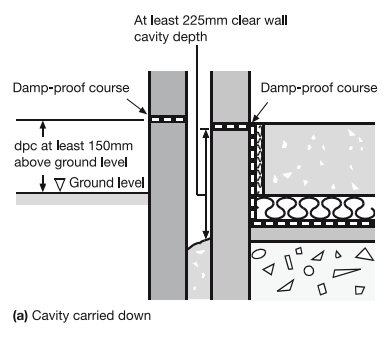
Our build is masonry with suspended beam & block floor, and has some varying ground levels. Some parts where FFL is higher than external ground, some level, and some that are semi-retaining with waterproofing. I'm trying to sort in my head what's going on with the DPC levels everywhere. External leaf is pretty straightforward with DPC stepped up-and-down as needed to ensure 150mm above external ground level. What about on the inner leaf? Do I just need to ensure the minimum clearance above the cavity fill (as in the building regulation diagram) regardless of whether that puts it above or below the external leaf DPC level?
-
Sewer connection quote. Reasonable?
BadgerBadger replied to Water's topic in General Self Build & DIY Discussion
Was this quote direct from the water company? When we did ours I found their pipe-laying rates were, probably deliberately, way over the odds. I think they have to offer the service but don't really want to do it, and would prefer you use a self-lay provider. I found ours by simply googling "sewer connection contractors" and getting a few quotes. Obviously the road and traffic management may push the price significantly. -
I'm just about to start getting quotes in for our scaffolding but keen to avoid appearing too naïve! I'm really not sure how to expect the quote to be broken down and what's going to push the price up. Also keen to avoid hefty charges for over-runs so would like to get this sorted from the start. We have a two-storey brick & block build, but the total perimeter is quite long and there's an adjoining single-storey section, so it's probably not the simplest job. Bricklayers are obviously expecting multiple lifts as the walls go up, and then the scaffolding remains an wall plate level whilst the roofing is done. Should I be expecting the scaffolder to quote for each visit they make to do the next lift or make modifications? Plus an ongoing hire charge for the length of time the scaffold is on-site? Or something else? Are regular H&S inspections visits whilst the scaffold is in use typically included, or should I be requesting this separately?
-
Yep, we've got nominal 15mm but my thinking is this disappears very quickly if we leave the headers protruding into it at all - and they'd clash with insulation retaining clips - so I'm thinking it might end up being more efficient all round if we can get the headers down to 100mm, hence the faff off the double-cut!
-
Good stuff, thank you all. Splitting just in half leaves 5-10mm sticking into the cavity. We're on rigid full-fill insulation with a very small residual cavity, so having the header bricks poking out is going to make a tricky job even trickier, and clash with insulation spacers etc. So the plan by cutting twice is we get much closer to 100mm so the headers are left flush with the rest of the brickwork. Bricky is priced in on meterage rate for laying the bond, but someone's still got to split the bricks. So we either pay for their labour, do it ourselves, or get it done off-site. Good advice and might be the decider. Pretty sure the mess and noise of water cutting is a non-starter on our site, we're working hard to keep neighbours onside as it is. Might try and find a splitter to have a go at a few bricks, if not that just leaves having them done off-site.

