andy
-
Posts
187 -
Joined
-
Last visited
Everything posted by andy
-
Perhaps the Samsung is more demanding in that respect? Seems odd though as I'm clearly heating the outside every time it does a defrost
-
Cool thanks, that's good to know it's working as expected in that respect. I will just keep an eye on the daily consumption in kWh at this point I think and see what it's chewing up... I've got 1-Wire sensors on the flow and return to/from the ASHP in the loft (long 28mm Hep2O runs, no joins - that was fun!) and at present it's 34.4C flow and 28.3C return. Eventually I'll have more 1-Wire sensors on each manifold and the outside unit and I will start collecting stats but for now I had to go for minimal viable house!
-
Hi all So I have my 8kW Samsung ASHP all up and running and heating the house and I'm trying to understand the bloody awful Samsung manual and general behavioural patterns of the ASHP. Whilst it does get the house nice and warm and as expected it's slow to respond due to the depth of the UFH pipes (on insulation under 125mm reinforced slab - don't ask..., was supposed to be on rebar but due to the winter from hell end of last year, it had to go on the insulation) I am confused about the behaviour of the pump and what to set on the controller... I've set Water Out Temp. for Heat to 40C max and 25C min and it seems that the flow temp seems to aim to be circa 5C more than the return temp, which is I assume a target delta which is also set in the Samsung? In addition, it seems to be doing a defrost cycle about every hour, which seems excessive compared to what I've read of other ASHP set to 40C on here. Is anyone familiar with the Samsung control unit and what the most sensible settings are? I am concerned that I'm using a lot more electricity that I maybe need to to get heat into the slab at present. Do you need to know any other settings that would infulence this? I am triggering the ASHP from Loxone and associated manifold pumps, which is all working fine (albeit somewhat basic at present but I'll get there!).
-
Location of MVHR System (Zehnder Q350)
andy replied to revelation's topic in Mechanical Ventilation with Heat Recovery (MVHR)
Another vote here for the Q350, I've got that unit mounted in our loft on a timber stud wall that's above bedroom/bathroom and there's zero noise downstairs from the unit, no transmission of vibration (there is no vibration!) and we just did a standard wall mounted install. The only noise you're likely to hear is the airflow from the vents itself so make sure you get the system designed with correct attenuators. All my rooms are about 25dB or less and you can just about hear the supply/extract flows; we have Lindab spiral steel ducting and fittings. Having never lived with MVHR before, we are absolutely amazed by it - especailly how effective it is at drying towels, washing, etc. Also it is really good at sensing humidity increases (e.g. boil a pan in the kitchen) and increases the extract rate automatically. We have yet to need to touch the unit to do anything other than pop to the loft and admire it occasionally Make sure you get the LAN connect module for it as you get the app for viewing status, etc. -
OK so I gave a 40mm waste in utility and no route to outside for overflow. My thoughts are to put the regen into a hotun down into a swept bend thus keeping air gap and seal. But I am struggling to work out how to connect overflow in too. Two hotuns?! Seems overkill... any other suggestions? I have v2 a sink with standard McAlpine spigots I could connect to, can I use that for refer and gave a hotun for overflow?
-
It was open a tiny amount.
-
Exactly.
-
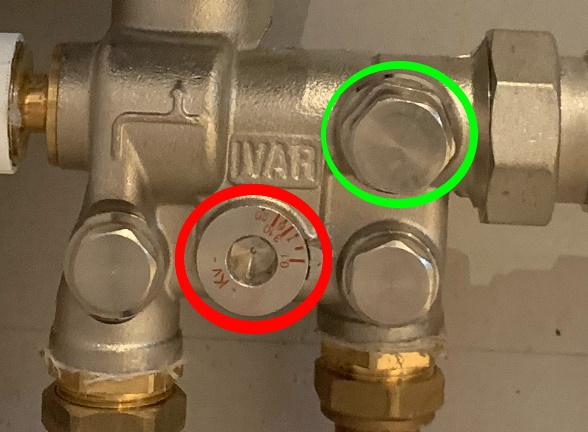
And in case anyone else is caught out by this, the isolation valve wasn't visible once the unit had been installed and wasn't checked it was open prior to mounting. It's as per the pic below, flows are now absolutely normal.
.jpeg.ab26ea7722918b3b2d9fc8b252fe99e1.thumb.jpeg.bbe90caa417d9ffc31454ce90532e472.jpeg)
-
Problem was an un-noticed 1/4 turn valve that we'd all overlooked on top left... once it was opened, all fine. Grrrrrr....
-
Plumber here tomorrow morning, so will have a look at what the hell's going on here...
-
Yes, flow to the top by the flow meters. I am going to get it replumbed directly avoiding the mixing set to see if the flow goes up, if it doesn't then I am really not sure what to do...
-
It’s fully unscrewed. I wonder if it’s something to do with the pump in the loft and at manifolds interfering with each other but tbh I don’t get it at this point...
-
Here you go, primary highlighted in yellow, secondary in green on zoomed in image:
.thumb.jpeg.d5d98026b3e2d497b84a4b983925d26b.jpeg)
-
I think at this point I should rip out the pump and mixing sets by the manifold, put one of these 25-70 pumps up in the loft instead of the 15-50 and see where that leaves me with regards to flow rates. Given my supply to manifolds is 30C I am not gaining anything by having the mixing set I would say. Thoughts?
-
At this point I have no actuators on and the screw caps are fully backed off, the actuators are Loxone ones that will be going on once I've got the system balanced (or if...).
-
Sorry didn't see the replies guys - thanks as ever. I have 4 pumps - 1 in the loft for the Samsung ASHP, 1 in the loft for loops to UFH manifolds and 1 on each manifold as follows: Grundfos UPS3 15-50 28mm to ASHP Set to constant pressure II Flow rate is 26l/min Light I (green) on the pump Low loss header in the loft to buffer that, with UFH 22mm flows coming off that Grundfos UPS3 15-50 22mm to manifolds Set to constant pressure II Lights I (green), II and III on pump when running Splits to each manifold in the loft, 22mm continue down to each manifold Grundfos UPM3 Auto L 25-70 on each manifold 22mm Set to constant pressure 3 Lights I (green), II and III on the pum Pump a bit noisy and I wonder if it's fighting with pump in loft...? The stuff in the loft was done separately to the UFH manifolds and the plumbing company just put in their standard stuff and I suspect that I don't want or need the pump in the loft for the manifolds and the pumps could be fighting each other. The company doing the loft plumbing knew there was a pump by each manifold and I think they should not have put that one in. Flow from ASHP is hitting each manifold at 30C. They also didn't recommend a TMV on the manifolds, said they've never fitted one and see it as pointless. Problem is even with all zones closed down I can only get circa 4l/min round a circuit, with all zones open I can barely get any flow to each zone - barely a movement at the top of the flow meter. The manifold has primary and secondary bypass - I've set the primary bypass to Kv0 as the local TMV is not yet fitted (long story, it is going on soon). Secondary bypass I took screw out by cannot seem to turn the 5mm key to turn and I don't want to force it. With regards to purging, yes all air should've been purged. The return temperature from each manifold is barely warm after the system has been running all morning.
-

Hi Download from Dropbox here. Andy
-
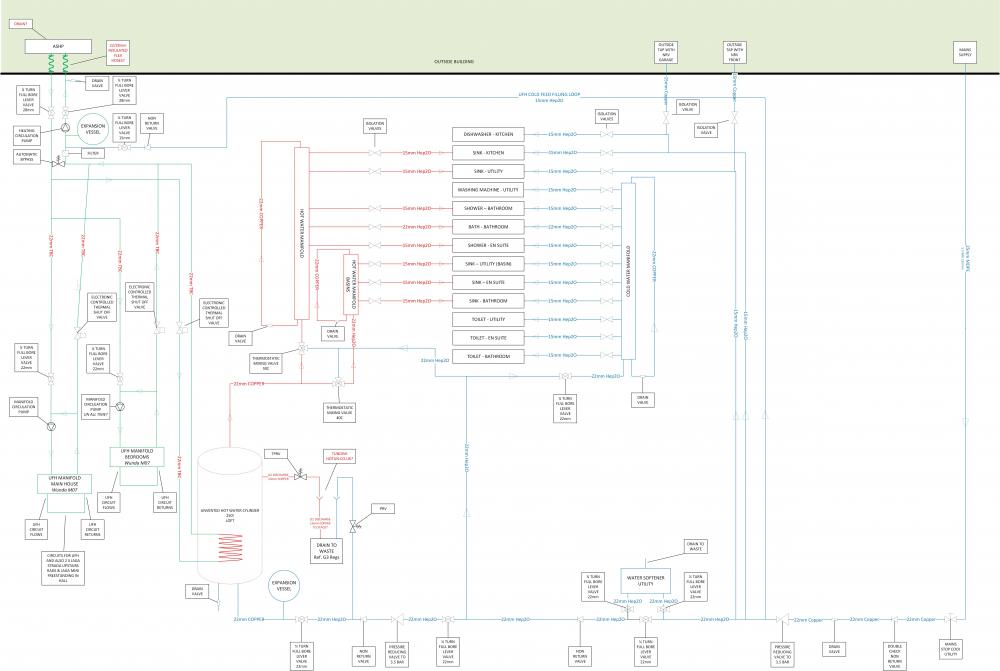
I did and whilst this doesn't represent the final version as I made some changes (left of the thermostatic mixing vales on hot manifolds and just did a single one), here's the JPG but I can't upload the Visio here. I also didn't go for an accumulator and have a low loss header in the loft.
-
Hi all Been a while but have had my head well and truly in the build and work, nearly at moving in point... We've finally turned on the ASHP and UFH today and am unable to get any sensible flow rate through the two Ivar mainfolds - some short loops (20m) can get up to 2l/min but that's all even with all other zones closed off. The manifolds are these: https://underfloorparts.co.uk/product/unimax-blending-10-port-underfloor-heating-manifold-with-grundfos-upm3-pump-uni-mix-temperature-contoller-mixer-valve/ I've looked at the instructions for the Ivar here: https://www.underfloorheating.co.uk/Files/127465/UFH-Mixing-kit.pdf But I'm still none the wiser and I am sure it's just something I need to sort on the primary and secondary bypass valves. I am confused why I cannot get more flow through the zones but I am sure it's just something obvious on the Ivar themselves; my loop lengths vary from 20 to 78m and I've got 2 manifolds - a 4 port and a 10 port with pressure at 2 bar. What am I doing wrong?
-
Thanks - we're at the end of a row of a few houses and they all have external vents. I suggested to our BCO that we don't require one due to this but they won't budge. Unless I can calculate this value, I'm stuck with putting in an external vent - Where these valves are used they should not adversely affect the amount of ventilation necessary for the below' ground system which is normally provided by open stacks of the sanitary pipework.
-
See what I mean...
-
I have been told we can go down to 75mm instead of 110mm (not sure if 75mm exists as a valid pipe size tbh!) and think under the eaves is OK, which at least stops me needing to go through the zinc which might be the easiest fall-back if I really can't do AAV... I hate the inconsistency of building control!
-
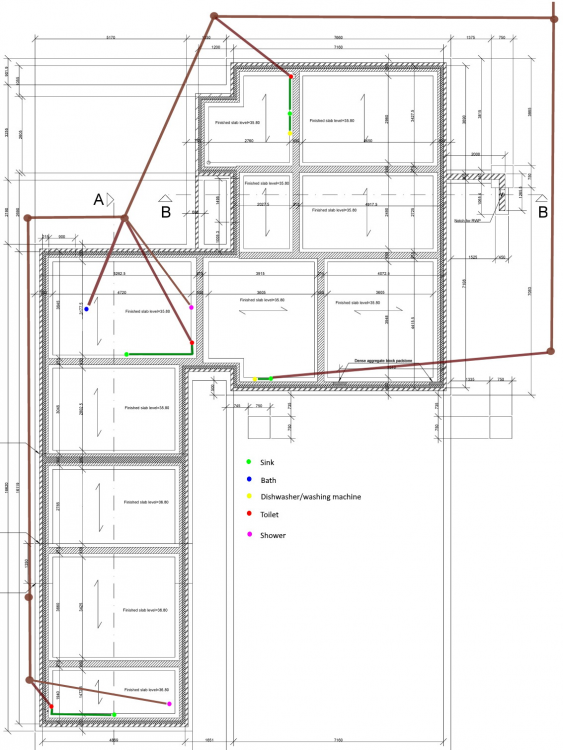
Hi I could do but the path down the side is quite narrow so would be a bit in the way. Options I have as I see it: Somehow get agreement I can have 1 or 2 AAV internally Put an external vent on the bottom left either going straight up through the roof or dogleg out through the gable wall at the bottom of the picture - we have a decent overhang of the verge there, so it can either terminate under the verge (no opening windows anywhere nearby) or even go through verge and zinc roof there if I had to. It would be great if I can quantify the vent requirement to prove 2 AAV will suffice I guess
-
I just need a way to calculate the "amount of ventilation" somehow - anyone have any ideas? I am happy to have a couple of AAV - one bottom left, one in attic just below the "B" in the image above but need to justify with some numbers.
-
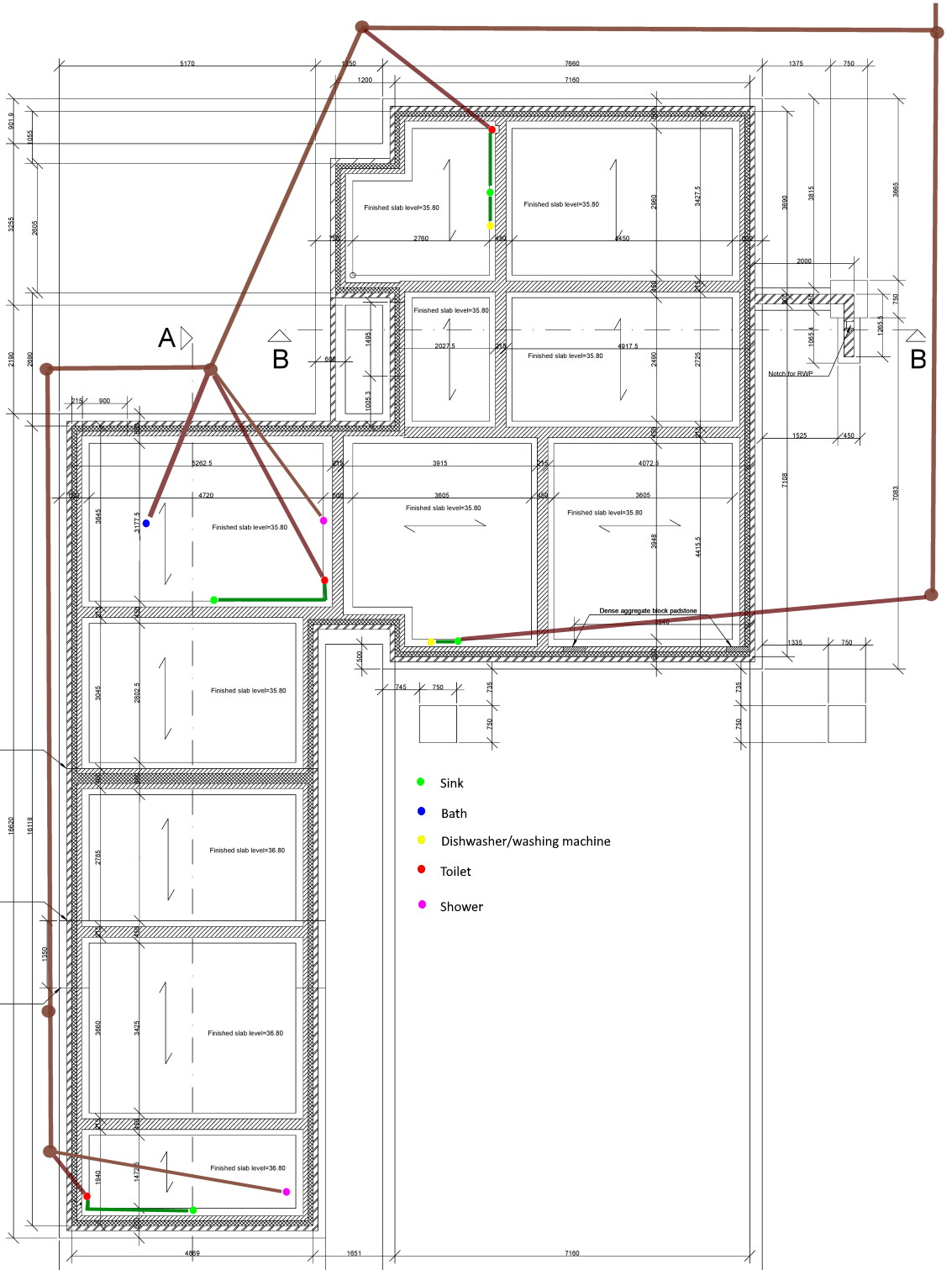
Finally we've escaped the rain and mud and have a semblence of a house... I am having a "discussion" with BCO about AAV. They are insisting that I have to have a penetration through the zinc roof for the furthest connection from the mains sewer and an AAV is not acceptable unless my structural engineer (eh?) can mitigate the yellow hightlighted: 1.33 Ventilated discharge stacks may be terminated inside a building when fitted with air admittance valves complying with BS EN 12380:2002. Where these valves are used they should not adversely affect the amount of ventilation necessary for the below' ground system which is normally provided by open stacks of the sanitary pipework. Air admittance valves should be located in areas which have adequate ventilation, should be accessible for maintenance and should be removable to give access for clearance of blockages. Air admittance valves should not be used outside buildings or in dust laden atmospheres. Where there is no open ventilation on a drainage system or through connected drains, alternative arrangements to relieve positive pressures should be considered. Any thoughts...? I'd rather have an AAV no no daft cold bridge/cowl on my zinc roof but not sure how to convince them... foul water is like this with the only air admitance we're talking abotu needing being bottom left corner - no redesigning the foul runs now please or I'll cry

.jpeg.ab26ea7722918b3b2d9fc8b252fe99e1.jpeg.266be3e332e6211596f35dbe79a6f25d.jpeg)
.jpeg.ab26ea7722918b3b2d9fc8b252fe99e1.jpeg)