


Levo
-
Posts
34 -
Joined
-
Last visited
Everything posted by Levo
-
Sub-distribution boxes?
Levo replied to tanneja's topic in Mechanical Ventilation with Heat Recovery (MVHR)
Isn't that the original "branch" approach used by larger installations? You can use a rectangular profile pipes which are much easier to fit into gaps, I think. 63mm pipes are really good for carrying around 30m3/h. Here's a rough calculation. Basically plan for upto 22m3/h for your nominal flows and can go upto 30m3/h at boost with 2.3Pa/m drop. Above that the pressure loss (and noise) increases dramatically. Note that the drop (DeltaP) figures are for 1m only. For a 10m pipe, you need to multiply by 10 and add acouple of Pa per bend on top.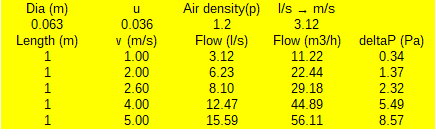
-
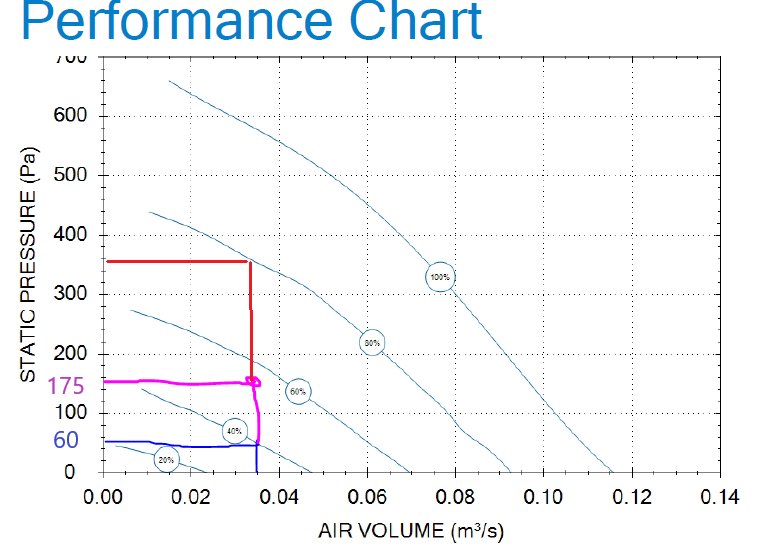
Please help! I am trying to figure out the impact of using F7 filters rather that the "standard" G3/4 and I wonder if anybody had any experience with them and share their experience and comment to my thinking and calculations below. Assumption-1: The manufacturers quote their flow rates using the "standard" G3 filters. Assumption-2: I have found a Filter manufacturer spec sheet and as best I can interpolate using the sizes they specced, a G3/4 filter will cause roughly 35-50Pa drop. Assume being fluff, the pressure drop does not go up dramatically over time. Assumption-3: From the same doc, an F7 filter will be in the 125Pa+ drop to begin with but will go up to as high as 450 Pa drop (@ rated flow) as it gets clogged up. Now, there appears to be almost 100Pa of difference (125 - 35) between a G3 and F7 filter to begin with and over time, it may go as high as 400 Pa. I have got the Ventaxia Advance SX performance chart below. I have plotted the flow/Pa for my installation, 130m3/h (0.036m3/s) and I assuming I could keep the system ducting pressure drops to 60 Pa total, I would be running the system at 40% fan rate with stock G3 filters. But if I decided to go to F7 filters (and the Ventaxia appears to have a piddly 365x135mm filter size), the initial drop will be ~150+ Pa which means the system will have to run nearly at 60% capacity (assume this to be the fan rate). And as the filter ages, even if I didn't wait to reach the +400Pa point and replaced at 350Pa, I am looking at 80% fan rate, and that is at nominal flow. Has anybody done or seen this sort of analysis before? Any comments on the noise etc. from those who tried using filters other than the stock G3/4? If I am correct in these calculations, I need to look for a different unit for sure.
-
As I said in my previous message, I am looking for an MVHR unit. Needs to be able to supply ~130m3/h nominally so looking for a unit rated at ~300m3/h to make sure it is quiet. I want to go British made, so had the Ventaxia Advance SX (1- F7 filter, 2- Constant Flow and 3- Enthalpy option) as the one I was focusing on. Thanks to this thread I have learned about Titon which, on paper, seems to be comparable to Ventaxia. Thanks MJewton?. Base on my three criteria above HRV 2Q seems to be a good fit (or HRV 3Q but probably a bit noisier). Has anyone got any comments/recommendation about these two? Support, noise, longevity etc. Anything that could help me will be welcome.
-
I am in the process of choosing my MVHR unit and one area I have been struggling with is whether I need an Enthalpy heat exchanger. (Though I have pretty much made up my mind that for where I live, an enthalpy exhnager will likely be more detrimental than useful as for temps above 10C it may end up increasing the RHI inside the house) If I got my calculations right, ~11C increase halves the RHI. Basically if it is 10C 100% RHI outside, when you pump it in at 21C, it will be at 50% RHI. And if it is 0C 90% outside, it will turn into ~25% inside. Doesn't matter whether you use the MVHR or open a window. As with open window, there will be a temporary temp drop inside but the Central heating (and the fabric of the house) will restore it to the regular temp soon after you close the window. The question I have is what happens on summer days. Basically if you need to keep inside, say 11C below the outside temp, e.g. 35C outside 24C inside, then even if you use the heat exchanger to reduce the temp, you are still blowing in air that is double the outside RHI. Even if it is as low as 50% outside, that still means 100% RHI (or more) in the supply air. This means condensation may form on the incoming air path. Connected question; if you use the heat exchanger in the summer, what happens to the condensation draining as I think it will collect on the wrong side?? Does it mean you are stuck with Summer bypass even on really hot days? My conclusions are that in southern England, Enthalpy exchanger may help both in the extreme winter (less than 5C with less than 80% humidity) or extreme summer (30C+ with 70% humidity outside. But we only get a few of those days?
-
MVHR with active cooling
Levo replied to worldwidewebs's topic in Mechanical Ventilation with Heat Recovery (MVHR)
>That was a heating example; i.e. whether the heat recouped from a Bathroom and/or kitchen would help any. I tend to blast the bathroom with an electric fan to warm up before shower. Never actually checked what temp, so assumed it would be 8C higher than the normal room temp in the house. > I am not familiar with Comfopost, just looked up the Specific Heat Capacity of Air and based my calculation on that but your example seem to use the same 15C delta as I used. I also checked one of the 2.5KW Fujitsu Split air cons and they quote 700m3/h fan rates. Even if they didn't need the full 700m3/h and only needed 4-500m3/h to achieve 2.5KW cooling, you will likely achieve only a fraction of the 1.9KW @140m3/h, I think. >I have a 1970s house and not one of them passive houses?. So, I personally satisfied myself that the MVHR at 100-150M3/h rates will not make any dent either on heating or cooling my house. Just a word of caution on air source heat pumps, I know they are improving every year but no matter what the manufacturers say, their pumping capacity degrades the closer you get to 0C and go below. I have some friends with Air sourced UFH in the south of England who live in a reasonably new (~5 year old) property and complain the house doesn't warm up on cold nights. -
MVHR with active cooling
Levo replied to worldwidewebs's topic in Mechanical Ventilation with Heat Recovery (MVHR)
? you are right, I did a very rough calc for that example, and the wrong one I guess. -
MVHR with active cooling
Levo replied to worldwidewebs's topic in Mechanical Ventilation with Heat Recovery (MVHR)
I am in the process of planning an MVHR for my house and was considering the heating cooling capabilities of it and did some quick research, here are my findings. The Specific Heat Capacity of Air (around room temp) is 0.00034 kWh/(m3*C). What this means is if you were extracting 50m3 an hour for the Full Hour from your bathroom at 28C and sending it back to the house which is kept at ~20C (8C difference), that whole energy would amount to 50*8*0.00034 = 0.13 KWh ?. If you were trying to cool a 140 sqm (~350M3) house and using a duct cooler at nominal (ACH=0.4) levels , say blowing air at 10C (Delta C =25-10 = 15), the cooling capacity would be 140m3*15C*0.00034 = 0.7KWh. Basically not much, just about enough to neutralize 2 people giving out 350Wh each.? On the other hand if you had a 140 sqm (~350M3) breezy house with 3-5-10 ACH, on a winters day with 20C differential (0C outside 20C inside) you would be loosing Which is quite considerable. I hope I got my calculations right... Hope this helps.
-
MVHR - list of questions/thoughts
Levo replied to mjward's topic in Mechanical Ventilation with Heat Recovery (MVHR)
Wow, that is cheap! Which supplier do you use? -
Hi All, I am in the planning stages of an MVHR installation for my detached house. Reasons for install: 1- M5/F7 filtration of pollens 2- Better air quality 3- Hopefully some energy savings along the way. Cheers, Levo

