Adsibob
-
Posts
3609 -
Joined
-
Last visited
-
Days Won
10
Everything posted by Adsibob
-

Do you need eARC to enjoy Dolby atmos?
Adsibob replied to Adsibob's topic in Networks, AV, Security & Automation
@MJNewton I wonder how you feel about the new Sonos Era 300 speakers as a pair of rears for surround sound. Reviews say that in combination with a Sonos Beam Gen 2 or a Sonos Arc, they work wonderfully to envelope you with sound from all angles. -
Difficult planning application for loft conversion
Adsibob replied to Ernie's topic in Planning Permission
I agree. You gain nothing by withdrawing. Just wait. -
Right, the good news is that we went with the larger size gravel and laid it and it's fine to walk on. Ultimately we realised we'd be more bothered by small bits of gravel getting stuck to boots or flying over the edging strip onto the lawn then the minor discomfort of walking on thicker gauge stones. But it's fine. The less good news is that the 200g sample, though perfectly representative of the gravel which was eventually purchased and delivered, was not really enough of a quantity to get an idea of what it would look like installed. Now that we've laid 850kg of it, it looks much brighter in colour than the 200g scattered across a paving stone which was how we checked the colours would go well together. We're idiots. Anyone should have realised that a few pixels look different to a densely pixelled image. Fortunately, we were short on gravel, and still need to buy another 400kg to 500kg or so to finish the path. This therefore creates a possible opportunity to fix the colour issue. The 2/3 of the path that has been laid is too light. We could spread that out across the whole path area, and then buy the remaining gravel of a slightly darker grey and top up the thinly spread gravel with that grey. Is that likely to darken the appearance of the path or is this not going to work. The mix is a mix of grey, white, pink and beige, but there is too much white in it really. I had thought about removing the white stones by hand and topping up with more of the same mix (of which I would remove the white stones as well) but I think that is super made way of wasting time. There must be thousands of white stones. I sometimes think I'm going mad. Then i have to remind myself I already went mad... long ago. Does that mean I'm getting madder and madder?
-
I don't know which brand drainage fittings have been used, i just know they are plastic and that therefore there is a risk it's cheap plastic. All supply pipes were done by my plumber out of buteline. That is strong. But all drainage was done by my builder and who knows what he used. But my OP was to question whether a mixture of vinegar and baking soda would be milder than the type of chemicals sold online, and whether using such a homemade recipe would be safe, even for "cheap plastic". @Temp or @SteamyTea normally have the geek power to work these things out scientifically.
-
The plunger technique is going to be very difficult because the trap is recessed within a channel that is covered by the tiled piece. I will give it a go. Need to buy a plunger first.
-
i've tried removing the trap, but whilst it spins around it doesn't budge easily and I don't want to force it.
-
We moved into our newly plumbed house in May. Some 4 -6 months in, I noticed that the shower wasn’t draining very quickly. It wasn’t flooding the wet room, it just didn’t seem to clear efficiently, which was odd, because the shower is on an external wall and on the other side of that wall, 3.5m down is our new sewer pipe taking water away to the sewer. It has progressively got worse and today a 12 min shower partly flooded the bathroom. Since I noticed the problem last year, I have been lifting up the tiled slot drain cover to inspect for anything that may be blocking it, and never found much, other than the occasional bit of SWMBO’s hair. However, today I noticed a black film of gunk all along the underside of the cover. Scraped it off into the bin. I suspect the same gunk has lined the pipes and narrowed them? Is that possible? The shower still drains fully, it’s just got progressively slower and has surprised me given we could have taken more than 500 showers there between us, and the plumbing was brand new! My pipes are plastic, so I’m nervous about using strong chemicals to clean it. But is this method, courtesy of Google, safe to do with plastic pipes? First, pour roughly a cup of baking soda down the drain (no exact measurement needed). After a few minutes, pour an equal amount of vinegar down. Leave the mixture sitting for at least an hour. Follow up with another round of boiling water, and see if the shower is draining faster.
-
Has anyone tiled a wet room floor with R10 tiles and regretted it
Adsibob replied to Adsibob's topic in Wall Tiles & Tiling
We actually en I can't now find the technical data sheet, but we laid R10 tiles on our outdoor patio and they are absolutely fine. I wouldn't want to walk on it on ice, but in rain it is fine. For the shower wet room, we used the same tile as outside, but in a slightly different size. It would have been R9 or R10, probably R10 but can't be sure. Conclusion: R10 (at least in Marrazzi tiles) is absolutely fine for wet rooms. -
Thanks @Temp, this just makes me think it should have been commissioned in room temperature-dependent mode.
-
no. don’t these two statements contradict each other?
-
Yes, it’s a system boiler. There are thermostats for each zone, on timers. The boiler should only come on when a thermostat calls for heat. But this wasn’t the case on Saturday 30h or so after the last call for heat.
-
@larry has the same boiler, so curious in what mode his was commissioned.
-
Indeed. Just curious as to other’s thoughts on the utility of a continuous operation mode. Maybe @Nickfromwales will chime in with some views.
-
You don’t want softened water for your garden. It will affect some plants, because of the extra salt. It’s debatable whether softened water is okay for human consumption. Some plumbers insist it isn’t, and I’m surprised your plumber didn’t separate a fresh un softened supply for drinking. But some members here think that unless you are drinking gallons and gallons a day, the salt levels are too small. I wouldn’t want to drink softened water though.
-
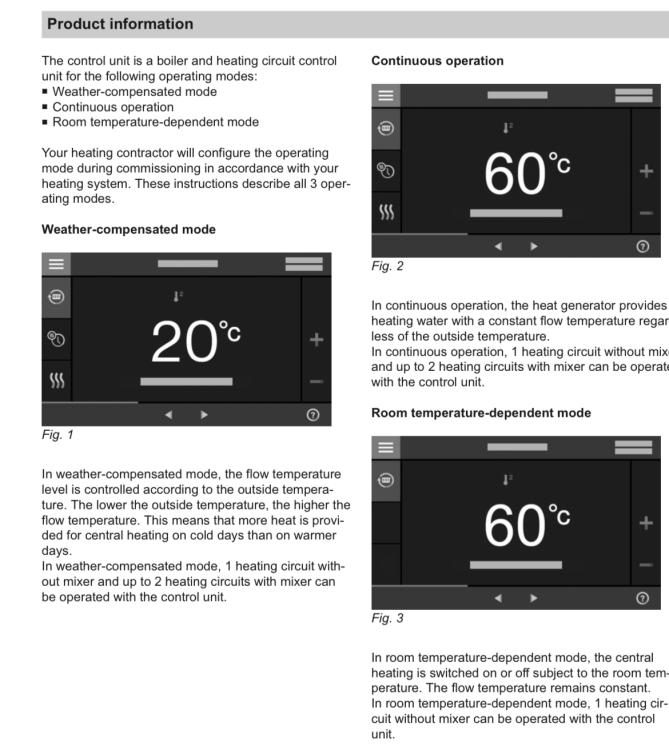
We are away on holiday and have a friend checking up on the house. He called me up to tell me the boiler fan was running and some adjacent pipes were hot. At the time this observation was made, the thermostats in the rooms and HW for the cylinder had all been off for 30h at least. Fishing through the various menus on the Viessman (a Vitodens 200W system boiler), and consulting the manual it appears that there are three modes which it can be setup on initial commissioning: - weather compensated mode - continuous operation - room temperature dependent mode Im just trying to work out if this was a mistake on commissioning or if there might be a reason for choosing continuous operation? We have our system boiler installed with a low loss header. All our heating is UFH (four manifolds) except in two bathrooms, where we also have a towel rad in each one. My friend couldn’t seem to change the mode to “room temperature dependent mode”, so he has just turned the whole boiler off at the mains. I will investigate when I’m back home, but it was commissioned 9 months ago and because we have the hot water tank heated by the boiler three times a day plus a recirculating secondary loop that comes on wherever you’re in the room where the boiler is, I had assumed the hot pipes were from that - never noticed the boiler make any fan noise when it was meant to be off, so I wonder if this is a mistake at the time it was commissioned, or an issue that’s developed since. I attach a screenshot from the manual; it doesn’t give much info:
-
MVHR is Largely Bogus
Adsibob replied to DavidHughes's topic in Mechanical Ventilation with Heat Recovery (MVHR)
I agree with your assumption. But does this account for the following: whilst it is obviously perfectly comfortable to shower in a 27C bathroom, it would not be comfortable to sit on the toilet in one that hot for very long. The reality of most houses with MVHR is that it is the hot water from the shower/bath that raises the temperature of the room whilst it is being used for showering/bathing and that heat is cleared by the boost on the MVHR being active for 20 or so minutes after showering/bathing or longer if boost is not used. -
Samples arriving soon. I will post pictures when they do.
-
Good to know! The two contenders are: The 3-8mm one which looks fairly angular in these pictures, but the intended "applications" on the website lists various things EXCEPT it doesn't list paths, which is somewhat of a red flag! The 14mm to 20mm one does say "Suitable for low traffic gravel driveways & footpaths", so maybe this is best. Here are the pics.
-
I read somewhere that 10mm stone was the recommended size for a footpath made of gravel. However, SWMBO has fallen in love with one gravel which is described as 3-8mm and another which is described as 14mm to 20mm. FFS! Are either of these sizes viable alternatives? I imagine the 3-8mm should be quite comfortable to walk on, but likely to get stuck in the bottom of people's trainers, whereas the 14mm to 20mm will be slightly uncomfortable if you walk on a 20mm pebble that is otherwise surrounded by 14mm stone. Shall i just stick to 10mm?
-
MVHR is Largely Bogus
Adsibob replied to DavidHughes's topic in Mechanical Ventilation with Heat Recovery (MVHR)
I don't think what I said is contradicted by what you've quoted. I said that MVHR won't equalise the temperature across a building. It will increase the temperature of the colder rooms marginally and decrease the temperature of the warmer warms marginally. I estimated the margin to be about 0.5C. The material you've quoted says: "The Passivhaus standard suggests assuming an internal temperature of 21 °C and to a certain degree the use of MVHR evens out the temperatures of different rooms providing uniform temperatures throughout the building." (my bold emphasis) Ultimately, it's horses for courses. My house is not close to being passiv standard. We have insulated a 1930s semi as well as we could, upgraded the glazing to 2G and installed 3G rooflights. We have a very efficient MVHR system and there is a 3 degree variance between the coldest room in the house and the warmest (at the moment). I imagine a better insulated house with 3G windows might have less variance. -
MVHR is Largely Bogus
Adsibob replied to DavidHughes's topic in Mechanical Ventilation with Heat Recovery (MVHR)
I'm not sure about this logic. MVHR will not equalise temperatures within a house, because flow rates are too low. It might make warmer parts of the house, a little cooler, I estimate 0.5C or so cooler, and colder parts of the house a little warmer, I estimate 0.5C warmer, but it's unlikely to move the needle much beyond that unless you ran the ventilation rates on max all day, and nobody would do that because it would be noisy. Ultimately the purpose of MVHR is to constantly ventilate a house with fresh filtered air, without losing the heat that is already in the house to the outside. So air of varying temperatures is extracted (say 22C plus from bathrooms and kitchens) and that heat is transferred onto the incoming air which gets distributed to the rest of the house, but not in sufficient volumes to really increase the temp by much more than 0.5C or so. -
So just to update: the windows company came back and tightened “the mushrooms” which are apparently what holds the window latches when the handle is closed. This has fixed the issue with the draught by the sofa. It turned out that was the only window affected. The other one was actually ventilation coming from the MVHR!
-
MVHR is Largely Bogus
Adsibob replied to DavidHughes's topic in Mechanical Ventilation with Heat Recovery (MVHR)
I’m really surprised by the title to this thread. I think MVHR is amazing. Probably one of the best “green” aspects of my renovation. I went out for dinner with some friends the other day who were complaining about how much it costs to heat their house, and how they have lots of draughts but still have condensation problems. I couldn’t help feeling smug that my bills haven’t been too bad this winter and the house never feels cold, smelly, damp or draughty (especially now we got the window fixed). -
Anyone know where I can find jumbo sized MDF shelves
Adsibob replied to Adsibob's topic in General Joinery
It’s not too late. Would you mind posting a link @oldkettle? I’ve youtube searched “Robin Clevett shelves” but not found anything that looks right. I’m familiar with him; would be good to see the video. Unless this is the company: https://www.cutwrights.com/new/ ? -
But if you look at that table, in the row above the row that talks about “solar protection” there is a “solar gain” row. And that says that there is less solar gain on the 60 model (which is 2G) than on the 66 model (which is 3G).