Archer
-
Posts
158 -
Joined
-
Last visited
Everything posted by Archer
-

Heatpump output vs efficiency dilemma
Archer replied to Archer's topic in Air Source Heat Pumps (ASHP)
How would you check this in advance, I thought it was all about inverter power? Is it stated on the technical spec somewhere normally? For the ducted A2A units that we are looking at (Mitsubishi FDUM series) this doesn't appear to be the case. The min/max output is listed together as 1.1kw / 7kw with no temperature range. Interesting that there's so much variation between the type of unit though. -
Heatpump output vs efficiency dilemma
Archer replied to Archer's topic in Air Source Heat Pumps (ASHP)
I love the fan strapped to the ceiling, that's absolutely brilliant!! Thanks @DanDee for the detailed post as well, that's really helpful. I think from what you've said, and other comments above, oversizing shouldn't be a huge issue hopefully on our system (because of the high modulation range) but could be on others. Seems like there is a key distinction between A2A systems (which generally have a higher ratio) and A2W; even more so with non-inverter systems. In both cases it may be preferable to undersize if anything and rely on a backup heat source for extreme conditions. For some A2A systems that modulate right down it's worth considering that larger output units may be more efficient than smaller, "correctly sized" ones in some circumstances. The Mitsubishi range for example have a number of units in the same series with the same minimum output but increasing max output's. The larger units have significantly higher COP values. I guess this is very situation specific though. In our system design we will have two wall thermostats, one for each floor and they'll be located away from ducts to hopefully avoid the distortion effect that you referenced. Because we're re-using the 1970's gas warm air ducts on the ground floor it's a single return duct in the hallway. Upstairs they'll be a supply and return duct for each room. The other thing I was wrestling with was optimizing the ceiling ducts for both heating and cooling which seem to be at odd's with each other. As I understand it, heated air needs to be forced directly down to reduce stratification and a warm layer at ceiling height (ie. what your ceiling fan does)... In cooling mode you want the opposite - a horizontal spread so the cool air naturally sinks and mixes. Found these Halton diffusers with a wax actuator that automatically changes the air throw and direction based on flow temperature. Seems like a neat solution, will post back once we've installed to say if they've worked out.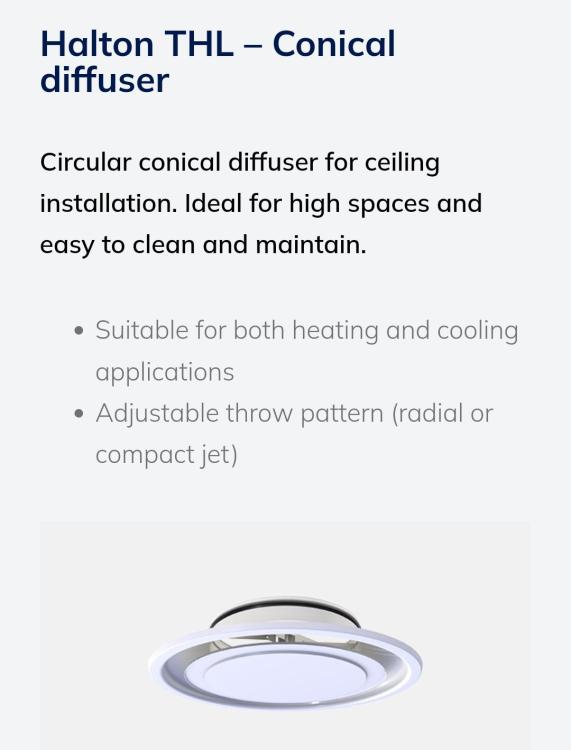
-
Heatpump output vs efficiency dilemma
Archer replied to Archer's topic in Air Source Heat Pumps (ASHP)
I think it depends on your proposed set up. You can get away with one large wall unit for a large room (I've seen this in classroom situations for example in non-resi set ups). Whether this gives completely even distribution across the room I'm not sure. In our case it's a ducted system with a set of floor vents (ground floor) and ceiling vents (1st floor). -
Heatpump output vs efficiency dilemma
Archer replied to Archer's topic in Air Source Heat Pumps (ASHP)
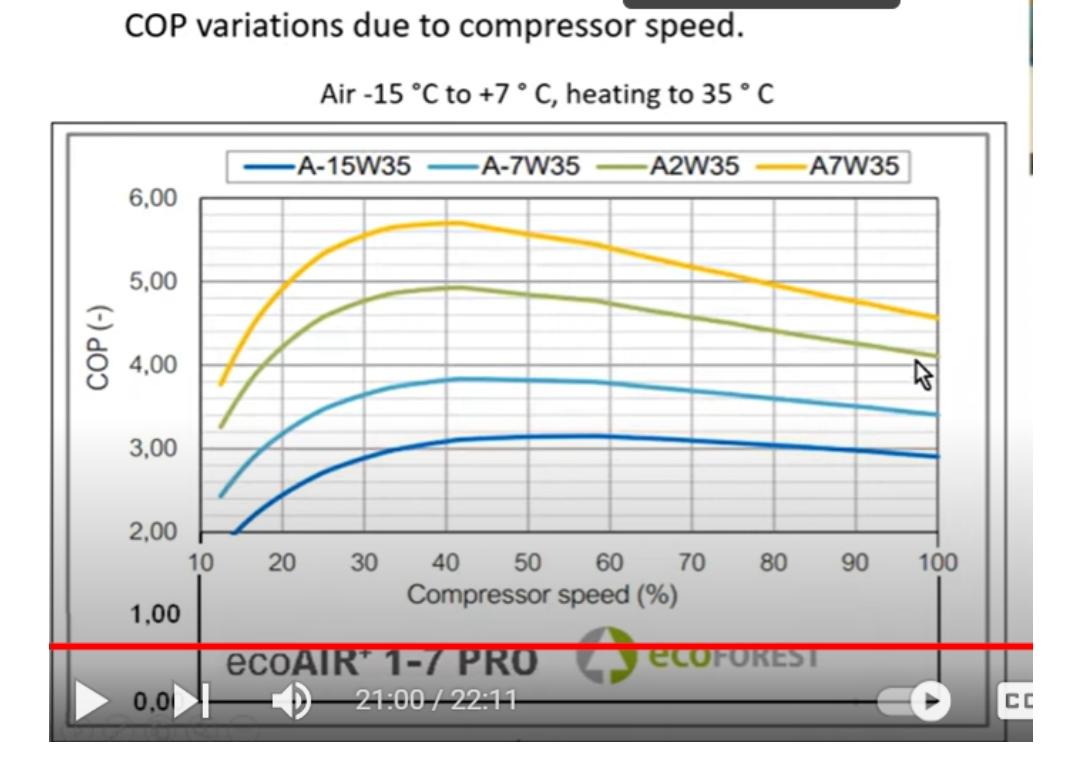
I've been doing some further reading online about this and I'm sharing here in case it's of use to anyone else in a similar position. Just to be absolutely clear I am in no way expert - what I've read and am posting below may not hold true and goes against conventional wisdom on sizing so happy to be challenged/ corrected by other more knowledgeable forum members... So to recap, the proposed system for our house is 2x outdoor and indoor A2A units with a total output of 17kw (1x10 serving ground floor, 1x7 kw serving first floor). The total estimated demand based on Heat loss is a little under 8kw @ -2.5 degrees OAT, our MCS design temp. So significantly oversized. My concern was mainly that oversizing would lead to excessive cycling and inefficiency, but both HP's have a low minimum output - 2.8kw in total; so the question in my mind was why is oversizing a problem if the pumps can modulate down? A few considerations from the info and chart below: 1. PDesign/ output @ -10 degrees; Heatpumps lose capacity, quite significantly towards the lower end of their temperature range. In my case the total output drops from 17kw to 12.1kw @-10 degrees (presumably an exceptionally rare temperature north of London) 2. Inverter HP's run less efficiently at the higher end of their range (80-100% output capacity); they also seem to run more efficiently at the lower- to mid point of range (30-60% capacity). These differences can be quite considerable (the research paper below suggests from 10% to 40% efficiency increase in tests). 3. Manufacturers set a cut-off for the lowest output a compressor will operate at based on it's efficiency, but this tends to drop significantly at the very bottom of the range (less than 15-20% of max output). This concept is shown in the image below from the John Cantor presentation. I've found other similar ones online showing similar findings. The efficiency peak seems to be around 40% of peak capacity. So what does this suggest (in my mind)? - Pumps should be sized at least 25% more than the design load to ensure that inverter efficiency is maintained and to provide a safety factor for extreme weather; - Use the minimum output as the key figure not just the maximum output; Heat Pump's with a high turndown ratio may be more suitable (for example, larger HP's can have better COP efficiencies than equivalent smaller pumps in the same range; lots of technical chat about this on Green building Forum - see links below. Size to avoid or minimize excessive cycling using the minimum output figure - ie. What heat loss is there at 12 degrees OAT? - The minimum output should be significantly less than 50% of MCS design heatloss (ie. 8kw heat loss, minimum output of less than 3 kw). This should avoid excessive cycling in most cases and ensure that peak inverter efficiency is achieved in most outdoor conditions. https://aceee.org/files/proceedings/2014/data/papers/1-371.pdf https://www.greenbuildingadvisor.com/question/how-does-efficiency-in-a-mini-split-vary-over-various-operating-levels https://www.greenbuildingadvisor.com/question/oversizing-a-multi-zone-inverter-heat-pump-does-it-matter Any thoughts...?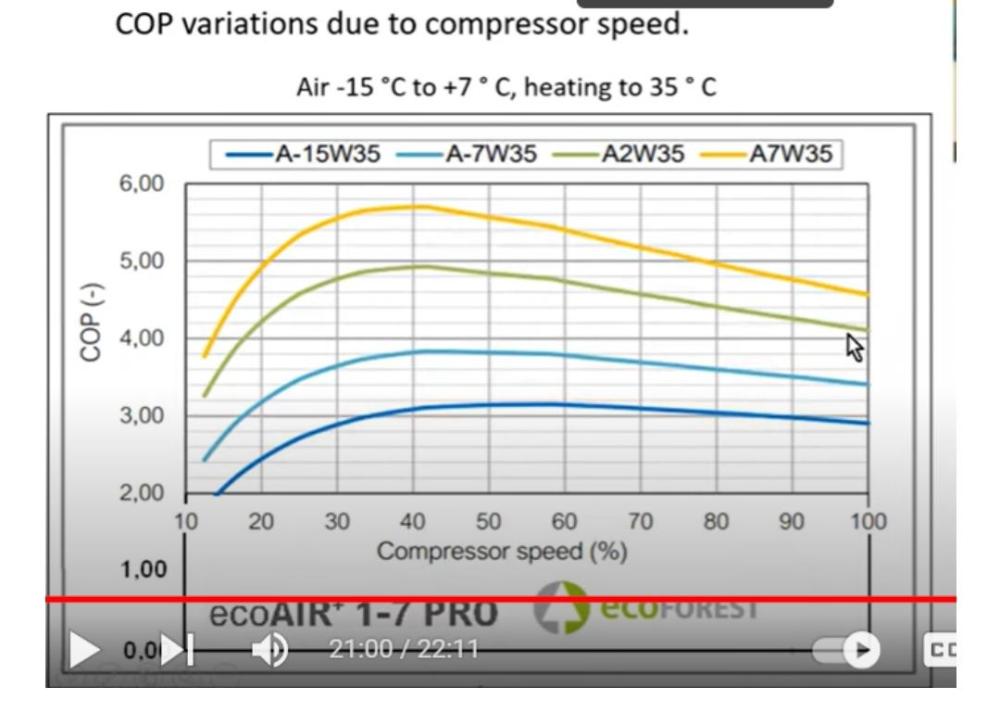
-
Heatpump output vs efficiency dilemma
Archer replied to Archer's topic in Air Source Heat Pumps (ASHP)
But following that analogy through for the heatpumps is harder because they are both achieving the same outputs - ie we know that one is 10% more efficient at 7 degrees outside temperature so why is there a 0% difference across the whole seasonal average? Or to put it another way, which one should I trust and piu my money in - the COP or the SCOP? -
Heatpump output vs efficiency dilemma
Archer replied to Archer's topic in Air Source Heat Pumps (ASHP)
Thanks Dan, appreciated. Any ideas why the SCOP for the two sized units is so similar consider the COP figures are quite different? In my mind it seems preferable to go for 2x 10's because the efficiency is so much better, but it's quite oversized and specifying 2x7 or 1x7 and 1x10 gives a more appropriate overall output for the house. Is SCOP for A2A calculated differently from A2W (because they allow for a cooling season / no DHW load)? -
Heatpump output vs efficiency dilemma
Archer replied to Archer's topic in Air Source Heat Pumps (ASHP)
10kw Option 7kw Option -
Hi All, We're in the process of specifying a ducted A2A system for our house, for heating only (hot water supplied via a separate system). System setup is a little unusual and restricted because we are using the existing ground floor ductwork from a gas warm air system, with the upstairs/1st floor supply coming courtesy of new insulated ducts in our loft (ie. with ceiling diffusers). Our engineer has specced a system from Mitsubishi Heavy Industries which he is happy will work in the existing GF ductwork, but has said that we need to split the system with 2x indoor units (one for each set of ducts/each floor). He also thinks - and I am not 100% sure about this, but it's the advice we've been given - that it's not possible to use a single outdoor compressor unit to supply both indoor ducted fan coil units. A google search sort of backs this up - the MHI ducted A2A units come packaged essentially with a specified indoor unit. Ok so anyway - I have now completed a heat loss survey - through Heat Engineer and also through the Heat Punk app - they've come back surprisingly low and suggest whole house heat loss around 7.8kw @ -2.5 degrees OAT (and recommended a 8 or 12 kw pump for the whole house). As I said in a different thread, our engineer originally specified a whopping 26kw in total (1x 14 and 1x12); I queried this and he has revised to 17kw (1x7 and 1x10). Looking for any advice on here that people can give; I'll put the data sheets below, but the MHI pumps appear to have really excellent modulation outputs; the 10 can operate down to 1.7kw and the 7 to 1.1kw. So unless there are any "gotchas" to be aware of they both should be fine to operate without excessive short-cycling even if they are significantly oversized? The other main difference between them is the efficiency, with the 7kw unit looking quite poor with COP @ 7degrees of just 3.76 (only 2.73 for cooling). The larger pump is more respectable - around 9-15% more efficient for heating/cooling using the same parameters (COP 4.08). Confusingly the SCOP for both models is almost identical (4.13) which doesn't make much sense... Sorry about the long read - my main question is should I be asking for the the larger output unit(s) to be installed for both floors, even though they are significantly oversized because of the efficiency increase? Or is it bad to have the pump operating towards the bottom of its output and 2x7's might give better overall performance? I trust the engineer and want to use them and there isn't a big cost difference between the difference size pumps, just thinking about what will be best in day to day use (ie. more affordable, more comfortable etc). Any advice massively appreciated. Cheers -
-
This video by John Cantor has some interesting analysis of Heat Pump cycling and how it isn't always a bad thing. I'm going to post a related dilemma in another thread so as not to hijack this one - would be grateful for any thoughts from people though
-
I've just used Heat punk and for the basic purposes I need (ie. a rough estimate of whole house heat loss) I thought it was pretty good and intuitive. Generates a free report at the end which is useful
-
Ceiling diffusers and fire safety
Archer replied to Archer's topic in Mechanical Ventilation with Heat Recovery (MVHR)
Is that because the risk is seen as low - ie. because the duct penetration is pretty small anyway for fire presumably? Should I worry about pumping smoke around the house or is that overthinking it... -
Ceiling diffusers and fire safety
Archer replied to Archer's topic in Mechanical Ventilation with Heat Recovery (MVHR)
Apparently with heated air you want the flow directed downwards to avoid keeping the heat at ceiling level, with chilled air you want an adjustable vane which directs air out horizontally so that it then slowly falls and mixes. There are a few diffuser products that have a wax actuator which automatically changes the vane direction based on whether the air flow is hot or cold. I'm struggling to find a product that has adjustable vanes (ie vertical/horizontal flow), also adjustable dampers (for overall air volume) plus the intumescent properties. Makes me think that mostly people don't worry about one or two of those properties. I think the dampers can be addressed on the main air handling indoor unit rather than the supply diffuser. Fire stopping seems pretty crucial but maybe leaving the duct is easier. -
Hi all, Does anyone know the regs around ceiling diffusers? I'm actually installing ducted air heating and cooling with the kit in the loft and ceiling vents coming through the plasterboard separating ceiling. What's the normal practice, do you install fire rated diffusers (like with spot lights) or intumescent compression sleaves on the ducts themselves... or nothing - is it just less of an issue with ducts and air outlets? Any advice appreciated. I'm finding it a bit of a minefield to find good looking diffusers that can be adjusted for airflow (ie. dampers) and also direction of flow which is needed for heating and cooling. Would be nice not to have to add fire into the mix!
-
Air-to-air ASHP replacing warm air heating
Archer replied to Gooman's topic in Air Source Heat Pumps (ASHP)
Have I got the basics of the heat loss spreadsheet right - ie. pick a given Delta T (outside & inside temperatures) and then compare the "Total required energy per day" to the output of the pump x 24(ie. 24 hours)? I've put in all the correct u-values, window sizes etc. -
Air-to-air ASHP replacing warm air heating
Archer replied to Gooman's topic in Air Source Heat Pumps (ASHP)
I didn't know that there was such a difference between the A2A and A2W units... so am I reading it correctly that the larger units (ie. the 14kw) can effectively modulate to a greater degree than the smaller ones (ie. because the minimum output is the same on them both) - That would be pretty neat giving a ratio of 6:1 in cooling mode for the 14kw? It sort of supports what my engineer has been saying - that there are less downsides to oversizing than undersizing the ducted A2A unit in this case. Appreciate that a full set of room heat loss calcs is the proper way to do it, but AC engineers don't seem to use them / seem to go off a rule of thumb approach Getting quotes from ANYONE has been so painful. I don't know if this is others experiences, but we've approached so many engineers and just found it really hard. The 2 quotes we now have actually both seem very good, both guys seem to really know their stuff (but not so much the MCS side - it's more commercial air con). I'm sort of torn because by having two different ducted zones - the upstairs and downstairs (now after talking to him again this will be a 12kw downstairs and 8kw upstairs) - there should be some ability to further control the overall energy use by just turning on one zone - so cooling the upstairs only or heating the downstairs only for example. I did have a stab at trying to complete @Jeremy Harris's Heat Loss Spreadsheet - I've inputted for just the ground floor - I've made an assumption at 5 ACH (no idea if this is right, but it's not going to be a very airtight building); using pessimistic assumptions - ie. running at -5 degrees with a 20 degree indoor temp... that gives a Total Energy Required per day of 259kw/h. I don't really understand what I'm doing, but have assumed that a 12kw pump x 24 hrs gives a total output of 288kw/h - therefore is sized about correctly for the floor, given that it can modulate down as well in milder weather? If anyone wants to jump in and check that spreadsheet or my basic logic above that would be appreciated. @DanDee - the other interesting thing from the HRP manual you posted above - which I hadn't fully grasped - is that the output for cooling and heating is rated differently. Do you know which of the output's is used to "label" the unit model? ie. would they call it a 12kw unit because it delivers max 12kw of cooling (but it would deliver max 14kw of heating)? Heat loss calculator - GroundFloor.xlsx
-
Has anyone on here managed to get a detailed quote for an install from British Gas yet? Do they install radiators and central heating system as well as the heat pump... Will they do anything "out of the ordinary" (such as fan convectors?)
-
Air-to-air ASHP replacing warm air heating
Archer replied to Gooman's topic in Air Source Heat Pumps (ASHP)
@severnside thanks a lot for your detailed reply above, that's mega helpful. I'm waiting on the technical details of the exact unit(s) proposed but I'm pretty sure it is the Mitsubishi Heavy Industries FDUM model so likely to be similar to your system. Hope you don't mind me asking a few more questions... This will be a huge financial outlay for us and I'm finding the whole decision quite stressful because of the scarcity of information available online. Do you mean that it can modulate by a ratio of 5:1 ie. a 14kw could modulate down to 2.8kw? Reading other posts about ASHP's it seems that the modulation ratios are normally quite narrow (ie. 2:1). A 5:1 ratio would be brilliant. This is brilliant advice, thanks I'll try this tack with the engineer and see what he says. One of the reasons that I'm worried about oversizing the system is because of the noise of the outside units it would be 2x double fan units which is pretty large and ugly but also may be loud with our neighbors around 5m away. I'm now thinking about specifying an acoustic enclosure to try and address any issues. Have you had any problems with noise at all? Also, did you upgrade the filters, and are you ok to adjust the registers / dampers in each room to tweak the airflow when the system is up and running? Sorry, I'll stop spamming all the questions after this, promise!!! -
Air-to-air ASHP replacing warm air heating
Archer replied to Gooman's topic in Air Source Heat Pumps (ASHP)
Just my luck that this will be launched right after we've finished our bespoke, custom job! -
Air-to-air ASHP replacing warm air heating
Archer replied to Gooman's topic in Air Source Heat Pumps (ASHP)
It's not exactly like for like as one quote assumes that a 15kw gas burner (the Multi-Calor Udara) will do the heavy lifting for winter heating, whilst the 12kw heat pump is used primarily for cooling but can also provide backup/ shoulder season heat. He was suggesting that because of the refrigerant gas it doesn't run that efficiently at the higher temperatures needed when the weather gets cold. If we have the gas option we are really limited on which HP can be used because it needs to be compatible with the Udara and also the Lennox cooling coil that goes on our warm air. Our property is a 1970's build, detached with around 130m2 GIA. Insulation varies from 75mm to 100mm mineral wool in the walls and 250mm in the roof. It's mostly timber frame - actually quite well constructed, but the air tightness won't be great. My instinct was that a 12-15kw unit would be correct but unclear whether there's something about retrofitting 2x ducted A2A units into the ducts that is giving some constraints. The engineer seemed to really struggle to find appropriate indoor units that would be large enough to push air around 10 or so outlets per floor. He hasn't said it explicitly but I wondered if that's because of a fan issue, not necessarily the overall capacity of the heat pump... But obviously we don't want a system that's hideous to run because it's greatly oversized. Just wondered if anyone on the forum has come across something similar? -
Air-to-air ASHP replacing warm air heating
Archer replied to Gooman's topic in Air Source Heat Pumps (ASHP)
@severnside with your system, are the controls quite intuitive can I ask? On the Multi-Calor there is some smart tech which modulates the fan speed right down as rooms near their target temperature to try and avoid some of the on/off hot/cold effect that you can get with blown air systems... Does your Mitsubishi ducted A2A do something similar or is it a bit less intuitive? Also, when weather is really cold in the winter do you tend to notice the house getting cold during defrost cycles? My other main worry is around the sizing. It just seems odd that one guy reckons a 12kw A/C will work for the whole house while the other has specified double that essentially... I trust him but neither engineer seemed very interested in looking at room heat loss calcs, it was all "rule of thumb" stuff and both advised over sizing rather than risking the units being undersized. I wondered if for the all electric option part of the thinking was to find a unit with a big enough fan to push enough air round the ducts for a whole 60m2 floor of a house. What do you think, should I be asking more questions about the sizing...? -
Air-to-air ASHP replacing warm air heating
Archer replied to Gooman's topic in Air Source Heat Pumps (ASHP)
Just to add onto this thread for some further advice and to share the latest with our plans. We are also in the position of updating a 70's gas Warm Air system (J&S). We've got two quotes for two different solutions that we are mulling over; Option A from one Contractor is all electric, using a ducted air to air system; to install 2x Outdoor Air to Air HP units and 2x indoor units - one serving the ground floor using our existing steel ducts and the second serving the first floor, with new ducts and ceiling supply and return vents in each room (they are currently in the floors). The kit for both would be 12kw Mitsubishi Heavy Industries HP's. Option B from a different contractor is a hybrid system - a gas Multi-Calor boiler and air handling unit on the existing ducts (ie. both floors), with a separate Daiken 12kw HP which provides backup/ mild weather heat if needed but is optimized as an A/C cooling unit for the whole house. We're trying to decide between them now - the gas hybrid solution is around 15% cheaper but the warranties are just for a single year against 7 years for the twin A2A option. Obviously there are other pro's and cons as well. -
PIV, heating and cooling: pros and cons, can and can't
Archer replied to Garald's topic in Other Heating Systems
@Garald - Sorry to resurrect your thread, but did you end up installing the VMI Purevent HydroR unit in the end? Looks very interesting for the setup that we have but it's a French company so not easy to find importers/ suppliers etc. If you went with this, any feedback on how it works or any alternative, similar PIV systems you found that can pre-heat and dehumidify? -
This is one of the options that we are very interested in (non-condensing cooling). Our current system is steel warm air ducts - so we could potentially send cool air around the system but only if it's above the dew point. We're considering adding a wet system and I was looking at Jaga who are one of the FCU suppliers who advertise light cooling. As a bonus they have very handsome (also very pricy...) looking rads. Who was the other company you saw out of interest? Heat Geek have a video online showing why it doesn't work very well with conventional radiators + computer fans. The rads are set up with the water entering the bottom of the panel and relying on hydronic convection to heat the whole radiator. In the experiment they did, the chilled water just sat at the bottom of the radiator, limiting the cooling output. The lower temp fan assisted/ fan coil rads use a different design which is supposed to be more effective in cooling modes.
-
I think you're absolutely right that the govt wishes to discourage installations for use as aircon but I feel it's a slightly outdated view on the debate - as the grid decarbonises rapidly there is less and less of an issue around emissions - and this can be further offset with rooftop PV where appropriate. Conversely, the situation we have now are big challenges preventing widespread adoption of heat-pumps, especially cost but also familiarity, aesthetic, complexity etc. IMO the govt should encourage anything that supports adoption as part of the bigger picture and cooling modes are a unique selling point against boilers, and will become more so over time with global warming.
-
We probably need to get it properly tested. We have a cold water tank in the loft at the moment so shower pressure is driven by that and seems acceptable but not amazing. Temperature has been ok but it would be nice to get rid of the pumps etc