Gooman
-
Posts
109 -
Joined
-
Last visited
Everything posted by Gooman
-
Party garage wall insulation methods - help!
Gooman replied to Gooman's topic in Garage & Cellar Conversions
Good point well made. I've skimmed BR443 and unfortunately I'm none the wiser. I assume I need to account for a timber bridging factor of 15%, but it doesn't seem to explain what that means. Is the R value for the elements that are bridged reduced by 15%, or to 15%? OK, read other stuff on this. Man, this gets complex. My head hurts. A different approach is needed I think. So now I'm thinking: 10mm gap 50mm studwork filled with 50mm PIR 12mm PIR surface mounted, joints taped 25mm batten filled with rockwool 12.5mm PB Plaster skim That seems to give a u-value of .261 on a combined thickness of around 115mm. -
Party garage wall insulation methods - help!
Gooman replied to Gooman's topic in Garage & Cellar Conversions
Just occurred to me. If my stud wall is independent from the garage party wall (offset by 10mm) do I need to worry about thermal bridging at all? The footer will be fixed into the concrete floor, but I doubt that's a big deal. If bridging isn't an issue I can have a party wall build-up of: 10mm gap 75mm studwork filled with 50mm PIR and 25mm rockwool 2 x 12.5mm PB Plaster skim According to http://www.changeplan.co.uk/u_value_calculator.php that gives me a u-value of 0.297 and a depth of only 115mm - see image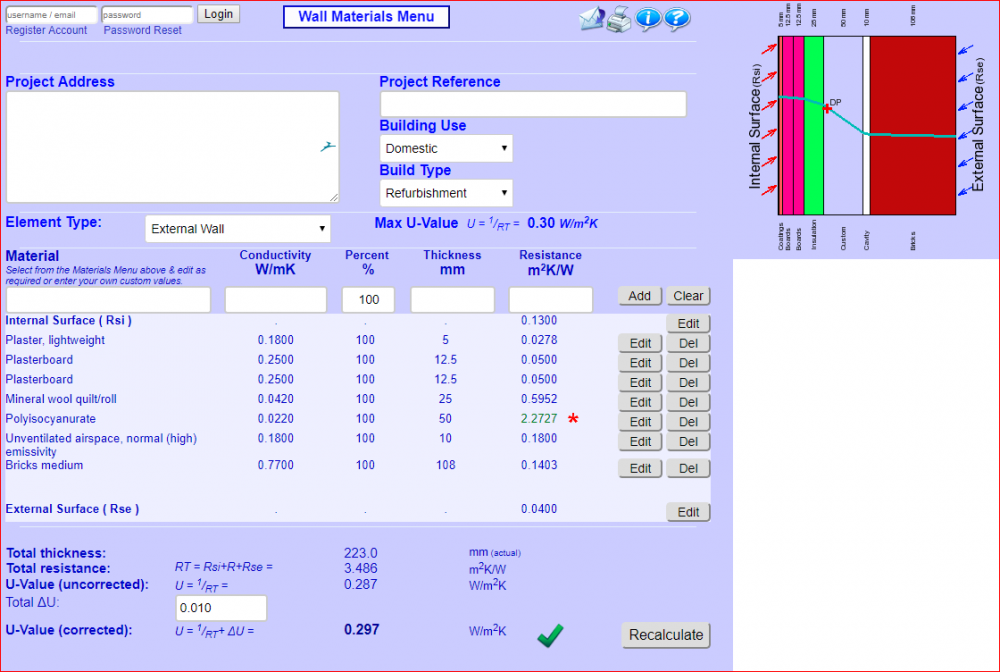
-
Party garage wall insulation methods - help!
Gooman replied to Gooman's topic in Garage & Cellar Conversions
The floor level needs to be raised and that will then require that the roof height is increased. My builder will be doing that work. I'll then be insulating it with PIR between and over the roof joists, extending over where the stud wall will be fixed through to the ceiling joists. My current thinking on the order of work is: Builder raises roof and levels floor (but doesn't raise it) Builder builds pillars and installs steels (leaving house side wall for the moment) Builder removes far, garden wall and builds footing for bi-fold door track (with temporary shuttering) I insulate ceiling (but not yet plasterboarded) I construct partition stud wall between front end of garage and new room area and insulate I construct frame for party wall, insulate and dry line I install floor insulation (but not yet chipboard) 1st fix - pipework for radiators cut into top of floor insulation, socket wiring within party wall rockwool gap (cable suitably derated), lighting wiring on ceiling I install chipboard floor I install battens on ceiling (for cable void) and plasterboard over Builder installs bi-fold doors Builder removes house side wall Sundry insulation and PB (window reveals, pillars, steels) and plaster skim 2nd fix Rough plan attached ...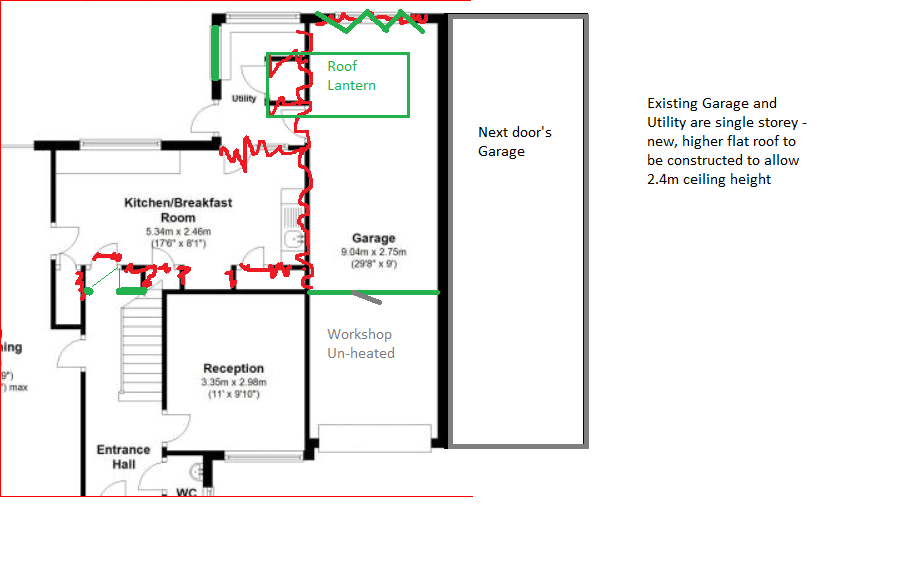
-
Party garage wall insulation methods - help!
Gooman replied to Gooman's topic in Garage & Cellar Conversions
The Changeplan calculator is exactly what I was after, thanks! That suggests that 50mm PIR (as part of the cross section I proposed above) would give a u-value of 0.286. The enclosed unheated space on the other side is a non-integral garage (as is the space I'm converting) which seems to be specifically excluded by BR443. So now the tricky part is specifying the timber frame. Ideally I want PIR between the studs and a separate layer over to avoid thermal bridging. But with only 50mm PIR that seems tricky, as the timber frame will need to be rigid enough. Any thoughts? -
Party garage wall insulation methods - help!
Gooman replied to Gooman's topic in Garage & Cellar Conversions
Thanks all for your good advice. The BCO has confirmed that he doesn't need any specific acoustic insulation. I'll definitely plan to add double-thickness plasterboard. If I can avoid putting electrics or plumbing in that wall I'll also include 35mm of mineral wool between the PIR and PB. Does anyone know of a u-value calculator that would help me work out the minimum PIR thickness I need, given that the mineral wool will have some thermal properties, and given the double PB? Seems to be beyond the capabilities of the Celotex and Kingspan ones. For clarity, proposed cross section of wall is now: Existing brick party wall (presumed single-skin, unheated garage on other side) 10mm gap Timber frame fixed to ceiling, floor and end walls with PIR board between studs 35mm timber frame with mineral wool between studs 2 x 12.5mm plasterboard Plaster skim -
Party garage wall insulation methods - help!
Gooman replied to Gooman's topic in Garage & Cellar Conversions
As this is a conversion within a self-contained dwelling, and not a "room for residential purposes" in the meaning of Part E, doesn't that mean that Part E requirements don't come into it and that Building Regs for sound won't apply? If so then obvs I still need adequate measures for my own satisfaction, but I don't need to satisfy Part E and it's not a BC issue. -
Party garage wall insulation methods - help!
Gooman replied to Gooman's topic in Garage & Cellar Conversions
I think he was meaning that the 10mm gap with the stud frame not attached to the wall would be sufficient insulation. The PIR insulation (see first post) is the thermal insulation. -
Party garage wall insulation methods - help!
Gooman replied to Gooman's topic in Garage & Cellar Conversions
Yep - I'm expecting both to be required. -
Party garage wall insulation methods - help!
Gooman replied to Gooman's topic in Garage & Cellar Conversions
Nope, that's still a double length garage. BCO didn't mention anything about fire spread ... what would be expected there? -
Party garage wall insulation methods - help!
Gooman replied to Gooman's topic in Garage & Cellar Conversions
Ah, I think I misunderstood BC's comments ... it's a 10mm gap from the party wall, not a 10mm frame. The new stud frame needs a 10mm gap and it's attached to the floor, ceiling and walls either side rather than the wall. -
Party garage wall insulation methods - help!
Gooman replied to Gooman's topic in Garage & Cellar Conversions
As we're not in the property yet I'm not 100% certain ... I believe it's just a single 100mm skin as it's just a single storey shared between the two garages. I guess my other alternative is to see if I can avoid having any electricals or rads on that wall and so avoid the need for a service gap. -
I'm planning to convert the far end of a double-length garage that's attached to the house on the left-hand side and has a party-wall with next-door's garage on the right-hand side. Most of the far end wall will be gone and replaced with bi-fold doors. At the front end there'll be a blockwork partition wall between the new space and the remaining garage/workshop/storeroom. The left-hand wall will go (in the converted space, not the remaining garage) and it will be open-plan to the kitchen. The party wall is the problem bit. Building Control have told me that as it's a party wall I need to achieve appropriate sound insulation levels, which they recommend doing by erecting a 10mm stud frame. I'll then need 100mm PIR insulation which will be taped to provide a vapour barrier. Then (presumably) I need a 25mm service void, so more battening. Then plasterboard. I hate the idea of battening twice - sounds like a real faff. Any bright ideas?
-
Is this BR-compliant for garage conversion walls?
Gooman replied to Gooman's topic in Building Regulations
Further answer to my own question ... local Building Regs folks have advised me that I will need sound insulation between the new room and the garage next door. A 10mm stud wall with PIR board on top (not between) will provide this. -
Is this BR-compliant for garage conversion walls?
Gooman replied to Gooman's topic in Building Regulations
TBC, but likely a cold-roof with PIR between joists and PIR/plasterboard combo over, sealed at the edges joining with the wall insulation. So order of build is likely to be: New roof construction Insulation on walls (dabbed) Insulate between ceiling rafters and run wiring for ceiling lighting Insulate floor + chipboard Insulate ceiling with PIR/plasterboard and seal all joins Battens to walls and fix plasterboard -
Is this BR-compliant for garage conversion walls?
Gooman replied to Gooman's topic in Building Regulations
New roof on the part of the garage that's being converted, as otherwise the ceiling will be too low. Leaving that job to my builder. -
Is this BR-compliant for garage conversion walls?
Gooman replied to Gooman's topic in Building Regulations
Answering my own question ... I contacted Celotex technical, and they say that although normally they wouldn't advise putting PIR straight onto a wall <200mm (this is a single-skin 100mm wall), as this is a party wall and isn't strictly external the dot&dab approach should be fine. Which is great, as it will save a lot of time and avoid any thermal bridging. -
I saw this suggestion on another site, and it looks like a good shortcut but I have doubts as to whether it would pass Building Regs ... any opinions? It would save time as there's no cutting of PIR to fit between battens (and arguably gives slightly better insulating properties). Wiring could be fixed in conduit taped or glued to the PIR before fixing plasterboard.
-
Sounds very similar to my setup. Take a look at OpenHAB: https://www.openhab.org/ Self-contained rules-based HA engine with good MQTT support. Runs nicely on a RPi.
-
There's a lot of mentions of Arduinos in this thread, and the odd mention of RPi, but for my money both of those are overkill. The best option (IMO) is either to go with Tasmota on a Wemos D1 Mini: https://github.com/arendst/Sonoff-Tasmota/wiki/Wemos-D1-Mini You can pick these up at between £2 and £3 a piece on eBay. Built on the same ESP8266 base as the Sonoffs (so with built-in WiFi), but you can roll-your-own interfaces for anything you like. Tasmota means you get MQTT (for any Home Automation server) and scripting (with the latest Tasmota version) built-in.
-
My work used to be linked with the highways industry ... nowadays they recycle most road planings in-situ, reducing transport costs and removing the need for additional oil-based asphalt products. So that's probably off-limits I'm afraid! Even if it wasn't, cutbacks mean there's very little road resurfacing going on round here anyway!
-
Good advice as always, thanks @JSHarris! The plan does note a maintenance hatch (at least that's what I'm assuming "M.H." on the sewer line on the deeds map means) which is where the cess pool is teed off the sewer line). That should help point towards the location. Both the map and the deeds specifically refer to it as a cess pit, and from the description in the deeds the intention clearly was to connect with mains sewerage at some point. There's definitely no leach field, as it's right next to a road and pavement!
-
Ah, interesting. So if that has actually already been done properly, it might be very difficult to find evidence of it? If we can't find it (even with the plan from the deeds) then this might be the case and I guess an indemnity policy might be the best route?
-
We're in the process of buying a new home. The house (and the one next door) were built in the late 60's/early 70's and it seems (from the deeds) originally had a cess pool before they were connected to mains sewerage. The plan on the deeds notes the location and that it was/is 10ft x 10ft x 6ft6in. Obviously, we want to satisfy ourselves as to its condition, mainly from a liability point of view. We're thinking that: We need to check that it was properly decommissioned by filling it with sand and/or gravel to prevent any collapse If not, we also need to check that it's empty Back-of-an-envelope calculations suggest it might need 2.5 tonnes of gravel to fill it, at a cost of around £2,500 (plus emptying if needed). Clearly something we'd want to be dealt with or accounted for in the price. Do you think these concerns are reasonable? Anything else we should be wary of?
-
Yep. It's got 100mm and I'm going to top it up to at least 270mm (after putting in lap vents, as there's no ventilation at present). That's the very first task after moving in. It has standard glass-fibre roof insulation stuffed down the eaves (behind the sloping ceiling panels on the 1st floor) which I'm planning to replace by sliding PIR sheets down from the loft if I can. Don't want to have to take the plasterboard off if I can avoid it. L bath is a good thought - I'll look into that, thanks!
-
Keep us posted - we'll be later than that