


puntloos
-
Posts
1575 -
Joined
-
Last visited
-
Days Won
1
Everything posted by puntloos
-

Examining the 'house sandwich' - working with 8250mm
puntloos replied to puntloos's topic in New House & Self Build Design
Not for us, one of the primary reasons for a new build is that we want high(ish) ceilings. I actually intended to start another topic on this (what is a good 'ratio' for height vs width vs depth of a room to not make it feel tunnel-y or tight.) But handwavingly, I'm tall enough that without any 'stretching' I can touch a 2m40 ceiling, so no. But 2650+ would be great, 2600 probably acceptable. What's the widest span you had to cover? (I understand there's a ton more variables, but just curious) Nope, don't know. I've been trying to find the info on my survey but I don't think it says. The only thing I see on there is a manhole marked "SV" (sewage valve?) about 20m away from the edge of my property, which is about 0.5m lower than my DPC, which sounds mildly promising since it would mean that it sits indeed at slightly better than about 1:50 ratio (assuming the actual pipe is somewhat below that manhole lid) Doesn't sound like a massive deal then? As it stands my current DPC is 300mm above the street level (at the lowest point, toward the manhole), and the house is on a very slight upward slope (higher toward the garden) (sorry for the colors, not my choice, but MH in green far left, SV slightly beyond that. Yeah I'm sure some strategy will be done there, we haven't done detail design yet..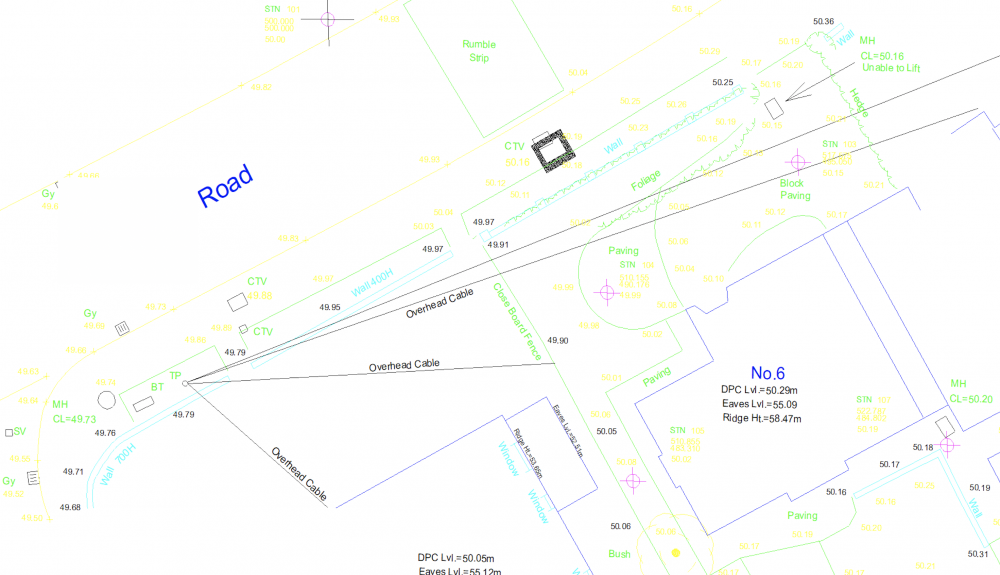
-
Examining the 'house sandwich' - working with 8250mm
puntloos replied to puntloos's topic in New House & Self Build Design
Thanks, it's good to sanity check but my current impression is that the architect is delivering 'sound' designs, just that my approach to suggesting changes is to basically be the stupid layman and just randomly add some space here or move something there that 'seems better' with little heed to regulations. Then the architect has to go in and 'solidify' things again. And because we're paying them I typically figure I ask here first Sorry if some of my questions seem like my architect is dropping the ball but really I think it's mostly my ignorance and trying to learn! Fair. Good to know FWIW this is the current architect design: (the 400mm floor structure was based on advice from our builder as a safe amount, but can probably be squeezed, the central hall is up to the roof, so the actual loft in this pic is the left+right section) As such, I don't think I can 'stretch' the loft to 2200. Loft is currently 1800. I could probably get away with 2650/2350 for 1st and 2nd -> 1900 Possibly 350mm floor structure depth (x3) -> 2050 But that last 150 I don't really see where I can get that, unless I perhaps 'sink the house' 150..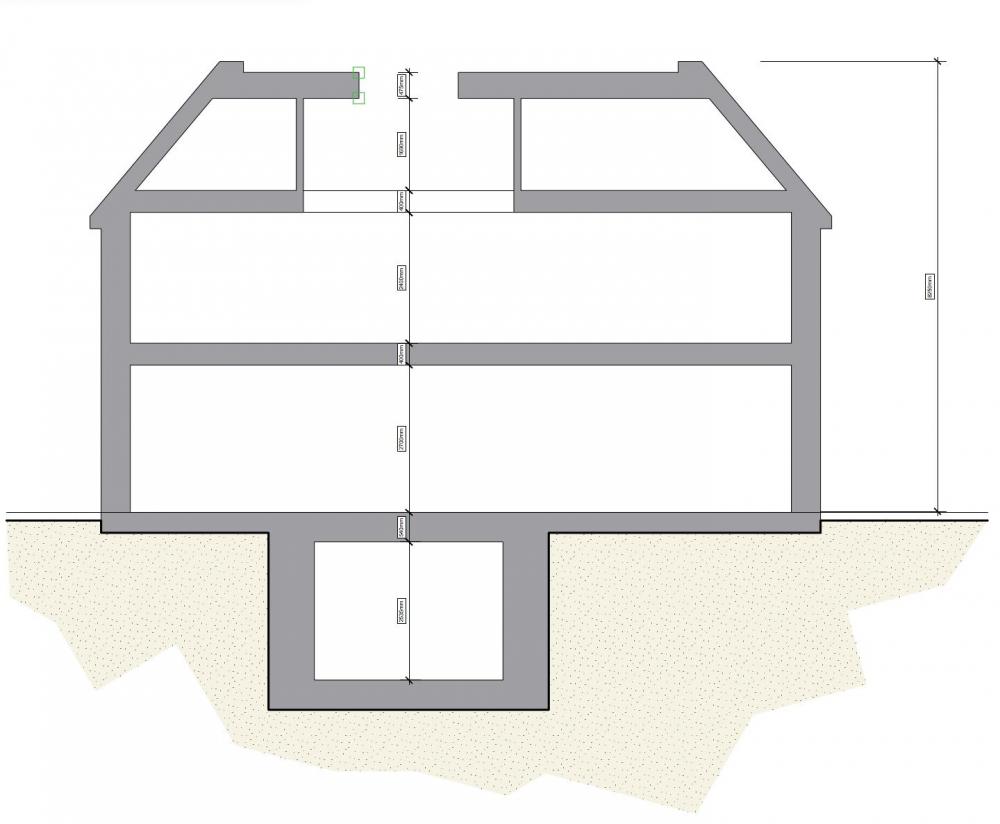
-
Examining the 'house sandwich' - working with 8250mm
puntloos replied to puntloos's topic in New House & Self Build Design
I did wonder about that one, but I thought that if the basement contains no official living space (just a plant room and some storage) it was okay to go without? -
Examining the 'house sandwich' - working with 8250mm
puntloos replied to puntloos's topic in New House & Self Build Design
I see your point, but nah it's not that bad, basically the exchange with them is mostly "here's the new design with the changes you requested implemented. We did it this way for reasons x,y,z. - and then I would go off and examine the details and figure out if perhaps I could push things further without running into worrying safety margins, and then repeat. Perhaps in retrospect it would fit my 'character' better if they would already give 3 options with pros and cons, but I just have the sense most people don't go into the level of detail and 'playing with options' that I do. (present company accepted of course, but I think this forum is unusually 'savy') In this particular (loft or not) case, they recommend against building a 2200mm loft because they feel the LPA would shoot it down, which seems like a valid concern, but my current sense after this discussion is we could actually get more out of it and still get it passed.. -
Examining the 'house sandwich' - working with 8250mm
puntloos replied to puntloos's topic in New House & Self Build Design
Do you mean my various posts across this forum? Or just here? We're pretty happy with the skill of the Architect to design something 'elegant' but these type of details seem to not rank highly in their mind. (frankly, they're a bit of a luxury architect that tend to deal with 5000sqm mansions, while I'm trying to be really optimal in space saving) So indeed I'm doing a bunch of legwork to squeeze the most out of the design myself. (plus they charge by the hour ) -
Examining the 'house sandwich' - working with 8250mm
puntloos replied to puntloos's topic in New House & Self Build Design
And as a bonus, surely I'd have to specify the basement? Or can I leave that out for planning permission? -
Examining the 'house sandwich' - working with 8250mm
puntloos replied to puntloos's topic in New House & Self Build Design
I guess my main question is: can I provide the info the LPA works with - e.g. can I put in my DAS that our ridge is planned to be 50.65 whereas neighbours are 50.55 and 50.89 respectively (which is also reflected on our survey) - or do they do their own due diligence, which might turn up the more contentious point of view, that we are aiming for 8.25m from DPC, where neighbours are 7.95 and 8.05 respectively. Who gets to "provide the data" the LPA uses So that's the key part, and I have a similar question as above: Who decides if it's a loft or a room? (and based on what) A few people already suggested a few things: So basically.. I'm thinking, of: - Not even mentioning the loft - Hatch, not my fancy spiral staircase. - No rooflights, but plan for them with trusses etc when the time comes - Make sure FD30 style doors can be fit in the right locations Does that sound like it could work? -
Examining the 'house sandwich' - working with 8250mm
puntloos replied to puntloos's topic in New House & Self Build Design
I think I'm missing one step of reasoning here. Which part of my 'ruminations' would imply I'm skimping on fire reqs? Maybe I misused 'small footprint' - I just meant that the full house footprint is maybe 125m2 where the basement is 25 and loft perhaps similar. -
Examining the 'house sandwich' - working with 8250mm
puntloos replied to puntloos's topic in New House & Self Build Design
That's it, I'm building a Church. It is an interesting point, but I think in my case 'ridge height' is better for my case. (difference in eaves height is worse) How do LPAs look up ridge heights and compare them? Case in point: Ridge height of neighbour 1: 58.90 (above sea level) My intended ridge height: 58.54 Fine, right? But no, sadly my neighbours DPC is at 50.84 and mine - in the current house, 50.29. The 'absolute height' of that neighbour is 8.06m (vs my 8.25) Dumb question but is there anything stopping me from sinking the house (or more specifically the DPC) a few cm? -
Examining the 'house sandwich' - working with 8250mm
puntloos replied to puntloos's topic in New House & Self Build Design
Eh I'm fine then my design is a Mansion King, I'll have you know. But it's a fair point, although when it comes to the "2 extra floors" - both would be "small rooms" not a "full footprint". Perhaps it depends on how it's presented, but if I can represent the basment for what it's actually intended for - a "plant room", and the loft as indeed an undeveloped loft, perhaps that would help. (and it is factual too - core reason for the basmenent is indeed storing plant stuff, and core reason for loft is storage, and perhaps some play space for the kid, but no proper living. -
Examining the 'house sandwich' - working with 8250mm
puntloos replied to puntloos's topic in New House & Self Build Design
Thanks ProDave, to be clear, in that case would you aim for 2650-2350-2200 floors, but somehow "mark out" that the top floor isn't actually usable 'yet'? How can I make plausible that 'for now' it's not intended as a real room? Or do you think that planners really don't care even if you do go for an 'unashamed' 3 floor house? (even though the top floor/loft would only be one room..) -
Examining the 'house sandwich' - working with 8250mm
puntloos replied to puntloos's topic in New House & Self Build Design
Thanks all, in general I think the question is less about "how to design a proper loft" and more if my council would approve the house "as we would really like to see it", or if there are ways to get to it. My attempt is around trying to get to a nice baseline that's acceptable, and then "bend it upwards" through either non material amendments or just moving a few windows around. The trouble with @PeterW 's suggestion to 'just go for it', I suppose, is that I can imagine there's a tendency in humans to go with and stick with first impressions. If the house we design is "outrageous" then they might require us to drop even further below what we want.. Plus lost time working on the negotiation.. no? -
Examining the 'house sandwich' - working with 8250mm
puntloos replied to puntloos's topic in New House & Self Build Design
No, their point was to not specify a convertible loft because they worry that we're too optimistic with PP, trying to "get away" with too much, and if we put in for what is basically a 3-floor house, we will get rejected. Happy to hear opposing opinions, but the 2-floor version of our house is already larger than the neighbours. Instead, they are specifying a "very roomy" (2700 ground, 2700 first, 1800 loft) house where after PP, we could theoretically compromise into 2650 + 2350 + 2200 by my math. Of course one question is when to do that rearrangement, and do I need to tell my council or can I just reshuffle the internals to my liking without any hassle? I noticed this one: https://www.britishsc.co.uk/building-regulations-for-spiral-staircases/ - I think that if the staircase only serves one room it can be pretty compact. What I'm not sure about is fire safety as you say. Does FD20/30 mean that the staircase should be enclosed fully into a "fireproof box"? Or is in theory an open staircase okay? -
Examining the 'house sandwich' - working with 8250mm
puntloos replied to puntloos's topic in New House & Self Build Design
Thanks, our main hope is to avoid exactly that - things that will be costly to alter later on. We already have a spiral stair that I think has enough headroom (2000mm) above the exit etc Do you have a list of these knock-ons? -
Not really Heh, not really a deeply meaningful update, so no need to reopen the discussion unless you have shocking insights you forgot last time But indeed a surprising amount of 'last minute' minor things mainly because we've been quite perfectionist about it
-
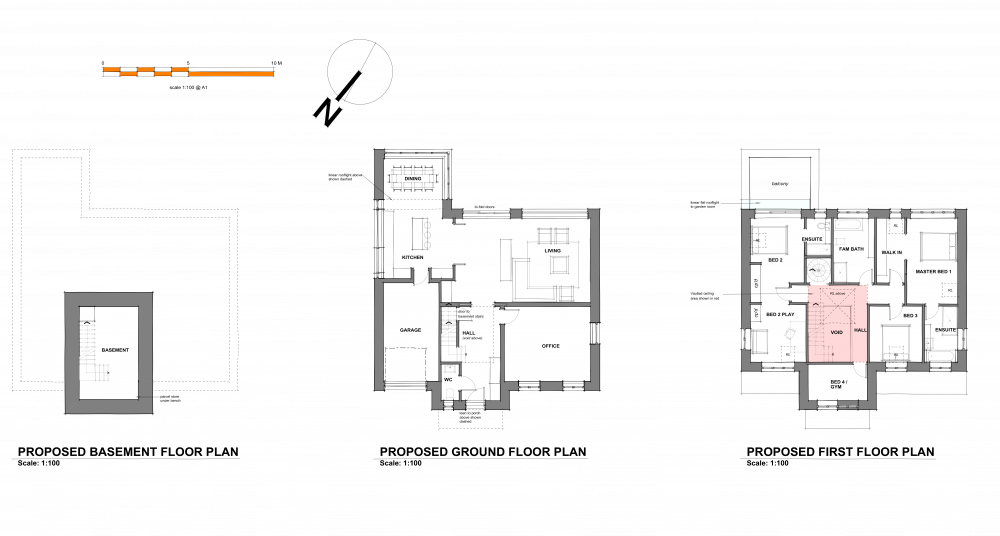
A few 'final' versions later.... (for @Mr Punter too) Puntloos-F.pdf
-
Examining the 'house sandwich' - working with 8250mm
puntloos replied to puntloos's topic in New House & Self Build Design
OK, if 450 works I'll use it as my baseline You mean for rainwater? Or sewage stuff? 99.9% there, but of course the whole discussion here impacts a few things downstream. I'll post them elsewhere in a sec -
Examining the 'house sandwich' - working with 8250mm
puntloos replied to puntloos's topic in New House & Self Build Design
So with 300 floor width, I could cut down the house by 100mm If you're right about 300 floor, then I would have 100 spare - is 450 sufficient? -
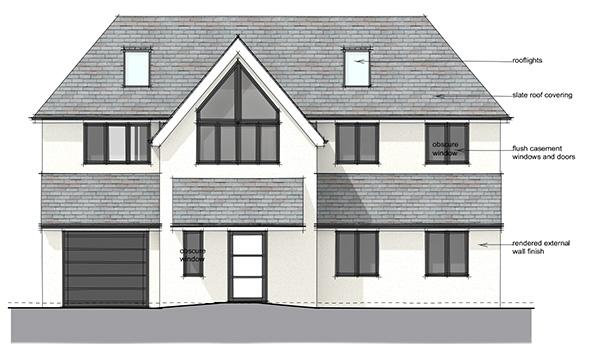
My architect feels the maximum height of our upcoming house (given the roofline of neighbouring are 8060 and 7940mm ridge height respectively) can be 8250mm from Damp Proof Course(DPC), which is already pushing it. We are hoping for a "convertible" loft. My architect designed 1800mm for loft head height (flat, see pic) which of course is 'meh' but he also recommends not hitting the required (?) 2200mm just to get through planning and not effectively proposing a 3-floor house rather than 2: My questions: 1/ Do you agree that it's better to stick to 2 floors, and then later do a non-material amendment, to "rejigger the internal sandwich to hit 2200 loft"? Risky? 2/ With 8250mm, how to get a proper (2200mm) loft head height yet retain a high ceiling ground floor and good structure width for high U-value insulation Is the below feasible: (numbers are "starts at") 8250 Roofline 7850 Roof Structure (350mm) 5700 Loft Space (2200mm) 5350 Floor 2 Ceiling (350mm) 3000 Floor 2 Space (2350mm) 2650 Floor 1(G) Ceiling (350mm) 0 Floor 1(G) Space (2650mm) 0 DPC / Floor -350 Basement Ceiling -2800 Basement Space -3200 Basement Foundation As you can see I just managed 2650mm ground, 2350 first, and 2200mm loft. Works? Or is 350mm too optimistic or missing important house layers? What we would submit to planning would be something like: 8250 Roofline 7900 Roof Structure (350mm) 6100 Loft Space (1800mm) 5750 Floor 2 Ceiling (350mm) 3050 Floor 2 Space (2700mm) 2700 Floor 1(G) Ceiling (350mm) 0 Floor 1(G) Space (2700mm) 0 DPC / Floor -350 Basement Ceiling -2800 Basement Space -3200 Basement Foundation
-
Quick update, I received a ballpark groundworks quote for 14,000 to effectively prep a 130sqm site and dig the hole of the basement. Demo of the previous house not included since they need to see the site. Seems fairly reasonable. So.. that gives me "100,000" for effectively everything that's underground. When it comes to the famous 'rule of thumb' - 1500-3000 per sqm, let's say 2250 for now - how much does that drop if the entire foundation can be assumed to be there? Putting it differently- how much would 'just groundworks+foundation' normally cost for 130sqm? (very much in general, yes I'm aware this can all change based on what SE finds etc..)
-
Wow @Bitpipe really sharing the knowledge. I've been speaking to a prefab basement team where .. well.. I should clarify this with them but I think basically prefab basements that are waterproof by design but I think they still have to do additional work, a membrane etc. SE and boreholes etc, so would you wait until after planning, or get going with this as soon as possible once the basic house design is done? As @Conor noted the probing done shouldn't materially change with the design so it sounds like I can do this sooner rather than later? The main difference between intention and reality that I am foreseeing is we might not be able to afford the basement.
-
Just a quick detail but would the house design fundamentally (ha) impact the work the SE does? Meaning if we decide to not build our garden room, would the SE outcome change?
-
Sadly (?) there is a house on the plot, so I think we can 'only do so much'? We can't drill (straight down) into the ground where the basement would be, at least not the entire area. Or would a SE not need to drill straight down and hiring a SE "now" could be a good idea (slightly pre planning permission)? My current designs are built on data we have from 2 nearbyish (0.6m away) boreholes.
-
Thanks, will do! But.. as long as it's anonymous (in public) forum rules allow us to share things publically I think? Of course builders might not be big fans to know how cheap is possible (perhaps with shoddy work!) Here's my quote - anonymized: https://docs.google.com/spreadsheets/d/1YXmQvNAT9tiMNJIrj_Ka0g-WVb1Hb0_eoEuw8_VqkPA/edit?usp=sharing In short: about 100K for 25m2 insulated basement + 130m2 foundation, but no ground works. (they expect a big hole)
-
You left out one key point How much are you paying for this ?


