G and J
-
Posts
1977 -
Joined
-
Last visited
-
Days Won
8
Everything posted by G and J
-

Avoiding steel wind frame with portal I-joist frame
G and J replied to thaldine's topic in Timber Frame
My word that’s what got Gregg W in trouble lol I keep reading steel is inexpensive but I’m damned if I can find sensible ways of guesstimating broad costs. -
What spans are these across?
-
In another thread @Indy expressed doubts about them having a woodburner. As you have added a woodburner @Andehh do tell, do you use it and do you leave sweat puddles or simply watch the main heating system ease off (or both of course?)
-
Noting the wildly differing views on insulation levels may I suggest playing with Jeremy’s spreadsheet might help, it did for me.
-
You could be describing our architect, and our experience with planning has been, perhaps partly as a direct result, a pleasant one. We did the actual house design ourselves, with a very carefully thought out aesthetic balancing our desires with what would look right in the street. Then that was drawn up and packaged by our architect, and I’m convinced that our application was received in a better light for coming from them than it would have been from us as individuals. So the usefulness of the hoary old whatsit role you describe I agree with, and I’d suggest that there are multiple sources of said experience.
-
We have a twinkle in an MCS plumber’s eye right now, we are planning ahead. Our plans will be vetted by BCO and SAP assessor in the next couple of weeks, so still lots of decisions to be taken.
-
A variation of conditions. In Suffolk it’s about £450 and takes 8 weeks. But a woodburner is a beating heart….
-
We built ours in ‘91. Better than the then building regs insulation but compared to our planned new pad it is a wind tunnel. We are used to cool bedrooms and significant temperature variations during the day on cooler days. Hence me asking so many stoopid questions…. How much will you be doing yourselves?
-
Then you have an advantage over me as I haven’t and I’m struggling to imagine how it will feel.
-
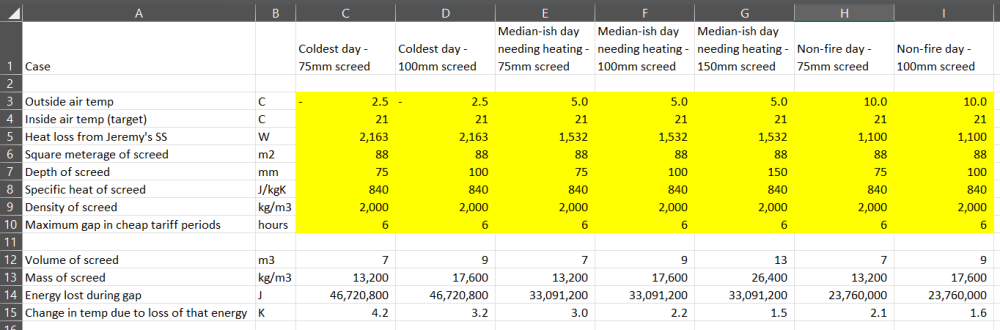
Indeed, I've been having a play.... OK, so I've some numbers, and gut feel says a 4C change in floor temp will feel f chilly - but what should I be aiming at? The complicating factor for me is that on a -2.something day we will have the woodburner going, and maybe even on a 5C day. But I'd like the system to work well on a normal cold day without a fire.... So what floor temp drop should I aim at?
-
@Indy Question: Have you ever lived in an airtight well insulated house?
-
So, the concept enshrined in 2) holds, the question is how much the screed would cool during the off period. I have difficulty finding stuff on here, do you happen to know how to find that?
-
Ideally you need an enthusiastic sole trader sparky.
-
1). If I run my ASHP UFH 247 then screed thickness will have no effect on performance and I’ll have reasonably constant room temperatures. 2). If I run the heating a bit harder but only in the cheap periods of a ToU tariff like Cosy, I will save money but the room temperatures will vary more than in 1). above. 3). If I have a deeper screed then the room temperatures will vary less. Is that correct?
-
Oh it must be true then. Was the next article DIY battery install? You know, the one that linked the blog about rebuilding after a house fire lol Being serious if one can buy the bits that cheap it might not be long before complete ‘plug in’ packages get to sensible money.
-
So £3k (exc. vat as I’m building a new build and can claim it back) all in with battery rated at 3,500 cycles, which means it is likely it would be good for more than that, a lot more if you are lucky. Using the Nirvana figures above £3k is equivalent to 20,000kWh at 15p saving per kWh. At 16kWh per day payback that’s a ~3.5 year break even. Getting warmer.
-
You are a very bad person @JohnMo! (Sorry!)
-
Found it! https://www.fogstar.co.uk/products/fogstar-energy-15-5kwh-48v-battery?variant=41607893876795&country=GB¤cy=GBP&utm_medium=product_sync&utm_source=google&utm_content=sag_organic&utm_campaign=sag_organic&gad_source=1&gbraid=0AAAAADdkPQNr_gr7TdOVsH8qb_ItWShjf&gclid=EAIaIQobChMIk8vFmZiGigMVwJtQBh340gUqEAQYASABEgJlKPD_BwE Can one of the grown ups add the cost of an appropriate stuff and inverter and gubbins to make it a complete thingy? (I’m assuming it has to be an ac coupled battery to do the job).
-
When I looked at this it seemed really attractive. But then I thought, hang on, if that kind of storage and resell type system paid in then in no time we’d see farms of batteries springing up all over the place, trading on an increasingly tight margin. Thus market forces would depress the margin perhaps to the point that it becomes irrelevant fir the domestic battery owner. I accept that in the short term it might work, but the paybacks are v long term at the mo.
-
Link away, and save me fruitless searching….
-
Payback calculations are, in my experience, often very difficult to nail down to a high level of confidence. And payback is only break even. An investment decision usually wants to see profit in return for the risk. The risk of future ToU tariffs having a smaller differential (which is what I think of as your ‘less generous’) ‘feels’ small to me. Growing national solar capacity must be driving an ever increasing differential in generation cost and ToU is all about demand shifting. In this instance though I think there is significant technology related risk. 9 years is a long time for a battery. That’s over 3,000 days, so presumably at least 3,000 charge/discharge cycles and some ToU tariffs have three low periods a day. How does a 9 year old electric car perform? Are there many that last that long? Those that do won’t have the same range they started with. How reliable are the charge/discharge efficiency figures you are using? Is it something like 100Wh in for 90Wh out? What’s your cost of capital? Current deposit rates are circa 3% so that’s a minimum I guess. The ToU tariffs I’ve looked at charge more than standard for some periods, which also needs to be factored in. What is the probability of the system working without needing costly repair for the time needed to payback, (let alone profit). How much will a battery system be in the future? Say two years time? I’m guessing less. But…. often a good way to kill an idea is to assume perfect everything, and if the results are either crap or borderline then no further work required as it’ll all be downhill from there. A sub 9 year payback requires 16kWh totally battery provided (there are multiple cheap rate periods and usage is perfectly distributed so battery never runs flat) at 100% efficiency, and zero cost of capital and no repairs. I think in reality it’s an unlikely best case break even over 15+ years unless ToU tariffs significantly increase their differential. Sorry. However, it’s still ok to do it if it feels good. Maybe power cut cover appeals (which it does to me) or you accept you are gambling on future tariffs being more advantageous. For me it’s a ‘wire up ready but wait till prices drop’ thing. Though I keep watch.
-
As we are thinking of using an insulated beam and block floor that’s a really interesting notion. So instead of a screeding team (is that what does screeds?) it’s a concrete lorry and a rake…. So the rest of the build happened off of the finished floor level….
-
And in winter the ducts will be warmer than the loft in our cold loft….. ok, condensation panic over.
-
Did that make it cheaper then? (He asked, aware of how much he doesn’t know….)
-
Looking like our 5kW heat pump will be needing to provide less than 2.5kW heat load at max (normal) temp difference if we don’t light the woodburner. Intuitively, against the various discussions on here, that feels sensible. Of course one piece of info that’s missing from my jigsaw puzzle is cost of screed. When I google I get handwavy £18 to £20 /m2 but no info as to how thick that figure refers to. Will there be much difference between 75mm and 100mm fibre reinforced screeds? Is there a budget rule of thumb I can refer to?