


Beelbeebub
-
Posts
1522 -
Joined
-
Last visited
-
Days Won
11
Everything posted by Beelbeebub
-
Clean Heat Market Mechanism to incentivise heat pumps
Beelbeebub replied to LnP's topic in Air Source Heat Pumps (ASHP)
Agree.......but.... I work in building maintainance and with tenants and from my experience the average "handiness" of householders in the UK is frankly terrible. The increase in refridgerant emissions from unrestricted DIY sale would be pretty large and given 1kg of r410 is equivalent to over 2tons of CO2 or about 40% an average UK citizen's annual emissions R32 is better at about 600kgCO2 per kg, but even that would be counter productive if left in the hands of the public. R290 is negligible for global warming so it's just the flammability issue. If someone could come up with a non toxic, non flammable, low GWP, low odp refridgerant - then I would say have at it. We should be selling those units on Amazon and in Screwfix. -
Interested in a Heat Pump...
Beelbeebub replied to Slippin Jimmy's topic in Air Source Heat Pumps (ASHP)
Don't be put off. Some posters on here are rather negative on the idea of HPs. As you say it's not always about the money. Your gas consumption seems extremely low - which is good. 1.5m3 is about 16kwh a day! Assuming your 2 hour run time, that's about 8kw heat input. I suspect your home could get by with one of the very small units like an 3.5kw Arotherm. If you were determined to stick to the low cost times you only need to "coast" through 4½ hours max. This will be dictated by the thermal.mass of your home. Have you tried turning your heating off for 4 or 5 hours? Does it stay warm enough? -
Clean Heat Market Mechanism to incentivise heat pumps
Beelbeebub replied to LnP's topic in Air Source Heat Pumps (ASHP)
Things like zero vat on units *as long as they have limits on cooling* would be sensible. A2A units need a qualified installer due to the f-gas regs*. It's probably a bad thing if we start allowing Joe Bloggs to piss about spraying refidgerant about willy nilly. *Technically r290 doesn't fall under fgas regs but that isn't something that we should he encouraging mass DIYing. If we can come up with a non toxic, non flammable, zero ozone depletion, low GWP refidgerant with good performance then maybe. -
Clean Heat Market Mechanism to incentivise heat pumps
Beelbeebub replied to LnP's topic in Air Source Heat Pumps (ASHP)
Our DHW is about 40-45C and our thermostatic mixer showers work fine. The only issue we have had, is our Mira unit makes a whining sound at certain combinations of temp and flow. I don't think that is directly caused by the lower DHW temp. Annoyingly one of those settings seems to be the one everyone likes! -
Clean Heat Market Mechanism to incentivise heat pumps
Beelbeebub replied to LnP's topic in Air Source Heat Pumps (ASHP)
I think it will. If you are doing significant work on the heating system, then the answer is simply to make sure you design that new/upgraded system for low temperature operation. Iirc 55C is the current standard, but if you can size it for 45C then the efficiency of a HP starts to hit the break even with gas. Then, one day in the future when you need to change your boiler you have 5ge option of just dropping in a HP. -
Clean Heat Market Mechanism to incentivise heat pumps
Beelbeebub replied to LnP's topic in Air Source Heat Pumps (ASHP)
To be fair, that isn't really a thing. As cooling methods go it's pretty poor. It has limited power and condensation is an issue if you try and push it. I'm not aware of any manufacturer that offers *slab* cooling as an approved option (there are some that offer fan coil cooling) It's only done as a hack by some enterprising "prosumers". A2A cooling, on the other hand, is pretty.much how it is designed to be used for the majority of installations. *heating* is the "hack". There are units out there that cannot heat. But you are right, excluding the A2A class on the basis that it is mostly for cooling is a bad move, especially now. 1) it's not strictly true, A2A optimised for heating is now a mainstream product 2) cooling during extreme heat events might actually be a sensible idea for the UK What we need to do is strongly discourage (or at least not subsidise) unnecessary "comfort cooling". By this I mean using air con to make a space unnecessarily cool to address poor building design. So no building a glass office box then using a air con to make it 16 degrees during a heat wave so everyone wears jumpers. A simple approach would be to not subsidise any heatpump that can be set to cool below (say) 28C. A2A would be (small) subsidy worthy. There could be subsidies for those that have the space to fit a UV cylinder heated by one. Heck maybe someone might come up with a head unit that transfers to water for UFH so you can have UFH downstairs and fan coils upstairs. -
Clean Heat Market Mechanism to incentivise heat pumps
Beelbeebub replied to LnP's topic in Air Source Heat Pumps (ASHP)
The only really power cut proof heating systems are ones that use no electricity at all (eg wood stove) and if you have one fitted already it's not a bad idea to keep it as a back up. Ironically my wood stove with back boiler was the backup for my gas boiler when we were without gas for 2 weeks a few winters ago due to a fault in the main! The vast majority of power cuts, for the vast majority of people are fairly brief events lasting less than a few hours. Whilst "what happens during a power cut" is a factor, it's not the huge differential between HP and gas that some make it. In the majority of cases the answer is "the same thing as if you had a gas boiler" -
Weather Compensation and Defrosting
Beelbeebub replied to ReedRichards's topic in Air Source Heat Pumps (ASHP)
The pump runs 24/7? -
Weather Compensation and Defrosting
Beelbeebub replied to ReedRichards's topic in Air Source Heat Pumps (ASHP)
The big thing slowing me up is that the current system is very simple, uses no custom hardware and actually works pretty well. Here is the internal temp track for the last few days. Realistically, i'm chasing marginal gains. (But it is a fun exercise)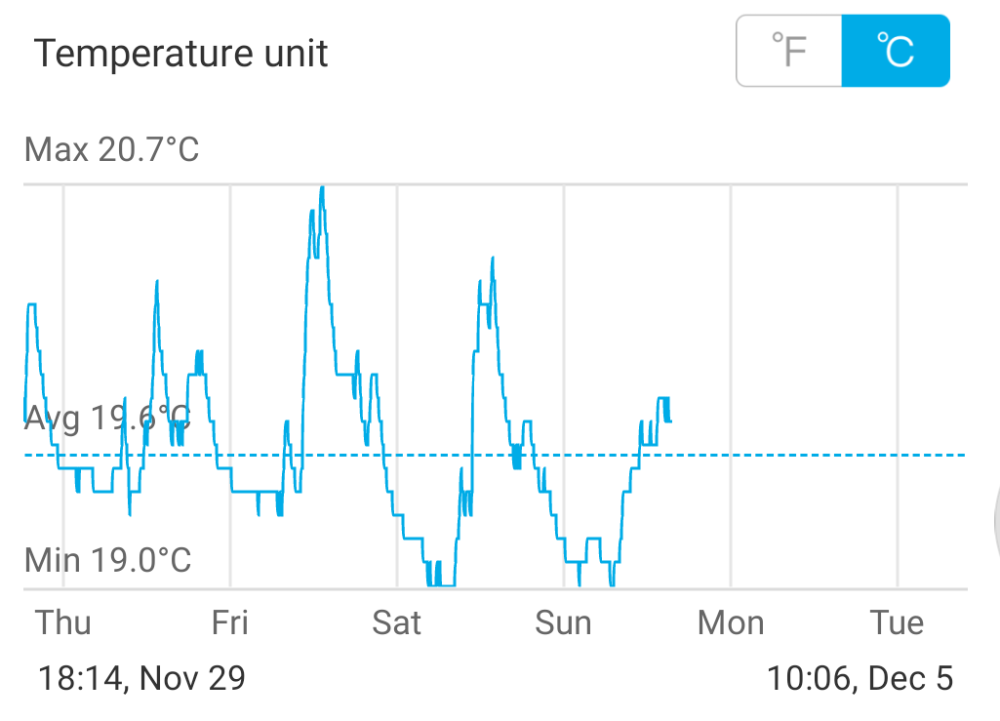
-
Clean Heat Market Mechanism to incentivise heat pumps
Beelbeebub replied to LnP's topic in Air Source Heat Pumps (ASHP)
Yup. The reason we are doing all of this is to reduce co2 (as a nation). All but the most cackhanded installations will do this. Even a rambling old farm house with no insulation and tiny radiators will emit less co2 using a HP than a gas boiler (or more likely the old oil boiler) So the only stumbling block is the current disparity between gas and electric unit prices. Part of that disparity is technical. Generating electricity from gas uses about 2.5 times as many kWh of gas per kWh of electricity so the base difference if all our electricity came.from gas wouod be 2.5x (plus capitao costs). But we don't generate all our electricity from gas and our differential is more like 3.9x Which is down to government policies. Them government could change the energy market policies tomorrow and drop the price differential to 2.5 or even lower. At which point tge cast majority of HP installs would be cheaper than gas. -
Clean Heat Market Mechanism to incentivise heat pumps
Beelbeebub replied to LnP's topic in Air Source Heat Pumps (ASHP)
True, but then you are comparing a heat pump against a boiler and a home battery system worth several £k It's only really possible to make that argument as a negative is you already have a battery and a boiler and are thinking of switching to a HP. If you don't already have a battery (which is the majority), then you will be no worse off with a HP Vs a boiler. Even with a battery a 10kw unit will power a 7kw HP for several hours flat out. Sure if you get a 24 hour or longer power cut you're in trouble, but how common are they? -
Clean Heat Market Mechanism to incentivise heat pumps
Beelbeebub replied to LnP's topic in Air Source Heat Pumps (ASHP)
I would say it's not quite that simple. The efficiency is governed by the temperature lift. Th heat output a given emitter is (crudely) the effective area x the temperature. A2A units use fan coils. If the refidgerant temp to get a given heat output is higher fornthr fancoil than it would be for the refidgerant in a plate heat exchanger feeding a UFH system, then the fan coil will be less efficient. Though the complexity will be less. But then you have to deal with high pressure refidgerant lines through the house which may be more problematic Vs low-pressure water. All that said, a2a is an avenue we should be using more, especially for flats (though it does mean lots of boxes on buildings) -
Clean Heat Market Mechanism to incentivise heat pumps
Beelbeebub replied to LnP's topic in Air Source Heat Pumps (ASHP)
Yeah, government targes and subsidy schemes do distort markets. Whilst I agree that A2A units are being unfairly marginalised given their potential, I can see the reasoning as to why they were excluded - at least when the system was set up (basically it would have been used to install summer cooling and make co2 emissions worse). Of course now, the situation is different - summer cooling might be useful for brief periods, and newer technologies like low GWP refidgerant mean installing lots of A2A units.mught not be such a bad thing now. -
Weather Compensation and Defrosting
Beelbeebub replied to ReedRichards's topic in Air Source Heat Pumps (ASHP)
The pump will only run when the room temp (measured by a probe in the MHRV room extract manifold) is below the set point. Eventually some logic will be put in so that continually running the pump whilst the slab return is at target temp (which is taken to indicate the target slab temp is too low to maintain the desired temp) will trigger a slight uplift in the target slab temp. (Maybe - if I can be arsed to do all the work) -
Weather Compensation and Defrosting
Beelbeebub replied to ReedRichards's topic in Air Source Heat Pumps (ASHP)
I might, but it requires a load more plumbing. What I actually have is a standard thermal actuator (a UFH zone valve) plumbed into the return from the 4nport mixing valve for the UFH. This is historical to preven some thermosyphon from my thermal store to the UFH. Currently it is plumbed in parallel with the UFH pump. When the thermostat calls for heat, the pump is activated and the zone valve (eventually) opens. Until that happens the UFH water just recirculates round the slab. As the valve opens the mixing valve starts to blend and the flow temp rises to whatever it's set to. I've noticed that I can actually control the flow temp to any point between slab return temp and the mixing valve setting by opening the zone valve fractionally. As the valve moves slowly, my idea is to measure the flow temp and then "blip" the thermal actuator on and off to hold it at the intermediate opening point that gives the desired flow temperature. -
Weather Compensation and Defrosting
Beelbeebub replied to ReedRichards's topic in Air Source Heat Pumps (ASHP)
I'm fiddling with my UFH (boiler driven) - at the moment it is just on/off from the thermal store at a set temp. I'm planning on measuring external temp (via my MHRV intake), and doing a simple linear weather comp to get the desired delta T between the floor slab temp and the desired internal temp. Its then easy to calculate the desired slab temp (thermostat setting plus calculated delta T). The controller then activates the UFH pump until the slab return temp is to the target. When it is, it shuts a valve that controls the hot water input into the mixer, but keeps the pump circulating to measure the slab temp. Rinse repeat -
Clean Heat Market Mechanism to incentivise heat pumps
Beelbeebub replied to LnP's topic in Air Source Heat Pumps (ASHP)
Poor installation is the major problem with HPs. The thing is with this system is you'll also have a reall good record of performance tied to the installer. Should help root out the real cowboys. In addition, rather than just a single "one hit" install like now, which is super dependent on the single installer, you would have a phased install over several seasons (possibly using dofferent installers) as the system is progressively upgraded (rads etc) to break even. And as for the very common "heatpumps don't work in a power cut argument".... How well does you combi boiler work in a power cut? -
Clean Heat Market Mechanism to incentivise heat pumps
Beelbeebub replied to LnP's topic in Air Source Heat Pumps (ASHP)
This makes my point. You've be guaranteed that the install wouldn't cost more for at least 5 years (or whatever the period is). 5k will pay the majority of the purchase price of a HP unit. 7.5k would pay for some of the extras as well. A boiler swap typically costs 2k, so that could cover a number of rad swaps, a bit of pipework etc. -
Clean Heat Market Mechanism to incentivise heat pumps
Beelbeebub replied to LnP's topic in Air Source Heat Pumps (ASHP)
Yeah, but the restrictions to get the £7.5k mean the consumer often still pays more than just swapping to a new boiler. New DHW tank, some new pipework, new rads etc. quickly eats up the subsidy. And there is still the fear that the running costs will be higher anyway. This would remove that and allow the install to be more minimal. After a season of running, guaranteed to be no more.esoensice than gas, a better assessment of what needs doing *in light of actual experience* can be done. Some upgrades carried out (say new rads), then try again and so on. You'd still get a 5k subsidy on the install (at least). But you'd also get the security of no higher bills for 5 years. The money for the subsidy would be collected from the gas bills (which would reduce the difference and also the amount of subsidy required!) -
Clean Heat Market Mechanism to incentivise heat pumps
Beelbeebub replied to LnP's topic in Air Source Heat Pumps (ASHP)
I've previously suggested putting the extra £2.5k towards a "price guarantee" subsidy. Scheme would be open to anyone (even self installs) as long as they have a smart meter and a smart heat meter (provided by energy company) fitted. The heat meter would work out the heat delivered and hence the cost of that heat if delivered via gas. It would then deduct the difference between that and the price of electricity from the customers bill. In effect guaranteeing that the customer never pays more than gas for (say) 5 years. The scheme would then taper off over the next 5. Combined with the £5k subsidy off the install this would make an install about the same as a gas boiler replacement. Therenwouod he less need for the rad upgrades upfront as the subsidy would take care of any underperforming. It would give 5 years to bring the system up to parity with gas (and grants would be available for that eg radiator scrappage schemes). -
Weather Compensation and Defrosting
Beelbeebub replied to ReedRichards's topic in Air Source Heat Pumps (ASHP)
What is the physical layer for opentherm? It seems to be some sort of 2 wire bus. I haven't seen any opentherm modules on the hobby market like you see for CAN or rs485 -
A2A Heat Pump minimum working temperature?
Beelbeebub replied to Ferdinand's topic in Air Source Heat Pumps (ASHP)
Ideally you would need a duct for inlet and exhaust for those portable units to work well. -
Heat Pumps work when installed correctly...
Beelbeebub replied to Marvin's topic in Air Source Heat Pumps (ASHP)
Safety standards have definitely improved and that has undoubtedly added weight. Luxuries like sound proofing, aircon, electric mirrors and windows are very welcome and have also added weight. I'm not suggesting we all go back to driving 2CVs and Imps. But the number of people who need a 7 seat car capable of 150mph and a sub 5 second quarter mile is pretty low. Especially for the school run. There should be a middle ground. The trend for bigger vehicles like SUVs etc was already erasing the efficiency gains of better engines before EVs. The thing with EVs is that poor efficiency has a much bigger impact on price and performance than with ICE cars. -
Heat Pumps work when installed correctly...
Beelbeebub replied to Marvin's topic in Air Source Heat Pumps (ASHP)
and the problem is both are porky! I know modern safety standards dose impose a weight penalty, but we are also making cars heavier by making them bigger, more powerful and with more stuff. A MK1 golf weight well under 1,000kg and a mk1 Polo could be under 700kg The latest Golfs can weigh more than 1,500kg and the lightest polo weighs more than the heaviest MK1 golf at 1,100kg When Tesla make a car with 400bhp and a 0-60 that would shame a decade old Supercar, that doesn't help efficiency of materials or consumption. We should be going back to lighter, smaller (at least externally) vehicles with "sufficient" performance (say 0-60 in a glacial 7 seconds and a top speed of only 70mph) The problem is, driving such a car would be less pleasant when everyone else is roaring around in 5 meter long, 2.5t pickup trucks at 90mph. I think Ciroen have the right idea with their Oli concept (thought the looks are somewhat errrr unique)
-
Heat Pumps work when installed correctly...
Beelbeebub replied to Marvin's topic in Air Source Heat Pumps (ASHP)
Nah......



