Trojan
-
Posts
23 -
Joined
-
Last visited
Trojan's Achievements

Member (3/5)
3
Reputation
-
I meant you ask the pump to make 40 degrees to the flow pipe feeding the central heating, meaning it'd actually be higher than that because of the heat loss through the cylinder. I think @sharpener is right though and it wouldn't really work, there likely wouldn't be enough of a drop at those temps, or if there was the heat pump would probably need to be oversized.
-
Well my thinking was it only needs to go through the tank when the tank needs to be topped up, and then can service the rads with the lower output temp at the same time meaning you don't have to choose between heating and hot water. Could just set it up as a zone valve aiming for 40 degree heat temp etc, itll lose the heat in the cylinder.
-
There's only one path in this scenario. Valve changes back to only doing the rads. Yeah, I'm assuming the minimum you would want to be putting through a heating coil though would be around 50C, even a 15C drop across the coil would probably still be useful in the rads no? Yeah, I'm not sure how much resistance a cylinder coil would add to it, presumably that could be overcome with a suitably sized pump though. I was also thinking if you monitored the flow temp after the DHW circuit, the heat pump would overshoot automatically and heat the water as a biproduct of making X flow temp for the radiators.
-
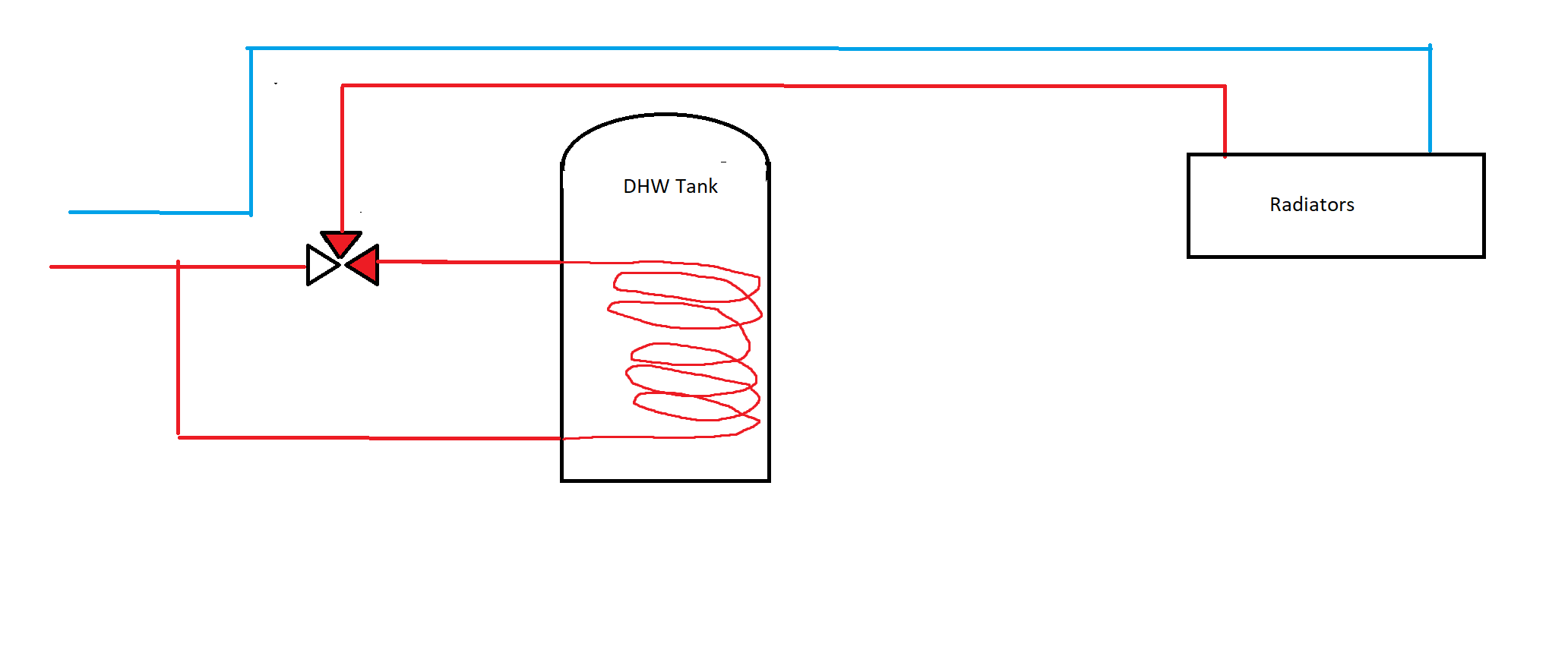
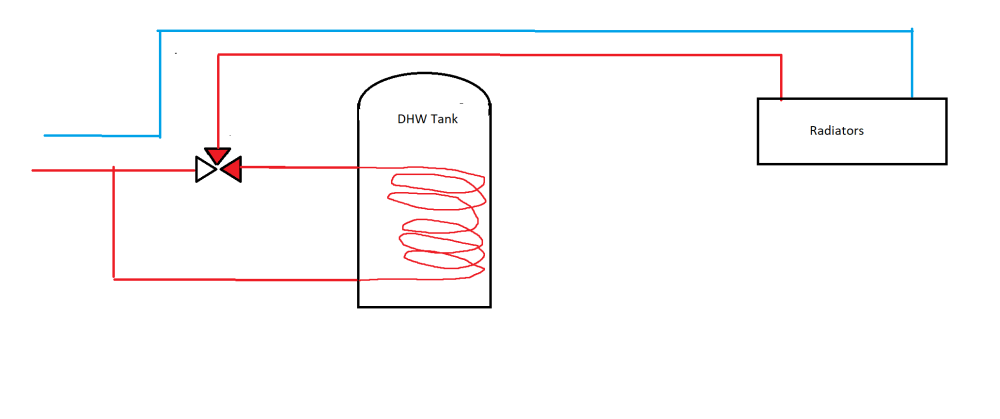
Any reason you couldn't plumb a hot water tank in series with the radiators? Would make sense to me given you normally want a higher flow temp through the tank than the radiators themselves. Crude diagram below
-
cable through to exterior- conduit required?
Trojan replied to jpadie's topic in Consumer Units, RCDs, MCBOs
Fitting, end box. Cut a 25mm hole in the back of the end box and screw in the adapter fitting, small section of conduit siliconed in the fitting and push it all through the hole from outside. Silicone round your hole where it comes through the OSB into your cavity. -
cable through to exterior- conduit required?
Trojan replied to jpadie's topic in Consumer Units, RCDs, MCBOs
Twin and earth isn't an exterior rated cable, not a problem if you're running direct through a wall into the fitting (ideally should be sleeved in a conduit but no ones losing sleep over it). Running it outside is a different story though and would need to be in a conduit, PVC would suffice if it's in an area not subject to mechanical damage. 10mm T+E is thick and fairly inflexible, you'd probably want 25mm conduit to pull that through. Any reason you don't want to use armour? -
That is a RCD not a RCBO - it has no overcurrent protection. The more concerning part is that looks like your consumer unit is being fed by what looks to be a 10mm twin and earth with no overcurrent protection (other than main fuse). How far is your CU from this breaker?
-
Positioning new CU, best CU, connecting CU to meter
Trojan replied to Del-inquent's topic in Consumer Units, RCDs, MCBOs
Yeah neither do I tbh. Another issue is that if you're removing the old CU you're potentially taking some/all of those cables out of safe zones. -
Positioning new CU, best CU, connecting CU to meter
Trojan replied to Del-inquent's topic in Consumer Units, RCDs, MCBOs
How old is the wall you want to go into? If it's old breeze blocks then honestly don't bother, if it's newer style concrete blockwork you might get away with it but I wouldn't be confident in saying whether that would be compliant with building regs (at what size does a hole need a lintel etc). Electrical reg wise - as long as it's 50mm from the finished surface of the other side it's ok. -
Probably depends on the model but the ones I was looking at are outdoor unit only with no pump. PUZ-WM50VHA. That's the one you should be looking at as well IMO
-
Positioning new CU, best CU, connecting CU to meter
Trojan replied to Del-inquent's topic in Consumer Units, RCDs, MCBOs
Obviously assuming this is a non load bearing wall. The hager board needs a minimum of 72mm to recess from the finished wall surface. With the 12.5mm plasterboard on each side (+ probably around 10mm each for dot and dab) you'd be right on the limit for being over 50mm from the other side of the wall assuming standard 100mm block. In reality though, good luck chasing a massive hole 50mm out of crumbly block without it falling to bits. Put it in the external wall or make do with a surface mount box. -
Positioning new CU, best CU, connecting CU to meter
Trojan replied to Del-inquent's topic in Consumer Units, RCDs, MCBOs
A bit confused at what you mean, I take it the internal wall you're talking about is perpendicular to the meter box wall? Are you planning to chase the cables into your block wall? If the cable is within safe zone on the external wall it's technically ok, if chasing though it's probably as easy to use SWA, clipping tails direct behind cabinet in zones is also ok. Fused isolator in the meter box is not a requirement if the tails are under 3m but isolator is always nice to have. -
Could you give a clearer picture of how it's plumbed into your system?
-
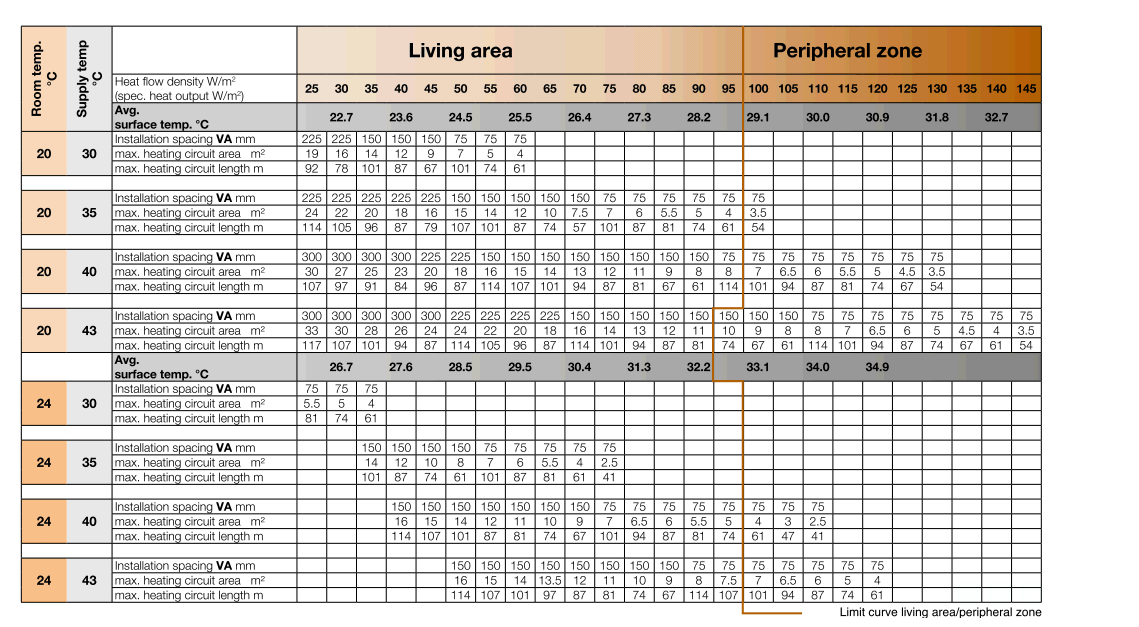
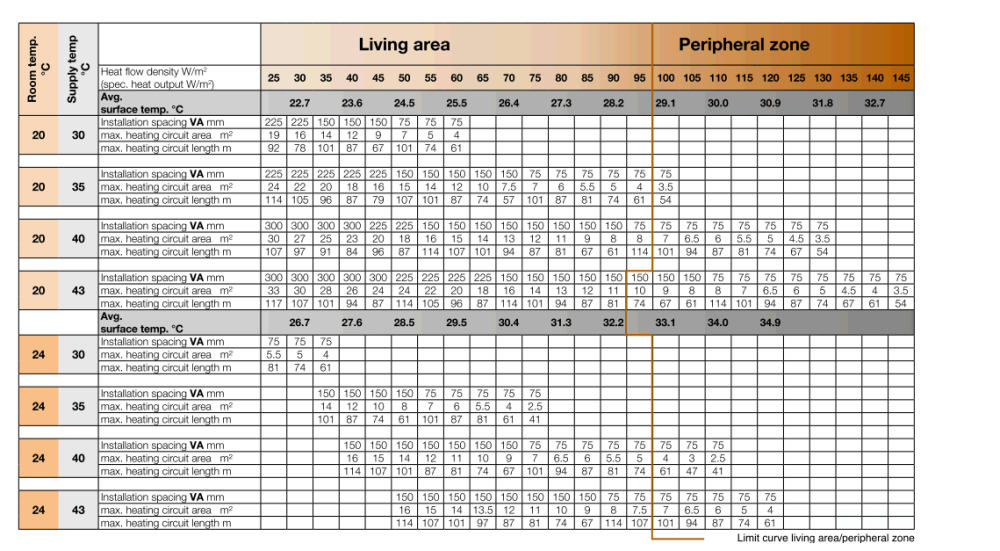
Similar to you badger I'm looking at installing a simple ashp single zone UFH system (although in a much higher heat loss area). This is a performance table I've been looking at to get an idea (they also have performance tables for their different systems and floor coverings, this ones fairly low profile with ceramic tiles - highest output). 4kW at 120m2 works out at 33W/m2. Looking at that 8 loops at 150mm centres would be more than sufficient and you could probably even get away with 6 or 7 at 225 centres while maintaining output at 35 degree flow temps. Looking into calculating flowrates a lot of google sources say 2-3 litres per minute or loop length/40. I watched a video of urban plumbers though where he calculates it by flow rate(l/s) = heat output(kw)/delta T(K) x 4.2 (specific heat capacity of water). Annoyingly his came out at 2.5lpm with a delta t of 7 so I don't know if it's just coincidence that he's in the range everyone else seems to use. If the formula is roughly correct though you'd only need 8 litres per minute (or 1 l/m per loop) for a delta t of 7, and the lower the output required (warmer days), the further that required flowrate falls. I've switched up the formula as I know the range the heat pump wants to operate (7-14l l/m) which would give you a delta T closer to 4 or 5 depending on output needed and flow supplied. I'd also urge you to go for the 5kw ecodan as it will modulate down to sub 2kw in warmer temps. Take everything I say with a pinch of salt though, I've not actually done it yet so it might turn out I'm talking complete pish.
-
He'll just be building the floor up with adhesive I'd assume