


sharpener
-
Posts
1492 -
Joined
-
Last visited
-
Days Won
1
Everything posted by sharpener
-
I agree, sounds daft, they do quite a good job of the fact-finding and survey and then come up with a proposition that is commercial nonsense. (Hence my earlier comment about banana boats.) Two heat pumps is in any case not permitted development whatever the noise level. Part of the explanation may be that the surveyors seem to be mostly self-employed sub-contractors who have no skin in the game provided their fees are paid by one party or the other. Can't find any retail prices or detailed specs or performance figures/graphs of Midea units for comparison. My concern would also be that the sole importer is claimed to be Freedom who have form for poor recommendations regarding buffers with Samsung HPs. No mention of a buffer with the Midea though, maybe they have better turn-down. @markocosic probably knows. Am still waiting for a Daikin HT quote from an installer highly recommended by ther distributors, but worry that the indoor unit has a 6kW inline heater in it, IIRC this will cause the DNO to suck their teeth and/or require an upgrade to 100A supply (which would be really disruptive because it would need new (25mm^2) meter tails through a very thick stone wall with other cables embedded in it). Scottish Power who are my supplier also invite HP enquiries but similarly don't have installers in Devon. They too know my address already so what is point? I am beginning to think it is like last year where I started looking for more PV in May and after contacting 20+ installers finally got 8 panels put up in November. Difference here is it is only April but OTOH no way am I having anyone disconnecting the oil boiler after 1st October.
-
As a Good Energy customer for my 2011 FIT installation they sent me an email today. It says Our engineers are already installing heat pumps in your area! They already have quite a lot of information about me in their database. So I click on the link in the message which takes me to their online estimating form. The first question is my address, which they already know. The rest of it is quite detailed, existing heating type, sq m, insulation and d/g, # of bedrooms, # of baths, # of showers. So far so good, I click on Continue. The wizard recommends a 16kW Midea M Thermal which is probably about right, "Continuous water supply temperature, 60°C even as low as -20°C" sounds good, installed with Magnafilter for £10582 inc VAT less the £5000 BUS grant. It says the 250l cylinder is optional for £2128 but warns that heatup may be slow without a new one. The Tado controller I decline for another £706. They guess I will need a typical 4 radiator upgrade for £1152 which sounds reasonable vfm so I tick that, bottom line is £6734 which is the best offer I have had on my house and I have been able to opt out of all the things I don't want. Conditional on a Zoom survey for £50. One click more to download the whole thing and BOOM! We are not installing in your area...yet Unfortunately this means we cannot progress your enquiry at this time. We are growing the team and as soon as we can install in your area we will email you to let you know. So what is their business model? They knew my address to begin with. So are there any areas where they are installing yet? Is it a fishing expedition to find out where best to deploy their limited resources? Or are they merely harvesting my data for a leads database which they are then going to auction to the highest bidder? (Though detailing Midea seems a bit specific for that.) Answers on a postcard please...
-
Well I guess we all did. But it's scandalous that even now it's not part of official advice on fuel economy. If you don't have condensing operation anyway you might as well have the Ideal Mexico which was simple, robustly built, and easy to service. <It's just sad that we don't get to make an informed choice, instead the industry does what it thinks is right (and for the majority of customers probably is right) rather than presenting customers with options. I suspect those in the industry will say, doubtless with some justification, that giving customers choice with trade-offs to evaluate is too complex for most customers. We are victims of our wealth (and perhaps our laziness?)> If "The industry" means the manufacturers then (having consulted for them) I think they are mostly OK but there is a total gulf between them and installers, be they one-man bands or national networks.* Ultimately I fear this is a lack of numeracy and basic scientific understanding on the part of the latter, which leads to over-simplification and playing safe in installation guidance. This is a far-reaching problem, underlying UK plc's poor productivity growth over the last decade and more. *According to a major manufacturer, condensate drain installation problems account for a large proportion of warranty callouts. I had to ask the plumbers who installed my gas boiler to re-do the drain as the pipe had a dip in it. When they had finished, it had a slightly smaller dip in it so in the end I sorted it out myself.
-
Do they think you came up the Clyde on the last banana boat or what?
-
Have seen the Samsung warranty stuff before e.g. here. From what I have read elsewhere you might as @JamesPa says do better with it as a 3-port buffer, as a compromise between too much mixing and not enought engagement. Ideally with the 1 port teed off the flow and the 2 ports on the return. If you can then tune the pump settings so there is least flow through the tank when the demand is greatest I think you will have better efficiency. Fortunately you seem to have better instrumentation than the installer!
-
Air Source Cylinder to power both hot water and underfloor?
sharpener replied to cee's topic in Air Source Heat Pumps (ASHP)
Ok, misinterpretation on my part. Still a long way from what is needed. -
Air Source Cylinder to power both hot water and underfloor?
sharpener replied to cee's topic in Air Source Heat Pumps (ASHP)
The killer info is this <0.663 + 1.5 (e-heater) = 2.163 kW>. So the actual HP is rated at only 663W i.e. only 22% of a standard 3kW immersion heater. Hence to get a reasonable reheat time you will have to use the 1.5kW electric element, even then it will be slower than a standard immersion. So no HP power at all left over for the UFH. Without seeing the property or doing heat loss calcs the best I can suggest is that from the cheat sheet here a complete renovation might need 30 - 65 W/m^2 so 3 to 6.5 kW for 100m^2. Many would disagree with this appoach, but it gives an order-of-magnitude indication of how much heat you might need and the combined ASHP is inadequate by a factor of 5 - 10. -
And quieter than the Grant and easy to interface with (mostly) external voltage-free contacts (though I was not looking at the 9kW specifically)
-
Air Source Cylinder to power both hot water and underfloor?
sharpener replied to cee's topic in Air Source Heat Pumps (ASHP)
Personally I would just look very carefully at the materials used but IIRC they are brass, s/steel and various polymers. The only problem might be de-zincification if you have very soft water, but you may be able to get a DZR valve more easily than a potable water one. I guess that is why the pumps are actually bronze. -
Air Source Cylinder to power both hot water and underfloor?
sharpener replied to cee's topic in Air Source Heat Pumps (ASHP)
I think @cee is talking about the hw cylinders that have a small integral HP supplied by air ducted from/to the outside. This won't IMO be suitable for supplying underfloor heating as well. You need a small conventional ASHP to supply both hot water and the UFH (at two different temperatures). With this in mind my detailed answers would be: 1. is 60l about right for 100sqm of underfloor? - not really the right question, you need to size the HP according to the heat loss of the heated room(s) 2. can I run both my washing water and my underfloor water off the same cylinder and not get ill from the water going around the system a bit? No, you need an indirect cylinder with a big coil suitable for HPs 3. Is this a good idea overall since it seems scarily cheap compared to other options (eg ground source pumps). No, it is scarily cheap because it is not a good technical solution. 4. Is the bathroom a good place to put the cylinder, my theory being that the bathroom will get hot during showers and baths and the cylinder can pick back up that heat more efficiently than in a cold room? If you are tempted to take the input air from inside the bathroom - even for a hot water only HP - be aware that the house will take in make-up air from outside by infiltration if no overt pathway and this will have to be heated somehow or the house will get steadily colder. -
Mad idea for DHW retrofit based on Mixergy?
sharpener replied to JamesPa's topic in Air Source Heat Pumps (ASHP)
Not quite. As I understand it is only the first HP that comes under Permitted Development in the UK. A second or subsequent heat pump requires full Planning Permission. So starting now, if you are lucky enough to get an HP installed over the summer but it turns out in October it isn't quite big enough you won't be able to fix it with an A2A this side of Christmas. -
Mad idea for DHW retrofit based on Mixergy?
sharpener replied to JamesPa's topic in Air Source Heat Pumps (ASHP)
You're making a lot of assumptions here and confusing two different houses owned by two different people. 1. I won't be "making a mess anyway" or taking any floors up, there is a straight uncomplicated run of 5m at ceiling height from the outside to where the oil boiler currently is. All the 22mm circuits (UFH downstairs, rads upstairs, cylinder coil) branch off there, just as @JamesPa describes above. Same in last house, could run 6m up the outside to where boiler is on 2nd floor. In both cases I would put buffer/thermal store where boiler is now. 2. I don't plan to fit a PHE, it was a thought experiment. As per earlier calcs the HP will get tank to 45 or more with existing coil, then if/when it shuts down the immersion takes over for last bit. Or a recirculating pump might improve the heat transfer without the PHE. Elec is free anyway as I have surplus PV most days even at this time of year. 3. I already have an unvented cylinder, and it was installed before the airing cupboard was built so that would need to be partly dismantled to fit a replacement. It is @JamesPa who has the vented cyliinder, and I sympathise with his unwillingness to pay good money to scrap off a working tank unnecessarily. -
Mad idea for DHW retrofit based on Mixergy?
sharpener replied to JamesPa's topic in Air Source Heat Pumps (ASHP)
These are not fundamental problems like trying to defeat the 2nd law of thermodynamics. They are engineering design problems like the ones I have been solving all my professional life. When I started in wind turbines 2MW was at the limits of what was feasible. Now 10MW is standard. If you want difficult conditions for rotating machinery try an ICE turbocharger, once they were extremely temperamental and fitted only to high end expensive cars, now they are commonplace. By contintually quoting current practice as though it was the unquestionable truth you are doomed to repeat it. FYI 18 litres/min with a delta T of 5 deg will transfer 6 kW of heat. That is 50% of a 12kW HP, so more than the minimum output and minimum flow. And it is a reasonable rate to heat a DHW tank. This flow will have a velocity of 0.9 m/s in a 22mm Cu pipe so is not noisy. Over a 20m run it will require delta P of 110mbar or a head of 1.1m which is unremarkable. This is not even 'A' level physics. If it does not demonstrate that you don't need 28mm pipework for a DHW tank then I don't know what will. -
Mad idea for DHW retrofit based on Mixergy?
sharpener replied to JamesPa's topic in Air Source Heat Pumps (ASHP)
Don't understand positive correlation between modulation ratio and gas pressure. Anyway for a monobloc it is all outside the building (like the 2 x 50kg propane bottles I saw this morning). Proposal is small (15 litre) intermediate store combined with inline boost heater as per discussion above. Edit: cross posted. Was distracted by finding this Samsung data sheet but it does not shed any light on modulation ratio. Seems to need boost heater to achieve 70C but I am not sure I am reading it correctly. Diagram shows hot gas bypass arrangement as discussed upthread, there is also an intercooler which will improve the efficiency. Is a monobloc so perhaps more versatile than the Daikin Altherma 3 HT. -
Mad idea for DHW retrofit based on Mixergy?
sharpener replied to JamesPa's topic in Air Source Heat Pumps (ASHP)
Something like this? Seems expensive for a 15litre/4.5kW unit but the 3kW is even dearer and you are now down to a 6kW HP. Still needs a drain for the pressure relief valve but if fitted in place of the combi it will be there already along with all the other connections needed. Add a flow switch and contactor to call for heat, and a timer to recharge from the HP every 30 mins during the day and conceptually we are there, obvs a purpose-designed unit would come into being with all this inside. -
Mad idea for DHW retrofit based on Mixergy?
sharpener replied to JamesPa's topic in Air Source Heat Pumps (ASHP)
Happy Easter one and all! There is an option to have an electric element up the middle, IIRC £119-95. But they don't tell you the rating of that either, I suspect it might not be 3kW. We seem to be getting there. You won't achieve a "power shower" - but they are the work of the devil from the pov of water consumption also. I get a more than adequate shower with 10 l/min, and when the rainwater filters are newly changed it even needs a restrictor in the flow (yes there is a UV steriliser as well). But many ppl have instantaneous electric showers, which have crept up in rating to 9.5 kW now (and 7kW was definitely on the meagre side), so a 10kW HP would give you the same performance if you need that much for space heating anyway. Some combi boilers have small HW stores inside to give a quicker response (though keeping them hot does waste energy) and you might want to do that too. The stuff about R290 seems to be something to do with flammable refrigerants only being allowed inside domestic premises in limited quantities if at all, hence my comments upthread about natural gas. But I don't fully understand it and last night I was unable to find anything on the web so I hope @markocosic or someone will be able to give us chapter and verse on the current and future positions in the UK. Meanwhile R32 seems to give adequate HT performance for the moment - but have you read about Vattenfall and supercritical CO2? The operating conditions for the compressor are pretty extreme! -
Mad idea for DHW retrofit based on Mixergy?
sharpener replied to JamesPa's topic in Air Source Heat Pumps (ASHP)
Of the last 4 houses I have lived in, all Victorian, two would have been relatively easy to fit new cylinders and two extremely difficult (several days' work incl. carpentry and redecoration). One (4-storey) house was heated by a boiler two floors up which would have needed very long connections to a HP. In none would I have wanted to replace all the radiators. I am not sure where all this concern about 28mm pipes comes from, I have not seen it raised as an issue before, either by installers or manufacturers. Where it is a real problem then having an HP for space heating and using E7 for DHW would seem to me to be a useful compromise and I may revert to that if all else fails. I think better turn-down ratios will come in time just as they have for boilers, there is no intrinsic problem with the thermodynamics. @markocosic can you provide an authoritative link to the issues surrounding R290 as a flammable gas? Surely this is a regulatory problem not an engineering problem. After all we allow unlimited quantiies of natural gas to be piped into our kitchens or bathrooms through a 22mm pipe yet in the whole of the UK gas explosions only seem to happen a few times a year (and then mostly because of tampering with the supply). I agree that split systems have some advantages and that is currently what I am awaiting a quote for (I may end up with an indoor unit with integral HW tank which I will use as a thermal store). I also wonder where is the equivalent of the combi boiler to provide DHW on demand? Personally I don't like them but they do save a lot of space. Most current HP system concepts still seem to revolve around having large quantities of stored HW, is this solely a result of the "modulation problem" or is it a lack of imagination? -
Mad idea for DHW retrofit based on Mixergy?
sharpener replied to JamesPa's topic in Air Source Heat Pumps (ASHP)
Me neither but I have had to relearn some of it for a series of boiler and A2A HX concept design projects. We even engaged the author of a book on HXs as an external consultant but he was not a lot of practical help. (Although I usually describe myself as an electronics engineer, in fact I have worked on everything from nuclear fuel handling to wind turbines via radio and laser systems. And if I could do it all again I might have designed bridges for a living, a wonderful discipline, WYS is very much WYG!) Anyway, if anything I would go further than you and say that once you have got the 60deg + or true 70C capability then you do have a drop-in boiler replacement, and it will be interesting to see how the competition reacts to what Daikin and Samsung are offering. There have been some interesting tweaks to the refrigerant cycle and the modulation issue can only improve; no-one even notices their gas or oil boiler going on and off all the time, it's what they do even with . I think however many people will baulk at having most of their rads replaced, for aesthetic reasons or needing to rearrange the furniture or re-decorate, and weather compensation (which is still far from universal) will give you all the benefits of a better CoP in less extreme weather. But I wholeheartedly agree that the best is the enemy of the good and the present approach is no way to meet a target of ?600k replacement installations/year. -
Mad idea for DHW retrofit based on Mixergy?
sharpener replied to JamesPa's topic in Air Source Heat Pumps (ASHP)
With the standard 0.8 m^2 coil the flow inside the coil may or may not be turbulent but is fast-moving enough not to be rate-limiting. I am pretty sure that the heat transfer will be restricted in a major way by relying on convection on the tank side. If you can get the heat away faster it would be much better. I think a pump on its own would do that. You can regard it as a stirrer or a de-stratification pump but mixing the contents is less important than replacing the water heated by contact with the coil with fresh colder water, though of course it is helpful for both reasons. Even the smallest one in @JohnMo's link upthread would turn the tank over 10 times in an hour! -
Mad idea for DHW retrofit based on Mixergy?
sharpener replied to JamesPa's topic in Air Source Heat Pumps (ASHP)
I've had a bit of a play on the web site he linked to. So far this is the best solution I have found, Eur125 list, or cheaper equivalent Eur51. (N.b. you have to use the tabs to get the price for the correct number of plates for these particular configurations.) Performance as under, will transfer 4 kW with a 5 deg drop from side 1 to side 2, with ~ 12 l/min flow rate and ~0.5m head loss. But I was wondering what result you would get by just having the pump to circulate the water in the tank. I would guess you could easily double the heat transfer compared with simple convection off the coil, this would (assuming linearity of yr model) give DHW at 52.5 and if 3x then 55 without any HX at all. Solarcoil looks interesting and not expensive but I wonder what its surface area is?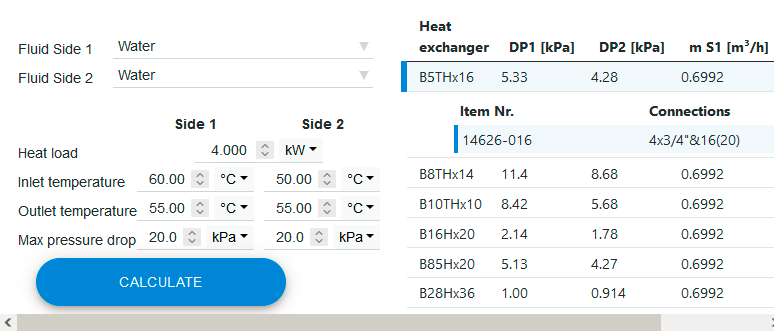
-
Mad idea for DHW retrofit based on Mixergy?
sharpener replied to JamesPa's topic in Air Source Heat Pumps (ASHP)
Nice analysis. Add to that the increasing penetration of free solar PV and it's even more compelling. Most HPs I have looked at in any detail (Daikin, Grant, CoolEnergy etc) have already forseen this use case, and an external call for DHW heating will automatically set a higher, programmable flow temp. At most you would need an additional timeswitch and/or thermostat to co-ordinate the HP with the immersion. BTW how did you get on with the HX selection? I see from this site that there are some typical DHW applications including this one for less that Eur 100. But also some warnings about limescale, and corrosion with open vented systems, so you might want the more expensive nickel brazing or gasketed construction. And they don't ship to the UK (thanks Boris). -
Two questions - I'm a newbie
sharpener replied to Adrian_london's topic in Air Source Heat Pumps (ASHP)
1. Not very likely. Starting now to get it done and snagged before next heating season I would plough straight on, there may yet be a lot of scope for delays of various kinds. Do we infer that if you pay the £500 and then do not go ahead after the survey it will be forfeit? Can you post a few details about your house (date, construction, total sq m)? What information was the £6100 based on, if they are willing to hold the price even before they have done the survey? Smacks a bit of desperate marketing to me. -
Mad idea for DHW retrofit based on Mixergy?
sharpener replied to JamesPa's topic in Air Source Heat Pumps (ASHP)
Generic, but only for UVC installations, where in the cold feed there is a pressure regulator which like the piling swivel in Henry Reed's Naming of Parts "you have not got". And this regulator typically has a port to feed cold to the showers at the same pressure as the hot so mixer taps work properly. As posted earlier, for a retrofit there will not be any spare tappings on the cylinder to connect the HX but you can make the hot connection to any convenient hw pipe. However the other connection must go into the cylinder low down and and on the cylinder side of the pressure regulator so with less freedom. Unless you reverse the flow and have a more powerful pump, then you could in theory connect it upstream of the regulator instead. A thought experiment on my part, but it is not very elegant on account of the additional pumping losses. -
Mad idea for DHW retrofit based on Mixergy?
sharpener replied to JamesPa's topic in Air Source Heat Pumps (ASHP)
Not sure where that comes in. Every three months I test the two pressure/temp relief valves, and once a year I check the expansion vessel pressure, clean the filter screen and write up the service record. Is there something else I should/could/must pay someone to do? If you have an S-plan setup you don't need the relay. DHW thermostat operates both pump and motorised valve, the contacts on the latter then provide voltage-free call for heat to the HP. No flow through the HX when themostat satisfied. Can easily lag the HX to reduce parasitic losses. I am with @JamesPa on this one and am now looking to see if I could incorporate it if necessary. Depends a bit on the pipe runs but certainly easier than a whole cylinder change, I hope being s/steel OSO it will have some life left. Unfortunately you can't use a pump powerful enough to push the water into the cold feed lower down (which is easier to get at) because the pressure regulator also supplies the balanced cold to the showers. Unless that is you only ever heat the water in the small hours when there is no chance of any simultaneous HW draw-off (you would also need two check valves). -
Mad idea for DHW retrofit based on Mixergy?
sharpener replied to JamesPa's topic in Air Source Heat Pumps (ASHP)
My mistake, for some reason I was thinking of the construction of the cheapo Stuart Turner jet pump in my rainwater system. And yet there is still something I have read or heard niggling away in the back of my mind.
