


sharpener
-
Posts
1492 -
Joined
-
Last visited
-
Days Won
1
Everything posted by sharpener
-
How to predict heat pump size from your EPC
sharpener replied to sharpener's topic in Air Source Heat Pumps (ASHP)
https://www.vaillant.ua/downloads/proekti/0020222099-10-compressed-2406863.pdf?fbclid=IwZXh0bgNhZW0CMTAAAR2cgInGE7BtvCgpdxYDszZUgKRAQE8jm3AIb_4C0KwHKwd_pHVLc5itfYA_aem_AaxrDlhR_6iT7VEGsQhhKVj5KjwLaeJTS-GNzLG_Gy5tBQRLd1zxg8__lVP42DpLQzO2V26rFwsW0FhdKIEFWMSo -
How to predict heat pump size from your EPC
sharpener replied to sharpener's topic in Air Source Heat Pumps (ASHP)
No. Most Vaillant installers I have spoken to do not know they exist. Nor did the V regional tech mgr for the SW. I have not found any explanation for why they are not available in either English or German (which I can read well enough). There is also a Planning your Installation doc of which the EN and DE versions are very different, it's all rather a mess, on the FB page there have been various discussions about this. -
How to predict heat pump size from your EPC
sharpener replied to sharpener's topic in Air Source Heat Pumps (ASHP)
You can download the full set of tables from the Arotherm FB page here starting at p34. So I can't see any way the 5kW model would satisfy this even with massive rads and a flow temp of 30. -
How to predict heat pump size from your EPC
sharpener replied to sharpener's topic in Air Source Heat Pumps (ASHP)
Heatpunk gives 7763W as the output at 53C flow and -2.3 OAT. So by choosing 53 not 45 as the flow temp it would still more than match the heat loss, and you might well need fewer radiator upgrades and maybe saving more in capital than you would lose in running costs. You will probably not find an MCS installer willing to do this though. When I lived in Hitchin there was snow on the ground for some weeks in I think the winter of 1968 - 69, but it was most unusual, I don't suppose you will see -2.3 very often nowadays. -
How to predict heat pump size from your EPC
sharpener replied to sharpener's topic in Air Source Heat Pumps (ASHP)
That's probably why they "highly rate" them! Also as an umbrella provider it de-risks the relationship with the actual installer. -
How to predict heat pump size from your EPC
sharpener replied to sharpener's topic in Air Source Heat Pumps (ASHP)
FWIW I received this comment from @mk1_manyesterday: "Air2heat highly rate Panasonic units especially the new R290 versions." They operate an MCS umbrella scheme and are in Shropshire. -
How to predict heat pump size from your EPC
sharpener replied to sharpener's topic in Air Source Heat Pumps (ASHP)
I don't think we even had EPCs 20 years ago, this article says they were introduced on 1 August 2007. Michael Podesta's blog on predicting HP size from gas consumption dates from 2022, and the extension of the idea to EPCs first appeared yesterday AFAIK. -
How to predict heat pump size from your EPC
sharpener replied to sharpener's topic in Air Source Heat Pumps (ASHP)
Do you have a reference for this? It was new to me. Yes. If for example you are looking at houses to buy they will have to show you (or you can look up) the EPC and from this you might then get a fair idea of HP size. As you also could using the Heat Geek cheat sheet. And then you could work out where it might be sited. (The installers who came yesterday are proposing a big Stiebel Eltron mounted over a passageway on wall brackets). But you cannot retrospectively ask for a year of weekly meter readings to be done, at most you might get quarterly gas bills and of course in that case the result would be more accurate than using the EPC. -
How to predict heat pump size from your EPC
sharpener replied to sharpener's topic in Air Source Heat Pumps (ASHP)
The three that you have to extrapolate in this seem to be rather different from the first three so I would be a bit sceptical about using them but I suppose taking the median helps. I take it these are perhaps smallish ?terraced houses (or maybe bungalows) of identical floor area? In which case an HP of 0.4 x 5.9 = 2.4 kW sounds plausible, whereas your 1 does not. -
How to predict heat pump size from your EPC
sharpener replied to sharpener's topic in Air Source Heat Pumps (ASHP)
Well clearly if you have got all the underlying data then it is of course better to use that in Jeremy's Spreadsheet or Heatpunk or Heat Engineer. I have been impressed by Michael Podesta's use of degree-days to calculate HP size from gas consumption. Essentially this method just estimates gas consumption from the EPC figures which can then be used to imply a certain HP size. The old GINO adage always applies, Garbage In Nonsense Out. -
How to predict heat pump size from your EPC
sharpener replied to sharpener's topic in Air Source Heat Pumps (ASHP)
No, I think you have got the dimensions wrong, but I am not sure I follow yr calcs, the product is the HP size in kW not kWh.m2.Year-1. Don't know what yr 1.75 is. Should kWh.m2.Year-1 be m-2? -
How to predict heat pump size from your EPC
sharpener replied to sharpener's topic in Air Source Heat Pumps (ASHP)
Mine issued 22/5/23 doesn't, in fact it does not have numbered sections at all. It just has (separate) estimates for total annual heat requirement in kWh like this: Estimated energy needed in this property is: • XXXXX kWh per year for heating • YYYY kWh per year for hot water I haven't been able to find an example online that looks exactly like mine. There are several links to this format which appears to date from 2012, however somewhere I read it was discontinued in 2017 so not a lot of help. Your method is fine @JohnMo so long as your EPC shows such a high level of detail, what date was the EPC survey done? Can you find a similar published example or could you post an anonymised extract so I can see what the relevant bit looks like? -
How to predict heat pump size from your EPC
sharpener posted a topic in Air Source Heat Pumps (ASHP)
Here is a thought-provoking result: Estimated Heat Pump size in kW = 0.4 x (Total EPC annual energy requirement in MWh) For the reasoning behind the formula see this post in Michael Podesta's blog. It would be interesting to know whether anyone on here has results which agree with it, or otherwise! -
Ground array: future project, what cables
sharpener replied to Post and beam's topic in Photovoltaics (PV)
And when you draw the cables through also draw a second messenger so you have always got one in the duct for the next cable and so on... -
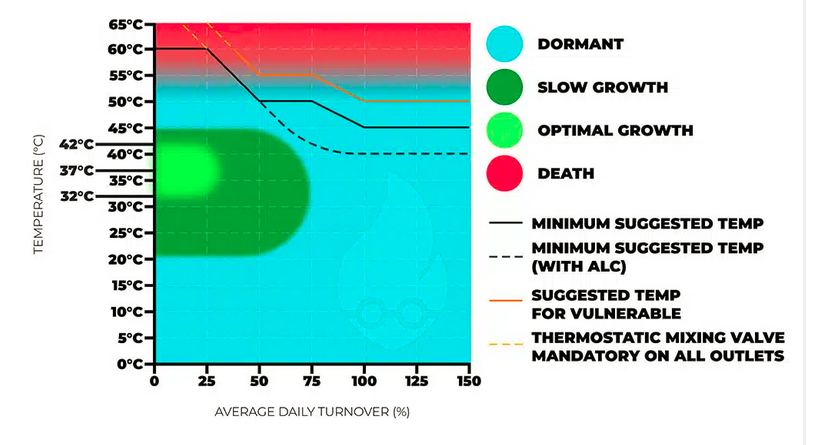
and there is also this which I have taken from the HG site (though IIRC it was not originally theirs), the other significant axis is turnover rate. Personally I think the risk in domestic premises is vanishingly small. We use filtered and UV treated rainwater and even when we are away the PV keeps the tank at 55C all the time, so have never had a problem with it in 17 years.
-
Would that be 90 mins? Maybe the button is faulty or there is a loose connection having the same effect? But only on Mondays, no I am stumped, ask yourself what else (apart from the cleaner) is special about Mondays? Perhaps the button gets knocked when you get the clean sheets/towels out of the airing cupboard? Or bang it with the vacuum cleaner, I am grasping at straws now.
-
Could it be that your cleaner comes on Monday mornings and routinely boosts the immersion heater or something like that?
-
Yes but since the OP wants two zones he will mostly likely be fitting a VR71 wiring centre and this has 3 separate outputs for up to 3 zones in addition to the HW. So no relay needed in his case though I appreciate the advice was useful and intended more generally.
-
That's what might be inferred from this incredibly unhelpful piece of publicity material but AFAICS it will be entirely adequate when fitted with this H-box 12 or similar, this is the "third party control" referred to. The H-box does indeed have the voltage-free relay output you need, which is an OR-function of the individual room stat demands. As it says on that spec sheet, any one room stat will then be sufficient to call for the HP to run. So you just need to wire those two terminals to the FTC2BR, job done. The Mitsi instructions are very easy to follow and personally I would have no hesitation in tackling the wiring as a DIY. BTW I take it you mean a mechanical tempering valve on the manifold, not an electronic one which is unnecessary given you do not have any rads. Yes although @mk1_man is in some ways in a similar position I had worked out it was yr own thread.
-
Am no Mitsi expert but having read the FTC6 instructions in connection with this thread I had a quick look at the FTC2BR, it is what is packaged with the smaller Ecodans and I think should be sufficient for your purposes as you do not want to control multiple circuits or mixing valves for which the FTC6 is required. AFAICS it will do WC and accept a voltage-free input assuming that is what the Wunda Hbox setup provides. As many have said in the past the best approach is often to utilise the individual zone stats more as a high limit set to 22C or so and drive the whole house as a big open circuit (whether using WC or fixed temps). That way you can avoid using a buffer - subject to the total volume being sufficient for defrosting. The room stats can be trimmed down as a later adjustment to allow for solar gain or lower temps in bedrooms.
-
For a new system it's entirely reasonable. For retrofit less so but then if you have been told you need a new cyl then the odd valve is down in the noise. Many ppl seem to be against pre-plumbed, they are intended to be foolproof so fools can install them, but constrain the layout as all the ch flow has to go via the cyl location whether sensible or not. Fine if there is a central plant room but not good if the cyl is going in the loft. Also the Vaillant FB page has reports of poor quality control, no 100% end-of-line pressure testing and hence fittings leaking on arrival. Used to be made by OSO, maybe they have changed to a cheaper supplier? Gledhill ditto, reports of leaks and also rattling noises from inadequately supported coils. Recent Honeywell valves as well, reports of balls becoming detached.
-
Off-peak energy storage for cheaper heating
sharpener replied to Originaltwist's topic in Other Heating Systems
Heat lost from the top of the slab is not wasted as it is within the thermal envelope, and to take @Tim S's recent example 37 tons of concrete beats any plausible amount of water even though it has only 1/4 the specific heat. Several ppl on here report good results, as mentioned below: -
Off-peak energy storage for cheaper heating
sharpener replied to Originaltwist's topic in Other Heating Systems
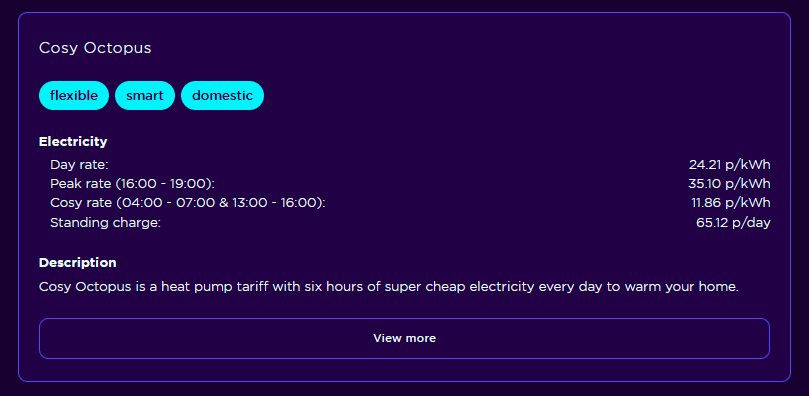
Octopus Cosy is well suited to this, you get 3 hrs overnight and another 3 hrs 1300-1600 which is ideal for a recharge before the evening peak. It will need some more modelling before I know if this is a better bet than Intelligent Octopus Go.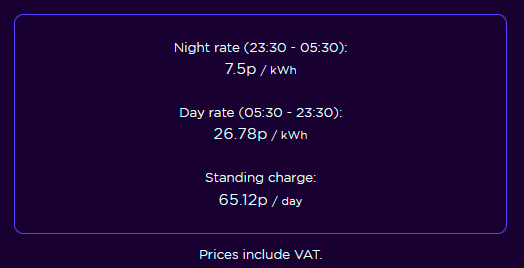
-
Because as @JamesPa says that was the deal to get early adopters to invest in PV. We paid £14k in 2011 which was a lot of money and would not have done it without the incentive. The breakeven point neglecting the cost of capital was 6 years which I think is about right. I worked for the DTI at one point and like many other government grant schemes this one was in part designed for political purposes and with hindsight could have been a lot better. In particular rewarding Total Generation not export has never made a lot of sense. And IMO it should never have been allowed on agricultural land when so many commercial and industrial roofs are still out there. Nevertheless I think it achieved its objective in that domestic PV is now commonplace.
-
Off-peak energy storage for cheaper heating
sharpener replied to Originaltwist's topic in Other Heating Systems
Yes, thermal storage is defo much cheaper than batteries and I agree in principle, but as you demonstrate @Originaltwist you have to do it on a heroic scale for it to be truly worthwhile. We only have room for a 260 litre thermal store, the economics are analysed here but in brief you have to assume 20% inflation in electricity tariffs to get a 10 yr payback. I am planning on doing it as much as an interesting experiment as for its economic value. The other issue is that MCS installers are not used to thinking like this and in a sellers' market mostly want to throw in standard systems at maximum profit rip-off.

