embra
-
Posts
59 -
Joined
-
Last visited
Everything posted by embra
-
Hey @TonyT thanks for the comments and tips! I've prepared my own heat loss calc which was a useful baseline to compare to that coming from heating engineer. My (more on the optimistic side) estimate puts us at ~5kW design case, whereas his draft model is more like 10kW! There are some obvious points of difference in there (e.g. he has not accounted for new insulation we're adding, new windows etc). We're going through in detail next week so hopefully we can come to a sensible agreement and avoid over speccing the system. Are you aware of any guidance on specific products, or a go to spec that I could use? Have included space in a riser duct for PV cabling (will be installed after building works). I hadn't really thought of EV cabling, since our meter / consumer unit is in our garage and I assumed it would be a simple case of running a cable to the driveway which is immediately outside the garage. Am I missing anything here?
-
Internal wall insulation on 1990s insulated cavity
embra replied to embra's topic in Heat Insulation
@IGP thanks for the comments. Based on a couple of borescope images (unfortunately I don't have a copy of these), we seem to have ~25 mm thick EPS foam boards in the cavity between outer brick and inner block it doesn't look particularly well secured, or evenly distributed. Is it feasible to just top this up with blown EPS beads? I'd love to get more insulation in there, but not sure if we need to try and remove the existing stuff completely before considering anything else. Or whether to simply ignore the cavity and focus on internal insulation only... -
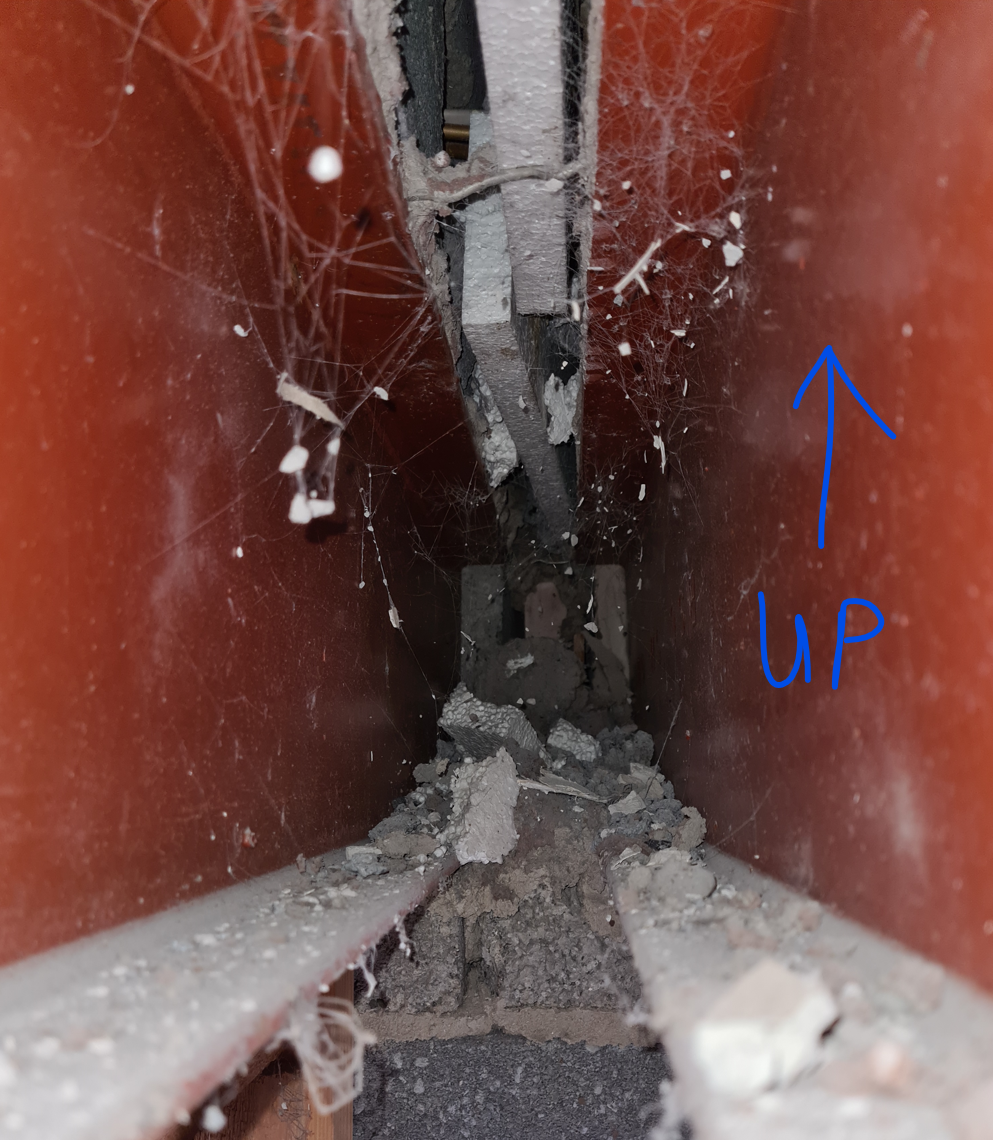
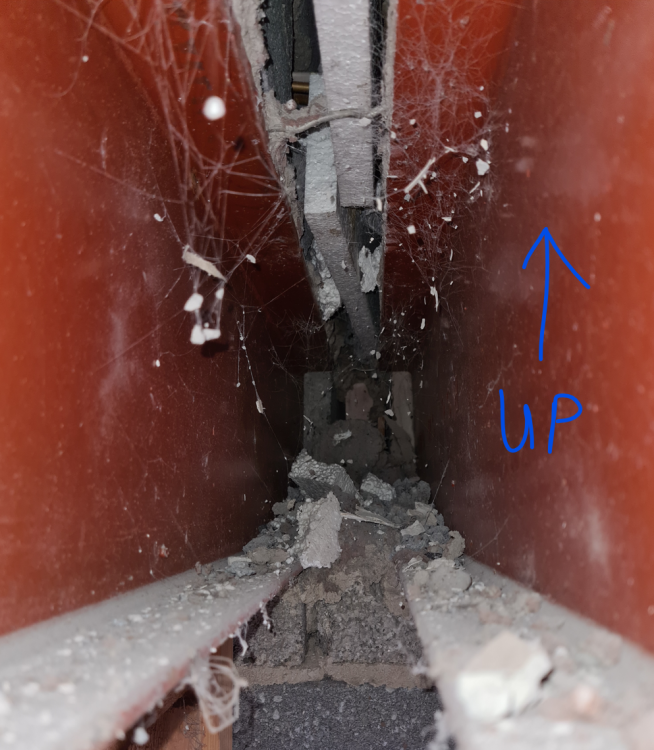
Our ~1990s built home has ~25 mm thick EPS foam boards in the cavity between outer brick and inner block. Based on a couple of borescope images (unfortunately I don't have a copy of these), it doesn't look particularly well secured, or evenly distributed. Is there any established method to break up these foam boards, ready for removal by vacuum? This would then leave the cavity ready to be refilled in a more complete / consistent way via pumped EPS beads. I'm trying to work out if it's worth investing more into improving the cavity insulation, or to focus solely on internal wall insulation (or maybe a combination of both). Sharing a photo as an example (not the actual external cavity wall, but an internal block / block wall with similar insulation between). I realise this is a very similar ask to @HughF's recent thread, but wanted to ask specifically about removal of EPS foam boards.
-
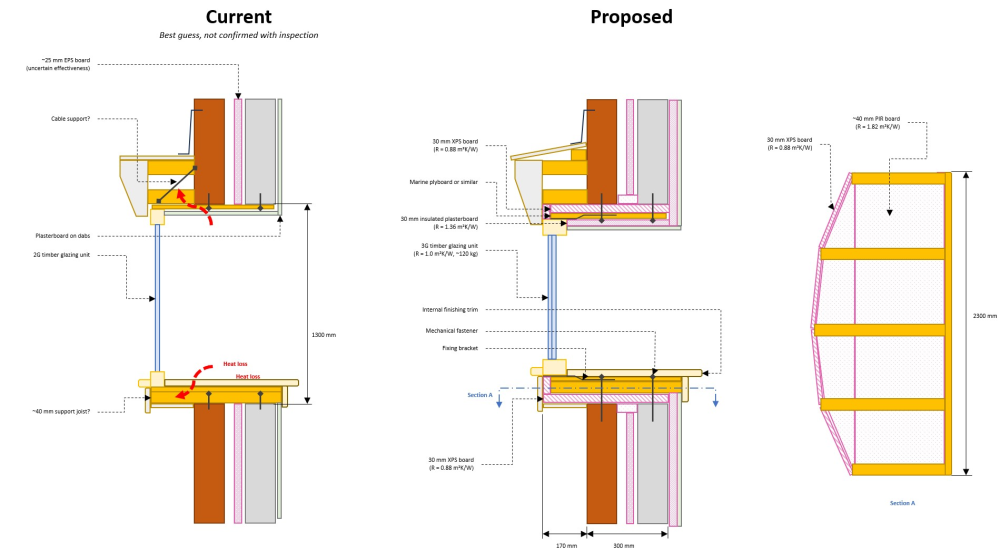
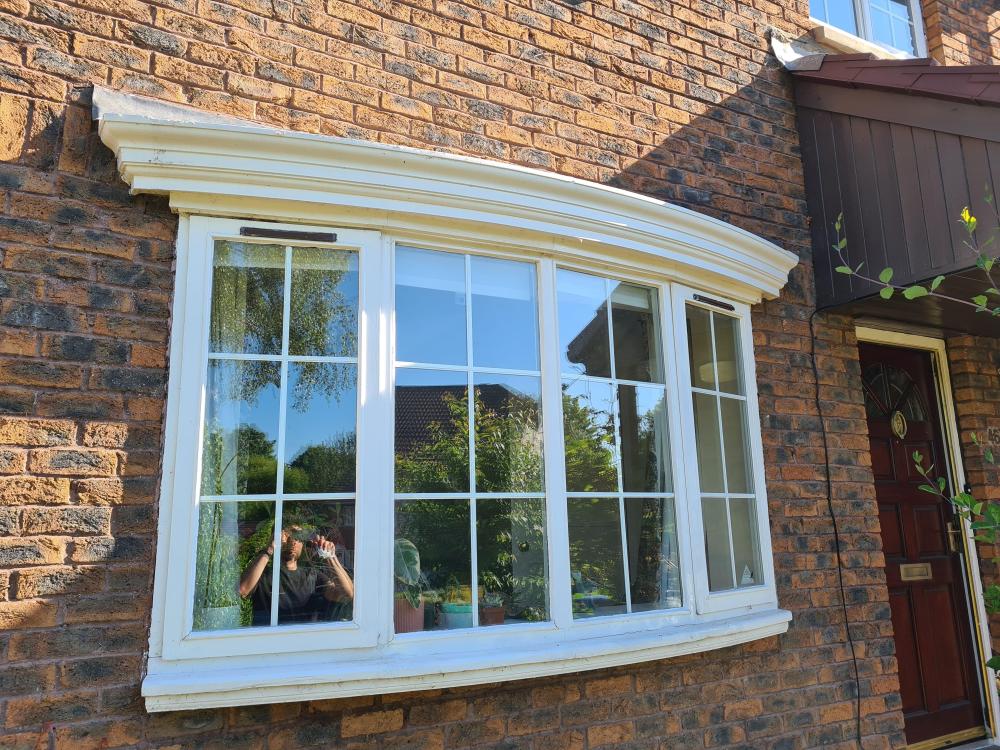
Hi folks, As part of a renovation project on my home, I’ve asked my joiner to replace the bow window in our living room, and would like to ensure the make up of surrounding materials is matched to the thermal properties of the new windows. I’ve narrowed down the search for windows and am settling on triple glazed timber units with a whole unit window u-value of ~1.0 W/m²K. I’m using this value as a worst-case upper limit to guide design for the surrounding structure. After scratching my head and doing a bit of reading, I believe something like the below sketch would be suitable. Interested in any guidance or pointers to help keep discussions with the joiner on track. I’m most interested in simple / pragmatic solutions – we’re improving what we can but will be nowhere near Passivhaus etc standards. Thanks as aways 🙏
-
Hey folks, can anyone comment on price difference between Rational and Bereco on same scope? I have quotes from Rationel already but targeting a price point around 20% less than their current offer.
-
Hi folks, We're remodelling our ~1990s built two storey, end of terrace home, and I'd like to improve our current wall insulation, since at present it offers the least thermal resistance of the building fabric. I'm interested in recommendations on approach we can take to improve this. Walls Current: Brick / cavity / block walls with some questionable looking EPS boards in the cavity. Dot and dab plasterboard on the inner block. Plan: Help! 😬. I've read a lot of conflicting information about whether internal insulation is suitable or will cause interstitial condensation. Also not sure of the most cost effective construction method (insulated plasterboard on dabs, insulated wet plaster etc...) There would be roughly 34 linear metres of wall to insulate per floor, at 2.4 m ceiling height. I’d like to focus on simple and practical solutions that we can relatively easily implement. The underlying work for our builder is to reconfigure the layout involving some light structural changes, and construct a porch area (all on ground floor of property). We're having the heating system pipework upgraded to suit low flow temperatures and fitting an ASHP. Any disruptive works (e.g. plasterboard off) would be constrained to ground floor initially, and could be extended to first floor as a phase 2 at a later date. Construction materials are: Ground Floor Current: Uninsulated beam and block, battens, chipboard deck. Plan: Lay DPM / PIR / floating floor deck on top of beam and block. First Floor Current: Chipboard deck suspended on timber joists. Plan: Nothing so far. Roof Current: Pitched roof / cold loft, around 100 mm wool insulation already laid. Plan: Increase to ~300 mm wool insulation. Happy to hear everyone's thoughts and advice 🙏
-
Hi folks, We're remodelling our ~1990s built two storey, end of terrace home, and I'd like to establish some simple practical guidelines that can be followed by our builder and myself to improve energy efficiency. I’m looking for advice on 1) air tightness, and 2) insulation for our external walls. I’d like to focus on simple and practical solutions that we can relatively easily implement. The underlying work for our builder is to reconfigure the layout involving some light structural changes, and construct a porch area (all on ground floor of property). We're having the heating system pipework upgraded to suit low flow temperatures and fitting an ASHP. I'm getting anxious that I'm missing an opportunity to make improvements now, as we won't have the appetite at a later date. It's almost certain I'm overthinking this, and hoping advice from others who have done something similar will help. I’d like to understand achievable air tightness and wall insulation improvements that we can intercept at this point, while keeping incremental project time and cost to palatable levels. Any disruptive works (e.g. plasterboard off) would be constrained to ground floor initially, and could be extended to first floor as a phase 2 at a later date. Construction materials are: Ground Floor Current: Uninsulated beam and block, battens, chipboard deck. Plan: Lay DPM / PIR / floating floor deck on top of beam and block. First Floor Current: Chipboard deck suspended on timber joists. Plan: Nothing so far. Walls Current: Brick / cavity / block walls with some questionable looking EPS boards in the cavity. Dot and dab plasterboard on the inner block. Plan: Help! 😬. Read a lot of conflicting information about whether internal insulation is suitable, not sure if we have the time / budget to make air tightness improvements that will actually be worthwhile Roof Current: Pitched roof / cold loft, around 100 mm wool insulation already laid. Plan: Increase to ~300 mm wool insulation. Windows / Doors Current: Original (~35 years old) 2G timber units, with trickle vents. Plan: 3G timber units, no trickle vents. Air tightness strategy: Easy (current thinking / approach) Illbruck expanding air seal in gap between skirting and plasterboard (ground floor, and ceiling joint of first floor from loft. Seal up any holes in the external brick with mortal, and blocks with expanding air seal. Tape ground floor DPM to plasterboard, and cover with wet plaster / skirtings. Tape all window / door openings, skim with wet plaster. Seal gaps around frames with expanding foam strip. Seal around any penetrations for services / sockets / light fittings etc with expanding air seal. Make sure brick / block cavity is closed at top of leaf in loft space. Remove shower / kitchen extractors that are currently ducted directly outside. Install MVHR positioned in loft. Remove other causes of drafts (gas fireplace and boiler flue, cat flap, penetrations for TV aerials, etc...) Caulking (or is there a better product) around all internal plaster corners Fit draft strips / insulation to loft hatch Re-glue joints in first floor chipboard deck (not really sure if this helps) Medium ??? Hard Remove all internal plasterboard. Fit air tight membrane / boards. Remove plasterboard / floor deck to enable taping around first floor joist / wall junction. Fit insulated plasterboard, skim with wet plaster. Fit vapour check layer and air tight membrane in loft at joist level, fully tape joists etc. Probably need a professional to design the details Happy to hear everyone's thoughts and advice 🙏
-
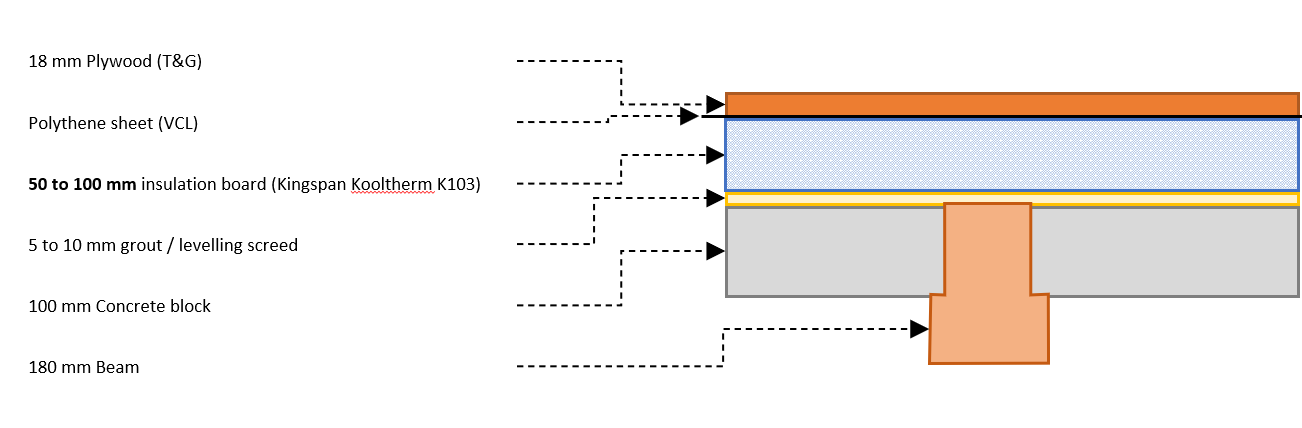
I'm looking for some advice on floating floor construction build up. As part of a renovation project for our ~1990's built home, I want to insulate the ~70 m2 ground floor which is currently of uninsulated beam and block construction with a vented cavity. We are constrained on height of materials that can be added on top of the beam and block, mostly to match existing finished floor level at the bottom of the hallway staircase, but also to avoid shrinking the ceiling height (currently ~2.4 m above finished floor level). So far, it seems like a ply (or other floorboard) sub floor floated on phenolic foam insulation panels will give best combination of thermal resistance, stack height, and cost. We would then add floor coverings, likely all vinyl tile with one room carpeted. I've added a sketch of the proposed build up. I'm looking at using Kingspan K103 which has a compressive strength of 120 kPa at 10% compression. The main questions I have are: Is 18 mm ply going to be rigid enough to avoid deflections / point loads being transferred to the insulation panels? Do we need battens anywhere? So far thinking adding these in doorways, under kitchen units, and for bathroom fittings. IS it necessary to factor in a 6mm ply layer on top as a "sacrificial" covering in case we go with glue down vinyl? Should this be fixed with screws? Interested in thoughts on these points, and anything else I might be missing. If there are any general guides to floating floor construction would appreciate the share.
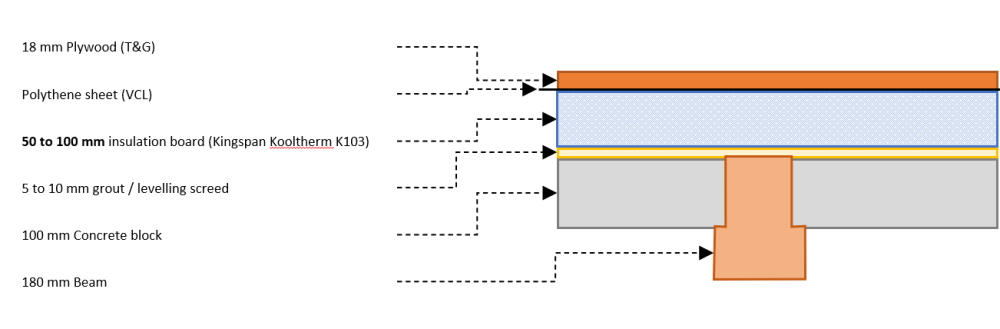
-
Best Subfloor for UFH with Suspended Timber Floor?
embra replied to hammerandnails's topic in Underfloor Heating
Hey @hammerandnails, what did you go for in the end? I'm also interested in using the NoMorePly TG4 boards on a project -
Interested to know how you got on with Fastwarm Duo panels? What was the final floor build up that you went for? Did you keep the 22 mm decking and float on top of the UFH panels? What output per m2 did you need? Also looking at the Fastwarm system and interested in others feedback!
-
Still not following... 100 W/m2 is not the heat loss of the house, if that's what you're implying. I'll need the same heat energy input to the house no matter the specific output per unit area of the UFH system. What's important to me is that I can achieve the right absolute energy output from the UFH in areas where it's not practical to cover the entire floor area with UFH.
-
I'm sorry, I don't follow. Why is it expensive to run underfloor heating at 100 W/m2?
-
I'm also looking for a high output (need 90 to 100 w/m2), low profile system for a renovation project. Did you make a decision on which system you're going for? Which companies supply Variotherm in the UK? I'd be interested to take a look. I'd also had a look into Continal tilefix, seems to be quite expensive though!
-
Creating access hatch in existing beam and block floor
embra replied to embra's topic in Floor Structures
I spent longer than I care to admit running through the MC heat pump / heat loss calculator yesterday. This allowed me to carry out a sensitivity analysis of insulation thickness vs whole house heating cost, and therefore determine payback period. I used Kingspan K103 (thermal conductivity 0.019 W/mK) as a basis, with 25 mm insulation as a starting point. Helpful perspective to avoid chasing diminishing returns. @Redbeard the beam and block is ventilated - is there a recommended approach for factoring this into u-value calculation? I did investigate Optim-R in the past (thermal conductivity 0.007 W/mK), initial discussion with Kingspan revealed the cost would be ~5x that of K103, meaning the payback just isn't there in our case.
-
Creating access hatch in existing beam and block floor
embra replied to embra's topic in Floor Structures
It's an end of terrace, ~9m front to back, ~8m side to side. Party wall is ~9m in length. -
Creating access hatch in existing beam and block floor
embra replied to embra's topic in Floor Structures
Reason for access: I'm investigating adding insulation below the beam and block floor, since there is none at present. Current floor construction from top to bottom: carpet, 18 mm chipboard, ~50 mm wood battens @ 400 mm centres, concrete beam (180 mm) and block (100 mm), 300 mm void, DPM, ground. Therefore I would not be breaking any existing DPM. There is more than 200 mm between beam centres, however I haven't managed to measure centres exactly.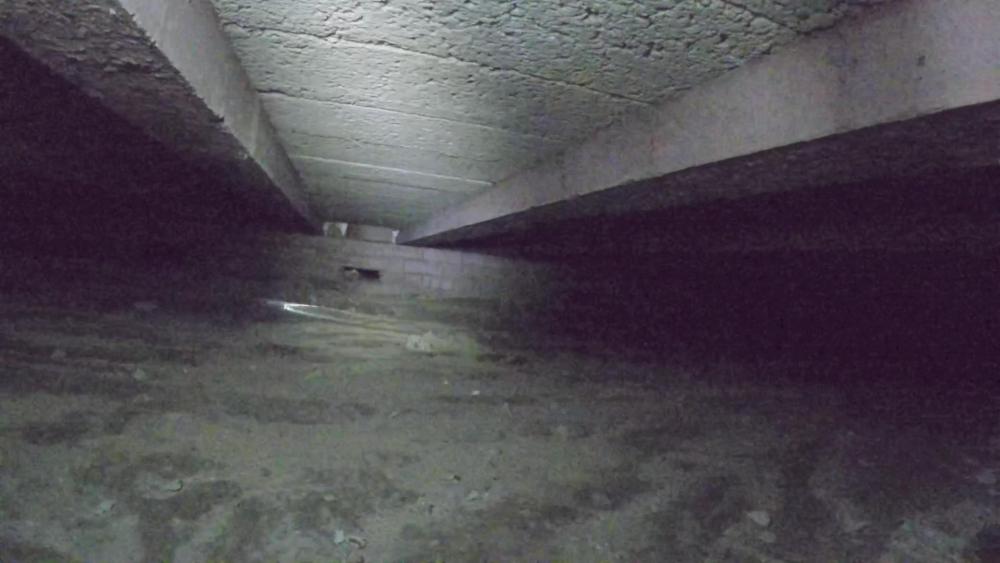
-
Thanks for bringing this up, I am not familiar with assessing potential for heave - can you share any guidance or pointers? I'm going to have a look at this page to start with. Property was originally built ~1990 in case this rules out certain scenarios. Internal ceiling heights are ~2.4 m from current floor finish, the larger issue with raising the floor height would be the effect of creating an unequal rise on the last step of the stair case from ground to first floor. Of course there is the option to install a new staircase which may prove to be simpler / more cost effective than sub floor insulation.
-
Really interesting analysis, thank you for taking the time to prepare and share these. A great illustration that insulation detail and positioning can be more significant than improving thickness / thermal conductivity. As a huge favour, would you mind running a couple more scenarios to add some data to ideas I've been toying with? 1) Repeat of the last scenario, albeit with a 50 mm only layer of insulation at a thermal conductivity of 0.019 W/mK (Kingspan K103)? Since I'm really constrained on stack height, I'm interested to see how the reduced thickness vs better thermal conductivity balances out. No insulation in the void. 2) As 1), but with a 120 mm layer of insulation at a thermal conductivity of 0.026 W/mK directly under the beam and block (to evaluate Q-bot application), as well as the 50 mm K103 insulation "inside" the house. Most appreciated 🙏
-
These are great points, and the reason I wanted to get opinions from others. I need to follow up with the supplier to see if there is any other approved arrangement for retrofit installation that are compatible with non-continuous DPM. I have been able to confirm the presence of a DPM in good condition on top of the ground in the void, but I can't confirm how it interfaces with DPC in blockwork etc and whether there is continuity. The floor was not insulated when built in ~1990, I believe this was allowable back then (source). This is why I'm looking for creative solutions to reduce energy loss through my existing floor.
-
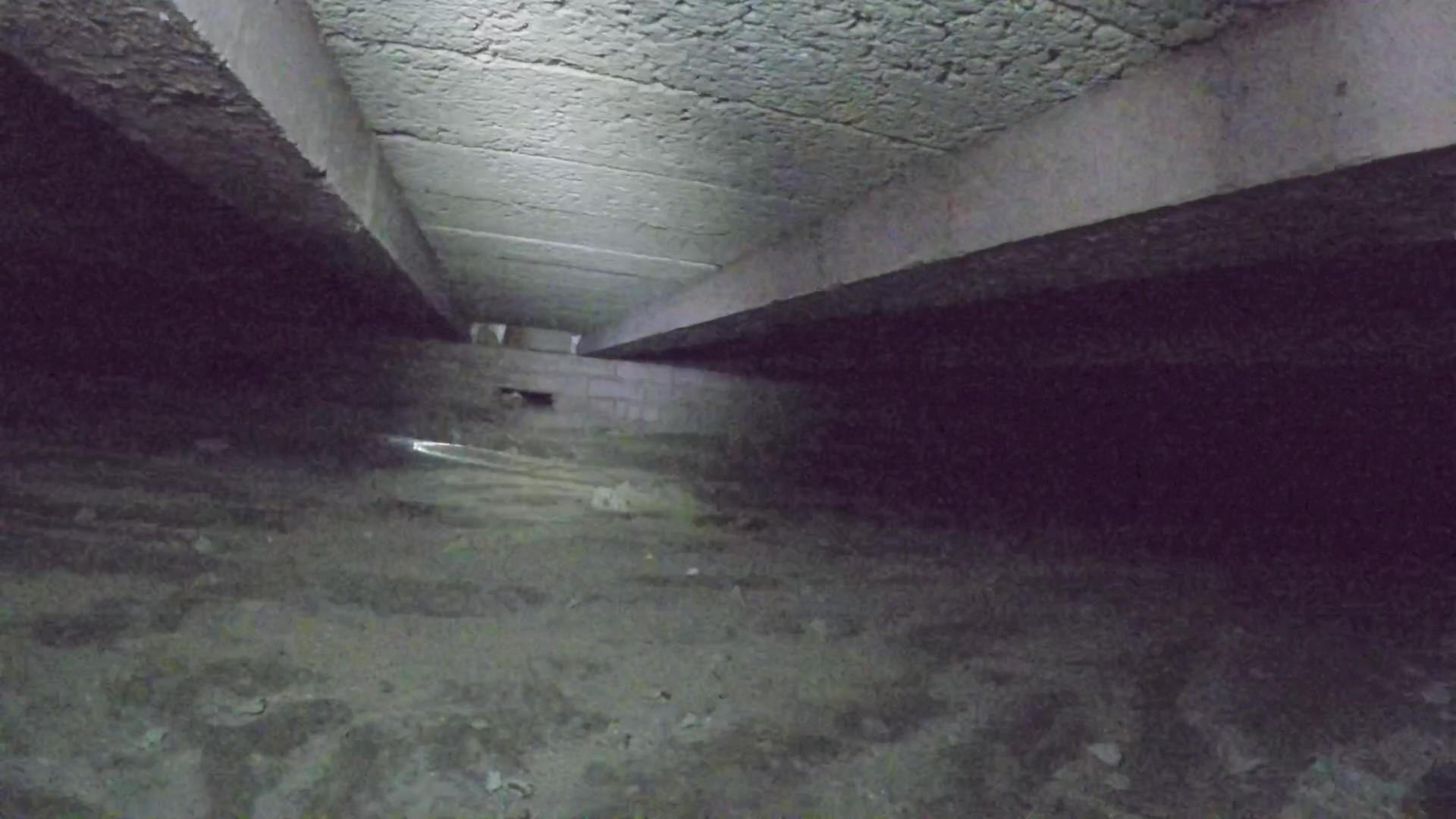
Hi everyone, Looking for some advice on creating an access hatch in an existing beam and block sub floor. There is currently a ventilated void of 300 to 380 mm (depending on interface with beams) beneath the subfloor, with no access to the void space. Our property was originally built ~1990 and is located in Edinburgh, Scotland. Ideally I would like to create an opening at least 400 x 400 mm. Is this as simple as cutting a couple of blocks out with a disc cutter? Anything else to be aware of? Beams would be left alone, so the opening would be limited by the beam centres in one dimension. Thanks in advance!
-
Yeah this for retrofit into an existing building. Actually, even in the new build scenario the beam and block floor is installed as normal, and then the beads are injected through holes drilled between the blocks (similar to retrofitting cavity wall insulation). This keeps everything in place. For reference the system manual including installation process can be found here. Since I already have telescopic vents installed, I'm trying to work out if I should do something to specifically block these up? In theory they would be blocked by the beads (coated with PVA) upon injection anyway... I haven't seen many examples of this overall approach, so I'm really interested to hear all opinions.
-
Unfortunately I cannot find a practical way to add more insulation above the sub-floor, without knocking the house down and starting again. The supplier has obtained an NHBC acceptance certificate for this arrangement in a new build setting, which is why I wanted to understand if there are any other potential issues in a retrofit scenario. Can you help me understand the specific concerns you have?
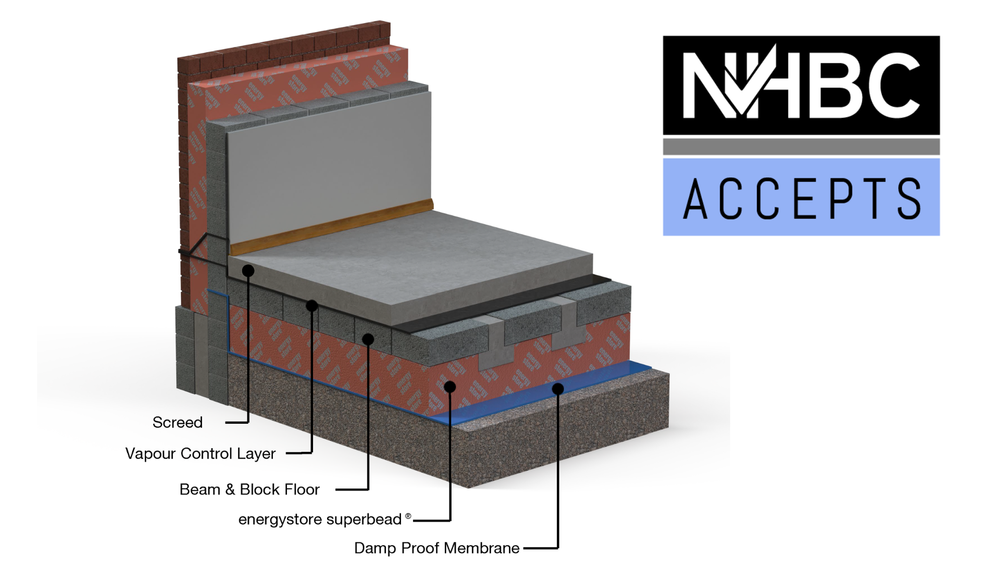
-
Thanks for sharing! At what centres did you place the battens? Has the floor felt solid underfoot? At the moment we're planning to fit battens around the perimeter of the room, in doorways, underneath kitcehn units etc.
-
Thanks for the insight, do you mind sharing the build up of your system? Is the engineered oak laid directly on top of the insulation board and UFH pipes? You've summarised the reasons why I'm thinking that a dry screed board may be a better option, since it offers a lower thermal resistance.
-
Those are useful observations, thanks for sharing. We'd be targeting to fill the entire ventilated cavity below the beam and block floor with the beads. Is that what you mean?