Dunc
-
Posts
210 -
Joined
-
Last visited
Everything posted by Dunc
-
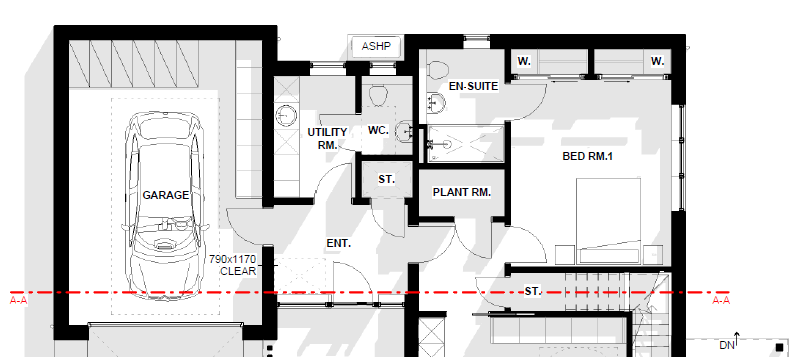
I would appreciate help on locating my plant room: Any thoughts on whether to swap the w/c in the utlity with the plant room? Entry area, utility and w/c are planned to be single storey flat roof. Plant room, en-suite, bed 1 are planned to be 1.5 storey. Working to Scottish regs, so must have the store area available as the "convertible-to-accessible-shower" and connectable to the w/c area. Current layout: Entry, utility and w/c are all within a "dirty" area of the house - useful for when working in the garden or garage. Plant room inside 1/5 storey area - easy to route services across the rest of the building. MVHR and ASHP main supply/return pipes are further from outside wall. Unsure of possilbe routing. Risk of noise from plant room? - bed 1 is the master bedroom. Risk of excessive heat from plant room? [aiming for passive-class build] Swapped layout: w/c more in the "clean" area of the house - more appropriate for visitors, but no window. Could remove the door between entry and internal vestibule bit and add a standard door in to the kitchen & rest of house, expanding the "dirty" area slightly. MVHR & AHSP main supply/return straight through the wall seems more efficient? Would it make services to the rest of the house harder e.g. longer run to kitchen for DHW. Is it easy to access the ceiling-floor void in the 1.5 storey part to route everything? Reduced risk of noise/heat?
-
I was going to suggest that if it's OK from the inside, and only because of the extended history, perhaps accept a reduction in cost and move on with the build. But if you're going to see it every time you're out, then as most others here it seems reasonable to reject it.
-
Does it look any different from the inside looking out, and is it in the same room as another different tint pane? How often would you look at the house from the outside and be able to see both sets of glass?
-
Howdens vs DIY Kitchens - which one to go for?
Dunc replied to johnhenstock83's topic in Kitchen Units & Worktops
I fitted a DIY Kitchens 2 years ago. I'd say it's a little better than some of the cheapest flat pack stuff but really it's marginal once it's fitted. Hinges and handles are probably the biggest noticable difference. Slightly heavier grade back board to the unit. Leg adjustment pretty good, unit alignment reasonable, choice of unit interior finish....er, that's it. The fact that the units come preassembled saved a lot of time. I'd happily use them again but I'll also be shopping around just to ensure best price. Oak worktops were cheaper elsewhere. Customer service was very good [couple of small items were missed in the original delivery and were sent within 24hrs of lodging an issue. I requested dry assembly for one unit so I could cut it to fit, which they forgot to do. They did want to see photos of the fact that I couldn't take it apart 😆 before they sent a replacement but that was only a 48hr delay]. The only real disappiontment with DIY Kitches was their showroom display where they have their own base unit lined up next to half a dozen compeitor units. All the competitor units were deliberatly misaligned or mis assembled to make the DIYK unit look better. Smacks of desperation and slightly underhand tactics. All could have been fixed easily and would therefore have been nearly indistinguishable....which for me is the bottom line - go with whatever you like the look of. -
How to estimate self-build costs before starting
Dunc replied to selfbuilder91's topic in Costing & Estimating
Yes, we interviewed 4 architects/designers in detial in order to select one to work with. That inculded giving them a brief, having a 1hr call with them and asking for their fees and their expectations of build costs. We did this in paralell with looking for a plot. None of the architects we spoke with included professional fees (architect, engineer, solicitor) or utilities provision in the cost/m2 estimates....so, as pretty much everyone else has said: it's a guessing game! -
How to estimate self-build costs before starting
Dunc replied to selfbuilder91's topic in Costing & Estimating
We've just been through this and are now in the process of purchasing a plot and working with an architect towards a planning applicaiton so I can share a little recent experience, but the short version for me is there are too many variables to get an accurate cost. Some thoughts: £/m2 ususally doesn't generally include cost of plot, professional fees (solicitor, architect, engineer, other specialists), getting utilities installed, or lanscaping the garden afterwards. Ground work/foundation seems to be the biggest unknown - untill you dig a hole you don't really know what's giong to happen, although if your architect is local and has done other work in the area they may have a general idea of what's likely to be in the ground. Architects may be able to give you an early estimate, just based on your general requirements, location and their ethos. However I had a range from £1800 to £3500. The architect (actually an architectural technologist) we've gone with reckons £2000-£2500/m2 for a timberframe build in the Highlands. We had a quote from one local timberframe company with their in-house architect for a turnkey build (this is before having any desing, jsut a bullet list of "wants" and an idea of size to form an architectural brief). That was guide-priced at £3500/m2. I found this really hepful as the spec included things like oak internal doors and skirting, a Mitsubishi Ecodan ASHP, Paul MVHR, 4kW PV and Tesla Powewall. i.e. there was enough info to see it was a high spec finish. So I see this as a ceiling price to beat and a worst case scenario. If timberframe is of interest, have a look at the catalogs of some stock stuff e.g. scotframe, hebhomes, dan wood who will give you prices to get a ball park for the main structure [but keep in mind there's probably the same cost again in turning a shell into a useable house]. I don't know if there are similar offerings for other build methods? Architect & engineer fees vary quite a bit and the more expensive architects we had quotes from were in the 10-15% of build budget range (even though they quoted a fixed fee). Allan Corfield architects have a pretty good resource on their website and do provide ballpark costs which were pretty close to their quote for us.https://acarchitects.biz/self-build-architect-cost/ and https://acarchitects.biz/professional-fees-self-build-project/ As above, there seems to be a certain level of commitment required just to get an idea of what it'll cost and it seems one has to start investing some cash to even find out if it's going to be possible. It feels like a big leap of a cliff wondering if the parachute will open!- 23 replies
-
- 1
-

-
- self-build
- budget
- (and 2 more)
-
Thanks all for the thoughts! Reassuing. I'm guessing one architect who spent a good 10 mintues stressing "we really understand TF sizing so will make an efficient design to manufacture" was perhaps slightly over-selling. All I want is a basic rectangular form...but I guess to keep £10k corners to a minimum we could go for a circle 😂
-
So I needed to replace the flush valve in a toliet cistern. No problem think I: I'll just isolate it at the conveniently located service valve and job'll be done in 10 minutes. Except the service valve (which probably hasn't been used in 5+ years) wouldn't fully turn so I ended up having to switch the water off at the mains feed, rather defeating the point of the service valve (which I've also now replaced, obviously!). Just wondering with a radial manifold system which seems popular here, there are some beautiful examples of the Hep2O system with isolators on the manifold. Are these valves any more reliable than standard service valves in the long term? Do any/all isolator valves need regular maintenance/use. Should I be going round once a year and operating every valve in the house - do "normal" people do that?
-
Global warming is in fact entirely natural and has already peaked
Dunc replied to ProDave's topic in Boffin's Corner
Well if it can be both a particle and a wave, surely it can also be a football, no? 😁 -
Global warming is in fact entirely natural and has already peaked
Dunc replied to ProDave's topic in Boffin's Corner
It is really important to have calm and reasoned debate, and it's gerat to hear a climate sceptic view presenten in such an un-Trumpian way. But I think it's very easy to cherry pick publications and their content to suit ones own view. Heres the conclusion from a similar oscillation study: "Forecasting through projection of pre-industrial temperature oscillatory patterns beyond 1880 AD by applying spectral analysis to generate input to train ANNs show that current atmospheric temperatures can be largely explained on basis of continuation of natural oscillations. This is the case irrespective of whether the hockey stick or MWP_LIA cycles are operative. This process could give rise to temperatures higher that past 1000 years without major contribution from anthropogenic influences." [Ref: doi: 10.11648/j.earth.20211003.14] Which I interpret as saying that CO2 has little effect BUT the same oscillations referred to in the video WILL cause a further increase in temperature, not the decrease suggested in the video. -
I'm dithering between getting a house desing via an architect, or going with a TF company who will do design&supply. I'm nervous about going with desing&supply basically around cost: if we get a design done with TF company A, expecting to use them for supply&erect, how do I then check that their cost for the supply portion is going to be reasonable? While of course I can set a maximum budget for them, presumably they'll simply aim to charge that amount. However, asking them to pause after the design stage to allow getting a quote from TF Company B seems, well, rude. If I go via an architect for design, what input and when in the process would be best from a TF company to ensure efficiency in buildability (e.g. what are their standard panel sizes, joist spans...). I'm guessing that without an intial design most TF companies won't be interested in a conversation?
-
We've been having conversations with architects very recently. All the architects I've spoken to are perfectly happy with working with me to get through the design stages then leave it to me to sort a timberframe company, ground workers, follow on trades, materials etc. so are definitely not locked in to the idea of managing a turnkey service. Those I've spoken to work to the RIBA stages so you only committ to each stage sequentially. (https://www.architecture.com/knowledge-and-resources/resources-landing-page/riba-plan-of-work) So for us (without a detailed design in mind) we would first commission and pay for a design through to planning permission. Then we could choose to part ways, or commission through to building warrant. Then we could choose to part ways, or commission through tendering out to builders ...etc etc. The quotes I have are provided broken down in to these stages. They are also avaialable on an hourly rate (seems to be around £100/hr) for support and advice as needed. The architects do seem to expect to deal with arranging engineers as required for each stage (e.g. site investigations, topo survey, SE) but the engineering fees are paid directly to the engineers as far as I can tell. The quotes I have are all eyewateringly expensive (~£50K to get through to building warrant approval) except for one guy who is an Architectural Technician and seems much more reasonable (~£18K), but offers much less in the way of "initial ideas". I'd suggest if you have a very good idea of what you want, looking for a Technician rather than RIBA Architect may be significanlty cheaper.
-
So we're talking to a few designers (Architects & Technicians) for our self build in Scotland (likely ~150m2, 1.5 storey, longhouse style, likely timber frame). I am not too surprised to find that architectural fees vary a fair bit from one Technician who will do just a single initial design then refine, to one PH Architect who proposes multiple sketeches and using virtual reality during the process...probably 15K difference in total project fees. BUT these designers are suggesting a huge range in their expectation of cost-to-build: One (non-passive certified) suggested a main contractor build would be in the region £2000/m2 for "better than building regs" heading to £2500/m2 working to "passive levels". A certified passive Architect reckoned minimum £3000-3500/m2 for a main contractor passive build (likely including ASHP/UFH). Another passive certified practice, specializing in self builders, was "very comfortable" to think that £1500-1800/m2 for a fully "functional passive house" (e.g. aiming for no need for ASHP/UFH, rather just using 3kW heater on the MVHR) would be perfectly do-able on a self-managed build and up to £2000-2500/m2 tops for a main contractor. I'm at a complete loss who to trust and what to do to interrogate these numbers in more detail. £3500/m2 is out of budget...obviously one could be tempted towards someone indicating lower likely build costs (even though their fees are higher) but getting caught out half way through would be disasterous. Prior to any kind of design it's not even possible to splash money on a QS...any suggestions please?
-
For future reference/linking I'm guessing it's this one? Which looks incredibly valuable! Thanks to the original author!
-
Is this what you're thinking of @Jenki? https://www.highland.gov.uk/download/downloads/id/22985/self-build_guide.pdf My initial conversations with a local designer suggest that a lot of the PiP can be "boilerplate" text and is open to "reasonable" negotiation. For examle our PIP says gable ends and white render....but the houses on either side of our plot both have hipped roofs. The one opposite is timber clad, one is bare stone. He's fairly confident that some changes will be acceptable.
-
I've not noticed any noise during the 4 site visits we've made. The nearest farm is just obsucred by a hill opposite, but a good mile or more away so presumably provides some sound insulation. Perhaps if the wind direction changes or speed increases...I hadn't thought of that, but it's too late now! 😆 Will look in to JML, thanks. I was looking at HH, but based on your posts, they're now lower down the list.
-
Stratherrick, to the southeast of Loch Ness, squeezed in between all the wind farms! Can't currenlty see any turbines, but I suspect that will change as more are added.
-
Hello Wonderful Forum! My wife and I have just had an offer accepted a plot for a self build in Inverness-shire. First time self builders. Gulp! I've already spent more time than might be considered healthy browsing through the vast quantities of information here and am simultaneously terrified by it and loving it....I suspect once we start paying bills it may tilt more towards the terrifying 😁. Ideally we'd like to build something to Passive standards, perhaps timber frame, warmcell (or other non-petrochemical insulation), and timber clad. Traditional long-house style appeals...hoping to contract TF company to wind & watertight then project manage the rest myself. Currently looking for an architect and trying to get our heads around budget. Any recommendations for professionals and trades in the Inverness area will be very welcome. Dunc.