Dunc
-
Posts
210 -
Joined
-
Last visited
Everything posted by Dunc
-
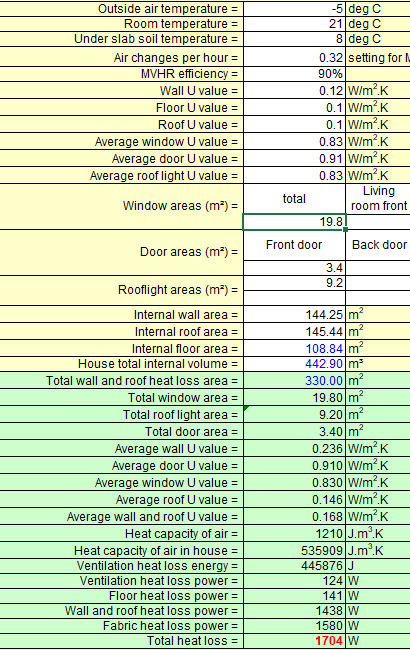
Apologies for yet another "how big does my ASHP need to be" question; I've read a lot but understand very little. ASHP to drive UFH for a 1.5 storey house, well insulated (U=0.1/0.12/0.1 W/m2K roof/wall/floor) and airtight (<0.6ACH) with MVHR. JHarris spreadsheet heating demand 1.7 kW (-5C out/21C in, to match UFH design quotes). Various quotes from ASHP/UFH designers suggest heat losses and pumps sizes: 4.8 kW loss/8.5kW pump, 4.7 kW loss/5kW pump, 3.9kW loss/5kW pump. All seem to be using -5C out/21C internal temps, flow temp 45C, return temp 5C SAP calc indicates 4.45 kWh/m²/yr, if that's relevant. 3 key questions: 1. Have I done something wrong in the JH spredsheet? 2. Can the ASHP be too big? i.e. supplier recommending 8.5kW pump for a load of 4.8 kW (or 1.7 if I'm right!)? 3. If the 4.7 or 3.9 kW load is correct and paired with a 5kW pump, is there enough overhead for DHW duty? Bonus Q: One supplier suggested that fitting a buffer will "deal" with an ASHP that is oversized. Does that sound right?
-
How much effort/time do you want to put in? If you have plenty of these, pretty much any standard construction technique can be made passive. Are you sure that you/your contractor can do the airtightness work well? If you want it wind & watertight & near-passive as fast as possible the MBC twinwall seems a no-brainer. I don't really see how either the KTS or the MBC HP "systems" are different from any other 140mm stud timber frame; they're just variations on the same theme you could achieve using a stick build on site or purchase from a variety of other suppliers and they will all need significant design detailing and on-site airtightness work. I would expect the floor area as drawn in the initial design reflects the INTERNAL wall (plasterboard). When your frame supplier draws up their plans they build outwards from that so your usable floor area stays the same, but your foundation footprint gets bigger for the MBC twinwall.
-
@Dave Jones that diagram appears to be for a single skin (e.g. 140mm timberframe) where the only horizontal insulation is 25mm PIR + the marmox block. In the case under discussion the build appears to be 2 skin blockwork with cavity insulation. If the cavity is insulated, the thermal bridge of interest is downwards to the foundation blockwork. @JohnMo's maths shows 440mm deep aircrete blocks will do just as well (if not better) than the marmox block.
-
@SBMS the architectural drawing appears different to your initial coloured plan: the insulation seems to be UNDER the slab on the architectural drawing?
-
Yes: radon membrane under slab, continues horizontally under the aircrete the turns up inside the cavity join the horizontal DPM throgh the wall. I'm at the design stage too and haven't specified the insulation for the cavity, so reading this with interest to see what options are available. Mine is twin wall timber frame with cellulose fill, so my above ground cavity insulation is a separate consideration. Because of this, I'll probably run the radon membrane under my foundation cavity insulation then up the inner face of the external block to keep both insulation and aircrete block dry. General question for you & others: I'm not sure on the value of 2x300mm aircrete blocks? With insulation above the slab the top block is pretty much continuous with this and limits both the horizontal and vertical bridges. What does another lower insulating block add?
-
The way I looked at it very crudely [hope I don't embarrass myself here!]: Thermal conductivity (lambda, k) of a Marmox block is 0.05 W/mK (https://www.marmox.co.uk/products/thermoblock). Maximum thickness of marmox is 0.1m (100mm) and you can't stack them. So thermal resistance (R) = 0.1/0.05 = 2 m2K/W. The U value (1/R) is 0.5 W/m2K. Thermal conductivity of an aircrete 7 or similar is about 0.18 W/mK (https://www.forterra.co.uk/product/thermalite-aircrete-hi-strength-7/). Assume you've got a single 300mm block R = 0.3/0.18 = 1.67 m2K/W. The U value (1/R) is 0.6 W/m2K. So not a lot in it as long as the aircrete block is kept dry by appropriate routing of the DPC? I've gone with a standard thermal block because round my way, no groundworker was likely to bother reading up how to install the Marmox blocks correctly.
-
Good info. I'm currently contracted with MBC...it's been generally good but a couple of points which anyone building in Scotland may find helpful: 1. They can't supply Rationel/Velfac windows in Scotland (someone else has the contract for that aparantly). This isn't made clear on the website. 2. The groundworks team don't want to travel to NE scotalnd to install a raft, even though the timberframe side of it is fine up here.
-
I haven't got a spade in the ground yet so not best placed to advise on future economies. But I have been through the "what can we afford" question very recently. What do you want to achieve in three key areas: Style: Architecturally interesting or simply functional? Performance: a bog standard building regs house? A passive house? Build: will you do any practical or management work, or do you want a project manager or main contractor to do it all? Talk to architects/designers. Some we spoke with gave us expected costings in the £3000-£4000/sqm. These were architects whos portfolios clearly show "flair" (balconies, ovehangs, fully glazed walls...i.e. expensive things to engineer) and/or who work most often to passive standards. Others suggested lower costs per square meter and clearly work more with self builders who have a tighter budget and want a nice, but fairly simple house. Even these latter types started at >£2000/sqm. I think unless you're very hands-on, the lower end of the range is not going to be achievable. YMMV. Cost per area doesn't usually include the plot itself. Or the professional fees associated with that...I'm rapidly finding that I didn't budget for all sorts of things that do add up. £180 just to register the address, for example. Fees for servitude to get services to site. Site surveys of various sorts. Insurances... I think self build is a bit like the stock market; it's an investment that contains an element of risk.
-
thank you @Dave Jones. Not sure I can use Marmox thermoblock as these require the sole plate to be at lest the same width as the block (100mm seems to be the narrowest availalbe). The MBC frame has 89mm verticals.
-
Do you just need to cross a road, or is the main under a road? Could you use a moling company to go under the road?
-
I suspect this is a typo from the architect; it's already on my list of things to check, but thanks for pointing it out!
-
Thanks for the thoughts! @saveasteading keeping the blocks dry was exactly the point of trying to find an improved design. Mannok have a variety of examples (for traditional cavity wall block construction) on which I based my sketch. @Dan F they do, but were very reluctant to send the groundworks team this far and this was reflected in the eyewatering quote. Odd since they've no problem doing the TF bit... @Kelvin will look into the Weber render. Yes, I noted your issues in sourcing I'm looking in to that. @Russell griffiths Duly noted. This is the architect's drawing; hasn't been through the Engineer's hands yet.
-
I would love to use a raft but can't find anyone willing or with experince to install one up here (NE Scotland). I'm not brave enough to DIY it!
-
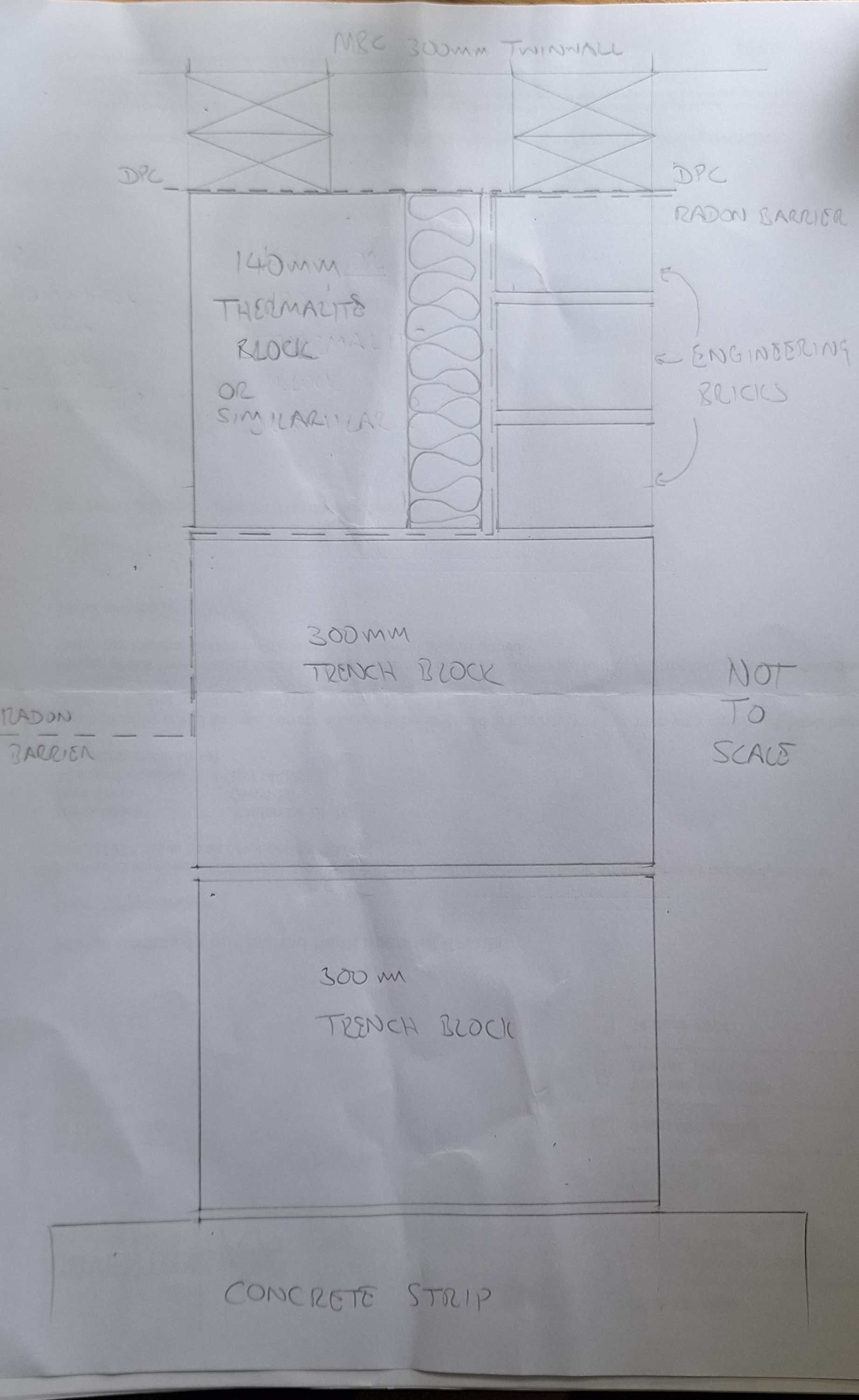
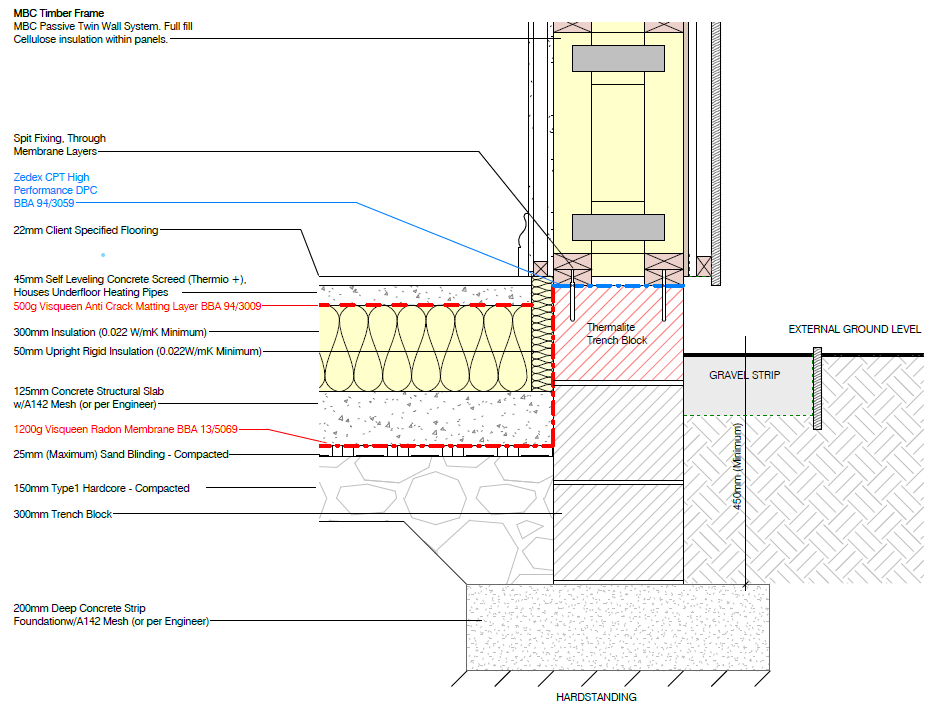
Architect's current foundation detial. Can I do better in terms of thermal bridging? Although the actual product is not specified, Forterra's thermalite trench blocks are 0.24 W/m.k below ground (i.e. when wet). A dry aircrete block seems to be closer to 0.17-0.18 W/m.k but obviously needs to be kept dry. I've trawled previous threads but haven't found a foundation detial for the MBC twinwall on a non-raft foundation. @JohnMo's ICF detail seems helpful so I'm wondering if something like this is possible and worth the effort? @Kelvin I belive you used Mannok's high strength 7 - presumably you need to keep that dry? Were they the full 300mm width? Would I be causing problems for lift& slide door threasholds later?
-
Following with interest...
-
My build will have an attached garage. If I put the consumer unit in the garage can all of the electrical cables from it be fed through a single duct through the insulated house wall (300mm cellulose fill) and then sealed? Perhaps using one of those mulit-cable conduit seals such as https://www.filoform.co.uk/filoseal-hd-re-enterable-duct-sealing. Or am I better to find space to put the CU inside the thermal envelope?
-
Looking at options for MVHR. Brink Fair 325 is looking promising for my needs. However the switching seems heavily biased towards using wireless switches which are rather expensive. The unit is supplied with a single manual rotary switch but I'd like to be able to fit boost switches to bathrooms and a loo which does not have a window. Anyone know if simple sprung rocker switches can be used with this unit?
-
The Home Insurer. Came out cheapest for us...haven't needed to claim so no idea if they're any good
-
That's exactly what I've done.
-
bit off topic but @Kelvin can I ask what size velux you have in those upstaris areas and what heights are the short and tall (false) coombs?
-
I've been struggling with this recently too. "design, supply and do all the work" is apparantly a big ask. I've contacted everyone on @garrymartin's list and more. I only found 2 willing to get even close to your requirement: MBC will design, engineer (subcontrated), supply and install from -150mm MOT to concrete finish, but the underbuild is still your job. And presumably will only do this if you're buying their frame too. Econekt will design, engineer, supply and install, but only starting from the formwork. All underbuild, service install, and the blinding layer are your job. I don't see much value in this proposition as getting the blinding layer flat with services in the right place will be half of the critical part of the install (the other half being getting the formwork square. Happy to be corrected on this). Everyone else I contactetd are desing/supply (+/- engineering) only, no install. AFT will design, engineer & supply but no longer send someone to site to supervise. Greenraft are similar to AFT but claim to have a network of installers...except in the highlands. If you can find a groundworker who has experience with insulated rafts (ask the suppliers who they've worked with) then you're probably good to go with any of the desing & supply companies.
-
I was going to suggest @Trw144 price may reflect the power of bulk buying? but then @haythorn_1 is buying 2x my area and looks to be more expensive. It likely depends on how many non-windows (lift& slde/paito/entry doors) there are. My internorm quote (April 2024) for 22.4m2 (1 lift& slide, 1 front door, all else T&T) was £939/m2 + fitting + VAT! At least delivery is included in that price 😕 GBS and Zyle are coming in at about £800/m2. Rationel, NordVest and others looking a little more sensible at <£700/m2 (+ fitting + VAT) but it's all rather eye-watering. Performance wise, GBS, Zyle and Internorm have average Uw values around 0.75 W/m2K for my window list. That drops to 0.85-0.89 for the less expensive ones. So for a 0.1 W/m2K hit in Uw at a peak difference of 30K (-10 C out/20C in) over the area (22.4 m2) that's only 67 W difference ....is that about right? If so, I'm not seeing how I'm ever going to realise the benefit of the extra investment up front. Have I missed something here?
- 65 replies
-
- 2
-

-
- comparison
- cost
- (and 1 more)
-
@Kelvin that's very generous of you, thanks! Will keep this in mind, though we're months away from digging. @JohnMo thanks for sharing this, appreciated! It is looking like I'll probably have to go in this direction ultimately. Cost wise, it's interesting. The EPS formers aren't really very expensive (<£10K from all the suppliers who quoted on my 138m2 GF build) and really I'd be buying nearly as much sheet EPS for standard foundation insulation, other than the thickness of the upstand. Suspect this will be more than ballanced by the cost of insulating blocks (marmox, mannok etc) - roughly £2k for my permieter, assuming I only need 1 block wide (MBC frame is 300mm wide - maybe it can overhang and I can have more upstand insulation internally?) The concrete slab component may be 40mm thinner in the diagram above than a kore raft, which on my build would only be 5.5m3 , so £825 less. Both require 2x A393 mesh layers. The underbuild for the kore raft would be 800mm deep MOT3 & 50mm sand blinding on my plot. For me that's 110m3 so about £5k. No idea what trench dimensions or blockwork would be required for a more traditional found (my perimeter & internal load bearing walls are about 80 linear meters). Then there's the top screed layer in the trad build. I really wonder if it will work out pretty similar materials wise, and I'd be happy to pay a small premium for the easy to achieve U value of 0.1W/mK. It's just the lack of experienced contractors that causes the issue. Or my lack of bravery to go DIY 😕.
-
Apololgies for lack of clarity @JohnMo Insulated raft as in Kore/AFT/GreenRaft type system, such as https://www.kore-system.com/products/kore-insulated-foundation/ Similalry to you @Kelvin am in conversation with Greenraft and they claim to have worked with a couple of installers up here, but have failed repeatedly to provide contact details. While several suppliers are keen to assure me that it's so easy as to be DIY-able I'm not prepared to take the risk on such a critical component! MBC's quote is eyewatering so I may have to resort to something more traditional with a trench, insulated blocks and upstand. Do you have any idea on the thermal performance you achieved? (U, psi?)
-
Can I set up my site before building regs approval (Scotland)
Dunc replied to Dunc's topic in Building Regulations
Just rounding this out having finally managed to speak to the right people at Highland Council who confirmed what @ProDave and @Jenki said: A static caravan on site during a build is considered a temporary Permitted Development, and the van must be removed on completion of the build. However, the waste water management (installation of water treatment plant and soakaway/outflow pipe to water) comes under Building Control therefore requires either a separate warrant if doing in advance, or should be included in the main build warrant submission and will be subject to inspection.