


Dunc
-
Posts
210 -
Joined
-
Last visited
Everything posted by Dunc
-
Won't the acoustic insulation between the joists be providing sufficient insulation to push most of the heat up in to the upstairs rooms? That's what I'm hoping will happen for me Despite the general consensus on the forum that UFH is not needed upstairs, where people have provided data, there seems to be a 2-3oC drop from downstairs. Most people reporting this seem to have near-passive type houses. Problably fine if you're sleeping, but if you use the rooms during the day (e.g. work from home in an upstairs office, kids play room) maybe not so good? Just my humble opinion. However, that 2-3oC can probably be provided in other ways like towel radiators, panel heaters and the like. I don't have the technical knowledge to do the calculations to know how much heat would be required upstairs, so I'm putting UFH in as it's relatively inexpensive in the grand scheme and not easily retrofitted. Caberdek on joists, plastic sheet (maybe not needed?), UFH pipes clipped down, dry mix sand&cemet ("Pug" mix) surrounding the UFH pipes, between 25 or 30mm battens (depending on UFH pipe diameter and clip size), caberdek on top to support final floor covering. @Redoctober has a very nice blog post on how theirs was done if you can find it. I think this will work out about £1500 cheaper than Lewis metal deck with liqid screed for me, over about 57m2 and seems very DIY-able. If paying a contractor, I'd just do the liquid screed as that will be much quicker.
-
Architects, ballooning fees and estimates
Dunc replied to Drellingore's topic in Costing & Estimating
Doubling of budget to £3500/m2 implies the original budget was £1750/m2 which feels pretty lean. When I was enaging with architects nearly 2 years ago, and in the north of Scotland, they all suggested starting with a minimum budget of £2000/m2. The two passive registered architects both suggested £3500/m2. So there may be an underlying issue on what was estimated for. As others have said, a good conversation is probably the best way forward. We did think about changing architects after planning permission was gained but were not brave enough to make the change. Better the devil you know? In my project all the experts (SE, architect, TF company) seem to have very finite boundaries and just push stuff over the wall. It is very difficult to get them to talk to each other to communally solve problems. -
I think you've answered your own question! Maybe try speaking with your planning officer?
-
You must notify the start of the works. https://www.gov.scot/publications/building-standards-forms/ - FORM J is what you want, Or you can do it on the eDevelopment portal https://www.edevelopment.scot/eDevelopmentClient/StaticFiles/eDevelopment-eBStds_Form_Help_Guides-Notice_Regarding_Start_of_Works.pdf Your warrant will have come with a check-list of stages that the BC surveyor wishes to inspect (CONSTRUCTION COMPLIANCE AND NOTIFICATION PLAN). It tells you how much notice you need to give. Mine are all 7 days notice prior to each inspection stage: "Advise verifier when foundation trenches have been excavated and ready for inspection, prior to the concrete being poured. Please give 7 days notice." sorry, no further idea on the SEPA stuff. Good luck!
-
If you have the warrant you're OK to start digging (assume you've submitted the notification of start of works form). I suspect BC has missed the SEPA thing and probably should have asked for it? It was raised as speific question on our BC submission. The risk is that if SEPA refuse the CAR how do you provide drainage for the house? I feel your pain - we've had similar issues with not having cast iron guarantees on all of the utilities but wanting to move ahead...it's down to your comfort level with risk and what the backup plan might be. I can't really comment on my neighbour's application, other than knowing roughly when they applied and when they got the (positive) response.
-
Our SEPA application took about 5 weeks (late 2023). Our neighbour's seems to have taken several months, submitted late 2024. Assuming you have an approved building warrant I don't see why you can't get started on the founds, but how do you have approval without the CAR?
-
would a layer of compac foam at the top of the facing brick be beneficial in diagram 2?
-
@JohnMo you've been very helpful in fondation design (thank you!) - I am using a modified version of yours for my TF build. As @G and J I'm wondering how to detail the threasholds - did you just omit the inner 140mm thermolite at the threasholds and set the doors over the outer block?
-
Cellulose-filled, cold, flat roof. Design & specification challenges help
Dunc replied to Dunc's topic in Flat Roofs
I don't understand how there could be no ventilation at all, unless the flat roof is a warm construction! -
Cellulose-filled, cold, flat roof. Design & specification challenges help
Dunc replied to Dunc's topic in Flat Roofs
Thanks for the thoughts. The same guidance that limits the vent path to 5m also suggests that Mushroom vents don't work. To be fair to the architect, the planning drawings were done before TF manufacturer was selected. I imagine he expected a warm roof and a standard 140mm frame at that point....although having selected the cellulose fill TF it would have been nice for someone (architect or TF supplier) to point out the problem months ago. And if I'd done my research I'd have known cold flat roofs are generally challenging. I wasn't even aware of the cold vs warm thing until this came up...but then we pay professionals so we don't have to know this stuff, don't we? 😞 @Nickfromwales any details on the flat roof you know about? Size? Vent path length? It does seem that we'll have to change to a warm roof and have that installed/insulated by someone other than the TF manufacturer. Disappointing. -
Our plans have a flat roof section of 5.8m x 2.5m. This is sandwiched between a 45 degree pitched roof on one side and a vertical wall on the other, along the long axis, such that ventilation and drainage are available only at the eaves on the 2.5m wide ends. The proposed build up is internal VCL, 421mm posi-joists with blown cellulose, OSB deck, firrigns (providing a minimum 50mm air gap), OSB deck, EDPM. I'm a bit stuck beween my architect who reckons this can't be ventilated appropriately, and the TF manufacturer who has provided an interstitial condensation analysis which shows the build up of doesn't pose a condensation risk. However they can't tell me what the length of the ventilation path is in the analysis (presumably there must be a limit) and just pointed me at NHBC guidance. All can see in there is section 7.1.10 which basically says "cold roofs are a bad idea; if you must do one the ventilation path should be less than 5m long". Anyone got a similar roof could you share details of how it's ventilated and why it works? Anyone point me at regs or guidance which would convince that the ventilation over the 5.8m length would be OK? I'm in desperate need of help here as this issue has only come up last minute and it's feeling rather catastrophic. thanks.
-
Not really, to be fair, the plot purchase was the major hold up (solicitors work to their own schedule it seems, no matter how hard they are pushed). As I understand it from our architect there were no really difficult questions or revisions on the warrant and nothing structural. Mostly on fire protection which was easily detailed on the building iteself. It is a little frustrating that the requirement to provde a reservoir of water for the fire brigade (because we're >100m from a hydrant) was not brought up until the last minute. I'd have expected the architect to be aware of this (given the location of the plot it's MILES from the nearest hydrant) and included it up front.
-
FINALLY! we have our Building Warrant approved. Nearly 2 years after making an offer on the plot; I really hope the rest of the project goes a bit quicker! 😁
-
Done. +1 with @Conor - very difficult to be specific about the "extra" value of eco features. Compared to what? Building regs? Some desicions may be influenced by other factors but end up being "more eco". Perhaps selecting a timberframe kit over brick& block for speed coincidentally changes the embodied carbon of the project, for example.
-
Are you certain they window size is limited to 1050mm (you used the word "tall")? Sounds rather close to the requirement that the bottom of an escape window should be no more than 1100mm above the floor. Nothing you can do about this requirement other than provide access to a protected stair instead. I'm not aware that the window size itself is limited to prevent falls, only that it either can't open more than 100mm, or a barrier is provided.
-
Protek structural warranty quotation
Dunc replied to Amateur bob's topic in New House & Structural Warranties
Which may be fine if you use a main contractor. If you manage the build and contract separate trades yourself this doesn't apply, based on my discussion with them. But I'd suggest it's worth a phonecall to confirm individual cases. Another thing to look out for is flat roofs - ProTek required a separate Insurance Backed Guarantee for the flat roof. Usually this is provided by the roofer, but obviously could limit your choice of contractor as not all will provide this. Possible to take out such a guarantee yourself but for £ several hundred. -
Protek structural warranty quotation
Dunc replied to Amateur bob's topic in New House & Structural Warranties
Very similar to my quote, though I haven't taken them up on it yet. Check the T&Cs. ProTek and Build Warranty specifically exclude the first 2 years after completion and assume that this is covered by the main contractor's insurance. SelfBuildZone do not have this exclusion, from my investigations. I guess this only matters if you're not using a main contractor. Don't forget there will be site visit costs on top (another £1.5-£1.8k for me in the Highlands). Stage certs are only needed if you are drawing down a mortgage during the build - they demonstrate to your mortgage company that you have achieved a particular point in the build to allow them to release funds. After completion they're irrelevant because you have the final sign off, AFAIK. -
+1 on the hob to oven distance being too far - carrying that heavy roasting tin across the kitchen and trying not to spill won't be much fun. Not keen on the bench seating. Fine for kids sliding in and out but older folks might not enjoy that? I'd put a corner sofa there and have the table over by the window.
-
thanks, @JohnMo some interesting points. I was looking at the NHBC diagrams (https://nhbc-standards.co.uk/7-roofs/7-2-pitched-roofs/7-2-15-ventilation-vapour-control-and-insulation/) Whether or not the roof covering is air permable, the suggestion is for a conitnuous ventillation gap which allows air flow. This seems quite different to gaps in the sarking which allow vapour diffusion.
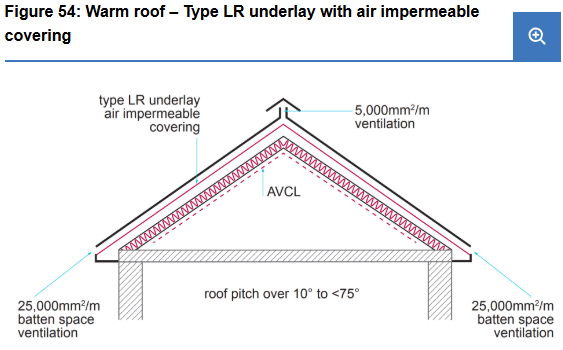
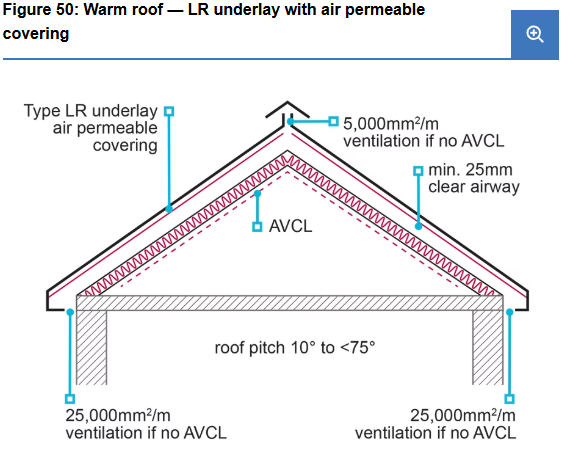
-
I have a couple of questions on slating. They seem well-worn questions but I’m not sure I’ve found any specific answers. Nail direct to sarking vs batten/counter batten; Hooks vs nails; and slate size. Context for this specific roof: This is in Scotland. 45 degree pitched. Hybrid/Warm roof – cellulose between rafters (but no insulation above) the rafter. This needs to “breath”. In-roof solar PV in part of the roof (needs ventilation behind). Roof will have some Velux windows. New, regular sized slates (Cupa 3 heavy or similar). I gather that slating in Scotland is traditionally done by nailing directly to sarking boards (with a membrane between boards and slates). For this warm roof I would need to vent behind the sarking, so will have to stand the sarking off the rafters on battens, with eaves and ridge vents (rafter, counter batten, sarking board, membrane, slate). At the ridge, the membrane would have to be cut to permit ridge ventilation (i.e. the membrane can’t span the apex of the roof). This worries me because if the dry ridge vent fails then water could penetrate behind the membrane at the apex. Is this an unreasonable concern? Any way to mitigate the risk? In a battened roof (rafter, sarking board, low resistance membrane, counter batten, batten, slate) the membrane can cover the apex of the roof so any failure in the dry ridge just runs down the membrane and out at the eaves. Penetration of the membrane is limited to nails holding down the battens. So, what weather conditions does Scotland provide that would make this battened construction less desirable? Wind uplift behind the slates? Is the nail-direct construction just a hangover from using uneven sized slates? Then for fixing the slates, hooks look to be a nice idea for long-term maintenance. Any down sides to hooks? And if I need to go the “nail-direct” route can hooks be used in this context? And finally, various places on t’interweb seem to suggest that smaller slates are more common in Scotland (400x250 vs 500x250 down South). Other than tradition, any reason to use smaller slates (more fixings, more time)? Thanks.
-
What are the noggins supporting? If it's not a joint in the OSB deck could you a) remove them and placed further out - about 25mm outboard of the outer face of the cladding, providing an inverted L-shape type vent. b) use a multitool or reciprocating saw to trim the top off all of them 25mm below the deck (providing your 25,000mm2/m vent). New noggins placed a little further out if required for deck support. Or c) trim 25mm off the bottom of the noggins to create a gap at the top of the cladding providing a Z-shape type vent.
-
+1 Good luck finding any groundworkers with experience in insulated raft foundations up here; I couldn't. Econekt based in Glasgow were prepaired to travel to Inverness. They were very helpful and engaged but ultimately the cost was prohibitive for me. I've gone with strip footings and, with advice from @JohnMo and others here, I think I've achieved a pretty decent design.
-
Haven't used it but this looks like it might allow for >1 pipe/cable per hole and be re-penetrable https://www.filoform.co.uk/filoseal-re-enterable-duct-sealing-system
-
Thanks for the thoughts, everyone. Very helpful! Clarifications: @ReedRichardsTypo (I can't edit the orignal post). Companies I've requested designs from all use flow 45C and return 40C, deltaT 5C. @Chanmenie U values should be correct, MBC Timberframe "pasive" frame with blown cellulose fill...so yes, we should be on the way to passive levels for both insulation and airtightness. Form factor is reasonable but not perfect, 1.5 storey but with a lean-too entry/utility, and thermal bridging not perfect. @BeelbeebubYes, we are far north: Inverness-shire. We can see snow on Ben Wyvis this morning 🙂. Great point on future proofing the installation site! I'm really curious about the design temps. Only one company will share the details prior to me coughing up significant cash. This one calculated transmission heat loss of 2.373 kW and ventillaiton loss of 1.506 kW for a total of 3.879 kW (26 W/m2, 9 W/m3). I asked them to recalculate performance for flow 35C / return 30C and they sent the data below...seems to suggest that with a 26C temperature differential, a flow of 35C is not sufficient?
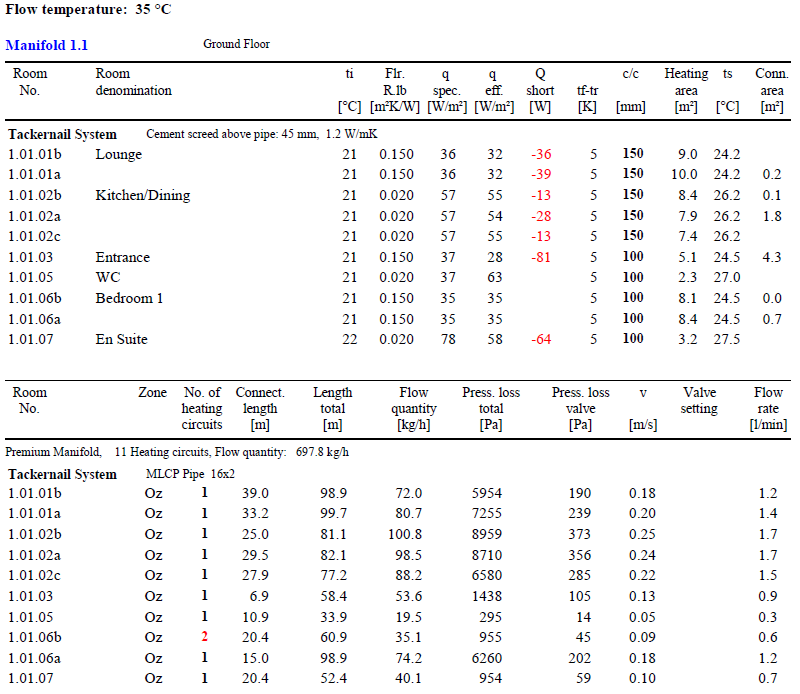
-
@JohnMo are you suggesting that a 4kW pump would be fine because the heat load is being over estimated, and my 1.7kW figure is correct. Or that even if heat load is ~3.9-4.8kW a 4kW pump is sufficient? @Beelbeebub not built yet but rather late to make a subtantial change in the overall plan!

