kandgmitchell
-
Posts
823 -
Joined
-
Last visited
-
Days Won
3
Everything posted by kandgmitchell
-
SAP befuddlement
kandgmitchell replied to Raine's topic in Energy Efficient & Sustainable Design Concepts
The chances are the planners will have no idea what the figures mean either but if they are presented by your SAP assessor they'll take them as complying..... -
True, but one doesn't realise the years have caught up until you're caught out!
-
Just to add to this with a bit of experience of what I would do differently "next time". I had installed 50mm twin wall duct for the electric supply. After completing the raft that duct was extended by the groundworkers to the electric kiosk with the meter some 20 odd metres away. Only later did I consider the cable needs - 3 phase 25mm. Upon picking it up from the suppliers I could immediately sense a problem coming. A) it was heavy and B) it didn't bend well. This week I discovered drawing it through a 50mm duct was not practical - should have used 80mm at least. Also the bends in the duct made pulling the cable through a nightmare. Luckily, after a struggle we got it outside the raft (all of 3 metres) but had to dig down to it and cut it open to get past the first (of several) too tight bends. Finally have strained back trying to pull it the last 5 metres - can't even bend over at present! Resourceful wife asked two random men in a family of four passing by to help and they very kindly stepped in and pulled it the last bit while I sat on the floor in a lot of pain. So, 1) work out cable needs in advance. 2) use a bigger duct than you think you need 3) consider running the cable through the duct laid out in a straight line, then placing both duct and cable in place in one go so you know it will bend where you need it to! 4) just get someone else younger and fitter to do it!
-
LDC for a Garage/Indoor Pool Refused
kandgmitchell replied to phykell's topic in Planning Permission
Hi Alan, I submitted the appeal on the 26th October 2022. I got my start letter on the 14th November 2022 so a pretty quick response. However I got this today in response to my formal complaint that the process was taking too long... Thank you for contacting the Planning Inspectorate. I have passed your email on to the Case Officer who is currently dealing with this appeal for them to respond to your complaint. If you have any further queries in relation to this appeal, please contact the Case Officer directly. Nevertheless, I would like to explain that although the time taken to handle an appeal may exceed the median of time published on our website, those are average handling times, not statutory timescales. We can only apologise for the delay and inconvenience caused by the length of time taken to process this appeal. I appreciate your concerns and dissatisfaction with the appeal process, please be assured that we are processing appeals as fast as our resources allow and that a site visit will be arrange as soon as possible. -
LDC for a Garage/Indoor Pool Refused
kandgmitchell replied to phykell's topic in Planning Permission
Well I got this back in October 2023 for a simple LDC appeal which started in November 2022 -- Thank you for your email relating to the above appeal, I apologise for the delay in arranging a site visit. Please note we have a significant backlog of Enforcement and LDC cases awaiting a site visit, we apologise for the inconvenience this causes. We will generally be working through the backlog in chronological order (oldest first), but I must also make you aware that you may notice that on occasions a more recent appeal may be scheduled earlier - the reason for this is we create all Inspector programmes in a geographical way, which might result in the need to allocate a new case to complete a group of older cases to ensure the Inspector is utilised to his/her full potential when visiting an area. Please also be assured that we are putting new measures in place to deal with the current delays and hope to see improvements over the coming months. We are unable to respond to any queries regarding appeals awaiting a site visit at this stage. While we understand that this is frustrating, doing so takes valuable resource away from our case work processing and can further delay appeals. I then got this in response to a chase up a couple of weeks ago.... Thank you for your email relating to the above appeal, I apologise for the delay in arranging a site visit. How long will I have to wait for an event date? Unfortunately, we can't give an accurate date when we can allocate an Inspector and set an event date, but please be assured that we are doing everything we can to process your appeal as quickly as possible. For some cases this might be longer depending on the complexity of the issues and availability of Inspectors with the particular specialisms required. Please also be assured that we are also putting new measures in place to deal with the current delays including the recruitment of additional resources to help recover performance over the coming months. Our average handling times on GOV.UK provide a useful reference for how long appeals take from submission to decision. How do you allocate Inspectors to cases? We generally allocate Inspectors to cases in chronological order (oldest first). However, Inspectors work geographically, and to make best use of their time, we sometimes need to prioritise newer cases within a certain region. This may appear that cases are 'leap frogging' older cases, however this ensures we make the best use of the Inspector's time while they are conducting other site visits in the area. We are unable to respond to any further queries on delays on this appeal, but please be assured that will continue to work hard to arrange a site visit and we will be in touch as soon as possible. Please use our customer contact form if you need further any assistance. Thank you for your patience and we hope to be in contact shortly. So still awaiting a site visit from the Inspector - I may be unlucky but just be aware of the delays out there! -
We used 1810 in the last kitchen and have specified them again. Very good quality. We had a sink and a half in a 600 cabinet. No draining board but we simply kept one of the plastic tray types in the cupboard under and used it as and when required. Just seen they do a 340mm x 400mm single bowl and sink and tap packs.
-
LDC for a Garage/Indoor Pool Refused
kandgmitchell replied to phykell's topic in Planning Permission
Along with just about every other bit of authority out there I would suggest...................... after all, don't forget they know more than you! -
88 new houses near Cambridge to be demolished.
kandgmitchell replied to Temp's topic in General Self Build & DIY Discussion
From recollection the application of the new Part L was done by a plot by plot basis rather than all plots within the original scheme. So even though the site may have have started as a whole, only those individual plots that were under way in June 2023 could claim to be built under the old version. If the defective house was being demolished and it's foundations removed I'd thought it'll be hard to argue that the new replacement wasn't an entirely new building and thus subject to the current regs. -
LDC for a Garage/Indoor Pool Refused
kandgmitchell replied to phykell's topic in Planning Permission
Remember that when you are applying for an LDC the LPA are not considering any planning policies in their local plan. They are being asked to determine whether the application satisfies the provisions of the permitted development regulations. Ordinarily that can be done by reference to specific measurements and dimensions set out in those regulations. The issue comes in here when the phrase "incidental to the enjoyment of the dwelling house" has to be determined. For some reason they have decided that the OP's building is not such. They are interpreting the law here and often these things are run by the Council's legal department before issue. There have been several legal cases over this phrase "incidental to the enjoyment" and it is not as clear cut as you may think. I don't have access to my case references unfortunately (they're in the container with the rest of our life) but I recall one judge suggesting that "incidental use" isn't simply up to the whim of the land owner and refusing an application to the court. Here, simply the scale and nature of the proposal may have swung the opinion away from "incidental" (minor, subordinate etc) towards something else. As to a way forward, by all means appeal but it'll take a while. The other approach is to negotiate and try to find out what the LPA do regard as incidental. For this I'd consider using a Planning Agent simply to distance yourself from the discussion. Planners are often more amenable to agents because they talk the same language (and in some cases worked alonside them). Good luck! -
I would agree to some extent. I see many architects drawings with a phrase such as " drainage layout to be agreed between builder and building inspector" and your example regarding foundations. That is unfairly using BC as a cheap design service and some designers/builders do take the p...s. However, BC has to agree matters on site when a building notice is used and I would hate to see things degenerate to a point where professional common sense could not be exercised on site.
-
LDC for a Garage/Indoor Pool Refused
kandgmitchell replied to phykell's topic in Planning Permission
But also be aware that they seem to use different Inspectors for enforcement and LDC appeals. At least that's the reason given for the 60 odd weeks I am in so far on a fairly simple LDC appeal in relation to a residential property. At the stage of a complaint about the delay. -
Part L - Enclosing an existing swimming pool
kandgmitchell replied to phillipsmw's topic in Building Regulations
Showers? Drinking water for the ice machine for those cocktails? -
Part L - Enclosing an existing swimming pool
kandgmitchell replied to phillipsmw's topic in Building Regulations
Well your enclosure, as you say falls into Class 6 of Schedule 2 to the Building Regulations and so is exempt. It also would not have been subject to the Energy Efficiency Requirements because Regulation 21 (which applies those requirements) gives exemptions to those requirements to several types of buildings included, as you point out, under sub-para 3(d) "stand alone buildings other than dwellings with a total useful floor area of less than 50m2". Since you have a pool inside, the provisions of G1 and G3 (2) and (3) may well affect you (cold and hot water supplies) however, (Regulation 9 (2) (b)). -
Combined prior approval and certificate of lawful development?
kandgmitchell replied to Brix's topic in Planning Permission
Agreed, keep them separate - they are different animals and follow different routes. With planning these days it's best to follow the KISS approach. -
That's not a change in regulations, that's a change in attitude. I agree you can get the "I can't design it for you approach" but equally the OP has a suggested solution - a short fixed ladder. That should be sufficient to open a sensible discussion with BC as to compliance. If you don't ask you'll never know.
-
You know the only way to resolve this is to ask your BC provider. It's them that are going to have to sign this off. This what the flexibility of the Approved Document approach was supposed to do - allow for unique design features to be assessed against the basic requirement of providing adequate means of escape in case of fire. The pre- 1985 regulations were prescriptive and any diversion had to be dealt with by a formal relaxation application.
-
Permitted Porch size ???
kandgmitchell replied to Sunny fallows's topic in House Extensions & Conservatories
Interesting, "ground area" is not defined in the order. So, it could be argued that the overhang has no ground area since it does not sit on the ground. However, it could also be argued that the overhang projects over a ground area so should be included. You can see why so much planning ends up in the courts! -
The good old 1992 version of the Approved Document to Part A had a wide range of timber span tables in the appendix. For a 5.5m clear span using C16 joists you'll need 63mm x 220mm @ 400mm cntrs assuming a dead load of no more than 0.5kN/m2 (excluding self weight) or 75mm x 220mm @ 400mm cntrs if the dead load is between 0.5 and 0.75kN/m2. Although C16 is not as common these days. If you have C24 joists you could "get down" to 75mm x 195mm @400 cntrs for the lighter dead load. But as been pointed out these are chunky bits of timber and open span joists may be cheaper in the long run.
-
That's not exactly correct. Your foundations can be within your own land but if they will be deeper than those of a neighbouring building within 3m then you must serve a section 6 notice. If within 6m and deeper than a line drawn at 45 degrees from the neighbour's foundations then again you need to serve notice. However in the OP's case I'd be surprised if their garage foundation would be deeper than the neighbour's house foundations although a modern 1.0m deep foundation could be deeper than a Victorian brick spread. It's all too easy for an adjoining owner to create an issue as they do not have to pay the costs of the party wall award, the building owner must. However, this should have been sorted out much earlier. OP did you engage with the neighbour about your works? It's being done on the boundary after all, what about damage to their property, how does the builder gain access to build the wall along the boundary? If these things hadn't been raised before then it's not surprising that they've gone down the formal route. I'd get round there and see if it can be sorted out amicably. If not then consider appointing their surveyor as yours as well (they have to act impartially) to keep costs to a minimum.
-
I need two small electric jobs doing. The electrician who wired up the static back to the cabinet housing my cable head and meter seemed the obvious choice. I need a suitable cable for the house pulled through the duct from the cabinet and left free at either end for connection at the appropriate time. I also need a temporary builders supply close to the footprint of the house for the kit erectors and fit out contractors use. Simple? well I've been let down twice now with promises of doing the job and then putting it off on the day promised so I'm getting a bit fed up. I know what cable I need to pull through so I can do that. At present I have an exterior type double socket in the cabinet wired to a small CU which also serves the caravan supply. The house slab is on the opposite side of the caravan from the cabinet about 15m away. Instead of fixing extra external sockets to a board fixed to the caravan as was my first plan can I just buy a decent quality extension lead reel with 4 outlets and plug it back into the cabinet socket? The builders can then move it to suit themselves. The house is timber framed, the raft is in, so the heaviest tools are likely to be plasterers mixing tools I guess.
-
Boundary means boundary of your ownership, the curtilage of your plot, the bit that you control. Not sure why the builder would think boundary meant the side wall of a building situated on someone elses property.
-
I think the latest changes to the fee system has taken away the "free go" arrangement.
-
But above you said you were 500 - 600mm away from the boundary, the plans and photo seem to confirm this. If so then under the Building Regs you will be limited to 1m2 of unprotected area (i.e ordinary window) which would affect what you propose.
-
The stone was MOT1 type stuff which I think is max 30mm downwards. It packed tight with a 2T vibrating roller. I used 150mm xps for the insulation because the Dan Wood spec uses 90mm of insulation across the top of the raft. I could have added more but it was diminishing returns really.
-
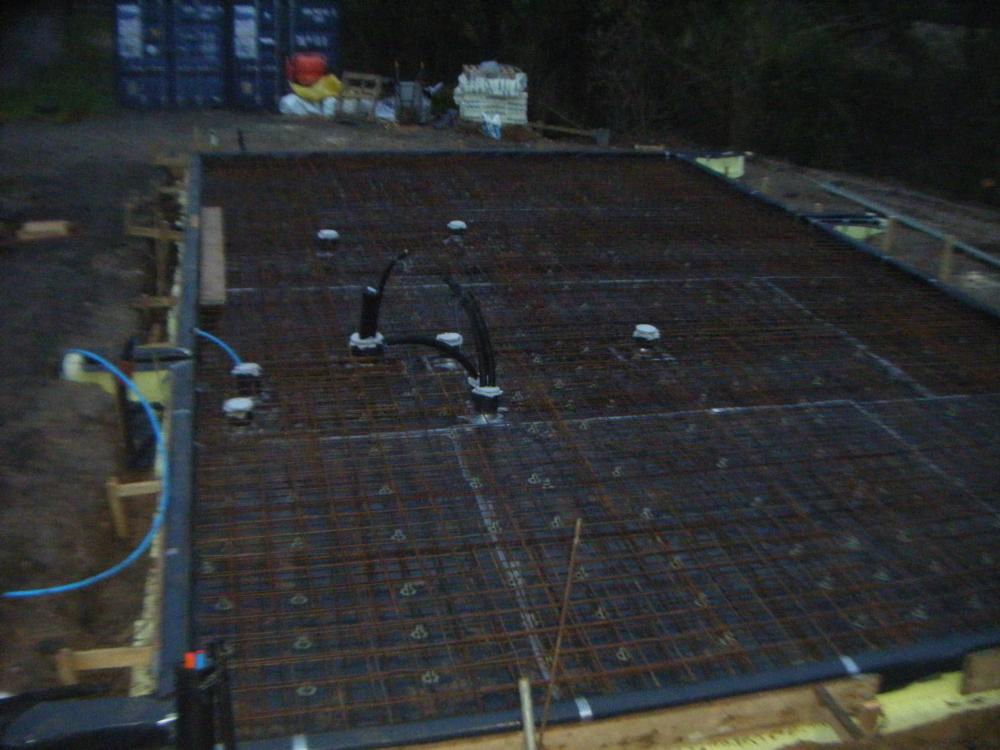
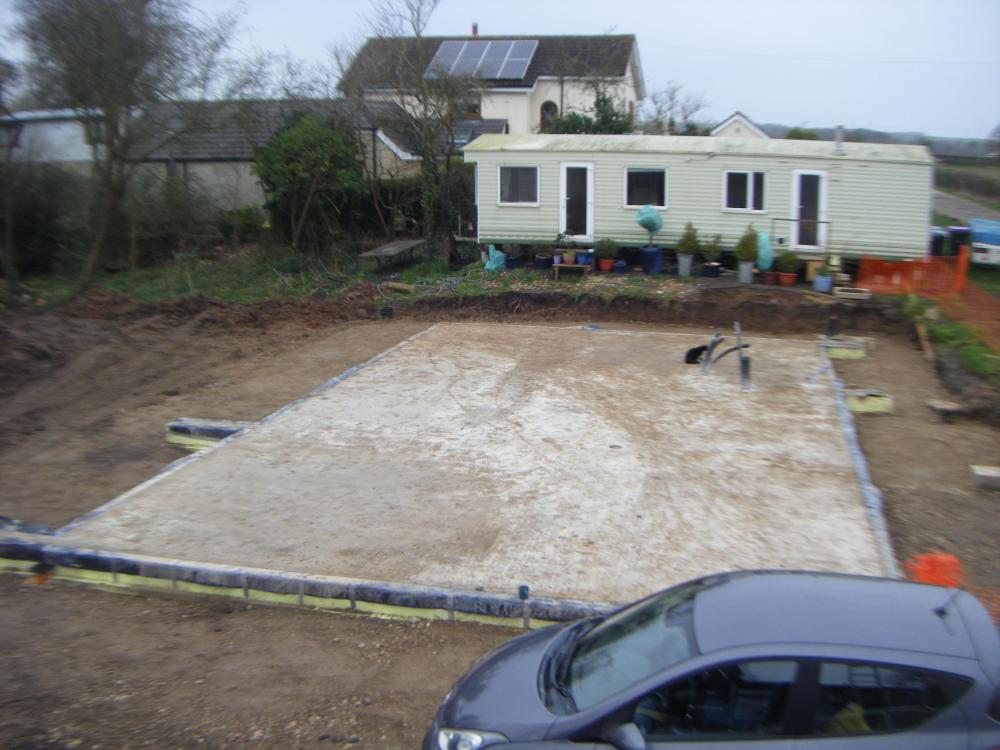
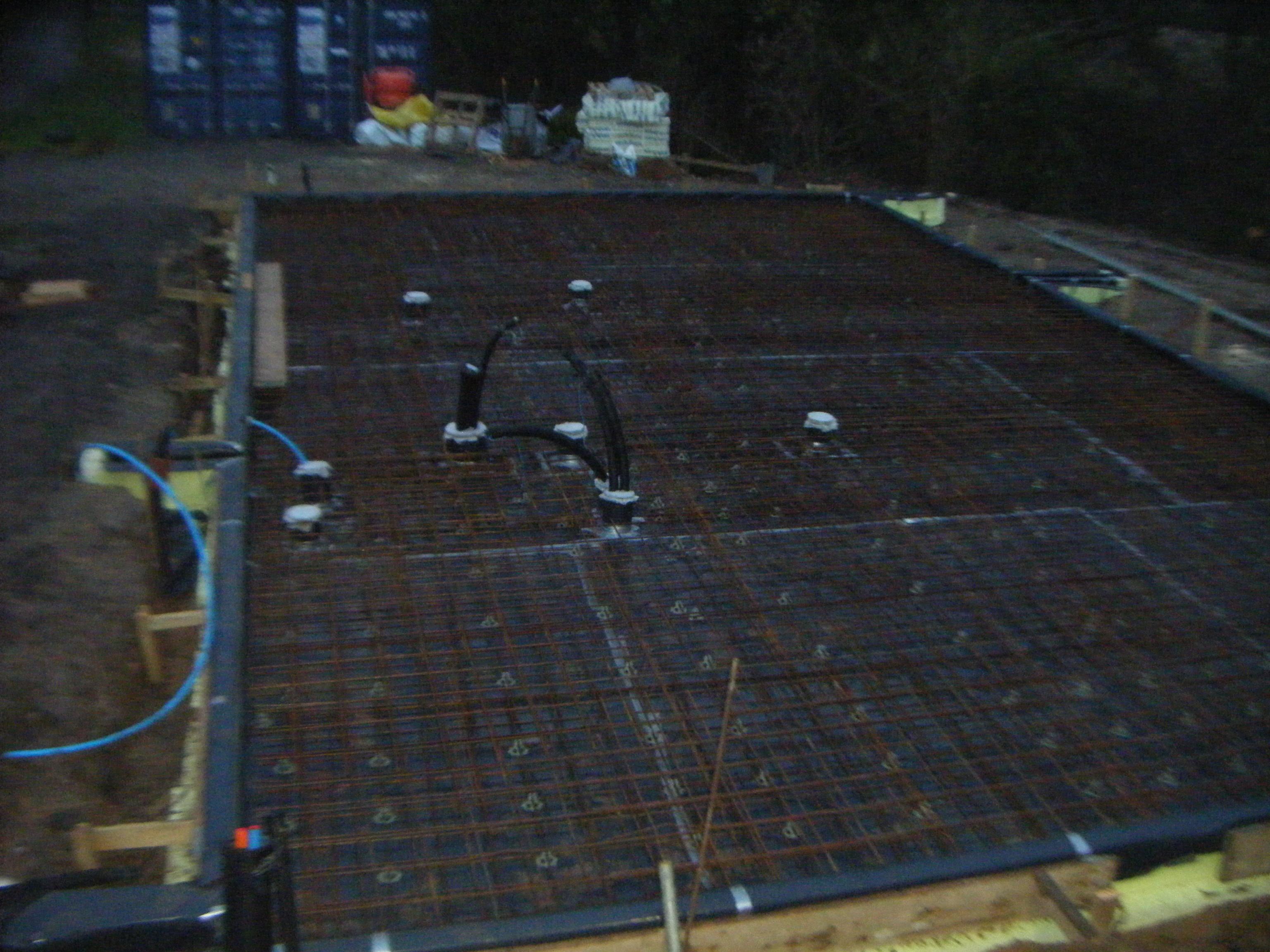
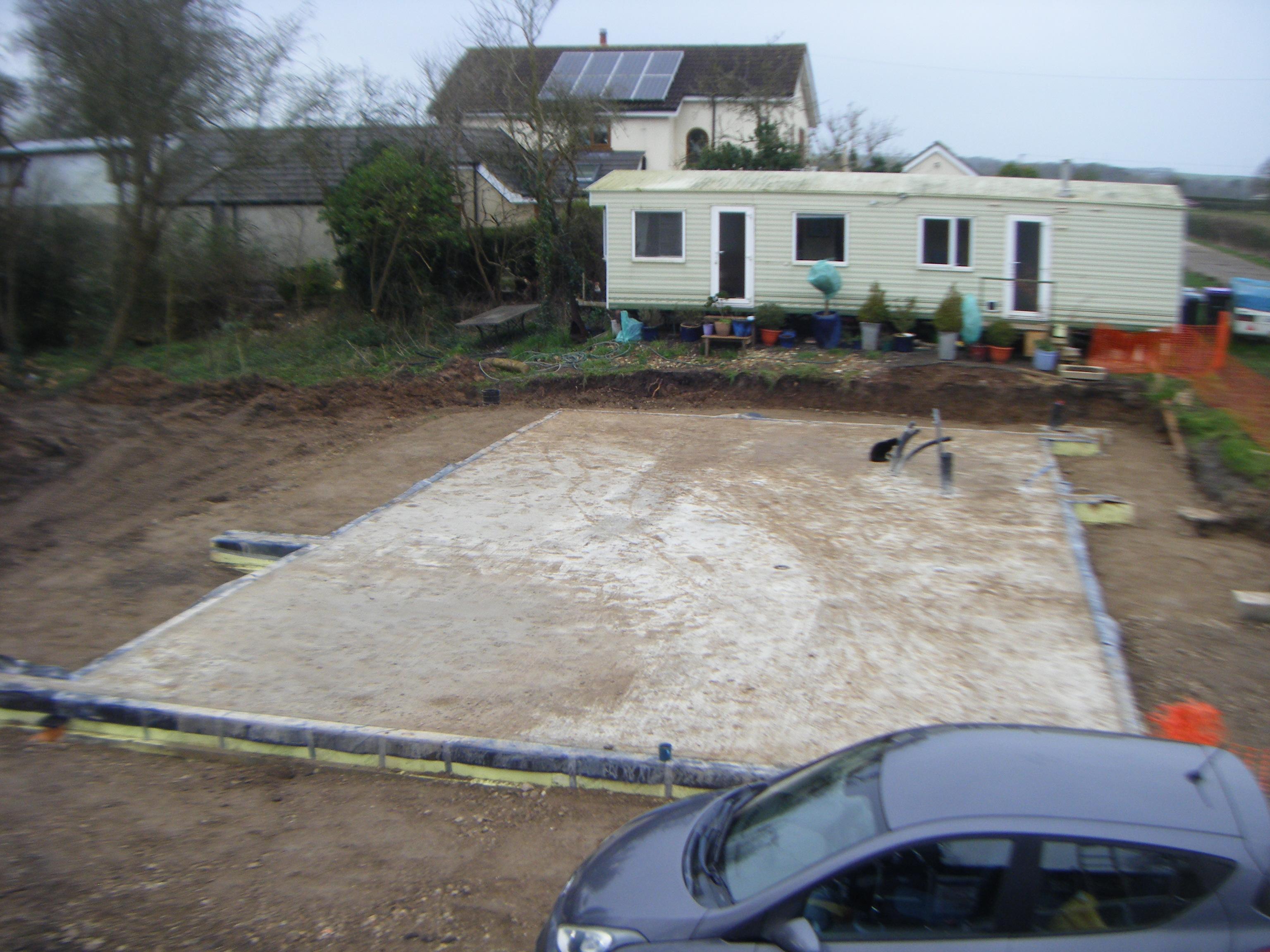
Final two photo's 8053 is the steel, sorry it was getting dark when I rembered to take this. Layer of A393 mesh in bottom and top with a further layer of A393 min 1.0 m wide around the upper perimeter (we just used the 1.4m offcuts from the main mesh). A couple of embedded beams using 16mm bars where the main load bearing walls are. 8059 is the finished raft with a muddy surface due to the state of the ground whilst the rain water drainage was being done. I'll power wash it off before the frame arrives.