


johnhenstock83
-
Posts
144 -
Joined
-
Last visited
Everything posted by johnhenstock83
-
help identify this damp/condensation patch
johnhenstock83 replied to johnhenstock83's topic in Damp & DPCs
the previous flooring was vinyl, fairly thin "plastic" flooring with something that looked like rubber on the back. you are right in that it would've concealed the damp patch if there was one, but before starting the construction work, we removed all of it and the entire floor/slab was bone dry, even during construction. again, this is INSIDE the original house, the extension has nothing to do with it. no changes were made to the existing slab and aside from those stud walls, nothing has been changed. had this damp patch been there for a while, we would've seen it straight away after removing the flooring. I'll give it another few days, it seems to have contracted a bit, but if it was just a wet spot (let's say from washing the slab or anything else), I'd expect it to be gone by now, it's not a huge patch. even the newly skimmed walls (drywall / plaster) dried up in less time or the screed in the extension. this seems persistent, but there's nothing fuelling it. no leaks, no pipes nearby, no ground on the other side of the wall (shared, covered alleyway, concrete at least 150mm below DPC). the only change from dry is the stud wall which was made with brand new, dry materials (stored inside). I'll keep posting until I find out what's causing it, like I said, it might go away, but the duration tells me there has to be something there. either drilling through the slab when installing the wall plate or a cold patch that creates condensation, otherwise it would dry in half an hour... -
help identify this damp/condensation patch
johnhenstock83 replied to johnhenstock83's topic in Damp & DPCs
so just to clarify, this patch is in the middle of the original kitchen, on the slab, nothing new has been built near it, other than 1.5 stud walls (timber, insulation, plasterboard). there are no pipes nearby, nothing is dripping and everything else is bone dry in and around the patch. if there was a leak, I'd probably see patches on the new plaster (it's very dry), or any spot in the vicinity. it seems like the patch is slightly smaller now, so as long as it's not growing, I'm "happy", but I just can't figure where it comes from. maybe there's a cold patch in the slab and it attracts condensation. since it's just in a corner, it probably doesn't ventilate properly. the mystery continues... -
help identify this damp/condensation patch
johnhenstock83 replied to johnhenstock83's topic in Damp & DPCs
no pipes above the stuff wall. besides, the patch is only on the slab, in a corner, not anywhere else in/on/around the wall. could the stud wall, where it's been fixed to the floor slab, have caused a leak? i.e. the builder drilled through the slab and created a hole between the ground and the house? I doubt it, as the builder is very experienced and all the work he did is sterling, I'm sure he knows not to drill though the slab or a potential DPM, but you never know. -
help identify this damp/condensation patch
johnhenstock83 replied to johnhenstock83's topic in Damp & DPCs
thank you all. I will do a few things and report back after the weekend. I'll draw around it, as suggested, to see if it's constant, but I'll open all windows/doors for a day, see if that has any impact. -
help identify this damp/condensation patch
johnhenstock83 replied to johnhenstock83's topic in Damp & DPCs
yes, it's only been showing damp since the stud walls have been built. this specific area wasn't under the kitchen units, but between ripping out the old kitchen and building stud walls, we're talking weeks in which there was nothing there, no damp either. the entire area is the original floor, it's just a divider wall creating a downstairs cloakroom. pipes are far away from damp patch and not connected yet, so they're not leaking. more or less dry, the patch is the corner you see and potentially under the stud. not much to see on the other side. -
help identify this damp/condensation patch
johnhenstock83 replied to johnhenstock83's topic in Damp & DPCs
there are no pipes in that location, I know that for a fact, but could it be that they drilled too deep in the concrete floor and created a link between the ground and the inside of the house? it's a 1950s house, I don't think it has a DPM. -
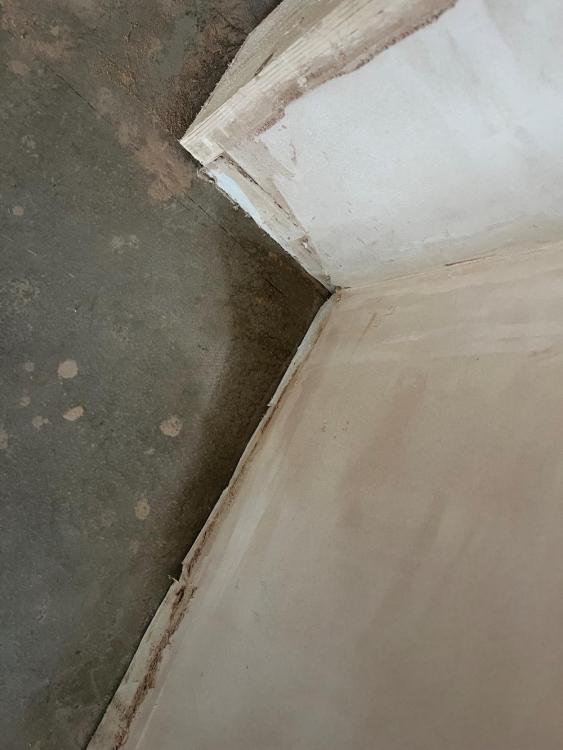
hello, I think I'm going mad here, I might have discovered the source to unlimited water out of nothing... when building our extension, we ripped our old kitchen out, including all pipes/cables/flooring. the floor is a concrete slab, probably uninsulated, but in good shape. for weeks, it was bone dry, despite builders working in/outside. the location in question is not near any old or new/existing pipes, valves, drains and so on. I seem to have a patch of damp that just won't go away, no matter what I do. I used an electric heater to evaporate it, it came back the day after. It's right under a brand new stud wall (2x4 timber, rockwool, plasterboard, skim) and doesn't contract/expand. since there's nothing underneath and it was always dry until the walls were built, I can only imagine it's condensation, but the location is weird. can someone give me an idea what it might be and why it won't go away? it's not wet, just a bit cold/damp to the touch. thanks
-
build in the early 50s.
-
the problem is, the existing downpipes (at the back, front is a different story) are not in my garden, so I can't check much. theoretically, if they flow into the foul sewer (thus a combined one), I should see the flow, but it's a bit tricky until it rains. would calling Thames Water help or will they be useless as always, not even knowing what I have in my garden?
-
right, some clarification: 1. I don't mean a sewer, I mean an inspection chamber. we have a private inspection chamber, where our private drains turn 90 degrees, and a public inspection chamber, just before draining into a main sewer. this inspection chamber collects stuff from all the houses in the row, including mine and has an interceptor trap. I can easily open this chamber when it rains, see if anything flows in there. 2. I'm not looking to connect directly into this final, public manhole, but have the downpipe drain into my private inspection chamber, from where my foul waste and flat roof water can drain slowly into an IC and from there into the main sewer, which is in the neighbour's (final house in row) back garden. 3. I'm thinking the same, I don't think the water authority cares either, but if I can do it by the book, I'd rather do it. can't be bothered to dig a soakway if it's a combine drain, the downpipe is literally half a meter away from the private manhole, it would take me 1 hours to connect it professionally, under the ground.
-
morning, I need a bit of help with my sewer, I'm not entirely sure if it's combined or not. the reason I'm asking is because we are looking to connect our extension downpipe (flat roof, approx 20m2) to it but as far as I know, that's not always "allowed". I know the issue is connecting foul drains to a surface water one, not the other way round, but I believe they don't allow surface water into a foul sewer if there's a separate drain available. we only have one sewer in the back garden (all neighbours do), so there's probably nothing for surface water, which leads me to believe it's a combined sewer. how can I tell for sure? the house was built in the 50s, ex-council terrace in surrey. we have a downpipe at the front of the house, but it just hangs above the driveway. the ones at the back go into the ground, but I can't see where. what will happen if I connect mine to the sewer? it's a small roof, can't imagine it will make any difference. thanks!
-
good morning, our extension is more or less ready, the skimming is drying nicely. I suspect we'll be able to start decorating (painting, flooring, second fix etc.) this weekend. I found 12mm thick laminate for a good price, we're probably going with that. I wanted to ask if people have some advice around underlay/insulation. about two thirds of the extension is new, hence 150mm celotex on a suspended floor, 80mm screed. the old bit is solid floor, directly on the ground, no insulation. I thought about laying aluminium foil all over the place, tape it with alu tape, foam underlay on top and then the laminate. is it worth spending a bit more or is it overkill? thanks
-
Evening, as our extension is more or less ready (waiting for plaster to dry), we started looking at kitchens. Based on previous experiences, friends’ testimonials but also advice from our builder, DIY kitchens AND howdens seem to be the only two good brands in that price category. I’d luke to go to a Howdens showroom with a ready made plan as we already have the layout / units / comparable prices etc. for our kitchen, but I don’t want to make a fool of myself. What I do know is that discounts are very much the norm, I’m just wondering what to aim for. I’ve seen 40% being mentioned somewhere, which would be in line with discounts on building materials, for example, would that be ok to aim for? I know there are many factors that count, but what should I be aiming for?
-
Recommend a software package for simple schematics?
johnhenstock83 replied to joth's topic in General Plumbing
I used librecad for my extension, it's a simple, free 2D cad package. very accurate, loads of tools, easy to get started, runs on any computer. -
easi fill 60 is what you need! are the pipes insulated?
-
Acceptable gap between frame and structure?
johnhenstock83 replied to ggc's topic in Windows & Glazing
sorry I don't have an answer, but that must be one of the best looking extensions I've ever seen, really good design! -
screed, then some type of flooring (engineered wood as it stands, but potentially laminate).
-
So for a domestic rear extension, which will have some typical things such as a kitchen, a dining table and a wooden floor, would celotex be able to hold the load?
-
I'm genuinely curious about the above and I was wondering if someone can explain, briefly, how this works. I know it's something that's done often, it's more or less standard practice, but I can't get my head around the numbers. we have a block and beam floor (roughly 20sqm). this is at ground level, with 3 courses to the existing floor level (2 + DPC). builder said he'll insulate it with 150mm celotex and then lay a screed of approx. 80mm on top. how can that sponge hold the weight of the screed and everything else that will sit on it without squashing?
-
I would try to break this down into individual "issues". I am more or less convinced that the foundation of the house hasn't been removed, this is not required for the removal of a structural wall. they probably removed the screed and a few courses of bricks from the footings, to be able to connect the new floor to the existing one, but the screed doesn't do much in holding the house up. with that in mind, if the house is propped correctly, it should stand, but you would want that done as quickly as possible. propping today, padstones in, steel in tomorrow, acrows gone by day 4-5... then there is the issue of the boiler/electrics. you don't know if the electrics are still on, it's easy to switch off specific circuits in the kitchen, for example. the boiler running doesn't sound too good without a wall, those fumes could enter the house and that's not what should happen. having said that, you won't be affected and while I understand your concerns, it's unlikely that someone will do something to a running boiler and cause it to explode. if you smell gas, DO report immediately, though. to me, this is more about access, but again, that's the neighbour's problem. I wouldn't accept a house to be boarded up, let alone left exposed to the weather and anyone from the outside, unless there's a proper door between the room in question and the rest of the house.
-
So from what yoh all said, unless appliances sit directly on the floor, there’s not much reason for it. that’s good bews, as the dishwasher is built in and the washing machines are in the utility room, which is tiled 100%. thanks all
-
the eternal question: to lay flooring (engineered wood) under kitchen cabinets or not? we've started planning the new kitchen and we're looking at 6.5m worth of units + an island (2m long). what is the general consensus on whether flooring should or shouldn't be installed under units? it could save a bit of time/money, but are there any disadvantages?
-
Hi all, extension being built, we don’t have a litchen anymore, all we have is a fridge, washing machine, a cupboard and a microwave. where can I buy the cheapest sink unit brand new? Any sink, any unit. I literally need that chipwood, plain white, laminated unit that lasts 6 months. plenty of free sinks on marketplace, what’s the most economic way of having this installed on a new unit? It’s literally for one month, I accept scratches, manufacturing defects. I always thought wickes is the cheapest, am I wrong? thx
-
sense check twin beam calculations
johnhenstock83 replied to johnhenstock83's topic in RSJs, Lintels & Steelwork
it is indeed 190kg altogether according to the supplier, that made me question it. I thought these beams were much, much heavier. the beams will rest on a 74cm return one side (30 side wall + 44 return) and 230cm+ return other side (30 side wall + 200 return). the diagram was accompanies by several pages of structural calculations, including a section generated by something called tekla tedds. thanks for your thoughts. -
Lintel crack serious or not ?
johnhenstock83 replied to mickespite's topic in RSJs, Lintels & Steelwork
in a cavity wall, the structural bit is always on the inside. the outside wall is not really holding any weight from above, so not that much to worry about. having said that, if I was you, I'd have it done properly, using a catnic lintel.

