johnhenstock83
-
Posts
144 -
Joined
-
Last visited
Everything posted by johnhenstock83
-
evening, this is probably the paranoia in me typing, but may I sense check my RSJ order with you? we're opening up an external wall (300mm cavity, brick/brick) to open up an existing kitchen with an extension. we paid a chartered structural engineer to produce calculations and a diagram, which he did. for some reason, it all "feels" a bit flimsy, but keep in mind I'm not an expert. engineer said we should use a twin beam, 203 x 102 x 23 UB, 4.1m long (3.6m opening + 2x over half overlap on 440mm x 215 x 102 padstone), held together by M12 bolts at quarter distance. this is to hold up an external wall on a typical 1950s council house, low ceilings (2.3m internal) and a typical tile roof. house is a terrace. does this sound right? I'm hoping those two beams together will hold the house, but I don't know why I imagined I would need something much more massive. any thoughts? thanks
-
Move steel column to be flush with wall?
johnhenstock83 replied to Dabooj80's topic in RSJs, Lintels & Steelwork
1. the columns are required because it looks like you're trying to remove the entire wall. while forces from above could be held by a horizontal beam, you must think about lateral forces as well. 2. the beam would ideally sit in the middle of the pad foundation. you can move it to the sides, but it would require a much larger foundation, to allow for eccentric loads. 3. not advisable to place the beam inside the cavity wall, it could lead to thermal bridging. -
thank you all for advice, builder reassured me he'll investigate properly before commencing and come up with a solution. just for clarity, it's not just strongboys they'll use, they confirmed the entire floor will be supported from the inside using acrows. assuming roof joists slot into the inner skin of the external wall, propping it from the inside will surely take some of the load of the wall. the load is then, I think, correct me if I'm wrong, spread on both sides, so that the strongboys don't have to take the entire load. I don't know why, but what I think of a cavity wall, I always imagine tons of weight per square metre, I never understood what a strongboy able to carry 340kg does in terms of support, in my mind this doesn't compute. thanks all PS: if it makes any difference, padstones go in first, without removing the wall. the intention is to first install the beams and THEN remove the wall, so the supporting should only hold for a few hours, until the beams go in.
-
Builder claims the leak is because of the boiler flue destroying the roof, even though the leaks are in random places. Is it worth getting a professional surveyor and take him to court? There are many problems with the roof and I’ve got photographic evidence, but other than a refund, I don’t want anything to do with this cowboy. Is it worth chasing or shall I just pay for a new roof and move on with my life? We’ve been stressing since we started the whole thing, no one seems to take thing seriously anymore.
-
found a local builder merchant who sells what I need by the piece, does delivery for a modest sum as well. thanks all. link for anyone else who might need it: PGR Builders & Timber Merchants (pgrtimber.co.uk)
-
morning, I am looking for a place that will sell me a lower quantity of bricks, I need 150 of them, to be more precise. the specific ones I'm after only seem to come in bulk, is there anything I'm missing? I need LBC sandfaced facing bricks, these ones: Forterra LBC Sandfaced Pressed Facing Brick Pack of 390 - Brick Wholesale thanks
-
We do have a contract, luckily. I'm just waiting for my bad cold to pass and I'll invite BCO back to discuss, see if there's anything I can do. I hope it won't trigger him to be extremely critical about everything else, but the walls seem ok. I'll revert with some pictures too.
-
I know, but I did call them back after the other builders warned me things are not ok and I asked specifically about the problems raised. He didn't seem concerned. For example, the wall plate is not held using epoxy bolts, but timber bolts going through the masonry. quite a few bolts, I'll give you that, but I was told it's not done. the double joists around the skylights are clearly not supported, they're screwed from the side in the first joist, so one joist is holding the roof, the skylight AND the second joist. I believe the BCO should've seen that from a mile away, he didn't say anything... anyway, fairly academic at this point in time, I've learned my lesson the hard way.
-
no. it's PD with building control sign off as we go along.
-
thanks for that, it's what I was afraid of. there's simply no point having them back, it won't be done properly and even without the leaks, it's not a proper roof. it baffles me that building control signed everything off, they should've at least picked up the other shortcomings. I will have a chat with the builder and hope he's reasonable. otherwise, it's a bad review and a very expensive lesson learned. cheers
-
afternoon everyone, I'm at my wits' end with our previous builder, I am starting to think that we hired a cowboy. this was "confirmed" by several other builders being a bit shocked about some aspects of the build. long story short, we paid someone what I consider to be a significant amount for an extension shell. brick/block walls, block and beam oversite and a flat roof covered in GRP. there were quite a few red flags during the construction phase, but I wasn't there all the time and I gave the builder the benefit of the doubt. long story short, our roof was completed towards the end of last year and we haven't had rain since, nothing serious anyway. today, we did and my roof is leaking... badly. aside from that, I was made aware by a builder we'll have to employ to fix the problems and finish our extension that there are other problems with the roof too. the height of the wall plate is not right, the double joists around the skylights are not held by anything, they are screwed into the original joist (basically adding MORE load, as opposed to taking half of it), there are no noggins at all, firrings are only present on some joists, not all and the plywood is not resting on the joists everywhere, meaning there are parts where they're sagging. I know that I would normally speak to the builder and ask him to make good the work, but we're about to spend another £30k on a kitchen/floor etc. and I really lost trust in this builder's ability to do anything properly, especially given the above. I know he'll come back and offer to "honour the warranty", but it will be the same people. some of them have been fired on the spot for lying about being roofers. I can't pray that they fix something properly this time, in the hope that I won't have to rip out my ceiling every time there's an issue, hence we decided to cut our losses and proceed with a new builder who advised on rebuilding the roof. how can I best go about getting some of my money back? I'm not looking for a fortune, several thousands at most (£3k). is that even possible given the legal system we have or am I stuck with giving him another chance? and another? warranty is good, but we haven't even started using the roof yet, so to speak, and it's dripping like a tap! thanks
-
hi Dave, thanks. there's one course of bricks on the existing house foundation on which the beams rest, they were not inserted in the original wall, so I guess that might not be strong/wide enough. in this case, probably best to remove blocks (I'll have to anyway) and build a support on the ground, using paving stones/bricks. I've seen that done before. I'm guessing undisturbed ground is strong enough to hold the floor for 1-2 days, until the beam is installed, right?
-
thanks all, a couple of points: 1. the beams do run parallel, so the load can be spread. alternatively, we can remove some blocks and somehow support the strongboys on the ground, that might be an option too. 2. the builders is taking responsibility for any mistakes he makes, unfortunately the block/beam was laid by another builder we lost trust in. since he doesn't know what's underneath and how it was done, he can't guarantee someone else's work, so should the block/beam fail, he won't cover that. 3. for a 3.65m opening, I believe the "guidance" dictates 4 strongboys (one every 900mm). If I go with 5, would that be enough to hold the external wall? it's not just the outer wall (bricks, but also the blocks inside, though I'm guessing propping the ceiling will help with that as well. would it be possible to prop the wall from the inside, so that the existing screed takes all the weight?
-
afternoon all, I was wondering if someone can provide a bit of advice, only looking for a generic yes or no. we have an extension shell (block and beam, no screed, walls + flat roof). we're looking to open up a section of the external wall between extension and existing house, roughly 3.6m. structural calculations done, signed off by building control. the builder proposed support the first floor on the inside, using acrows, and supporting the external wall from the outside, using strongboys. the strongboys would basically rest directly on the block and beam. are these usually strong enough to support an external wall (cavity brick/block, 300mm, 2.3m internal height)? worth mentioning that there's a 700mm return on one side and a 2m return on the other. thanks
-
glowworm c30 fault F75
johnhenstock83 replied to johnhenstock83's topic in Boilers & Hot Water Tanks
engineer dropped by, it's the pressure sensor. no danger at all, boiler running (you can start it manually), part to be replaced today or tomorrow. always the pressure senor... just can't seem to handle any pressure. -
glowworm c30 fault F75
johnhenstock83 replied to johnhenstock83's topic in Boilers & Hot Water Tanks
Thanks both. The only issue with the warranty is that we bought the house with a brand new boiler, no paperwork is available, so difficult to prove it’s still under warranty. -
evening all, very quick question, if I may: we have a 14 months old boiler, a glowworm c30. everything worked flawlessly until tonight when we both came back from work. when we left in the morning, heating was on (21 degrees on thermostat, always on). hot water was working. I switched the heating off (thermostat) when I left, no point heating the house for 10 hours. when I got back home, I switched the thermostat back to on, but the boiler wouldn't function. it had a cross symbol on the screen. I tried resetting it, it threw a F75 error. I then found this video online https://www.youtube.com/watch?v=PEibsWnVIDQ and followed the instructions. added 2-3 secponds worth of pressure, manually, currently at 2.0 bar, and low and behold, it works again. I already called my plumber, he'll drop by first thing tomorrow morning. it won't explode until then, will it? thanks
-
does a boiler need a fused box straight away?
johnhenstock83 replied to johnhenstock83's topic in Boilers & Hot Water Tanks
thanks both. all I know is that the current boiler has literally one "standard" cable coming out of it, but instead of going into a socket, there's a white fused box on the wall where the cable goes. no other components and the thermostat is wireless. I was mainly interested if there's a legal requirement/standard to have it fused, but it sounds like I can use an existing socket until the electrician sorts out the cables. -
morning, I had a quick question on moving a boiler roughly 2-3 meters sideways, part of finishing our extension. we have separate contractors for gas and electrics and they're likely to work on different days. once the boiler is moved, can I plug it in a normal socket for a few days, until the electrician installs a permanent fused box, or would that cause issues? the socket would be in an easily accessible place, easy to switch off in case of. thanks!
-
around £90/m, this is primed, no other preparations.
-
a bedroom. used twice a week, usually, otherwise empty. there's a double bed, two bedside tables and a chest of drawers, almost empty. the kitchen had a dividing wall before, but it is non load bearing, as the joists run in the direction of the crack. it was also removed many years ago, so I'm guessing if that was the cause, we'd know.
-
not a daft question at all, we do heat up the house, it's constant at 20 deg during the day, 19 deg during at night. maybe I should bring that up to 21 constantly.
-
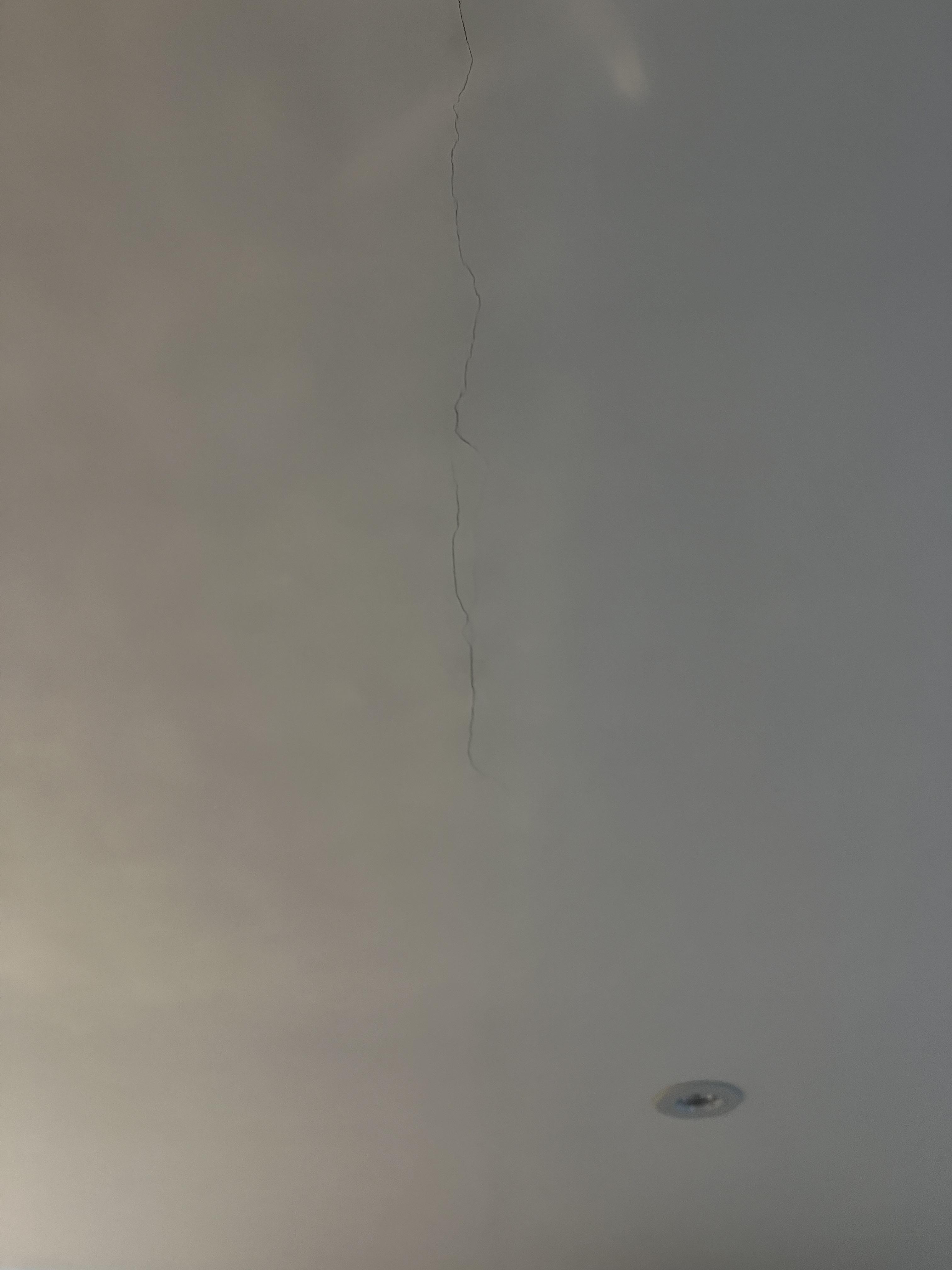
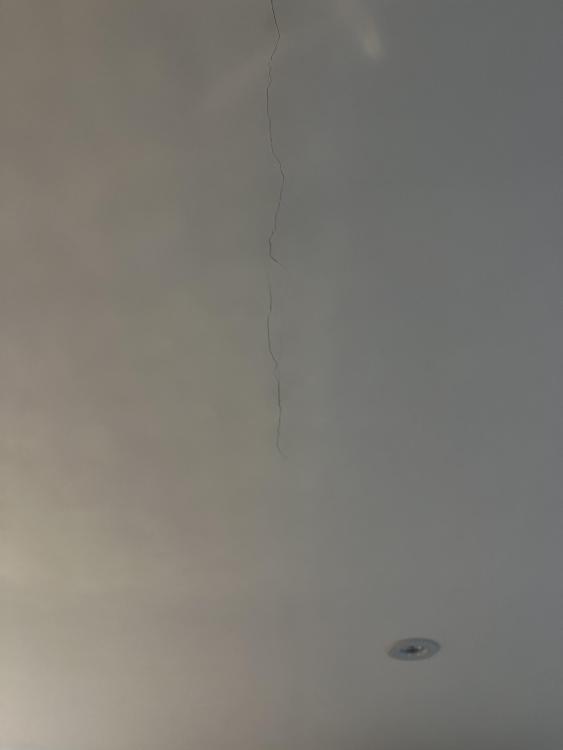
hi all, long story short, we moved into our first house nearly 2 years ago. the house had been vacant for around 4-5 months before we bought it. prior to that, the previous owners gave it a full revamp, but a cheap one, for a quick sale. everything was "new" (doors, kitchen, bathroom, carpet etc.), but the actual render/plastering was the old one. they painted over wallpaper in some rooms, they replastered the old plasterboard (house is a 1950s terrace). fast forward to today and we started getting some hair cracks in the ceiling (most rooms), following horizontal/vertical lines that in my opinion are the shapes of the plasterboard. in the kitchen, however, there's a "bigger" crack, see photos. the plaster there is quite thick, you can feel it by running over it with your fingers. the crack doesn't stretch all the way to the other side and it definitely doesn't continue on the wall. there is also nothing directly above it, not even close, never was. upstairs is just a bedroom with a bed in it, nothing else. can I assume these are plaster cracks as a result of a quick and cheap job without changing the old plasterboard or can it be something structural? how do I find out? thanks

-
can I "extend" my boiler flue?
johnhenstock83 replied to johnhenstock83's topic in Boilers & Hot Water Tanks
thanks all. I decided I'll buy a piece of celotex and cover the affected area, cheap and easy solution, safe as well. having said that, I'm intrigued by the boiler efficiency discussion. the burning temperature is set at 75 degrees and when I try to change it (I wanted to lower it slightly, as per general advice), the screen flashes "no" (glowworm c30). I figured out, by reading the manual, that the installer locked the temperature, hence not too easy to change it. we have radiators with TRVs fitted around the house, they're all on max. if the house is cold-ish and I turn the heating on, it feels nice and cosy in about 10-15 minutes, so the system works ok. is there anything I can do/alter/measure to start playing with some (safe) efficiency settings? worth mentioning that boiler is on 20 deg during the day and 19 deg at night, bills never went above £180/month with the current variable prices, so something MUST be ok. I just went outside to check and once the boiler reaches around 70 deg, this is what the plume looks like. does this look ok to you? https://file.io/W4XthvF19Hhs the problem is that the house is well insulated and it takes quite some time for the temperature to drop (could be 1-2 hours). by then, the circuit cooled down and when the boiler starts up again, the fumes are "white" because the boiler is not at the optimal temperature for condensation. can that be true? -
can I "extend" my boiler flue?
johnhenstock83 replied to johnhenstock83's topic in Boilers & Hot Water Tanks
it does reduce significantly once it runs for a little while, could it be a case of not reaching a required temperature for condensation or something like that? also, in slightly better weather, the fumes are barely visible. isn't it the case that water vapour condenses, hence you can see the steam? what's the water return temperature, what's causing it and can I set it up myself? I'm fairly technical and I have the boiler manual. understood that only a plumber should touch the flue, I'll look to cover the immediate area above the flue with some celotex or plywood.