Tony K
-
Posts
516 -
Joined
-
Last visited
-
Days Won
1
Everything posted by Tony K
-
A Labour exchange is an excellent idea. It could also be an opportunity to learn a bit from each other on site. Unfortunately you're too far away from me, but good luck.
-
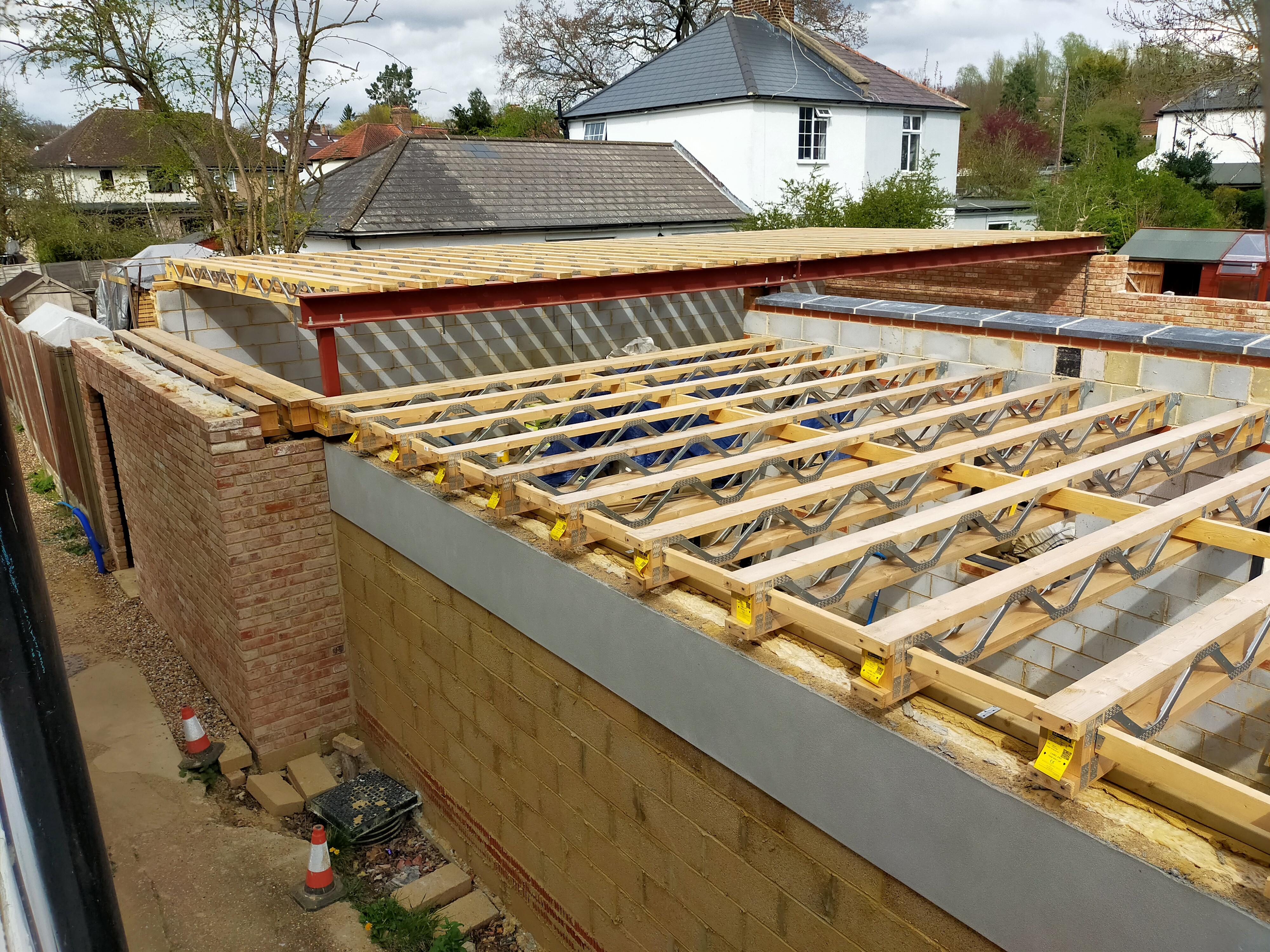
Some interesting ideas here, thanks. The idea is to fix the ply deck in place, and get the epdm up and at least resting in place all as one operation if possible, so as to minimise the time the ply is exposed to the risk of rain. I'll have at least one other person with me when I do all this, so I reckon I'll hire a genie for the day, and possibly a block tackle kit, then work my way through the various options. My concern about using the joists to winch the roll up, especially if I use a counter weight, is the amount of stress I'm placing on the joists. The whole of the joists are resting on a wall plate at one end (only on the inside leaf), but at the other end (above the steel) only the top chord of the joist is resting, and I may be taking a risk relying on that to take the weight.
-
Leaving aside whether the joist can take being used in the ways suggested above, the ply boards that will sit under the rubber need to be installed to some extent or I'll have nothing to rest the rubber on when I get it up to roof height. The normal way is to have all the boards fixed in place before getting the rubber up there, but I can look into winching or pulleying it up. Thanks
-
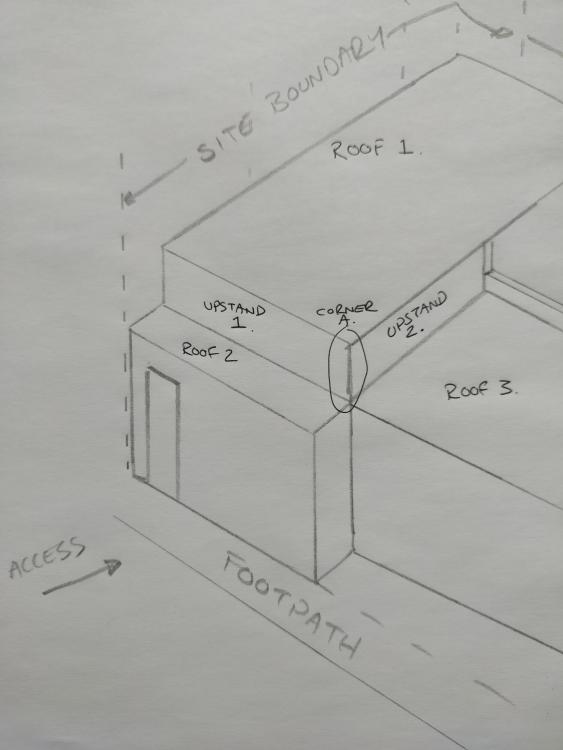
If the EPDM comes on a central cardboard roll, I could run a scaffold pole through the centre of the roll, then (having placed the roll adjacent to the wall) place something under each end of the pole, allowing it to rotate. I then take the end of the rubber and feed it up onto the roof (as per my sketch), like unrolling a giant toilet roll, except upwards. That could work?
-
Ha! The SB is adjacent to our current house, and the whole place is accessible only by footpaths. Once, as part of renovating our current house I moved a 300kg 4m long, 40cm depp, 50cm wide green Oak Beam down a 80m long, 1m wide footpath using timber rollers like something from ancient times. Then I used a genie to lift it up near the opening it was to span. Then I realised I couldn't get it across from the genie to its destination. Then I rested the beam on two piles of blocks at either end while, underneath the resting beam, I built a platform of scaffold boards across the threshold. Then I heaved the genie up onto the scaffold board platform. Then I lifted the beam, from its centre, up to the required height (each turn of the genie handle made the beam see-saw precariously). Then, once the beam was up at the right height and perched on the genie above head height, I (and this is the best bit) unlocked the genie wheels in the hope I could roll the genie, with 300kg beam balanced on top, gently forward into position. The laws of physics had other ideas, but I just about got away with it. I could have made a grand at least out of You've Been Framed that day!
-
There does seem a relatively high level of potential comedy here! If I follow my sketch above, I am only lifting the weight of the section between the ground and the roof at any one time, rather than the whole weight. I think.
-
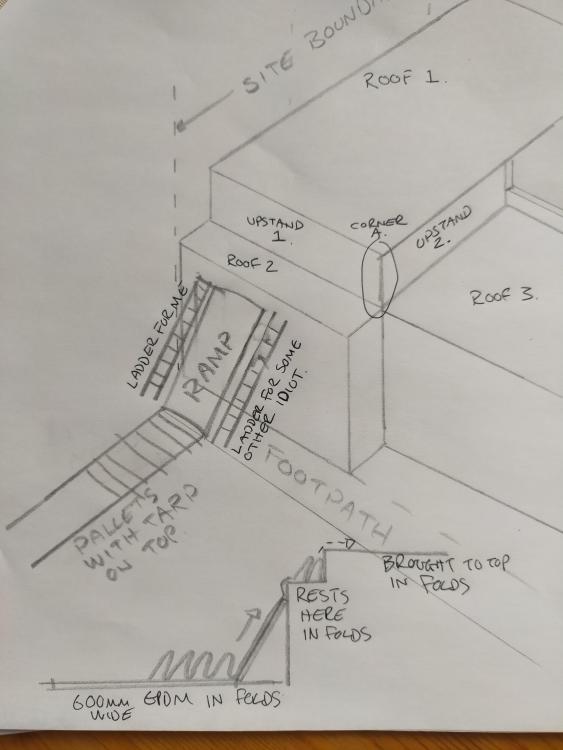
Here is my revised idea!
-
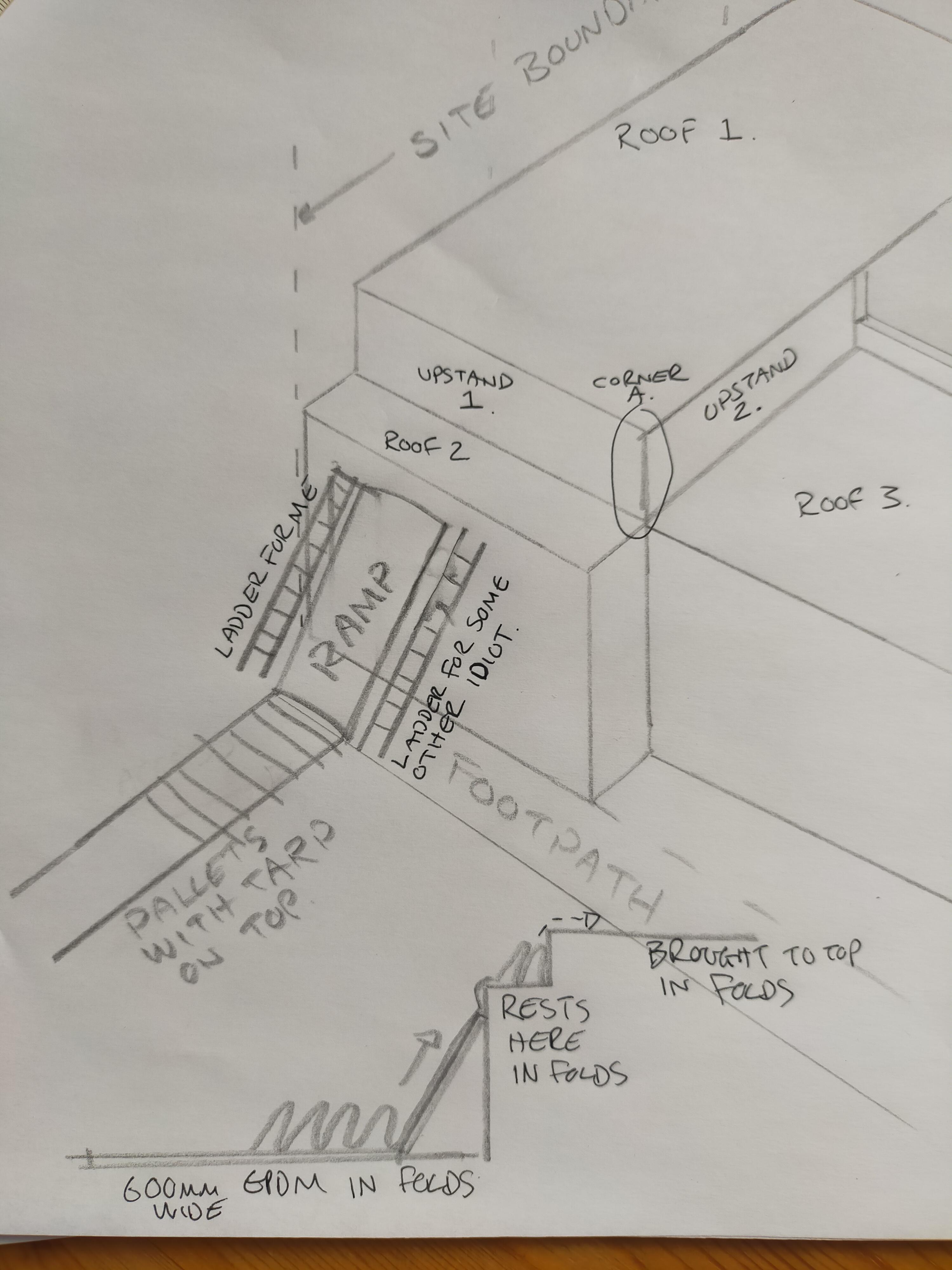
I think I understand. You are proposing dragging the rubber up a ramp, but designing that ramp so as to make that dragging easier, as the top layer of the ramp will move with the rubber roll as it is dragged up. I don't think this is so far removed from my idea, if I expand my proposal to include something protective for the rolled out rubber to rest on. I could set out a series of pallets with tarp or something on top, lay the rolled out rubber on them, have a ply sheet ramp leading up from the ground to the smallest roof section, and ruffle the rolled out rubber up so that it is not a dead weight when pulled from one end. Then two of us carry either end of the 600mm wide rubber up onto the first roof in sections. Hang on, I'll do a crap drawing.
-
The biggest roll (for roof 1) is about 12m long and 5.5m wide. Perhaps I could unroll it on the ground, then fold it over so that it is 12m long and about 60cm wide, then feed it up into position bit at a time? Anyone ever tried this?
-
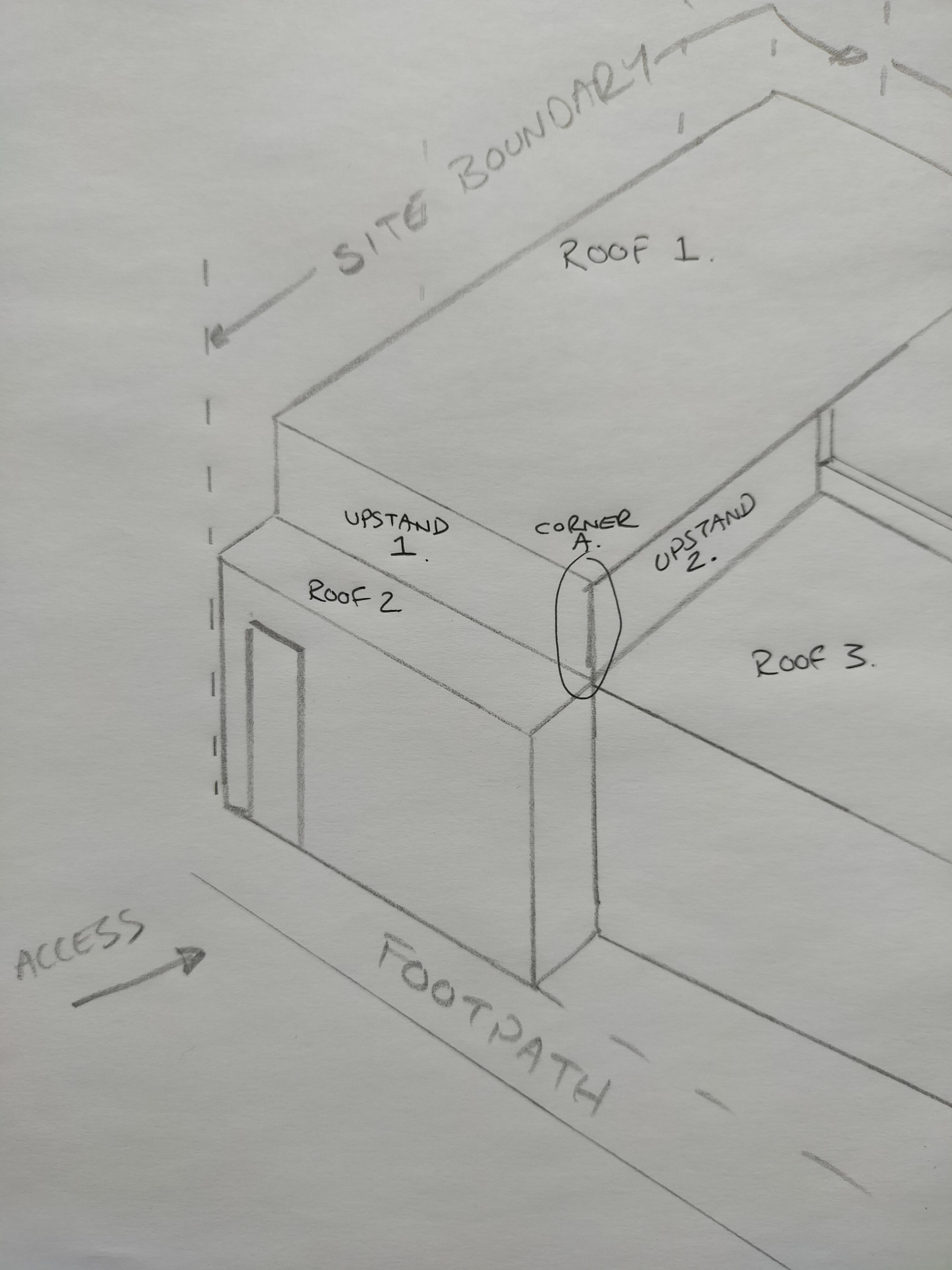
I could get a genie placed parallel alongside roof 2 and 3 (in my sketch above), then possibly lift the roll up so that it sits on the genie arms, and is level with the roof area, but then I've got to get the roll across from the genie to the roof somehow, as a genie doesn't swing round.
-
I will probably end up doing something like that, won't I? You'd be surprised how weak and useless a lot of one's mates turn out to be when tested by this kind of carry on!
-
-
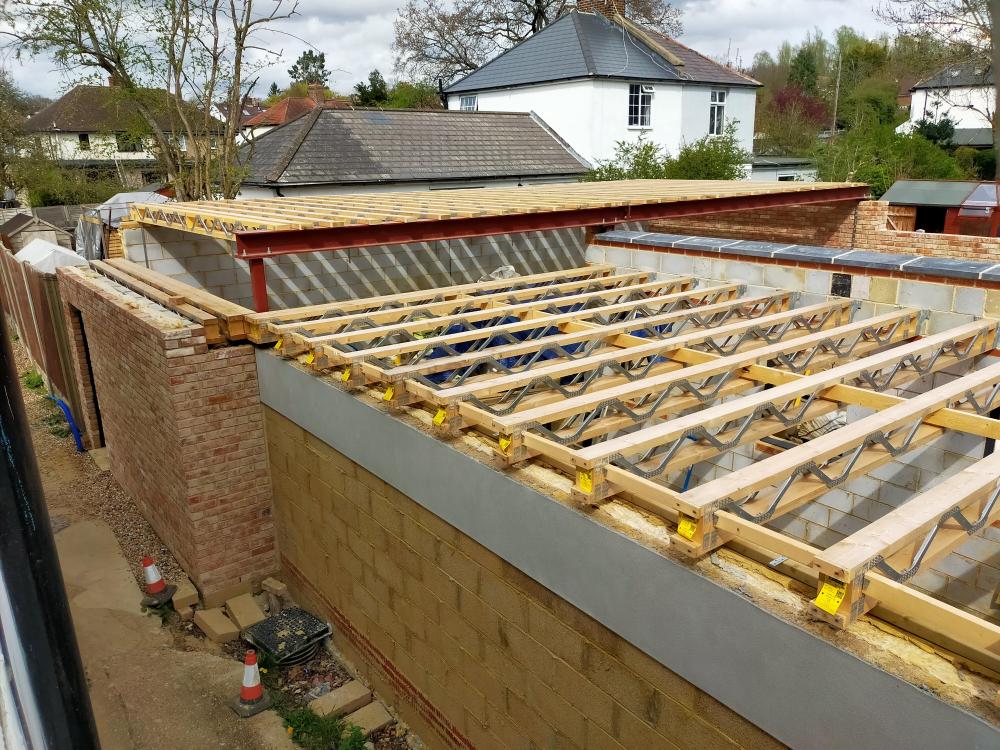
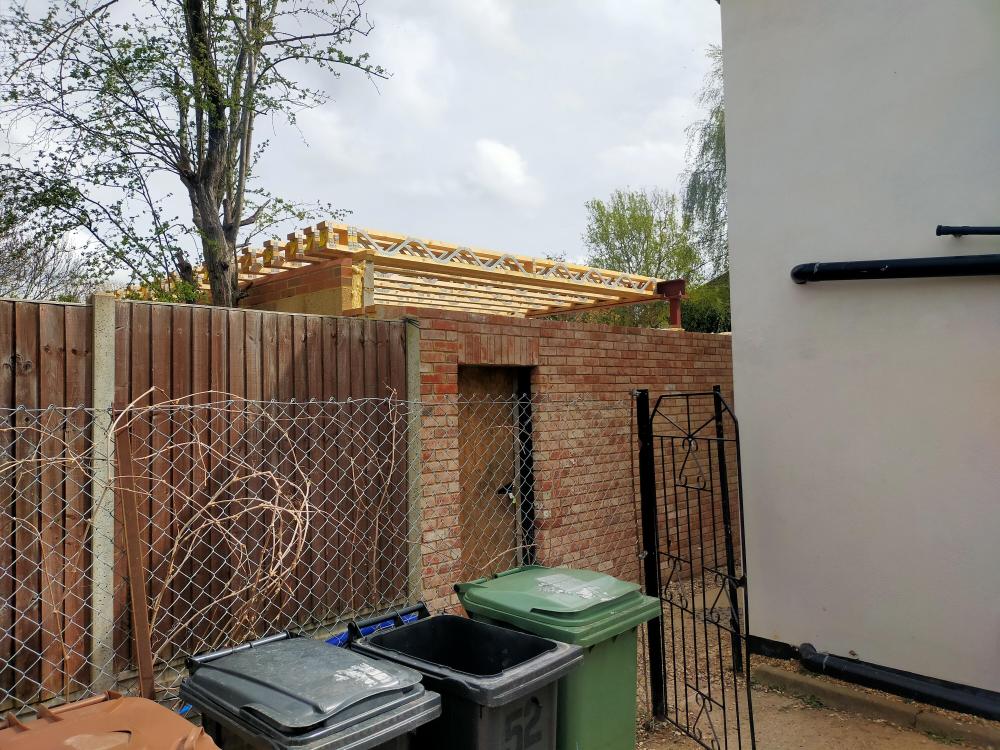
Hi @Conor The rubber is coming pre-cut to size already, and is still 100kg. Photo below...
-
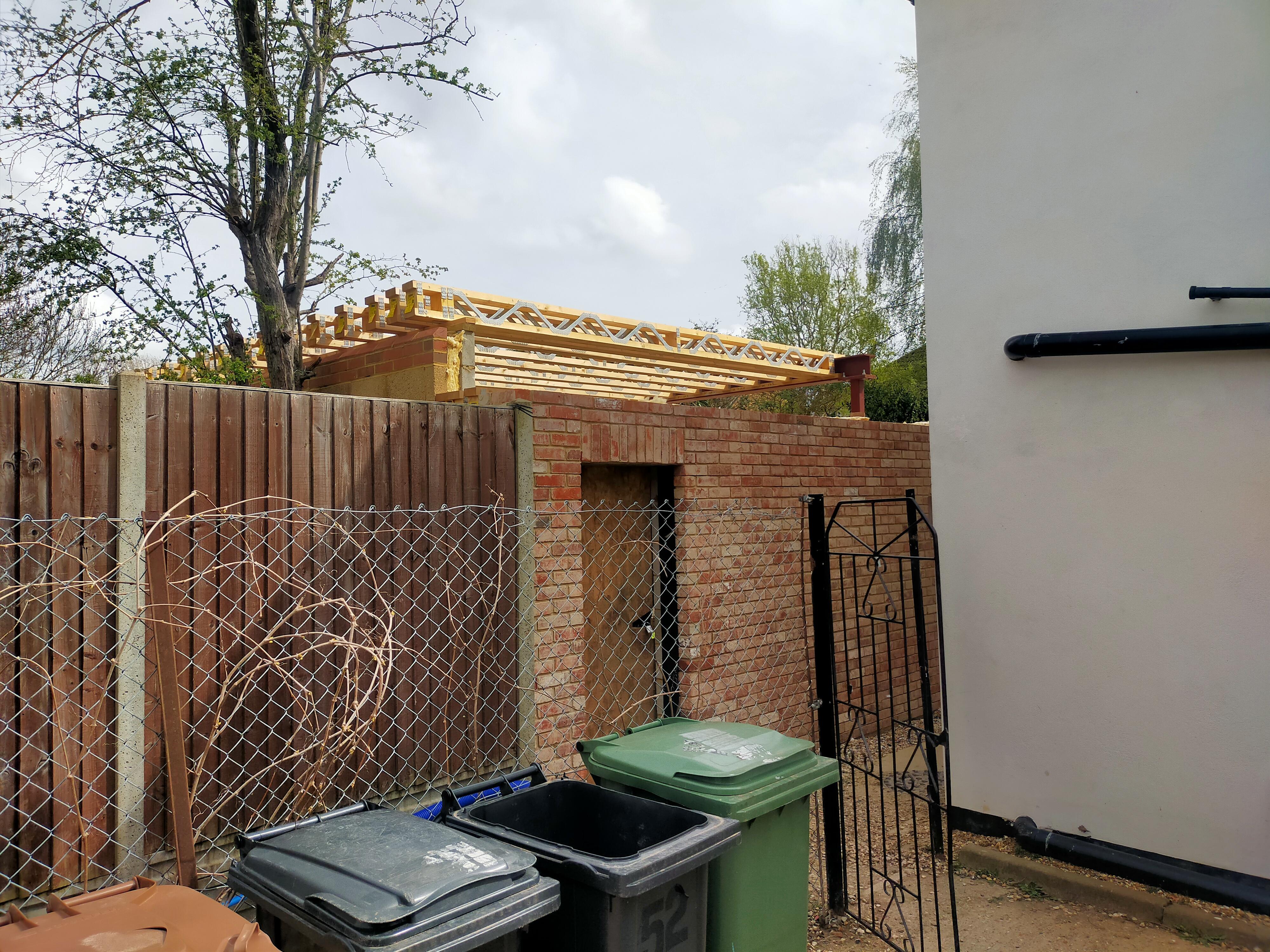
Afternoon all. I will need to move 2x 100kg rolls of epdm up on to the roof areas of my SB. The set up is as per the sketch. Roof 2 and 3 are approx 2.5m from ground level, roof 1 another 710mm more. I have seen folk run a pole through the roll, and carry it up using ladders, but not for rolls of this size and weight. A genie lift could be an option, but only in getting the roll up, not over and across into position. Any tips?! I have considered unrolling the rubber on the ground so it can be fed upwards gradually, but haven't seen this done before. Thanks
-
For those to whom this thread may be of use, I received the following advice from the heating engineer I have hired to design my MVHR, ASHP and UFH set up: 'Having a cooker hood that vents to the outside can cause issues with an MVHR system as the fans are quite powerful and can overpower the MVHR extract, so we always recommend that hoods are the recirculation-only type. The MVHR unit has a humidity sensor that automatically boosts it when it detects moist air. It also comes with a single gang switch that can be used to manually boost it; some folks put this in the kitchen or utility area so that they can boost the system when cooking particularly smelly/smoky food.'
-
Afternoon all. MY SB requires four bedroom windows. They are not key architectural or aesthetic features, and so I am free to source the cheapest decent but basic windows that do the job. I am looking at fairly plain casement UPVC windows, grey on the outside and white inside. A few online-only retailers appear to offer good value, and A+ energy ratings, but I can't see or touch the product ahead of ordering it. My local window firm has a high street showroom where I can inspect their products, but wants twice the price. Has anyone used online-only window suppliers? Were they any good? Cheers
-
Thanks all. I am leaning towards the circulation model based on the comments. Like @Beckside ours will be an open plan kitchen, dining living area and so I am interested to read that you didn't find smell and steam will be invasive, and that @Conor has a similar experience. My instinct was that chucking out all the heat through an external vent seemed illogical when the principle of MHVR is to reuse it, though I note the comments about balance. Cheers
-
Thanks all. @Conor I am using MHVR in the house, but the heating engineer advises that cooking extract should be a separate entity due to grease. @Marvin I plan to assess any conflict between the joists (which are bloody big thick posi joists 122mm wide) and the vent pipe. Gien the joist sizes I may not have much wriggle room if there is a conflict. @Beckside What makes you suggest recirculation? One article on the comparative merits said that 'You may find that some steam is returned to the room via this [recirculation] method. In general, recirculation models offer a reduced extraction rate at a higher noise level than ducted models — it is usually more efficient to port the extracted air directly outside than to filter it inside the unit.' Cheers
-
Afternoon all. My SB is single storey and has a flat roof. I will be using a rubber roof finish. We have a fairly settled layout plan for the kitchen including the size and position of the oven but have not yet chosen any particular cooker hood, other than we know we want it to be an extract model rather than recirculation. As I am about to fit the rubber roof I need to make provision for the kitchen extract vent now. The oven will be about 900 - 1000mm wide, so the extract will be 1000mm or more. From what I can tell, I seem to be able to leave the exact choice of cooker hood until later so long as I.... 1. Provide ducting and the external flat roof vent now (based on 150mm diameter vent pipe as opposed to 120mm). 2. Presume that the hood will have its extract connection in the centre of the unit and close to the back edge. They all seem to, but is this actually the case? 3. Opt as far as possible for rigid ducting over flexible to avoid any slight restriction in the airflow. Am I missing anything / about to make a problem for myself later? Cheers
-
Thanks all. I've got nine holes to do. I'm trying to compare the cost of getting enough sand and stone with the cost of just biting the bullet and getting postcrete. A 25kg bag of sand yeilds about 0.015m3, so based on the calculations above I'll need at least one bag of sand and two or three of stones per post. Call it ten bags of sand and thirty of stone altogether. If I'm lucky I'll get the bags for £3 each, so £120 in materials, as I have the cement already. Alternatively, I reckon I'll need three bags of postcrete per post, which means about £160 if I go down that route. It will of course be quicker and easier with postcrete.
-
Cheers Barry. Any idea how much cement I'll get through per post? The posts are 10cm wide, so the hole will be 30cm2 and 65-70cm deep.
-
Evening. I'm going to be installing 2.7m concrete fence posts, and rather than buying the postcrete, I've got a load of bags of cement to use up. Question is, what mix ratio is best for the job? I have heard I can use aggregate and sand, but what ratio?
-
Afternoon. I have a decent electric paddle mixer, and am wondering if I can use it to dig post holes. I have seen a number of these type of auger bits available.... https://www.amazon.co.uk/Makita-E-07319-Earth-Auger-bit/dp/B08PDMXYWL/ref=sr_1_3?keywords=earth+auger+bit&qid=1647357229&refinements=p_76%3A419158031&rnid=419157031&rps=1&s=diy&sprefix=earth+aug%2Cdiy%2C119&sr=1-3 ...but cannot establish whether they will connect to the mixer. Anyone ever tried this before?!
-
Understood, thanks.
-
There is one column in particular I need to address. To accommodate an exposed brickwork inside to outside feature wall which needed a vertical insulated dpc, I have had to place the shs column so that it is partially in the cavity and partiality sitting on the outside wall, exposed to the elements.