


Tony K
-
Posts
545 -
Joined
-
Last visited
-
Days Won
1
Everything posted by Tony K
-
Thanks @ProDave. If it's not too personal a question, what was it about the whole thing that makes you say you would not want to do it again?
-
Thanks all. I am aware that renting is not necessarily easy (particularly given that we will be living next door at House B, and so be contactable by tenants morning, noon and night, even if I use an agent, and also will be constantly looking to see if the House A is getting well looked after or not). I am also aware renting out is nor always lucrative in the short term. I have undertaken my SB on the basis that House A will be sold, therefore. Now that I actually come to it though, I want to be sure. I have made contact with an accountant and am awaiting a reply. If anyone knows of one that is good on this sort of thing, please let me know.
-
Thanks @nod and @Alan Ambrose. I am aware that CIL regs are a little unclear, hence my asking on here. As you say I must, if nothing else, consider whether I am comfortable with that uncertainty. One question on your responses above - I am aware that I avoid CGT if I sell House A, but I am thinking of renting it out. Do you mean to say that I would then be liable to CGT later on down the line if/when I ever sell House A, or that I would be liable to CGT once I start renting it out?
-
Happy new year all. As per the question above, we own and live in House A. We built House B to live in. Not long after getting planning permission for House B I also got a CIL exemption certificate from the local Council. Obviously, the exemption is based on House B being a self build, and also (from memory) that it would be our main home or only property. It is the last bit that I am interested in. I always intended to sell House A once we moved into House B, but am not thinking about whether to explore renting it out instead. Would I be liable to pay the CIL on House B if I kept House A and rented it out? Cheers
-
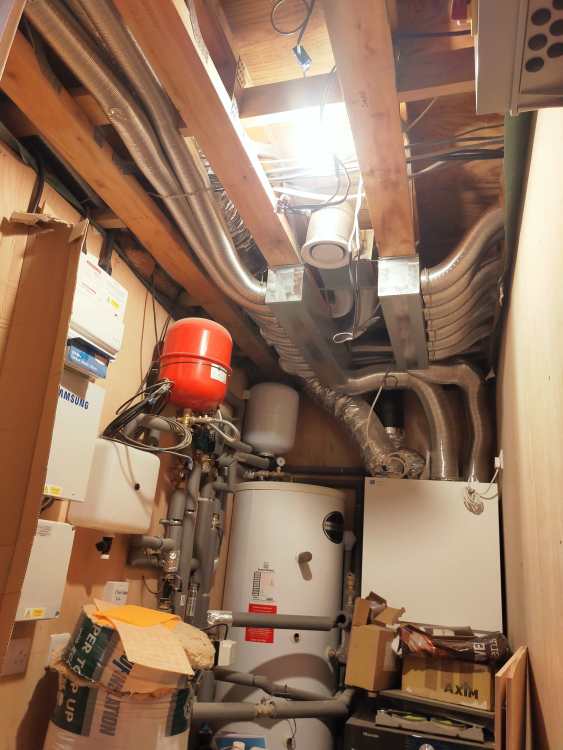
Hi all. My SB uses a cold deck flat roof made with posijoists. To keep building heights down but ceilings high I generally stuffed fluffy insulation into the void of each joist, before fixing solid PIR between them. Then, I attached further 50mm underneath throughout. Services run through the joists. My small plant room is where they all terminate, and is a busy place, therefore! I now need to close off the plant room ceiling. I cannot use the same method as in the rest of the house due to the mhvr duct runs. So, how best to do it? I am considering a suspended plasterboard ceiling where possible, but I cannot fit one throughout as the mhvr junction is lower than the highest bits of kit attached to the walls. I have considered a net ceiling which I could perhaps cut around all the ducting and pipies, but don't know how or where to start looking for a suitable product. Any ideas?! Thanks
-
Housewrap, or roofing underlay on garden office?
Tony K replied to Tony K's topic in Garages & Workshops
On to the next question! How best to pin the membrane in place before I fix horizontal batons over it? I've tried copper clout nails, staples, and various screws, but they all buckle against the dense blocks. -
Housewrap, or roofing underlay on garden office?
Tony K replied to Tony K's topic in Garages & Workshops
Well, my presumption is breathable, but I'm open to advice! From what you say, a breathable roof membrane will do a fine job on my walls? -
Evening all. I've built a single skin block work garden office using dense blocks. I plan to clad the outside in strip timber. I am considering putting some sort of membrane around the walls before applying the cladding, just to ensure protection from the rain. have seen different housewrap products online. 1. Is there a particular type of wrap anyone would recommend or avoid in these circumstances? 2. Is roofing underlay any good for the job? Thanks
-
Creating a fall into a floor drain
Tony K replied to Tony K's topic in Bathrooms, Ensuites & Wetrooms
Do the drains in your floors serve much purpose then? -
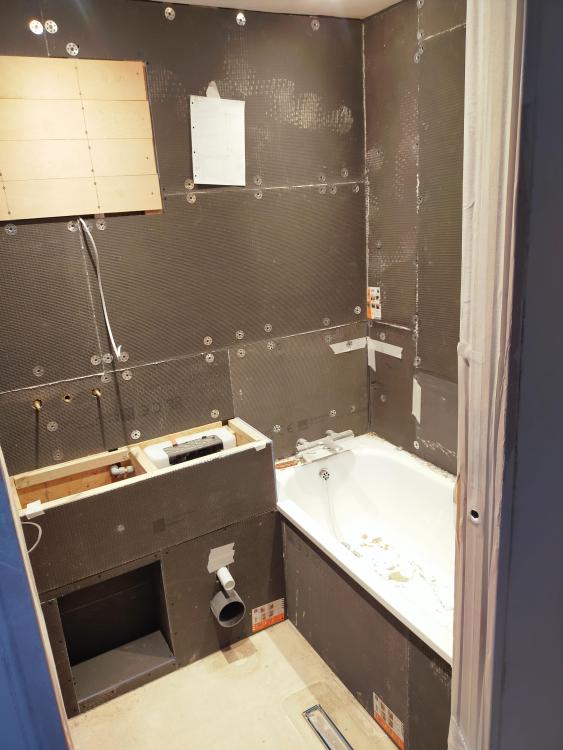
Hi all. I have included a wetroom floor drain in our bathroom. It's not a wetroom at all, the drain exists only to handle stray shower spray and drips from wet feet. The drain is set into the slab, which of course is flat and level. A couple of tilers have ummed and ahhed about how best to create a slight fall. It's a tiny area, and only needs the tiniest fall to do the job. Does anyone have any experience or ideas when it comes to this type of thing? Thanks
-
Which (if any) fixings hold PIR and Plasterboard to blockwork?
Tony K replied to Tony K's topic in Garages & Workshops
I had totally forgotten the service void! Thanks very much. -
Morning all, I am providing myself with a tiny little garden office, the walls are built of single skin heavy block. I plan to add 100mm PIR insulation inside the blockwork, then finish with plasterboard (or maybe ply sheets). There are a number of mechanical fixings I could use to pin the PIR to the walls internally, but the question is, how best to fix the plasterboard or ply in place? I had thought to fix 100mm timber batons to the wall, but that will, of course, create a cold bridge. Is anyone aware of a fixing solution they would recommend? Cheers! Garden Office Details (1).pdf
-
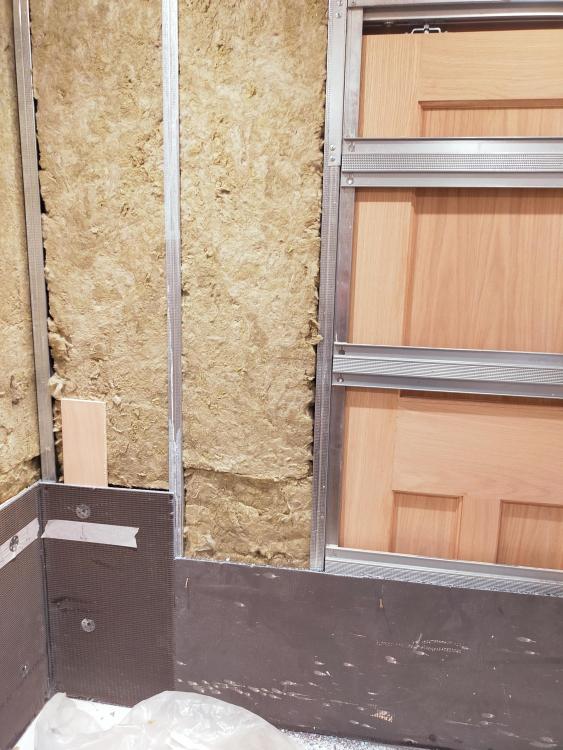
Afternoon. I am about to fix tile backer boards to the stud wall shown in the attached photo. In fitting the bath, the plumber pinned in place the backer boards you see. The bottom of the boards go down past the top of the bath by an inch or so. You may notice that the horizontal frames of the pocket door housing (on the right of the picture) protrude past the face of the metal studs (on the left of the picture) by about 5mm. The wall is only 1.6m wide, and when I hold a straight edge to it, it seesaws. Is that degree of deflection acceptable for a tiler? Or do I need to cut out the existing boards, build up the stud faces and fix them back on? That seems to defeat the benefit of the boards going down past the bath as they currently do. Cheers!
-
Thanks all. I will experiment with something like this... https://www.amazon.co.uk/Replacement-Toilet-Operated-Concealed-Cistern/dp/B0BC1N3Y16/ref=mp_s_a_1_4_sspa?crid=D1O01DITMN8T&dib=eyJ2IjoiMSJ9.ERMgARrvZFy0BoXJyt7MtFuOhUMsVDUAaHEI8p4lH0D_kAnr_crZ6_NCaWpTL0KsyO0jwKgA3XtaQyPVD9B5D7-lhYlKiGHzQXdVwExyHFgWNJ3qA8Wqp7VjZnqTuq1WLmWsHTYvYF8hd_lUChsX-Kz-BFHcJFrWEEC2RFzTM16mw9xaGmepy0NUX4_NZSaiR3-cptrS-uaxTvDno9VB8Q.ObIkBD9VA4Q6FUFy-ZOiFllaKnuo0HkOkFFXSq3VNPg&dib_tag=se&keywords=fluidmaster+push+button+cable+dual-flush+valve&qid=1709323996&sprefix=Push+button+flush+cabl%2Caps%2C120&sr=8-4-spons&sp_csd=d2lkZ2V0TmFtZT1zcF9waG9uZV9zZWFyY2hfbXRm&psc=1 And see if it works!
-
I have. They do a very limited range and none of them are a good fit aesthetically. Ideally, I want a copper/bronze coloured one which VP don't do. The purpose of my post is really to see whether I am about to waste my time searching high and low for a suitable looking flush only to find that it will not fit my cistern, despite being cabled. I have no idea whether any old cabled flush will fit my set up, or only very specific ones.
-
Thanks @marshian. Do you know if it is possible to use an old-fashioned flush lever with that set up?
-
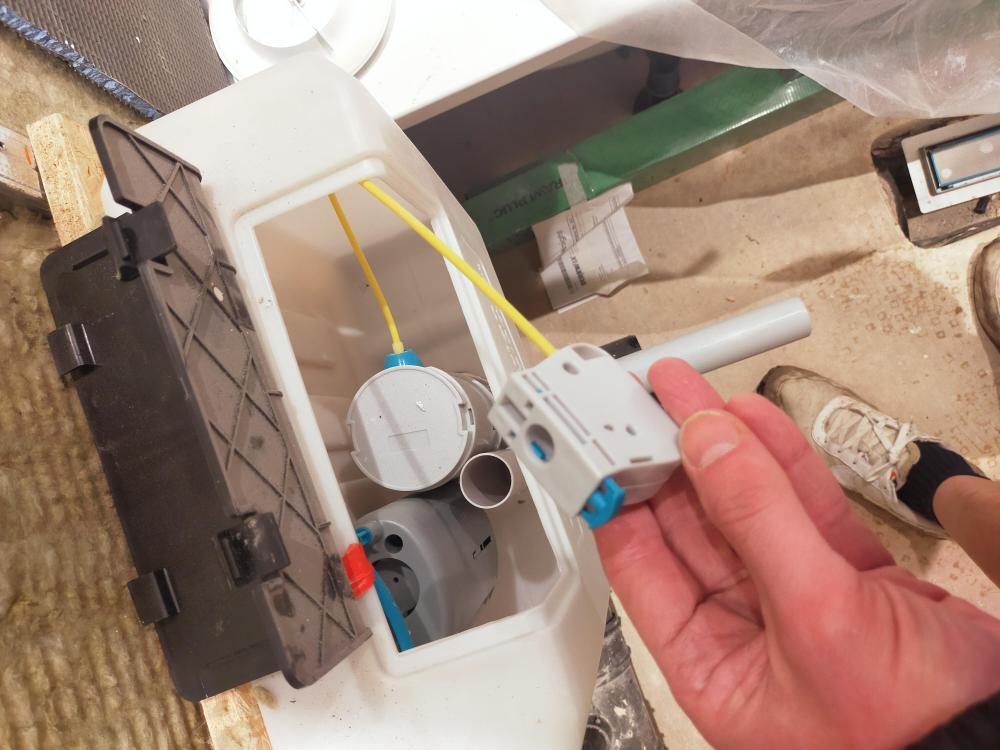
Afternoon. My plumber has installed three of these cistern sets for me... https://www.victorianplumbing.co.uk/back-to-wall-toilet-pan-d-shape-soft-close-seat-with-concealed-cistern I am now boxing them in. The cistern has a cable and push button housing as shown in the attached photo. It seems only a few flush buttons are compatible. I know nothing about plumbing and am struggling to establish what type of flush plate or button I am looking for. Most plumbers merchants carry a limited range of options and can't guarantee compatibility! Does anyone know what spec I am looking for, and whether any mechanical flush button will work? Thanks
-
Evening all. I have a small under-stairs WC I will soon decorate. Two walls are exposed blockwork, two are studwork (including the housing for a pocket door). I plan to create panelling around the lower 90cm on all four sides, probably out of MDF. The top part of the walls will be wallpapered. I need to use some sort of board on the top parts to enclose the studs and the block, and so that I can wallpaper. Obviously, plasterboard is the norm, but I have doubts. I will be building the bottom parts of the walls out of MDF anyway, and the top parts will be papered over, so the use of PB seems unnecessary and perhaps unhelpful if I need to peel off the wallpaper in future. I have considered using hardboard on the upper portions. That will be fine for the stud walls, and I see no obvious reason not to screw the hardboard to the block walls and then wallpaper over it later. Am I missing anything?! Anyone got any better suggestions?! Thanks!
-
Thanks @markc. I have just heard back from the tech dept of STS, the manufacturers of the backer boards I have. Interestingly, they say I do not need tape, just this stuff: https://www.wickes.co.uk/STS-Mega-Strength-PU-Adhesive---310ml/p/101132?fix&gad_source=1&gclid=CjwKCAiArLyuBhA7EiwA-qo80GBaJkYaeTyYQRfKm_5FBQ3PPmZUSGkYke6J4j4W6dFpoKPXr0ZnOhoCrX4QAvD_BwE&gclsrc=aw.ds Apparently, I use it not only to glue the boards to each other at the joins but also at the join between the boards and the block wall. They said I did not need tape, which slightly surprised me.
-
I have just seen a video on youtube in which care is taken to address the joins between the boards to ensure tat the substrate is waterproof. I suppose that is in case the grout fails or something. Do you think that the combination of backer boards and block wall will be OK as a waterproof substrate?
-
Yes, the lower part of the block wall will be boxed in using timber faced with tile backer boards so as to form a shelf in the shower area.
-
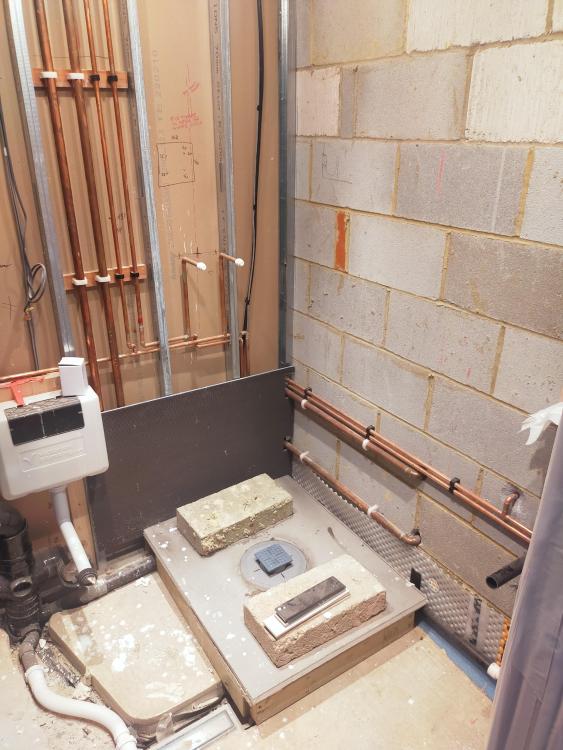
Afternoon all. I am about to prepare a bathroom for tiling. I attach a picture of the shower area which you can see is in a corner formed by an internal partition wall and an external cavity wall. I will use tile backer boards to complete the partition wall, and to box in the low pipes on the block wall. Should I be fixing tile backer boards to the face of the block wall generally, or is it OK to tile straight onto the blocks? My tiler is happy to tile onto the blocks if they are level but he is only responsible for the finish. I am thinking more about whether I need a continuous waterproof substrate on both walls, and whether block work provides one anyway. Any advice gratefully received!
-
The void where I might fit noggins is the void into which the door slides. I do have a soft-close mechanism fitted, but there is still a tiny bit of wobble as the door hits either end of the track.
-
Thanks. The bathroom is very small, so the bath is tucked in tight to the pocket door frame. That prevents noggins, and probably prevents the use of a thicker board!
-
Afternoon I am just about to box in my bathroom. The room is built from metal stud which I will cover with tile backer board, before tiling in the usual fashion. The bathroom has a sliding pocket door. The door goes into a lightweight Eclisse kit designed for the job. When I close the door I notice a slight wobble in the Eclisse housing. Nothing to worry about within itself, but I do wonder if it is wise to fix tile backer boards and tiles to a frame that has this bit of movement. The door will be opened and closed thousands of times over the course of its life, and I wonder if that will push the tiles apart. I have had contrasting advice to (firstly) use large sheet shower panels in that location instead. or (secondly, and conversely) that tile adhesive has enough flex to withstand the slight movement. Any experience of this? Thanks!





