


Tony K
-
Posts
516 -
Joined
-
Last visited
-
Days Won
1
Everything posted by Tony K
-
OK thanks
-
Thanks. What benefits are there to an insulated foundation as opposed to what I've currently got, where insulation will sit on top of the slab once the outside walls go up?
-
Did you find that what you saved in costs doing it yourself you lost in time and therefore mortgage payments?
-
Cheers. What sort of depth would you advise? I can't get a positive result from doing that. Is there a link or suchlike? Ta
-
Thanks for the advice. Any idea what I should be looking at to pay a groundwork firm to do it for me? I've priced materials already, but not sure what labour costs might be. Not that any of the firms round here even respond.
-
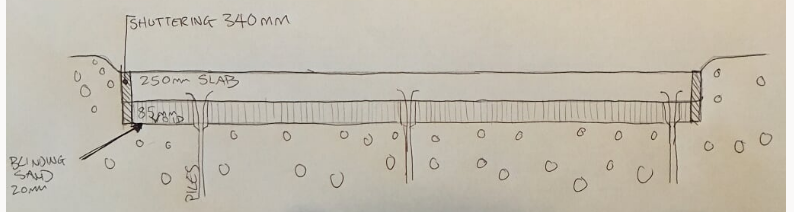
Hi All, Leaving aside the footings themselves (which might be piles, steel screws or concrete trenches), I need to construct two 5m x13m raft slabs as shown in this sketch: From the top down it is: 250mm poured concrete slab with A393 mesh top and bottom, and rebar to SEs design. 85mm clayboard, which will collapse leaving 75mm void. 20mm blinding sand used just to ensure a level base to lay the clayboard on. I will be need shuttering / formwork to create the edges as shown. I have fallen out of love with local groundworks firms who, based on their inability to even quote for work when they say they will, I am not thrilled about employing for anything that matters. Like this. Question is, can an amateur like me create the above? I'm already excavating the area. How difficult is.... Creating level formwork to the edges. What would I use? Timber? Hired road planes? Getting the sand base level? Installing the clayboard? Placing the mesh and rebar in? Accepting the concrete when it arrives? Cheers
-
Taking my neighbours tree down wqithout his consent
Tony K replied to Tony K's topic in Party Wall & Property Legal Issues
@Big Jimbo - No problem fella, cheers. Out of interest, and to round off this thread which has been so helpful to me, these are the relative foundation costs based on the (very limited) quotes I've been able to get: 1. Auger Piles: 38k without muckaway costs. 2. Pre-drilled Driven Piles: 30.5k. 3. Ground Screws / Steel Piles: 15.5k - 20.5k depending on soil test results. (Soil test is only £375 with one ground screw firm, or free from another as they are doing a job down the road anyway). 4. Creative (slightly fiddly) Trench Foundations with cross-ways groundbeams: 7-8k, including digger hire, muckaway costs and concrete. Might be more like 10k if I need to get a larger digger hiab-ed in to my site to excavate the bits of trench that are 2.2m deep. All prices are for foundations only, so they don't include excavating the site down to required level, soakaway, pipes and of course the slab itself. The temptation is to go for the cheapest of course, though a consequence of the trench method is that I'd end up with a ground beam set 10cm into my floorplan (like a big skirting board) to avoid the tree, and given the many benefits of the screws (as you say, great eco-credentials, but also quick, easy, tree-friendly and no threat to the nearby 120 year old cottages which, my neighbour and I know from experience having extended them, have very little by way of footings), they look the way to go. The ground screw firms feel certain they can appease the warranty provider and building control. It is new tech, but mine is far from the first house to use them, so I don't foresee too many issues (famous last words!). I'll start a new topic elsewhere about forming the slab, but as far as the footings go, the options are as above. Cheers all for the discussion. -
Taking my neighbours tree down wqithout his consent
Tony K replied to Tony K's topic in Party Wall & Property Legal Issues
Excellent legal advice. Thanks. Interesting thing though, how much detail to get into before making a planning application? Everyone from self builders to larger developers make a judgement call on what time, money and effort to spend fine detailing their proposals before they even know if they'll get permission. Some spend years, or tens of thousands, or both, ironing out every aspect, even appointing a contractor before applying for planning, almost like that bit is an afterthought. Others apply for planning before they even own the land, let alone employ an architect and engineer to actually check their idea can be built, all on the basis that if they don't get planning permission then all of that other stuff would have been a waste of time and money. What I did was design a house to avoid all the many possible reasons for planning refusal, use the simplest construction techniques, and work with the limited site access. I did a lot of research first, including assessing the tree. I found that a piled raft was viable and wouldn't require tree removal. I didn't get so far as to get an engineers design up front, or to get quotes for the groundworks. I viewed the planning application as a 50/50 shot, but worth a try given I could do it myself. By keeping my planning application homemade I saved myself the risk of throwing thousands away in fees for nothing, but left myself some further learning to do post-permission. Ultimately I accepted there would be one or two (to borrow the phrase) 'known unknowns', but I have confidence in my ability to problem solve when needed. Sure enough, it took more time and energy than I hoped to get me to where I was when I started this thread on Monday night. Now, a few days later, I've learned that my rights to cut roots on my land do have limits, that not everyone is comfortable with even a very nice tree close to their house, and that a fair few buildhub members are open to lighthearted skullduggery when overcoming obstacles! I've also (having learned I can't compel my neighbour to even discuss the tree with me) been forced to explore alternative foundation designs, including an excellent tip from Mike about ground screws. Turns out I can use various combinations of trench and groundbeam footings, or ground screws instead of the piles I had come to dread so much. These options seem far safer and easier, do not require removal of the tree (which in fact I really rather like), and cost half what the piling was going to. So all in all, I feel less of a muppet than you might think. But thanks for your valued contribution. -
Taking my neighbours tree down wqithout his consent
Tony K replied to Tony K's topic in Party Wall & Property Legal Issues
I'd grow a tree just to get 10k to remove it! -
Taking my neighbours tree down wqithout his consent
Tony K replied to Tony K's topic in Party Wall & Property Legal Issues
In fairness the planning system doesn't assess whether something can be built. I did check though, and found that a piled raft would work. When I started this thread I had concluded that the cost and risk of this method made the preservation of the tree disproportionate. Since then I've made progress on a cheaper, safer, tree protecting method so its all a bit of a false alarm (sorry!), though very interesting to see peoples views. -
Taking my neighbours tree down wqithout his consent
Tony K replied to Tony K's topic in Party Wall & Property Legal Issues
Now this is extremely interesting. I had looked at this, but only found screw piles for garden buildings (in fact the websites are clear that they can't be used for houses). When I designed our house it was with the specific intention of happy coexistence with the neighbours tree, and as much as my head knows that trying to have it removed is the sensible option, my heart still wants it to stay. I always liked the idea of it as a backdrop to my house as viewed from my garden. Trying to make that happen has cost me about 3k in engineers fees and at least a year trying to get someone who is willing and able to do the piled foundations and raft slab I had designed, taking into account the difficuylt access to my plot. All to protect the tree. End result: It costs an awful lot of money, and stress, and time to get pretty close to nowhere. Turns out there may well be a method using trench foundations (with which I am far more comfortable in terms of experience, how forgiving they are, the cost, the logistics etc). This method doesn't involve the expense and risk to nearby property of piling, but should protect the tree, so that's what I'm set to do, though I will look at these ground screws. Thanks very much for the link. Yep. Hired one, used it to survey the roots. Its great, so long as you only want to know about the top 30 - 40 cm of root structure and nothing else. Beyond that I was into the clay, and the air spade didn't want to know. That said, if your not in clay these are amazing machines. -
Taking my neighbours tree down wqithout his consent
Tony K replied to Tony K's topic in Party Wall & Property Legal Issues
Good job you and I aren't neighbours then! In all seriousness though, if you were my neighbour and it was your tree I'd respect your right to adopt that position.... if you always loved that tree, and cared a lot about it's vital role in your lovingly tendered garden. Even then, I'd also expect you to respect my right to develop my own land, and at least explore the issue with me. If it turned out you were an absent landlord using a tree that you actually didn't care about just to hold me over a barrel to line your pockets, I'd perhaps think a little less of you. If you were an absent landlord who wouldn't even respond to my polite enquiries, I'd probably start a thread on BuildHub asking how to force the issue! -
Taking my neighbours tree down wqithout his consent
Tony K replied to Tony K's topic in Party Wall & Property Legal Issues
Yes I think you're right. The key for me now is that I don't need to be held over a barrel by him. I'll persevere but only to a point. -
Taking my neighbours tree down wqithout his consent
Tony K replied to Tony K's topic in Party Wall & Property Legal Issues
Thanks all for all the advice. I reckon I might just have come up with a foundation design that doesn't need piles, doesn't include ten metre deep trenches and also doesn't require the tree to be removed. Nevertheless, I've offered to pay for the tree to be removed and replaced 2 for 1 as it would simplify the foundations even more as well as eliminating any risk of future issues for either of us. That would be to both my benefit and my neighbours. If he blanks me then so be it. I'll not be offering anyone 10k! -
Taking my neighbours tree down wqithout his consent
Tony K replied to Tony K's topic in Party Wall & Property Legal Issues
Yeah that's occurred to me. I could liaise with the tenants directly and if they don't mind then just do it. None of this is in the textbooks. -
Taking my neighbours tree down wqithout his consent
Tony K replied to Tony K's topic in Party Wall & Property Legal Issues
Because even once I've cut the roots the tree will remain, which means building control and the warranty provider will want to see that my new building can coexist with the tree. Either I tell them 'Don't worry I've killed it', in which case they will panic at the presence of a now dangerous tall tree right next to my new wall, or I don't tell them I've killed it in which case they will presume it is staying and require a highly engineered very expensive foundation solution to ensure tree and house can coexist. If I'm going to do that I may as well not cut the roots to begin with. Cutting the roots is only helpful if I am prepared to wait for the tree to die. And thats without even considering the risk that while I'm waiting it could fall on someone. -
Taking my neighbours tree down wqithout his consent
Tony K replied to Tony K's topic in Party Wall & Property Legal Issues
This is useful, thanks. The only issue here is that until the tree actually dies I wouldn't be able to start building. I'd be playing the long game. -
Taking my neighbours tree down wqithout his consent
Tony K replied to Tony K's topic in Party Wall & Property Legal Issues
It's right next to it. As in ten inches! -
Taking my neighbours tree down wqithout his consent
Tony K replied to Tony K's topic in Party Wall & Property Legal Issues
Yes, it falls away because it is unenforceable. The formal process is to apply to have the condition removed, which I may yet do. In this case my Council planning officer just wanted it off his desk and so (at my suggestion) discharged the condition (i.e. approved the foundation details) but with an informative stating that conflict with the tree was inevitable, even with piled foundations. In so doing the Council demonstrated the error on their part - they either should have refused my planning application at the outset on the basis of harm to the tree, or approved it without condition. As you rightly say, planning permission is only one hurdle to be negotiated in the process of building a house. Others include the building regs, and any civil issues. Many projects clear one or two of these hurdles only to fall at the other. Thanks for this link. The apparent conflict between my right to cut back roots on my land and his right not to have his tree killed by my actions is addressed clearly in the advice: 'This right is subject to some limitations. The cutting back must not make the tree unstable or cause it to die.' However, the same advice also goes on to say that: 'A tree owner has a duty to do what is reasonable in all the circumstances to prevent or minimise the risk of interference with or damage to the property of his neighbour where: (a) he knew of the encroachment of the tree roots or branches or ought to have been aware; and (b) there was a reasonably foreseeable risk of damage to property or enjoyment of it as a result of the encroachment.' 'A court has ruled that the party causing the nuisance is entitled to notice of the nuisance and a reasonable opportunity to abate it before any liability for remedial expenditure can arise. If the tree owner is not co-operative action can be taken to obtain an injunction (to stop the nuisance continuing) and/or to obtain damages to compensate you for your loss.' I wonder whether my 'enjoyment' of my property includes being able to build on it? It certainly is an interference with my property and there seems to be some acknowledgment in law that a tree owner has to address the impact of their tree. The landlord was consulted and objected. Funny story. Before my planning application I asked him how he felt about putting together a deal for me to have use of part of his land for parking, as my land has no vehicle access. His principal concern was keeping his tenants happy as they are paying over the market rate in rent, and he might not achieve that again if they leave (his words). Even so, he was happy to look at various options on a deal and we agreed I would explore with the planning dept. I submitted an application to build on my land and park on a bit of his. His tenants objected, and got on to him about it. He then wrote to the Council saying that he knew nothing of this application, that I didn't have any agreement to use his land and that he wouldn't let me use it. What I don't think he knew was that letters of objection are published. I tried to contact him to see if I had misunderstood our previous conversations. Absolutely nothing heated, all very polite, but he just wouldn't respond. I think he got caught between wanting to keep the income from his tenants and the prospect of income from me. In the end I just removed his bit of land form the planning application and it got approved. I have asked him if he minds me taking it down, but he hasn't responded. I will probably offer him and his tenants some money. I'm happy to do that, but I just wanted advice on how to proceed if he just stays silent. -
Taking my neighbours tree down wqithout his consent
Tony K replied to Tony K's topic in Party Wall & Property Legal Issues
I appreciate what you say, and of course the tree is not mine to take down but in terms of doing such works as will kill it the thing is, I can do that anyway, can't I? I have planning permission to build on my land and the legal right to remove the roots and branches on my side of the boundary. Nothing I have read says either of these rights are suspended by likelihood of the tree dying, only that I am liable if it does. I am happy to accept that liability. That's exactly what I'm trying to do. I simply want to avoid the creation of an unsafe situation which will likely occur when I do exercise my rights. -
Evening. As I understand it I have the legal right to cut back the roots of a neighbours tree where those roots come onto my land, in the same way that I have the right to cut back overhanging branches. I also understand that I am liable if, in so doing, I kill the tree or make it unsafe. Does anyone know how I might compel my neighbour to allow me access to his land to remove his tree, the roots of which I will have to remove to a significant extent when putting in foundations for my selfbuild? My self build obtained planning permission despite the reservations of the Council tree officer about the impact of my footings on this tree, a semi-mature Robinia located in my neighbours garden. The tree is not protected by a TPO, and we are not in a conservation area. The tree is right up tight to the boundary, and half its roots are therefore on my land, in the footprint of my new house. I have yet to start building. Initially the Council granted planning permission for my selfbuild on the condition that my foundations be designed to protect the roots of the neighbours tree. I submitted a piled raft design, but the Tree officer felt that even with piled foundations, the wall of the new house was just too close to the trunk of the tree for the two to coexist. Planning permission has already been granted though, and cannot be reviewed, meaning that the condition falls away - I work in planning and am confident of that. All that remains is a potential civil issue between myself and my neighbour over the tree. I've emailed the neighbouring landowner - an absent landlord - and asked his permission to remove the tree. I've offered to replace it with two good quality, smaller trees. Thing is, he never replies to anything. I am uncertain of how to proceed in the absence of his consent. It seems plain that he can't stop me from ripping out the roots on my side, and I could just proceed to do that. However, by doing that but not removing the tree as well I would be creating a unsafe tree, both for me and his tenants, which I don't want to do. If I don't hear back from him, how can I take this forward? I am aware that the Access to Neighbouring Land Act may be an answer, but am unsure that it caters for this situation and would be grateful for any practical experience and/or alternative solutions anybody has. Thanks
-
Part R / TV Aerial or Coax (in this day and age?)
Tony K replied to Tony K's topic in Electrics - Other
Upon further research I have concluded that whilst it is possible to get by without an aerial, it reduces your options. Most freeview boxes for instance offer both digital apps (BBC iplayer, amazon prime, netflix etc) which work exclusively from the internet and don't need an aerial, but there are a great many other channels that don't (yet) have apps, and so rely on an old fashioned aerial. Oh well, coax and aerial it is then. -
Part R / TV Aerial or Coax (in this day and age?)
Tony K replied to Tony K's topic in Electrics - Other
The quadplexer looks interesting, but is perhaps an example of my point - surely by now a lead for a radio is unnecessary and almost obsolete? If you've got Wi Fi then you have every radio channel, station and show available digitally through your mobile phone, which in turn connects to your Sonos speakers. Is the same not true of the TV? Do any of us still need connections to aerials and dishes any more? I don't know the answer to either question by the way... -
Hi I am drawing up the plan for lighting, switches and sockets for the new build at the moment. Two separate questions.. 1. What do I need to require of the electrician in terns of meeting Part R of the Building Regs (i.e. the requirement that I must provide physical infrastructure to allow high speed electronic communication networks - or 'the internet' as it is more commonly known)? 2. Do I need a coax cable socket connected to a TV aerial and/or satellite dish in this day and age? My instinct is that such things must be out of date and unnecessary by now, replaced by wi-fi based TV. However, recently something has gone wrong with the coax / aerial in our existing house, and the BT TV box (which remains connected to the wi-fi) can only allow me access to apps rather than the full channel list, making me think the humble aerial remains essential... Thanks!
-
No but I'd struggle to demonstrate any good reason not to have one, plus I kept the heights down for planning (even more so) first time round, then went back in for what I've now got.
