chrisb
-
Posts
95 -
Joined
-
Last visited
Everything posted by chrisb
-
My extension design has two 1m x 1m flat, fixed rooflights / windows to let a decent amount of light in. I've been looking around for quotes / reviews of a particular product so that any installation requirements can be taken into consideration when the TF design is finalised. I've seen Eco branded units here for £690 each and a U-value of 1.1. Fakro triple glazed are £1141 from the same outlet with a U value of 0.88. This seems expensive for what is likely to be a small energy saving in the grand scheme of things in my house. Signature units are also available, but don't seem to have any customer reviews and I've not seen them mentioned anywhere on the forum. A quick search on eBay didn't turn up very much in the way of cheap Fakro or other branded units. However, loads of sellers are listing things like this, which seem very similar to a glazing unit that goes into a UPVC window to me. Installation method seems to require forming a 100mm wide frame around the opening with timber + whatever roofing material you have (in my case it will be GRP, I hope) and sticking the glazing unit down on top with sealant. If that's all that is required, then £375 seems like a much better option! I guess there would be a cold bridge where the timber frame is, but this could be reduced by lining the aperture with 25mm PIR perhaps? Any advice welcome! Chris
-
So, discussed with architect: "this is the way slabs should be built" and many variations on that. Then came around to "if the BCO will accept a ground-bearing slab then there's no reason not to do one". Lots of chat about old-fashioned builders, experience in designing slabs, etc etc. BCO said he'll accept a ground bearing slab, providing soil looks OK when we do the foundation dig. He's familiar with the locality and can't recall any issues with the nearby works done recently. He did suggest making the slab 150mm thick though as its "such a large span" and otherwise it might crack. Given @JSHarris's house is sat on a 100mm slab with A142 fabric, that seems unlikely and 150mm thick is excessive? Unless the ring beam on Jeremy's slab means that there is more support and less tendency to crack? Could adding fibres to strengthen the concrete be an option rather than increasing the thickness? Also, my current design includes three 'intermediate footings' marked in blue rectangles on the image below. I can't see any reason for them if changing to a ground-bearing slab as intended. Am I missing something? What about the 14m long section - do I need to split it up with expansion gaps or one of the footings? (attempting to insert an image below here...)
-
@Nickfromwales Thanks. All noted. @PeterW & @Nickfromwales, I think the architect has done a lot of copy & paste, and use of standard drawings, specifically from www.buildingregs4plans.co.uk as the text on my drawings is exactly the same as theirs, and there are other errors too. I suspect that the huge overkill is to use standard details and avoid the need for any SE work. I'll give him a call tomorrow and discuss. http://forum.buildhub.org.uk/ipb/applications/core/interface/file/attachment.php?id=o_1bl8hto6bk0o72l9kpesa4ol16 shows the drawings - I can kind of understand some extra concrete where he *thinks* the TF guys might want to place some steels, but I can't understand the need for an intermediate footing halfway across the rear extension, and under the internal wall between workshop and utility room. The longest dimension is 14m, but in his drawings this is broken up into three separate sections, max 4.6m long each.
-
Some more work done on this over the weekend. I note @Russ P's thread here: The suggested floor construction from @Nickfromwales , @JSHarris & @Onoff is: 1. MOT Type 1 whacked 2. Sand blinding whacked 3. 25mm EPS 4. DPM 5. 150mm PIR 6. Thin membrane to stop concrete attacking PIR foil 7. 100mm concrete with mesh and UFH pipe cable tied to it This above seems consistent with @oranjeboom's method too. I would then add: 8. Latex screed done by Karndean (or similar) installer Some questions please: A. What should go under the MOT Type 1? Is there any alternatives here? B. Do I really need the sand blind as the 25mm EPS is quite squishy? If so, how thick should the sand be (trying to estimate quantity required). C. Taking a quick look online, 150mm PIR is more expensive than 200mm EPS, and 200mm EPS will give me more insulation under the UFH than the 100mm that the architect has specified. Does my thinking sound sensible? Should I try and get more EPS in, or swallow the additional cost for PIR? D. If I do use the EPS, can I put this directly on the sand blind, with DPM on top, directly under concrete? This would save additional labour and cost to lay 25mm EPS and thin membrane. E. Mesh is currently specified by architect as B785 which comes in at >£100 / sheet. Mentioned here and on the old place is much cheaper A142 (£20/sheet) or similar mesh. Why is my slab likely to need so much more reinforcement? I wonder if adding fibres to the concrete could allow a cheaper mesh? I have 3 intermediate footings in my design - not entirely sure why, neither were the builders when they looked at it. On other points - cold bridges inner leaf to slab - it seems the usual method to alleviate this is to run 25mm EPS all around the edge of the slab, so this should be fine I think? UFH designs - everyone I've looked at / spoken to so far don't seem to understand the concept of UFH pipe tied to mesh. How have others done pipe layouts / circuit designs for this method? Is it worth giving Wunda a call and see what they say? I'm thinking that the proposed rooms (study/utility/garage/new kitchen/diner) will have their own circuits and the existing kitchen will have it's own when I did up the floor and replace it. I'm hoping to be able to do this at the same time as the new floor, but that means dismantling and emptying the kitchen and logistics might not allow that :-( Humidity sensors - worth incorporating into the slab? If so, any ideas on a type / supplier? If I want to run some 15mm PB water pipes and some electrics in the slab, is this going to cause any issues? I was expecting to run the electrics in 20mm PVC conduit (or pull through later). Not sure of the best solution to 15mm PB plumbing though? The flexible conduit offering from John Guest seems very expensive? I'm also likely to want to re-run my mains water pipe to the house in future (it's 20mm black poly at the moment) and possibly the electric cable too. I'm thinking it's wise to run some ducts for these anyway so they are there, even if I never actually use them? Same goes for a water tap in the back garden, I'd like to bring this out underground if possible rather than having to take it through the study and out through the wall. Is there likely to be any issues with this? Thanks for all the advice Chris
-
It did reopen, but with the content of my first reply again, rather than the second. Perhaps I wasn't editing the second one long enough for it to save or something like that. Chris
-
Still learning about the forum - closing the tab you're editing in is a bad idea it seems! Flooring - we had decided on stuck down Karndean, but that was based on research ~2yrs ago, so maybe worth a revisit now. Especially as it seems the slab drying time measns we don't have to make any quick decisions! On that note, I was planning on putting some DS18B20 temperature sensors in the slab inside lengths of UFH pipe - same method as OnOff used in his bathroom I think? Should I also be thinking of something to measure humidity in the slab, and if so, what? Thanks for all the input so far Chris
-
Ferdinand, Thanks, I'm just getting to grips with the forum, I really wanted to be able to display the images inline, but they need converting from PDF first, which I will do later. 1. We wanted to get as much done as possible to a watertight shell and deal with decor etc when funds allow. I particularly wanted to avoid demolition works and building in the future next to a rear extension, so it seemed best to do as much structural stuff in one go. The South gets lots of sun, solar gain is a big challenge as I have 2 x 8'x4' windows in the front aspect - one main bedroom and the other lounge. The back garden gets sun in the summer as there is really onl a 6' fence either side to limit it, but in the spring and autumn, the back wall of the house is quite cold. 2. The shed and decking are existing, the decking has already been extended by 3.6m towards the house on the garage side in order to put a temporary shed to house the contents of the garage while I knock it down and rebuild (although my wife would have far preferred much of it to leave in a skip....). The shed has been eaten from the bottom up by rats, so will be replaced in the future with a better one with at least the first 18" in masonry. I'll also move it further from the boundary, after removing the pear tree which currently pushes it that far back. 3. I wanted to try and preserve a 1m wide access straight through the garage, utility room and study/playroom for exactly the reasons you describe. However, as the rooms are only ~8' wide in the side extension, I can't really afford to put an outside door in one end of the study and an inside door to the utility in the other as the remaining space would really suffer usability-wise. I'm planning on making the internal doorway garage => utility 1m wide and the same utility => kitchen/diner. French doors or bifolds from there to the back garden should still give me the capability to move big things if I really need to in the future. Additionally, the boundary to the garage side is my fence (panels & concrete posts) with the front gardens to the neighbours houses end-on to it, so with some negotiation that route is also available. 4. There is a chance that my son will need ground-floor accommodation & bathroom in the future, so the intent is that the study and utility could be turned into a bedroom with en-suite and the utility moved into the garage. It's too narrow for a car anyway, so will only ever be a workshop (except for the planner who signed it off!). I am planning on keeping the structure the same as the rest of the extension - slab, UFH, insulation etc, so it wouldn't need major works to accomplish this in the future. Last point - where do you see the title of proposed development as single storey? Its a 2 storey side and single storey rear extension, with the existing garage coming down to make way for new garage and 2x bedrooms above. I know the architect who did the BC drawings was a very poor proof reader and has many details left in from other jobs, so I'm busy getting those changed before going back to the BCO for an updated approval. The architect is a friendly chap though, so I can ask him about covered way stuff if you like? Chris
-
Hi all, Over on the old forum, I described my plans for an extension to our semi-detached house in Berkshire. Since then, lots of time has passed, planning issues dealt with and drainage details fought over with Thames Water. I've found a builder to take on the project, and have engaged a TF supplier too. I have BC approval, but want to make some changes, and also would like a sanity check from the collective thought of the forum before finalising things. I've attached BC drawings for reference, and would welcome any comments please. The floor slab is currently to a traditional design - hardcore, slab with mesh, insulation, screed with UFH pipes. We have decided on Karndean flooring and have confirmed with the installer that they will latex screed whatever floor exists to a depth of 3-6mm. On that basis, I wanted to change the design so to insulation under concrete slab containing mesh & UFH pipes as I've read others have done on here. Builder is happy to do it, but I need some guidance on the spec please. Reading all about cold bridges and wall/floor junctions, I'm concerned that I haven't paid enough attention to this area. The plan is to have a brick outer skin to the TF, as per the attached detail from Silvaframe. Thanks Chris Edited as the attachments didn't list exactly as intended! Further edited to add a link to the recent images from a Google visit: https://goo.gl/maps/p9vasZwbZov P702-01-master-First Floor Plan Details.pdf P702-01-master-First Floor Plan Structure.pdf P702-01-master-Foundation Plan Drainage CB v3.pdf SilvaFramePackage-SilvaStandardPlus.pdf P702-01-master-001 Site Layout.pdf P702-01-master-002 Existing Floor Plans.pdf P702-01-master-003 Existing Elevations.pdf P702-01-master-Build Over Detail.pdf P702-01-master-First Floor Plan Dimensions.pdf P702-01-master-First Floor Plan Structure.pdf P702-01-master-Foundation_Plan_Drainage_CB_v3.pdf P702-01-master-Ground Floor Plan Details.pdf P702-01-master-Ground Floor Plan Dimensions.pdf P702-01-master-Ground Floor Plan Structure.pdf P702-01-master-Posi-joist layout.pdf P702-01-master-Proposed Elevations 1.pdf P702-01-master-Proposed Elevations 2.pdf P702-01-master-Rafter layout.pdf
-
Is there a marked benefit of one technique over the other? I kind of like the idea of double thickness for more secure fixings if I want to hang things on the wall, but I wonder if the Fireline will be easier to install and therefore cheaper? I'd far prefer a rendered finish, but planning dictates it must look 'similar' to the rest of the house unfortunately. I have established that there is no way to actually enforce that as there is no requirement to submit materials for approval prior to building and there is no completion inspection, but I don't think I'd get away with a totally different finish.
-
OK, some progress. I was barking up the wrong tree (slightly). The BCO's requirement is that the whole wall has 60 mins fire resistance from either direction, not the cladding per-se. I have discussed this with the TF supplier and they have done this before by swapping out the OSB on the outside and replacing with fermacell. The cladding can then be applied directly to the fermacell if it is waterproof (as with GRP) and no breather membrane is required. Naturally, the TF supplier says that it should be the architect that comes up with the design and the architect says it should be the TF supplier as it's an integral part of their wall! I need to speak to the fermacell tech dept and the TF supplier again to work out who is going to do what. The compounding factor is the inside layer - the architect is suggesting fireline plasterboard as an alternative to another layer of fermacell as it will be cheaper. Any thoughts on wall construction?
-
Another call to the BCO - who is very helpful. The relevant requirement is 60 minutes fire resistance as I am building to boundary. There is also a spread of flame standard, which he will look up, but the suggestion was that a product that is compliant from a fire resistance perspective will also likely comply with spread of flame requirements. @SteamyTea Thanks! I mentioned this to the chap at GRP Building Products and he said the issue was that the pigment used in the gelcoat adversely affected the fire resistance properties. Of course, I have no idea if it's just his gelcoat and pigment, or a more general issue?
-
I've taken this a bit further today, including a discussion with the BCO. The stumbling block at the moment is prevention of the spread of fire, apparently not the same as flame resistance. The manufacturer (http://www.grpbuildingproducts.co.uk/) can make it flame retardant, but not fire resistant due to the pigment in the gelcoat. Both he and I are now looking into intumescent paint to see if that would be an option to make it meet the BC regs. @Ferdinand I've just searched for the terms you stated and found a few more suppliers to call tomorrow. Interestingly they don't appear with my previous searches of "brick effect cladding". Thanks.
-
Gents, thank you very much for your speedy replies. I can remove a couple of bricks above the garage door if I arrange some weather protection. I guess then I should take a tip round the BMs to seek out a match, or is there a smarter way? I have considered brick slips, but certainly for the matched brick its very expensive as each brick needs to be cut. I have some stock slip samples which are a lot more economical. I haven't really identified a system to mount the slips on - there seems to be a few options, some of which alter the construction of the wall with insulation, cavity etc. Guidance and opinions very much appreciated please. @SteamyTea & @Ferdinand, I'm reassured by your posts - I was beginning to think that with only one supplier that I found, I was onto a crazy idea, but it seems more like its one of those things that just never caught on here. Any suggestions for suppliers welcome. Thanks Chris
-
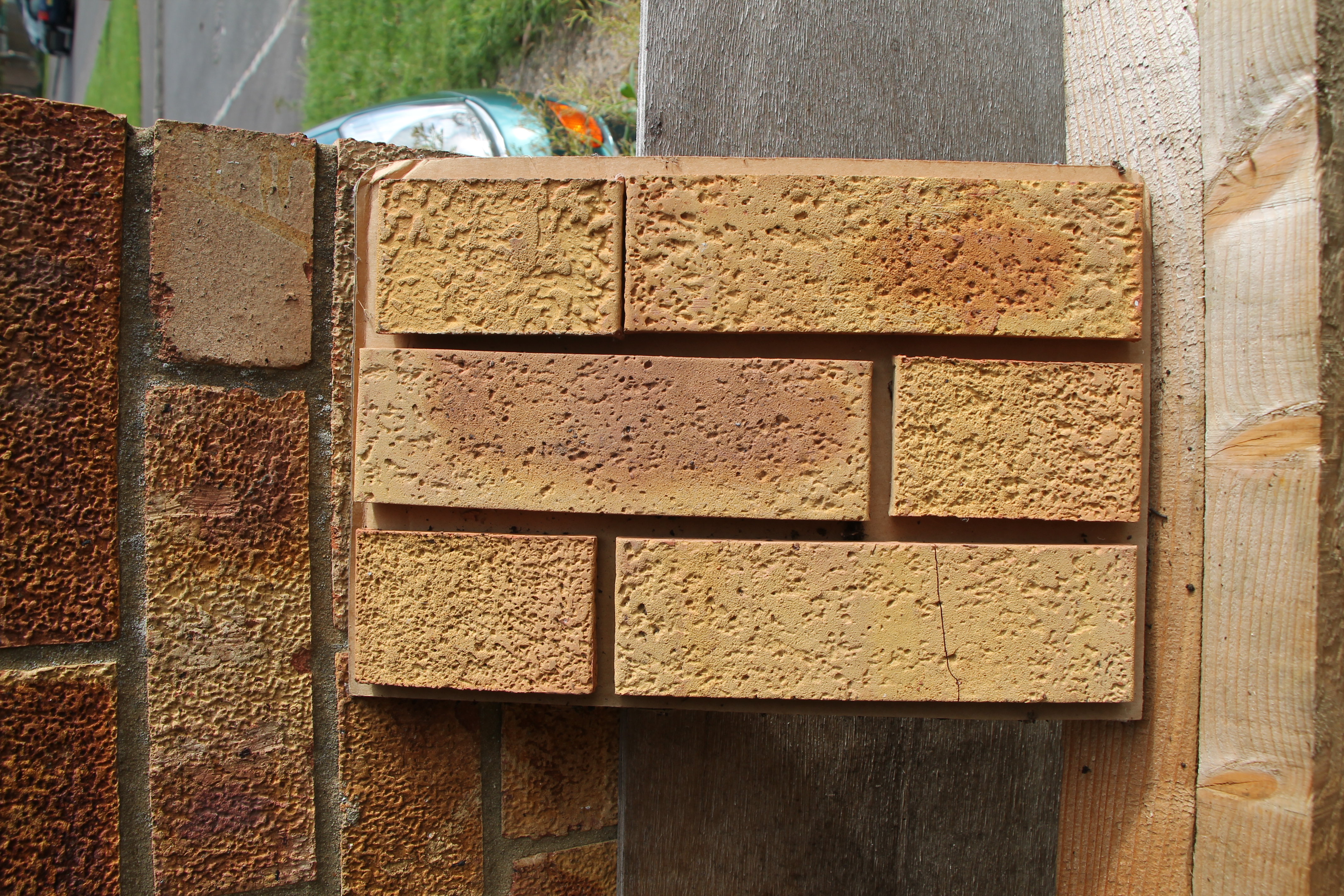
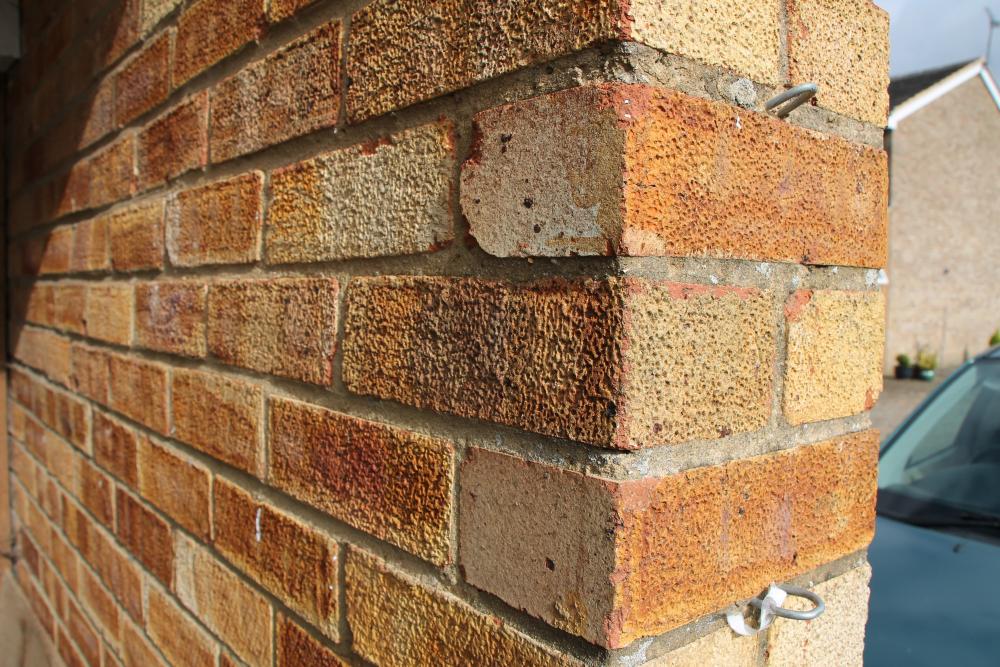
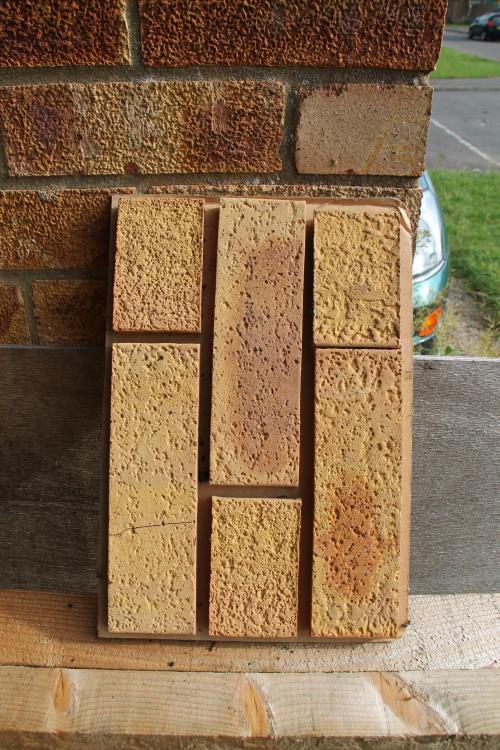
I've got planning permission for a large side and rear extension to my house (semi-detached) with a condition that the materials used in the construction of the external surfaces should be of similar appearance to the existing brickwork. I believe this to be Marston brick - see photo below. These are apparently no longer available and Selco's brick matching service have come up with an alternative - that doesn't match very well (see image with matched sample), they are also relatively expensive at 61p each exVAT. From the outset I was keen to avoid a brick outer skin to my timber frame as it takes up valuable space and adds little to the thermal properties, but struggled to find any alternatives. I've now found a firm doing GRP brick-effect cladding in panels which are probably just as good a match as the matched sample above, but slightly different. This would be good as I could gain another 3 inches of internal room width, be quicker to put up and I hope cheaper overall. Does anyone have any experience of this type of cladding? I can only find the one firm doing it so far, which is a little worrying. I also need to research fire resistance (it is offered as standard, or class 1 flame protection) and check it would be acceptable to the planners in order to discharge the condition. Any thoughts much appreciated! Chris
-
As per the title really: has anyone had any dealings with SilvaFrame as a TF supplier? I'm considering them for my extension as they are competitive and I've had no issues with the spec or my interactions with them up to now. Happy to receive PMs if that's better. Cheers Chris
-
I'm hoping mine will break up an old garage base - I've experience of using the SDS drill as a breaker at a previous house, and it was tedious. I hope this has enough oopmh to make it a bit easier, but also not so heavy that I can't lift the thing - I'm about to have hip surgery and after 8 weeks on crutches I'm not going to be up to doing much. The online reviews seem fairly positive. Time will tell, and if its naff, then I've spent £50 and not £100 on a naff tool :-)
-
Aldi had 1700w breakers in a couple of weeks ago for £99.99. I went to pick one up, but they had sold out (unsurprisingly). On a trip back today (for groceries this time) I noticed a small pile of them with the price reduced to £79.99 as they were not in the current special buy leaflet. Imagine my surprise when I got to the till and it said £49.99! So, pop down to your local Aldi for a bargain, till they have none left, anyway. Chris