Garald
-
Posts
1113 -
Joined
-
Last visited
Everything posted by Garald
-
What should one aim for, then?
-
You can blame me - I am translating my memories of a conversation on the phone two days ago or so.
-
PS. Is the insulation guy right about the upsides of increasing thermal mass and hence thermal phase (by means of wood fibre)? Ubakus tells me that the phase shift is already 13 hours in the current setup (assuming 24cm of solid wall, which seems like a safe assumption - this is construction from the early 1930s; also, notice the pictures above - sideways bricks mean "solid wall", no?). With any kind of outside insulation (rock wool or wood fibre; oddly enough, Ubakus tells me that rock wool gives a greater phase) we'd be looking at a 20-21h phase. Isn't a phase closer to 12h better (day->night)? Also, it's odd that Ubakus gives a greater phase (21h total) for rockwool than for wood fibre (20h total). Doesn't wood fibre have a much greater thermal mass (2.3 J/g K) than rock wool (0.8 J/g K)?
-
She has tried different hats in her career ("urban planner/architect", and also some initials that turn out to just mean some sort of assistant), and, if you follow her tax number, you'll find she's registered as a "plastic artist" (of course plastic artists pay less taxes - perhaps she'll be nabbed for that). She hasn't quite tried "designer" yet - don't give her ideas :). I tried to do a blower-door test myself, but failed due to my fan being sort of pathetic. I queried the fake architect (whom I did not know to be fake at the time) about airtightness, but she only gave evasive replies. I'm still trying to find a ventilation company to do an airtightness test (or whom would one usually hire to do that?). The contractor has told me there are deliberate outlets near the windows in the first floor (I have never been able to find them), as I have PIV and such deliberate weaknesses in the airtightness are necessary - I imagine people who do blowerdoor tests are able to find such outlets and block them. My medium-term aim is finding a company willing to design and install a cascade double-flux system, though I am a bit concerned about noise issues. (I am very sensitive to noise.) I was away while most of the work was being done, but requested and got plenty of pictures, and also took some myself: From the outside to the inside: old render of whatever kind Solid wall (it would seem to be a bit more than 25cm, so some 24cm without counting the render, say) bit of air reflective insulation with linen/wadding backing, 40mm thick (allegedly R=1.96 "intrinsic" and 'as good as R=6 because of reflective insulation", but it's probably more like R=1 if you discount the reflective effect; it's not nothing, as it can't be 40mm worth of nothing) bit of air 45mm of BioFib Trio (hemp/cotton/linen), R= 1.18 13mm fireproof plaster
-
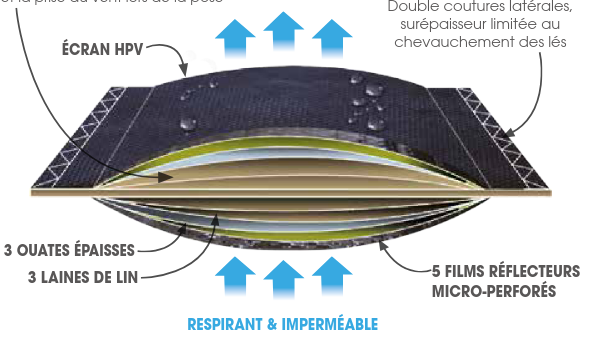
ATI PRO HPV (see the photo and the product specification sheet above). It seems to be used mostly for ceilings. Here are some thermal pictures of the north wall I took last January. (I thought I had posted some in this forum, but they seem to have disappeared.) Bedroom wall and window: Same wall, with roller shade pulled down: Under the small staircase going to the attic: Top of small staircase (notice the metal frames inside the wall, clearly visible thanks to the thermal camera): Large staircase: WC: Bathroom, I think: Ground floor: cupboard under the stairs. I had a mold problem there later, specially in the corners. Ground floor room, corner.
-
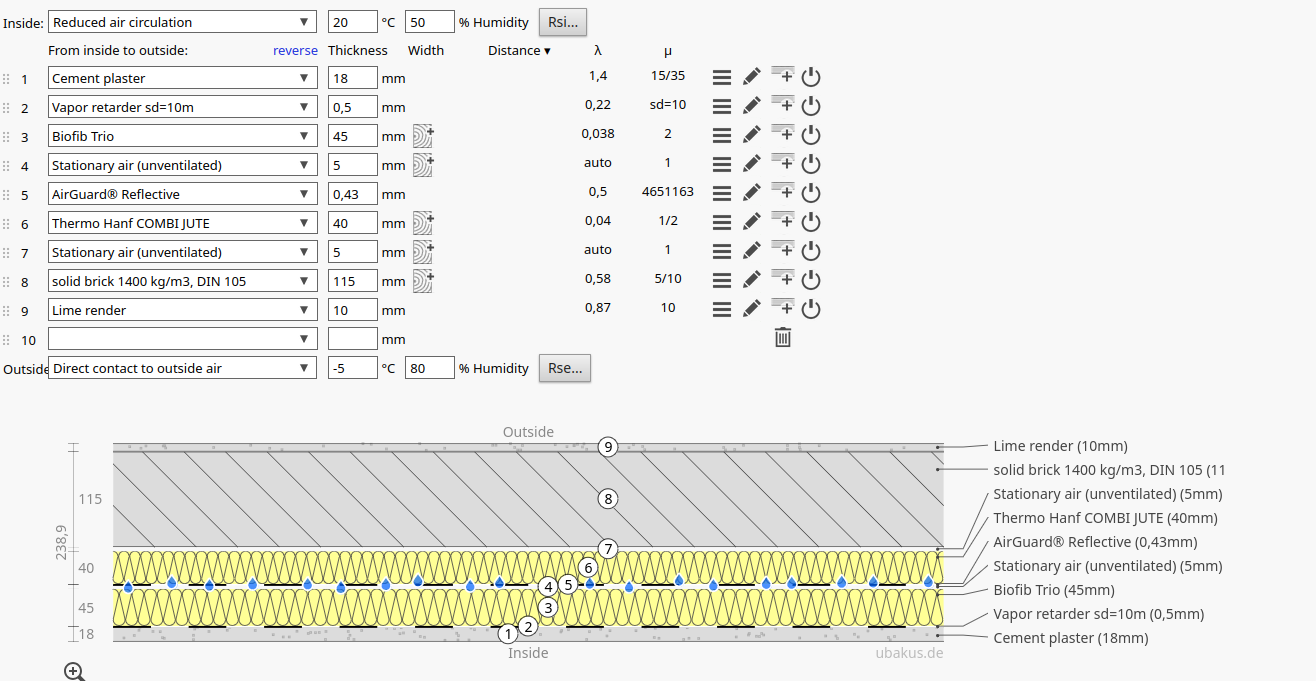
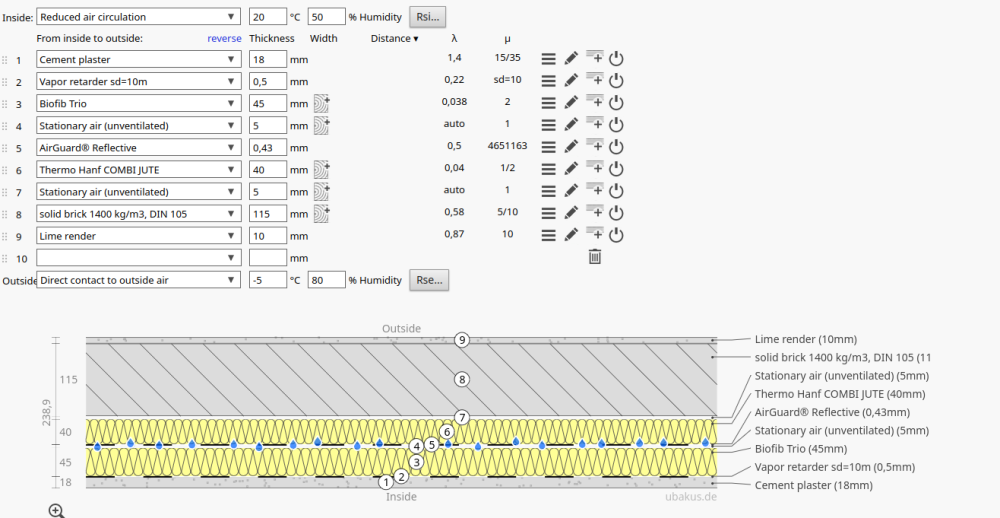
Here is a second attempt - again, approximate, but maybe more realistic. What I have done here: - ATI PRO MULTI HPV is 40mm thick - the reflective insulation is a combination of linen and some sort of wadding ("ouate"): It's supposed to have an intrinsic R of 1.96, which doesn't sound very believable for 4cm. I've keyed it in as a reflective insulation layer + 4cm worth of a hemp-jute product that Ubakus has on file. - I've included a vapor barrier (which is the plans; I hope it's really there - I saw it on other walls when the insulation was being installed). As you can see from the diagram, Ubakus still predicts some condensation (nothing as dramatic as before). FT_ati_pro.pdf
-
Right, the "architect" I first used: - became very upset when I pointed out to her that her plans on how to install a heat pump ran against physical law (I owe you guys a big thanks - you remember that I posted a question here right after getting a sketch from her, as I had serious suspicions), - started asking for more and more money, - left in a huff in the middle of work, - turned out not to be an architect. Possibly a failed architecture student in the 90s, got a cheap master's degree in urban planning on Saturdays in 2005 or so, spent 15 years working as a fake architect (claiming to be an architect, but being careful not to use the word 'architect' in print; it's the sort of thing you realize post facto). I was keeping mum about the matter just in case she reads this forum (very unlikely; her English is nearly non-existent, but then there is Google Translate) but, as I said, there is now a real lawyer taking care of things. Who knows what will happen.
-
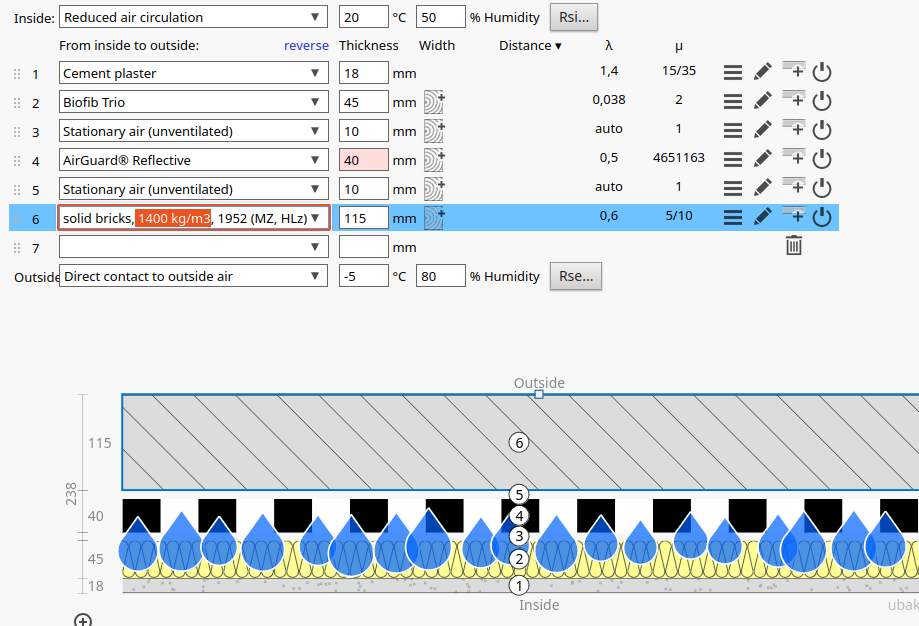
The exact (?) data on the insulation is here: (The diagram there is not from Ubakus - it's from the pdf given to me by the fake architect. Long story - a real lawyer is now taking care of that.) I have tried to reproduce this on Ubakus, with the following approximations: (a) I couldn't find ATI PRO MULTI HPV there, so I've chosen "AirGuard Reflective"; (b) I've keyed in both layers of air as unventilated (since I do not see how the one next to the masonry is supposed to be ventilated) and (c) I have used '1952 solid brick, 1400 kg/m3' (a medium density within the list) instead of my unknown masonry from the early 30s. Here is what I get:
-
Would wood fibre be "woodwool"? The first two volumes are embedded energy by weight and embedded carbon by weight. Hard to compare if one doesn't have typical densities - what would those be, roughly? (I wonder about the difference in embedded energy by weight between loose woodwool and woodwool board.)

-
Ah, I was falling asleep. That it gives excellent sound insulation. So does rockwool, no?
-
I am extremely sensitive to noise - to such a point that I have a funny (and fairly expensive) arrangement on my streetside windows: one layer anti-noise double glazing, then 15cm air, then heavy single glazing. And yet I don't regret for a minute getting a heat pump. It's a whooshing that is barely noticeable in the courtyard; it is never noticeable indoors. It's dwarfed by the noise made by your garden-variety ventilation fan. (Yes, I have one of the quiet ones - Mitsubishi Zubadan silence. And yes, I have PIV, and I'm getting someone over next week so that an extractor fan in a laundry room can be removed.)
-
(Quick summary: this is a north-facing masonry wall that has already been insulated from the inside (with a combination of reflective insulation and 45mm of BioFib Trio; both "breathe"). I am considering insulating from the outside as well because - I am concerned that there may be condensation problems in the long term (Ubakus thinks there will be) - the reflective insulation underperforms, or so a thermal camera tells me. Of course I'd need the outside insulation to also be breathable, i.e., permeable to water vapor.) Two options that have been mentioned by possible installers are polystyrene (this seems very standard; must make sure the installation is breathable) and rock wool. Today, an installer (who will come visit in a couple of days) proposed wood fibre. In brief, he said - in terms of cost: wood fibre > rockwool > polystyrene - the R per cm of wood fibre is very nearly as good as that of rockwool. - he doesn't see the point of rockwool, as wood fibre has much greater thermal mass, and that is helpful during the summer. (OTOH, this is a northern wall, so sun exposure is not a big issue.) - he said wood fibre gives excellent - He also says rockwool has much greater environmental costs than wood fibre. Is this true? How does the environmental impact of rockwool vs. polystyrene help? - He waved away my concerns about the use of flammable materials, saying there are no rules from the fire code about that (this is basically a house, not a tall building). I'd still rather not burn. Is the flammability of wood fibre or polystyrene a real issue?
-
I talked to a company that gave me a horrible quote for stone tiles (about 7000eur or so). So I just bought a Kärcher and power-washed everything (well, tutored by a friend who likes to power-wash). If we ever install a Canadian well, we'll obviously need to rip up the courtyard, and then we'll have to make a decision. I'm currently vacationing in Siena, where it actually gets colder than in Paris (and it certainly rains and freezes over in winter). And guess what? The town square is tiled in bricks, in excellent condition. So, maybe contact an Italian (preferably inland Tuscan) tile company and ask for advice?
-
Can one have a roof with variable albedo?
Garald replied to Garald's topic in Roofing, Tiling & Slating
What about this - does it really work? https://www.3m.com/3M/en_US/energy-conservation-us/applications/passive-radiative-cooling/?fbclid=IwY2xjawFksOlleHRuA2FlbQIxMAABHUIw6wTdqv5HwAj5NW5qUxQY8ieuzPDxidYH4a-5zm2WiJLgE0U8Y2G6jg_aem_n1OSWXTEyGv0_g2AfBHrig -
Can one have a roof with variable albedo?
Garald replied to Garald's topic in Roofing, Tiling & Slating
*Fourth* power, right. Oops. -
Can one have a roof with variable albedo?
Garald replied to Garald's topic in Roofing, Tiling & Slating
Actually, wouldn't the ideal thing be something like a Trombe wall *on the roof*, to be covered in foil during the warmer half of the year? -
Can one have a roof with variable albedo?
Garald replied to Garald's topic in Roofing, Tiling & Slating
I thought radiation was proportional to the cube of *absolute temperature*? Wouldn't we be talking of the temperature of the sun, at any rate? -
Can one have a roof with variable albedo?
Garald replied to Garald's topic in Roofing, Tiling & Slating
I have (most of) a broad, short rowhouse with a clay tile roof. The ground-floor (well, the bit of it that I have) is pleasantly cool in summer, the first floor is quite all right, but the attic gets hot. At some point, I may raise the attic roof and in the process redo the roof insulation entirely. I'd obviously want to do as good a job as possible - that was one of the motivations for the question. Of course I don't know whether townhall would give me permission to have something other than a clay tile roof (though every neighbor seems to have a different kind of roof). -
Is there a realistic, non-science-fictional way to have one's roof be (much) more reflective in summer than in winter? (The relevance to energy efficiency is obvious.)
-
I have asked at Forumconstruire, and got no replies: https://www.forumconstruire.com/construire/topic-483977-seche-linge-pompe-chaleur-entree.php#6441205 Notice I've already got VMI (that is, PIV).
-
I've found the regulations, but I am not getting any hits for "laundry" (buanderie): https://dn790002.ca.archive.org/0/items/dtu-237-www.-engcopilot.-com-nf-dtu-59.1-p-1-1/DTU_292_WWW.ENGCOPILOT.COM-NF DTU 68.3 P1-1-2.pdf It's the only mechanical extract in the house (and a very noisy one it is). Otherwise I have PIV ("VMI"). The entryway/laundry closet opens on both sides (being an entryway) and should be adequately ventilated (to the extent that PIV ventilates adequately), no?
-
Ah, so the important thing is to block the *exit* from the house? It’s a pity if one can’t remove the bit of pipe photographed here - one could then shift the VMI, which is now fitted in an extremely cramped way (one needs to twist the filter to change it).
-
Very well. Should I just figure out how to turn off both the extractor in the picture and the fan in my entryway/laundry for good? Or do I need to pay someone to actually remove that duct and both fans and close the fan outlet? (That is, can a duct that just sits there make trouble in the long run?)
-
In the end, it turns out to be a duct for an extractor fan in my vestibule/laundry room. It’s unclear that I actually need an extractor fan there; the dryer is one of those new models that condense humidity and store it in a receptacle that then needs to be emptied, rather than release it in the surrounding air. What do you think?
-
I’ll call the horrible ENEDIS once I have the phone number of the right service. « Waiting for weeks » is optimistic!