Garald
-
Posts
1113 -
Joined
-
Last visited
Everything posted by Garald
-
Roof insulation on the inside - quotes - discussion
Garald replied to Garald's topic in Heat Insulation
Right, that could be part of the solution, though neither reflective insulation nor something I would scavenge myself with help with subsidies (not that they amount to much); they may not even be counted towards energy ratings (the reflective insulation I have on the north wall got counted last time, but the examiner told me he was being lenient). I think of a radiant barrier as a possible nice addition once one reaches the R one can realistically reach. This is a side issue, but: I imagine the ideal thing would be to have one layer outside the insulation, shiny part facing in, and one layer on the bottom of the insulation, shiny part facing out? -
Roof insulation on the inside - quotes - discussion
Garald replied to Garald's topic in Heat Insulation
Folks here have dim views on reflectant insulators such as superfoil. I have a combination of BioFib and a reflectant insulator on the northern wall (a muddling-through decision by a fake architect) - it's probably better than nothing, and might actually be a good thing to have if you are insulated up to code. I may insulate that wall on the outside at some point. At any rate, that's all moot because, let me repeat myself: *the main problem is during the summer*, and I don't see how to deal with that in any way other than thermal inertia. Sure, it might be nice to put reflectant facing both ways. We can discuss where to put each reflectant layer. But that would just be the cream on top. The main point is: I don't know of any synthetic stuff that would do the job. If somebody can tell me of any (preferably recycled) high-tech stuff that thermal inertia higher than that of cork or wood fibre, please tell me. In the winter, the question is: isn't it a shame that the attic is the coldest place, whereas it should be warm? (Energy conservancy, (non-)professional pride.) In the summer, the question is: how can I work here when is it so darn hot? I can't use any of this space as a bedroom, particularly not for anybody young or old, with the possible exception of my great-aunt from the tropics, if I ever convince her to come visit. -
Roof insulation on the inside - quotes - discussion
Garald replied to Garald's topic in Heat Insulation
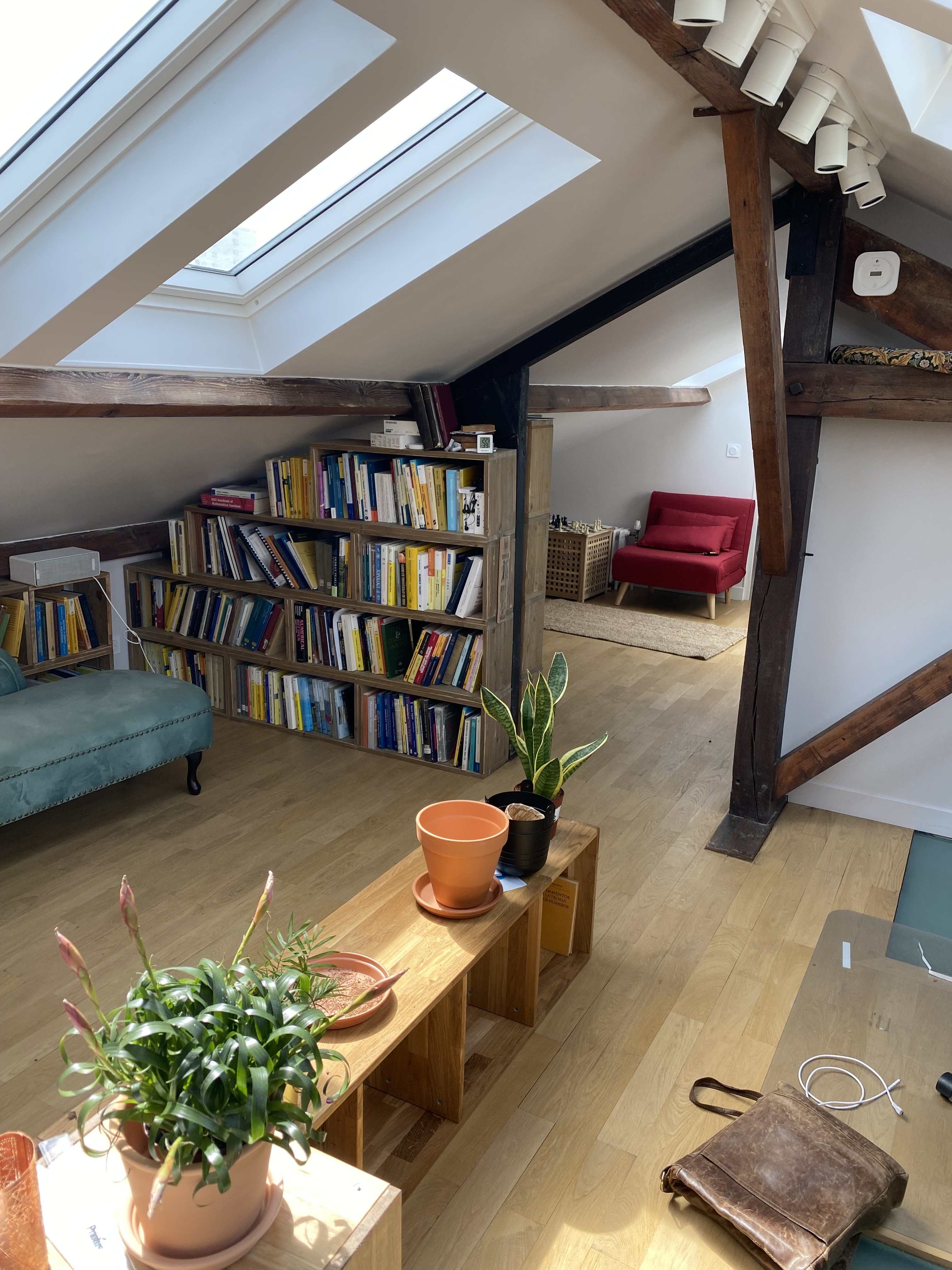
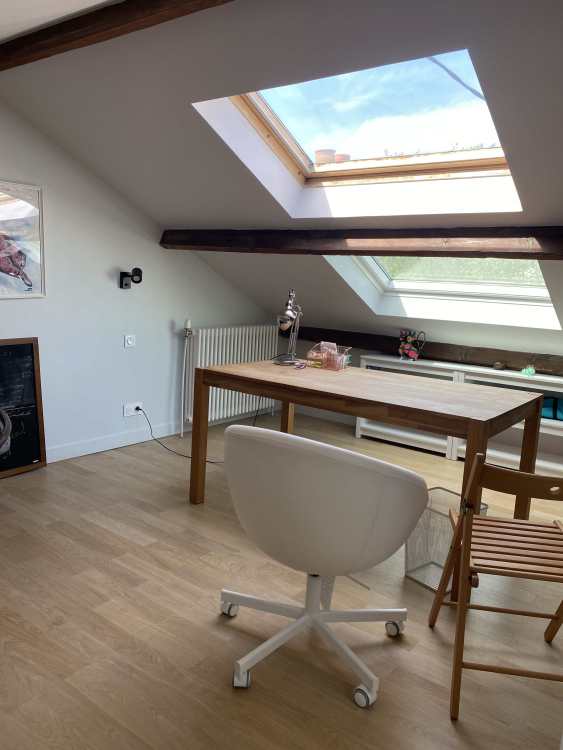
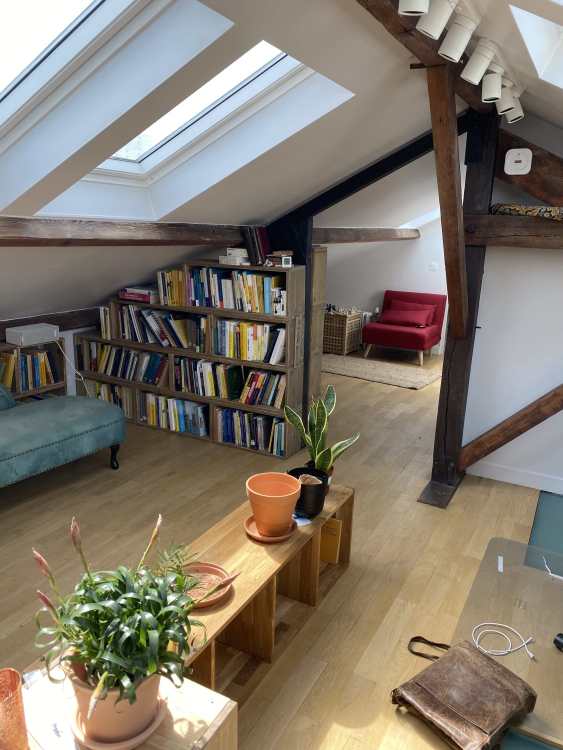
Let me include a couple of pictures, in part to make clear that this is a fiddly structure that not every builder *wants* to insulate from the inside, and in part so that everybody can see how short I am of headspace as it is. I *could* consider losing a couple of cm in the lower parts (where one can't stand anyhow) just so as to reach R=6 (the magical level for the however rather paltry subsidies). Not in the middle part, however - places where a 180cm-high person can still stand are worth their price in gold (plus, I am 178cm, and I want to hit my head as little as possible). I can of course remove all the furniture myself. The bookshelves are DIY - I can modify them a bit if the ceiling on the lower part needs to be dropped 3cm, say.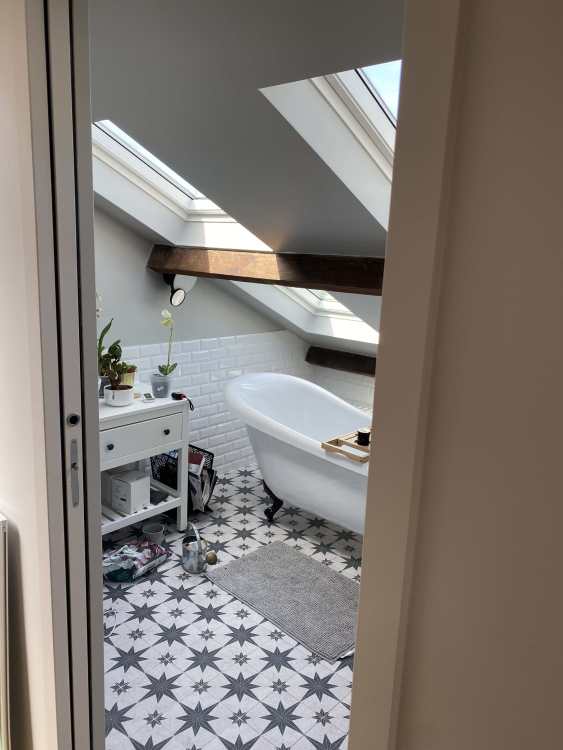
-
Roof insulation on the inside - quotes - discussion
Garald replied to Garald's topic in Heat Insulation
Not sure I understand - flesh out the details, please? -
Roof insulation on the inside - quotes - discussion
Garald replied to Garald's topic in Heat Insulation
Also, cork has higher thermal inertia than wood fibre, no? (Why am I having a hard time finding a good table?) The ISOVEO folks objected that they wouldn't cut cork boards in such a way that everything would be airtight - but surely I can suggest a combination of cork and wood fibre, or will I sound like a ninny? -
Roof insulation on the inside - quotes - discussion
Garald replied to Garald's topic in Heat Insulation
Low thermal inertia (would be a particularly serious problem during the summer). Worse than that of fibreglass, no? -
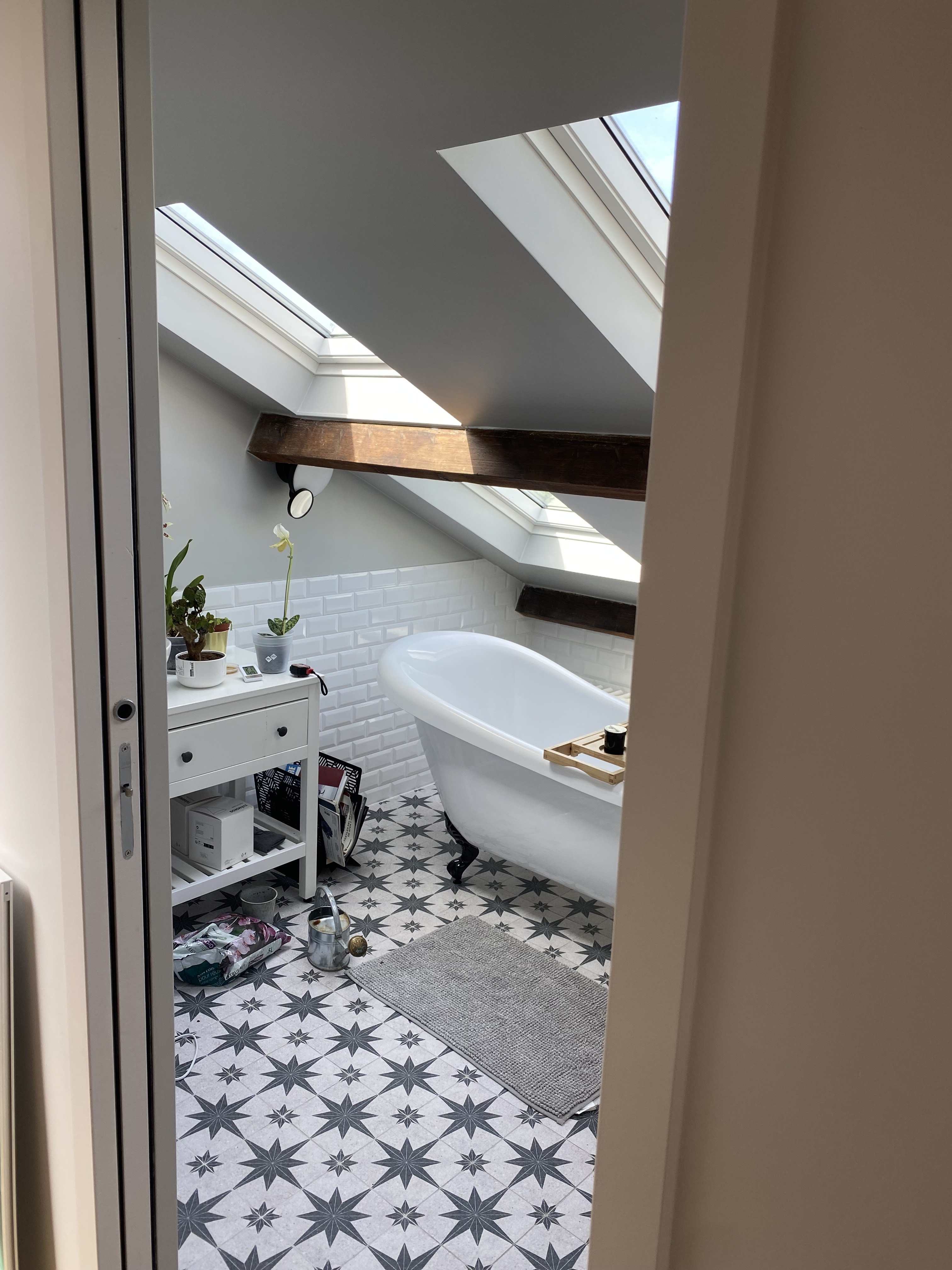
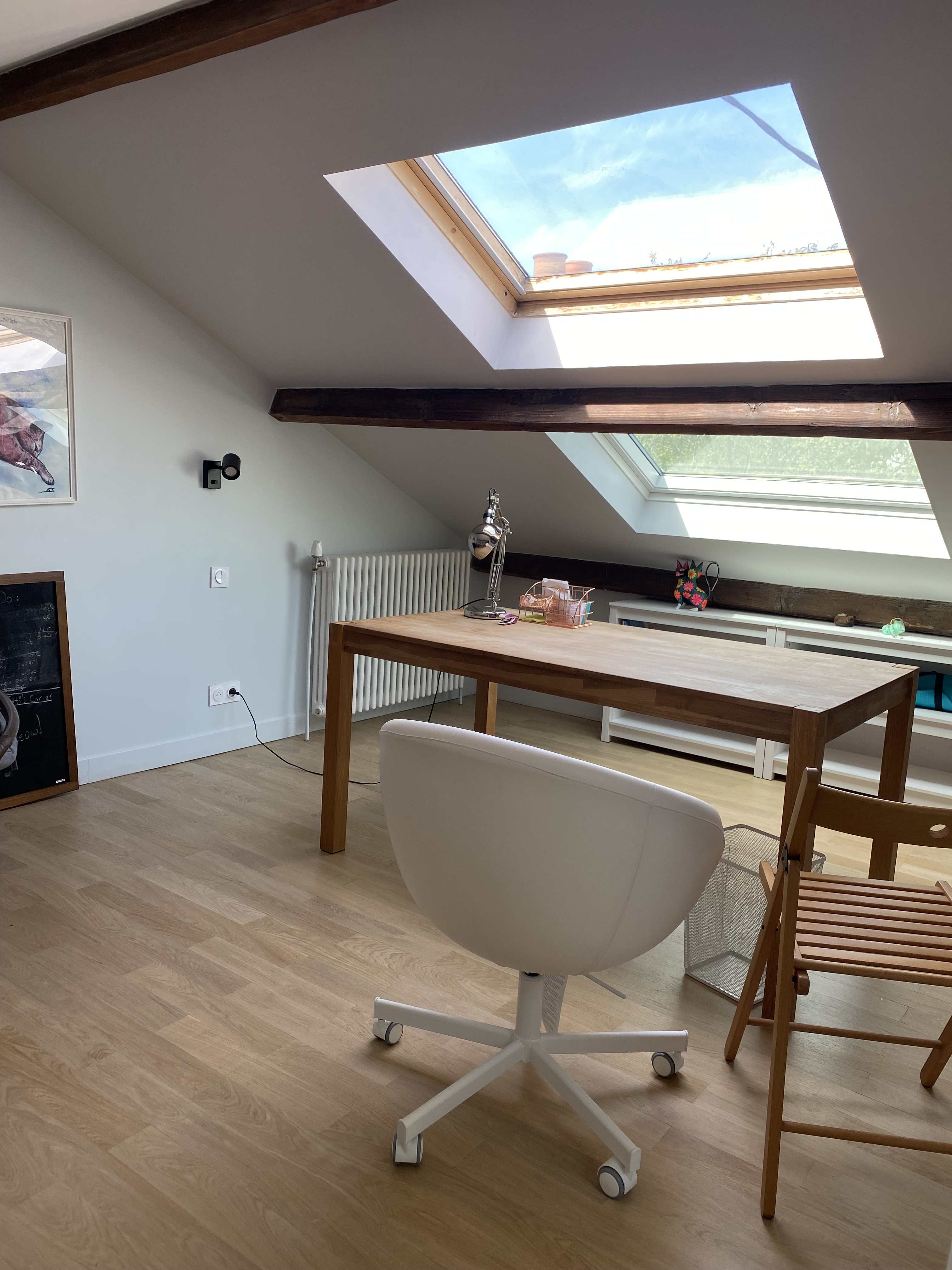
Currently, the attic (inhabited: home office, bedroom/home office, bathroom) is the worst-insulated part of my place: the ceiling was insulated by the owners before the previous ones, at least 15 years ago if not more, with what looks like fibreglass. It's expensive to heat in winter and it gets rather hot in summer. Putting outside shades on the skylights has helped a great deal with the heat, but the main issue remains. Sound insulation is also an issue. Insulating from the roof from the outside (called "sarking" over here) would be very expensive (ca. 40k apparently). I've asked for quotes for insulating from the inside. It's not an optimal solution (I have only 18cm to play with - I do not want to lower the ceiling any further, since it is low as it is) but it is what is possible for now. Since summer is at least half of the problem, I've asked quotes using materials with high thermal inertia (wood fibre, not rock wool; I may also get a quote for cork). I'm attaching the two quotes I've been able to get so far. The one with the lower surface area (60m^2) has the right measures - folk from that company (ISOVEO) came to measure, whereas the fellow from the other company (SMCI) had visited a while back and went off an estimation. My take: * Both quotes seem rather high (SMCI, in particular, proposes to charge me an insane amount for painting the attic ceiling and preparing it to be painted). * The R given by SMCI is mistaken - the figure should be R=5. * Neither company wanted to raise the tiles a bit to reach a higher R, as has been suggested here - they said it would cost a fortune (presumably in labor costs). The idea in both cases is the same - watertight membrane, 18cm of woodfibre, air layer, plasterboard. I include an UBAKUS simulation that ISOVEO Sent me. - Should I keep looking, hoping for something significantly lower? What price would you expect in the UK? - In part because the plasterboard and painting would be such a large part of it, I'm tempted to consider just having exposed cork insulation. My girlfriend, however, would kill me (she might have a point: the attic might look a bit too much like non-inhabitable attic) and not having plasterboard could go against local regulations. Perhaps I should consider decorative cork in place of a paint job, on top of naked plasterboard? Is that a possibility? (Sounds expensive until you see that SMCI wants 6 186,68 € for painting and preparation.) Any ideas? Comments? Also, I've given up on getting to R=6 (the level at which I would get a bit of subsidies), but if you have any notion of how to get there without losing space, be my guest. Perhaps I should consider losing a couple of centimeters in the lower parts, where one can't stand anyhow. SMCI.pdf UBAKUS_SIMULATION_M_HELFGOTT.pdf devis isolation combles ISOVEO.pdf
-
I have an extremely stupid question. I was planning to hang some flowerpots from the central support beam in the attic (not sure whether I should use nails, screws or pegs?). My girlfriend objects, saying one shouldn't risk damaging the beam. Surely this is an excessive concern? Or not?
-
That sounds very good. I'll ask a couple of insulation companies, but I'll be lucky if I find one that likes technical challenges more than money. If I am not lucky, I guess what I should do is: (a) keep saving money, try to get to know some good local engineers, and, in 5-10 years, if I don't move, redo the entire structure of the roof to get much more standing space, and then do things optimally, (b) cope and see what I can realistically do in terms of DIY. In (b): airtightness is the easy part. I've already sealed with acrylic and silicone everything I could seal. My hardwood guy suggests: paste a 1cm layer of cork on the inside yourself. (As in: don't open the ceiling - paste cork on the ceiling, using glue made for cork.) I may like the aesthetics (... even if my stepcat's cohuman does not), but in terms of R the improvement would be piddling. Would it help noticeable with decrement delay, though?
-
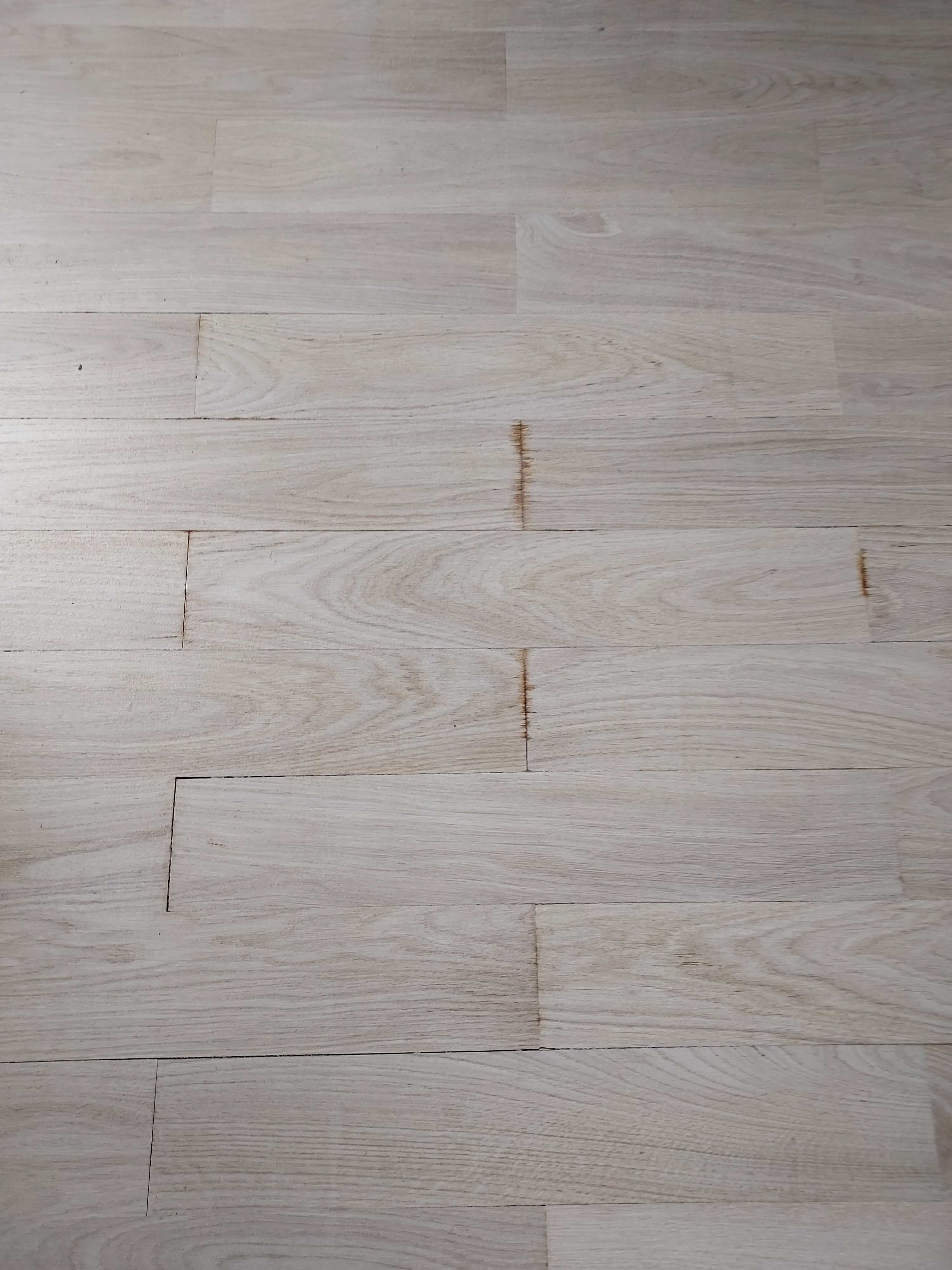
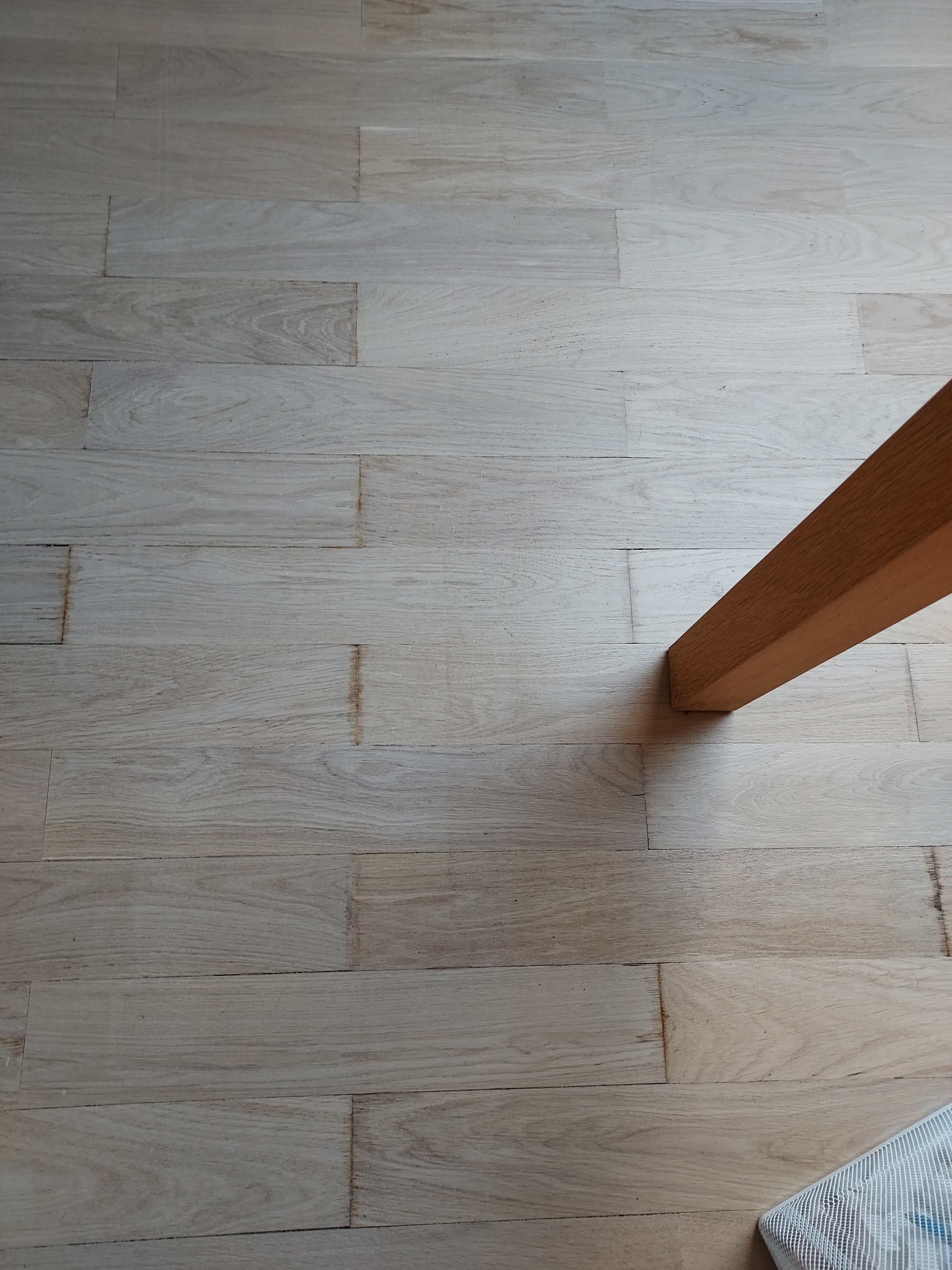
A couple of months ago, I stupidly left the roof windows open in part of the attic (I had used some silicone sealant that smelled to high heaven) and forgot about it when I went to sleep. Guess what - rain, water damage. Several warped boards, lots of staining at the end of boards. My hardwood guy sanded the floor (put me back some 1700eur) and refinished it. Now it's all perfectly flat (in fact, flatter than before - the floor had been laid by a general contractor) but there's still some staining visible at the ends of about 10 boards. Girlfriend not happy. Hardwood guy says he can replace the boards for about 1000eur, but that there are better uses for my money, in the house or elsewhere. Is there a less pricey cosmetic treatment, possibly DIY? Note: I think the stains have become a little less eye-catching in the two weeks since the sanding, but it may just be my sunny outlook on life. Note 2: the finishing is acrylic, I think. PS. The photos don't show a sample of damage, but the total remaining damage - the rest of the floor is fine.
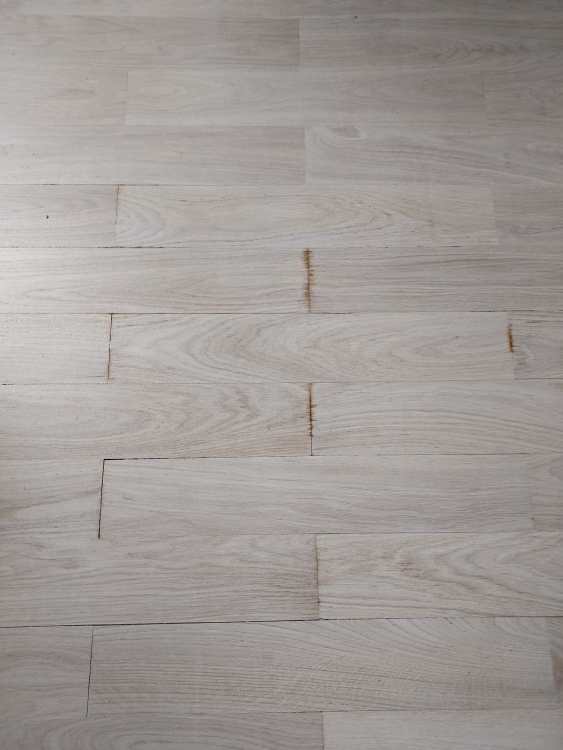
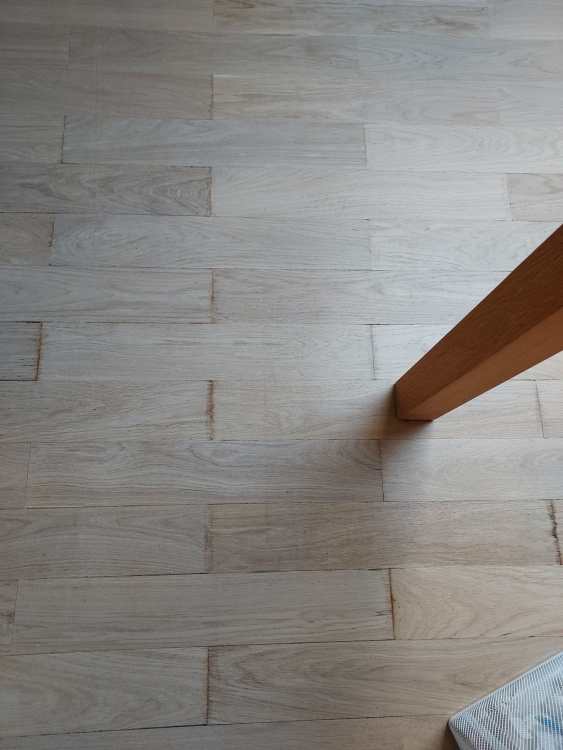
-
Traditionally-styled low temp radiators?
Garald replied to YodhrinForge's topic in Central Heating (Radiators)
Well, sure (0.1^1.3 is indeed about 0.05), but I wouldn't expect any empirical exponent to give a good approximation that close to the minimum. -
Traditionally-styled low temp radiators?
Garald replied to YodhrinForge's topic in Central Heating (Radiators)
At any rate, the TL;DR version is that the OP now knows he can get some nice, big iron-cast radiators (used/antique are fine, they just need to be properly refurbished/checked for flow). If the house is well-insulated and the radiators are big enough (likely the case, but he should use the spreadsheet), he'll be fine at T40. What I'm left with is the curiosity for the real reasons why the exponent is greater than 1 (other than "practice is never as nice as theory"). I'd also like to know what to expect at T25. I don't imagine any radiators are large enough for that to work in winter. I've set the temperature curve in mine to start at T25 in early autumn/mid-spring temperatures, but the heat-pump seems to want to go up to 40. OTOH my heat-pump is probably a bit oversized, especially in those seasons. -
Not my bag either, but: - use https://www.ubakus.de/en/r-value-calculator/ to spot possible condensation issues, - consider using an insulating material with good moisture-regulation properties. Others will give much more solid advice than I am able to.
-
Traditionally-styled low temp radiators?
Garald replied to YodhrinForge's topic in Central Heating (Radiators)
Right, that's surprising. As I said, radiators are, what, 80% convectors and 20% radiators (more or less, no?), but as radiators their dependency on flow temperature is actually minor, in the range we are discussing: it is proportional to the cube of temperature in Kelvin, and (273+60)^3/(273+40)^3 = about 1.2, which is much less than 2, so you'd expect the power of a radiator at 40C to be a bit *greater* than half the power at 60C. -
Traditionally-styled low temp radiators?
Garald replied to YodhrinForge's topic in Central Heating (Radiators)
4ish; 3 or so minimum. Since it was the first time I was working on heating calculations, I decided to take the joke on engineers ("calculate everything very precisely, optimize, and then multiply by 2") literally. I wasn't really going out and buying oversized radiators - I had bought a place with vintage radiators, which were of course oversized, and became much more oversized when I insulated and made the place more airtight. In rooms where I figured I didn't have enough of a safety margin, I would move an existing radiator to a smaller room and then buy a particularly tall new radiator. Had to do that only a couple of times. The insulation on the north wall is not as good as I was promised, and I think the insulation in the last floor (attic) really leaves something to be desired (it was mostly done by the owners before the previous ones; it's not quite thick enough (16cm or so) but the bigger problem is that there's no airtight membrane) so having a large correction factor turned out to be the right decision, I'd say. -
Traditionally-styled low temp radiators?
Garald replied to YodhrinForge's topic in Central Heating (Radiators)
The document https://www.delta-q.de/wp-content/uploads/heizflaechenarten_recknagel_sprenger.pdf gives an exponent of 1.3 as typical for flat panel radiators; is the exponent an empirical approximation? It does not give a value for what would be a typical exponent for legacy cast-iron radiators (what I have). Apparently it's sometimes a bit lower (i.e. better) than 1.3; see, e.g., https://www.cinier.com/en/products/voltaire-47/ I am a happily heated man, but then I didn't just calculate 2 = (60-40)/(40-20), I also added a big fat safety factor of about 2 on top of that. -
Traditionally-styled low temp radiators?
Garald replied to YodhrinForge's topic in Central Heating (Radiators)
What is the physical reason for that? -
Traditionally-styled low temp radiators?
Garald replied to YodhrinForge's topic in Central Heating (Radiators)
Right. For a back-of-the-envelope calculation, I just use Newton's law - radiators' function as literal radiant bodies is a thing but it's a second-order term (and at any rate it varies less with temperature in the range we are talking about). What correction factor do you use? -
Traditionally-styled low temp radiators?
Garald replied to YodhrinForge's topic in Central Heating (Radiators)
How low is low? My cast-iron radiators work just fine at 40C - that's their usual working temperature. For truly low temp (25C, say) I don't think it makes sense to use any radiators, traditional or untraditional - they would need to be huge. That's why people use underfloor heating (basically huge radiators hidden by the floor. Is there a real difference between traditional radiators and radiators that are sold as "low-temperature"? I was taught here that there was not, and followed the advice, which turned out to be good. -
Can’t sacrifice head height - there isn’t enough as it is. As for depth: there’s somewhere between 15cm and 20cm to work with - not enough for current standards (whether I use rock wool or wood fibre), but enough to do a decent job for now, I’d think. Exactly. I’m asking the old contractor but I’ll be lucky if I get a response.
-
1. As people who've come across my posts know, my lodgings are the greater part of a rowhouse of sorts (1930s) in the Paris area. I have brought up the energy rating from a F to a B, and improving matters further is an ongoing task. Skip the following two paragraphs if you already know the context. Now that I've made things as airtight as I can, the weakest part of the insulation is clearly the roof. By rights, the (heated!) attic should be the warmest part of the house in winter, and it is not. The roof was insulated by the owners before the previous owners, some 15 years ago. When we had new skylights installed, the insulation next to the skylights was redone - it was in poor condition. We also had the combles perdues filled with cellulose insulation. It's still the case that the insulation of most of the attic ceiling was done 15 years ago, to dubious standards - and it is a certainty that cold air (or, in summer, hot air) manages to circulate in the insulated space between the ceiling and the roof tiles. The question is what to do. Opening up the ceiling and redoing the insulation with an airtight barrier would be 10k eur. Insulating from the outside (perhaps raising the ceiling by a couple of centimeters in the process) would be very expensive - around 45k eur. It would make more sense to wait 5-10 years and a couple of year-long academic invitations to better-paying countries, and then hire a structural engineer to restructure the entire roof, gaining a lot of living space. But that's not the subject now. What to do for now? My parquet guy is worried that the attic gets too cold when I put the heating on low (as I do when I'm travelling or simply not using half of the attic). He suggests lining the coldest attic room entirely with cork. That's a tempting suggestion (and one that risks giving my girlfriend the fits; she hates cork - the parquet guy says it can simply be painted over). At the same time I wonder how much of an effect it can really have. 1cm of cork adds just 0.25 to the R. Or does having cork exposed (and separated from the insulation cavity) give extra gains in any way? The parquet guy even suggests using 1cm only in the coldest bits, and using 3mm on the rest, in part due to cost considerations and in part not to give up on any precious headroom. Believing that 3mm helps (on anything that is not, say, metal) sounds unscientific. (Of course 1cm cork could help a lot with sound insulation, and that's valuable given that I live not far from an airport, but that's a different issue.) Here are some thermal-camera pictures for context: Paradoxically, as you can see, some of the coldest parts are the low walls of the combles perdues. I know I didn't get cheated on the insulation - I actually used a laparascopic camera to be sure - so I wonder what is going on there. The insulation on the side walls is new but not fantastic: 2. A friend just sent this link to me. Insulating from the outside using cork is nothing new - the issue is that the ranking by price is polystyrene << rock wool << wood fibre << expanded cork. What is new here is that expanded cork is being used in a brutalist way. Is that really viable? How do these folks protect their cork? And does not hiding the cork lead to significant savings? Could it make insulating on the outside with cork more competitive? https://www.theguardian.com/environment/2025/feb/18/enveloping-calming-london-house-wrapped-cork?fbclid=IwZXh0bgNhZW0CMTAAAR2Zk58djcTehOcpjhUDnBMdP3brmAF1ODNiXyjXOqS42IV4R10Upgs3_YI_aem_I90joDLxrFtqV6BSf4iJjA
-
Hi! I am in the Paris area, have solar panels (just 3Kw) and I'm not an engineer (I'm very pure) so I've been pestering everybody here with questions for the last two years and a half - this forum has been a lifesaver. Welcome!
-
I haven’t got the tape for the joints yet (it will arrive next week) but is this starting to look good?

-
Two kinds of insulation material just arrived. One of them looks more substantial but also very rigid. Will have fun later.

-
I'm confused - it would seem that officially (whatever that means) DCM is classified as in a danger class slightly above that of acetone (see, e.g., Wikipedia, various things on reddit, etc.). Would I be better off having DCM rather than acetone in a box in the garage? What happens if it spills? Was about to try acetone on a particularly nasty stain on a shirt - not sure what to think now.