Garald
-
Posts
1113 -
Joined
-
Last visited
Everything posted by Garald
-
Sure, would be nice, but where to get it?
-
I meant insulation that can be added to an existing door without making it look silly, not a new door. I think I've seen (non-obviously-silly) insulation padding on the inside of front doors in Moscow, so it exists.
-
That's the challenge, isn't it? You'd think that would be standard by now. I wonder why one can't just get it on IKEA or Amazon.
-
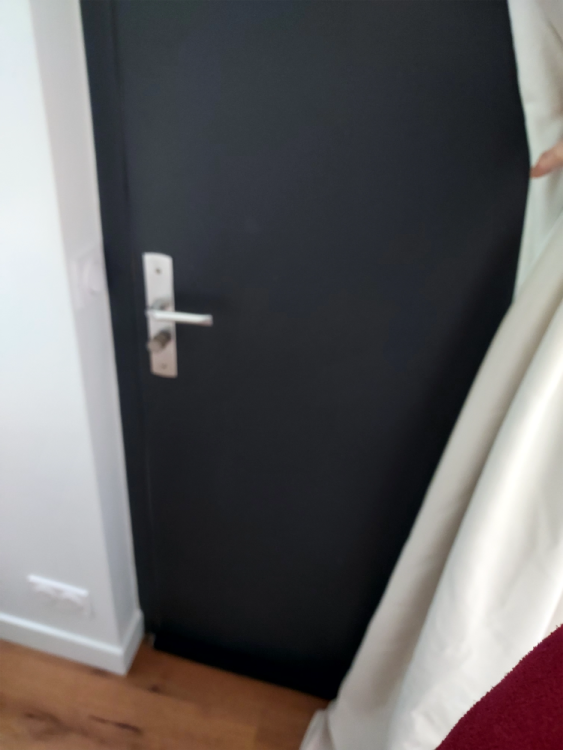
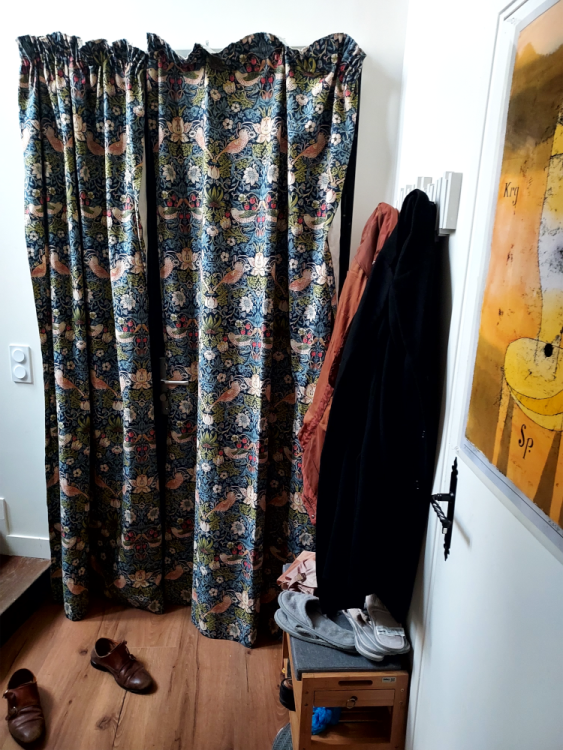
I thought reflecting thermal energy and stopping convection were the only thing one could do with trivial thickness. Is 2cm of anything (that is, anything other than a vacuum) really going to help more? (I thought phenolic should be used only on the outside, due to potential toxic emissions? Of course for all that I know there may already be phenolic inside the door.) Here's the beige curtain that most likely has a space blanket within it, as part of the lining. OK, OK, if I keep this ugly beige curtain, I'll have its bottom part hemmed. Behind it: OK, this second picture is so out of focus that you can barely see the new seals on the side and on the bottom. They help. The same kind of door is hidden behind this nicer-looking curtain: I think my parents are thinking not of "improvised supplementary insulation" but of "the landlords are too cheap to pay for doors, so they put curtains instead". That sounds like the beginning of many an interesting story.
-
Right - outward opening windows are called "English windows" over here, and sell for a premium. Well, this *will* be a full double window - each window will have a (supposedly) decoupled frame and so forth. I can't have quite the arrangement you mention (which I think is exactly what I had in my office when I worked in Germany) as there is a railing outside the window. This is meant to be a quality window frame - see https://www.technal.com/fr/fr/accueil-professionnels/les-produits-technal/la-fenetre-et-porte-fenetre/
-
I have two metal doors, one leading to a common corridor, the other one leading to a courtyard. Since they were installed by a previous owner, I have no information on whether there is any insulation inside, but there can't be much. I want to know how to improve insulation by attaching fabric or other materials to the door. If I understand correctly, there are basically two effective things one can do (since one needs much more thickness for effective insulation of a more conventional kind): a) convection barriers, b) reflective material (basically, "space blankets") What I have so far: 1) door seals/gaskets (work rather well - before, one could clearly feel a draft by wetting the back of one's hand and putting it on the door's edges on a cold day), 2) a Moondream thermal curtain, beige and ugly as sin, 3) on the corridor door, a William Morris curtain, with lining pocket still empty. Notes: - I used to think that 2) was just an overpriced curtain, but now I realize it must have a space blanket inside (since it is 99.99% polyester and 0.01% aluminium) - My parents and my girlfriend dislike both curtains, but 2) in particular, for non-identical reasons: my parents associate curtains on doors with extreme poverty, whereas the gf associates it with windows in Amsterdam brothels. Go figure. - My parents suggest https://www.amazon.fr/magnétique-thermique-Phonique-Isolation-extérieure/dp/B0BJ2XZDKR/ref=pd_lutyp_ci_mcx_mr_typ_d_d_sccl_1_2/258-6865142-2480719?pd_rd_w=7ub4t&content-id=amzn1.sym.7c1a512f-46a9-459c-9fcb-1c7b8864b865%3Aamzn1.symc.0e04ee4a-2b8c-44d8-b829-f6d01bf2800a&pf_rd_p=7c1a512f-46a9-459c-9fcb-1c7b8864b865&pf_rd_r=N33HFZP7ZADRK8GC1NFX&pd_rd_wg=XQmgG&pd_rd_r=54d45237-debc-459e-99e3-f2e1671ffab7&pd_rd_i=B0BJ2Z21VL&th=1&fbclid=IwAR2FUPTW2ARERdP9w81MtLRnG52fcKpLXomTXWRJzkMZSfYTYcW1Ro1bROE (which looks like a (heavy?) cotton curtain made for doors, nothing more) As I see it, I can do two things: - cover up the Moondream thermal curtain with that thing from Amazon - line the William Morris curtain with a space blanket, getting a local sewing shop to sew it into place (can space blankets be washed?). Comments?
-
Having a DHW system that draws heat from air inside the house is actually common: in French, it's called a "chauffe-eau thermodynamique". Two people (one of them in this forum) recommended Atlantic Calypso. Of course these are "heat the water you need and cool the room in the process" not "cool the room as much as you want and heat water in the process." Oddly enough they are not marketed as (it would seem to me) they ought to be: a system to use during the summer months - or (do you know someone who does this well?) something that can be used as part of a poor-man's MVHR system. Instead, it would seem that installers rely on a total lack of physical intuition on the part of customers. (Why on earth do you want to draw heat from the inside of a place you are paying to heat? Might make sense if you are overheating by having a blazing fire in your chimney, but you shouldn't.)
-
This is the Paris area - not really that different from Southern English weather - and a brick-and-masonry house from the early 1930s. I'm running a heat pump at medium temperature (45 C so far) on radiators.
-
Filtering is a must. I'm not so far from a motorway going around a city centre. I have a PIV entry in every floor. Wouldn't it be best to have the extract fan in the top floor (since used air tends to rise)? The ground floor would actually be more convenient (since that is where my utility room is). How do you use the recovered air? Thanks! This is what I am aiming for. Went from an F to a B rating (French standards, which are harsh) :). Had that done. They are not open; they are closed by old-fashioned iron shutters (which are not hermetic). Is sealing still a must? Doing my best to eliminate that. The heater there is fed by the same heat pump as everything else. But does it really make a difference? It's just a strategically placed radiator, after all. It's fine - blown-in cellulose in the eaves, hemp and reflective on the sides, insulation installed by previous owner in ceiling.
-
Hi, So, I'll go through with my project - installing sliding windows 15cm outside sound-reducing windows (since that seems to be the only way to really deal with the lower frequencies). Let me ask some questions before I give my agreement to the quote: - Having the thermically weaker window on the outside actually prevents condensation, no? (Why?) I'm attaching the technical information for the existing windows. The glass in the sliding windows would be of type STADIP Protect 88.4, as in the table https://befr.saint-gobain-building-glass.com/sites/saint-gobain-building-glass.com/files/documentPdf/STADIP PROTECT P4A Cahier des charges.pdf - Should I insist on having some sort of sound absorber on the sides of the 15cm-thick space? Right now that's mostly brick. DoP_d2601503_20221016 (7).pdf
-
PIV: no outlet in attic; how to make it less stuffy?
Garald replied to Garald's topic in Ventilation
Updates: - yes, the exterior see-through blinds helped massively - yes, there was an outlet in the top floor (just very carefully hidden) -
I agree. The long story is that this was a major renovation at the beginning of which I had pretty terrible pseudo-professional advice. Thanks partly to the help of people in this forum (who helped me see just how terrible that advice was...), I've managed to get a pretty good overall outcome (according to official diagnostics). Now I'm wondering what can be improved. But yes, the contractor got back to me: there are vents in the kitchen, bathroom and a couple of other places, as well as mechanical ventilation in the tiny laundry room. (The vents were preexisting, as simple outlets; of course more air goes out of them now because of the PIV.) He recommends not locking the skylights in the attic - that's presumably a place where there aren't enough outlets (if any). One change I've thought about for the medium run is to install a thermodynamic water heater in the attic. Surely one should be able to have a switch so that: - in summer (when the attic tends to get especially hot) the air cooled by the heater can be mainly recirculated to the attic, - in winter, the air cooled by the heater can be extracted to the outside? This would be in addition to my current water-heater (part of the main heat pump). Does this sound like a good idea?
-
As many of you know, I'm now tinkering with improvements after a major renovation. My place is the greater part of a house from the early 1930s. I have PIV (positive-input ventilation), with pre-heating. I am not finding the ventilation outlets (or rather, I've found two outlets, outside the bathroom and the kitchen, but they look a bit abandoned; the contractor is being his usual laconic self). Perhaps the idea (not mine) was to just let air leave through imperfections in the air envelope - which of course I will be minimizing as I make things more airtight. (Then there's also the chimneys, which I haven't sealed - but they are in the first floor; shouldn't there be outlets in the (inhabited) attic as well?) And then there's what is really a separate question: if I succeed in making things fairly airtight, would it not make sense to install extractors with heat-recovery, with heat being "fed" into the PIV? This makes sense at a physical level, but I'm not sure it's a thing that is done at all at the practical level. (Not to mention that all the walls have already been painted and I would hesitate to rip everything apart.)
-
Does this setup for testing airtightness looks right?
Garald replied to Garald's topic in Heat Insulation
Hm. No whoosh. Well, maybe some whoosh when I open the big window in the little staircase leading to the attic from the cat door, but no whoosh whatsoever when I open a skylight. -
Does this setup for testing airtightness looks right?
Garald replied to Garald's topic in Heat Insulation
PS. It may be that there are just no gaps left in the attic - at least no gaps a young wasp can get through. Up to a couple of weeks ago, wasps were getting through and then getting stuck and dying in the attic. Turned out the joint between a ceiling beam and a side wall had not been sealed. The contractor found the problem (after I insisted repeatedly that a problem existed), applied sealant (polyurethane - is it OK that it's unsealed?) and told me to tell him if I noticed anything of the sort still happening. There have been no more dead wasps since. -
Does this setup for testing airtightness looks right?
Garald replied to Garald's topic in Heat Insulation
One alternative is just to give up on the fan approach and just do the wet-hand approach on a very cold day. Today it's just 9C, but the other day it was about 0C, and the fact that air gets through the perimeter of an outside metal door in the ground floor was obvious (it isn't today). -
Does this setup for testing airtightness looks right?
Garald replied to Garald's topic in Heat Insulation
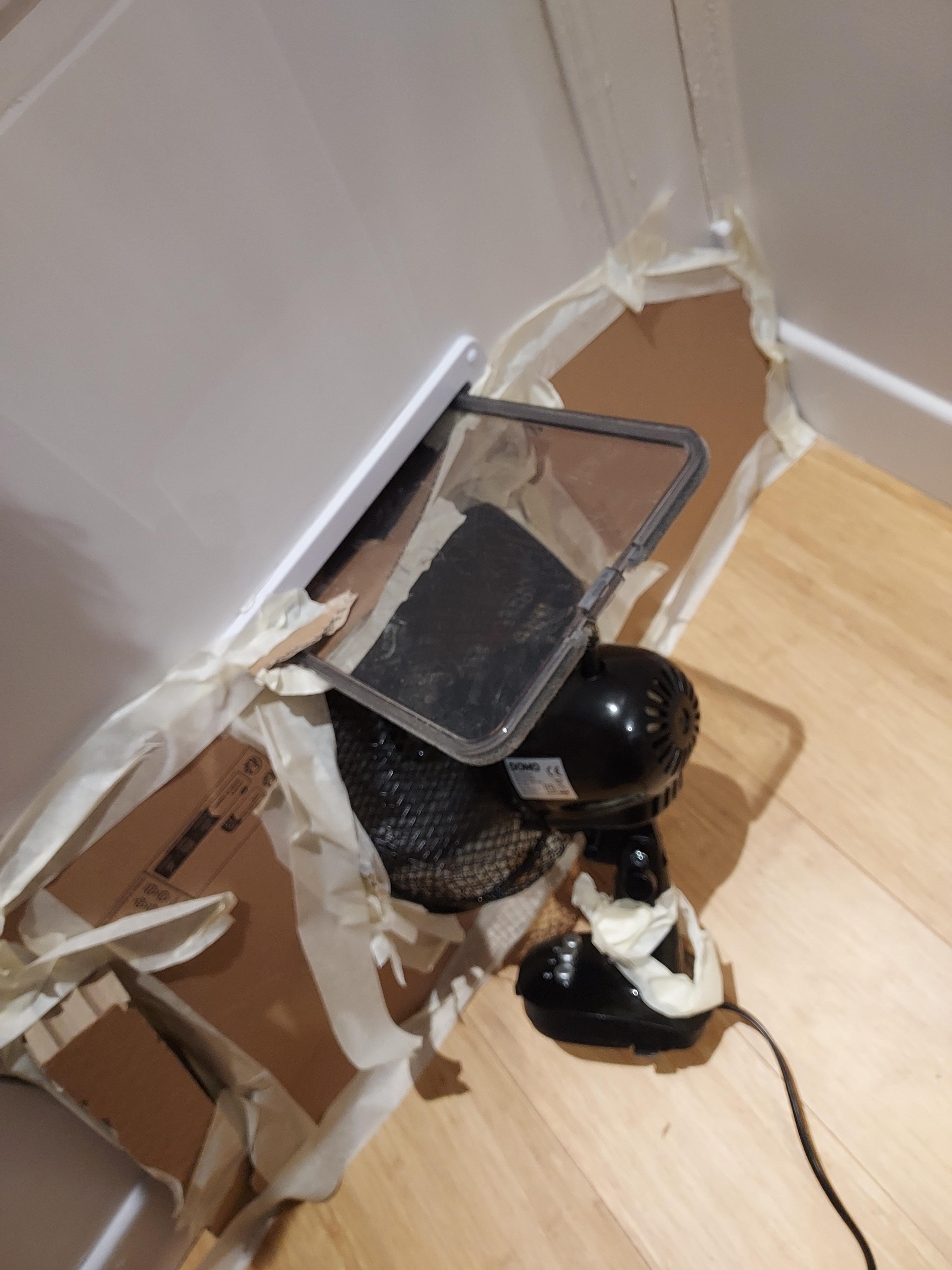
Couldn't detect a thing. But then, as people are saying, 30W is probably just too weak. The patchouli stick indicated that air was being sucked out of the room only when it was in the immediate vicinity of the fan. Is there such a thing as a powerful fan the size of a cat? -
Does this setup for testing airtightness looks right?
Garald replied to Garald's topic in Heat Insulation
Oh, the cat is not in the house right now - she's at my girlfriend's. OK, second try: Is that enough? The fan is 30W - is that ridiculously weak?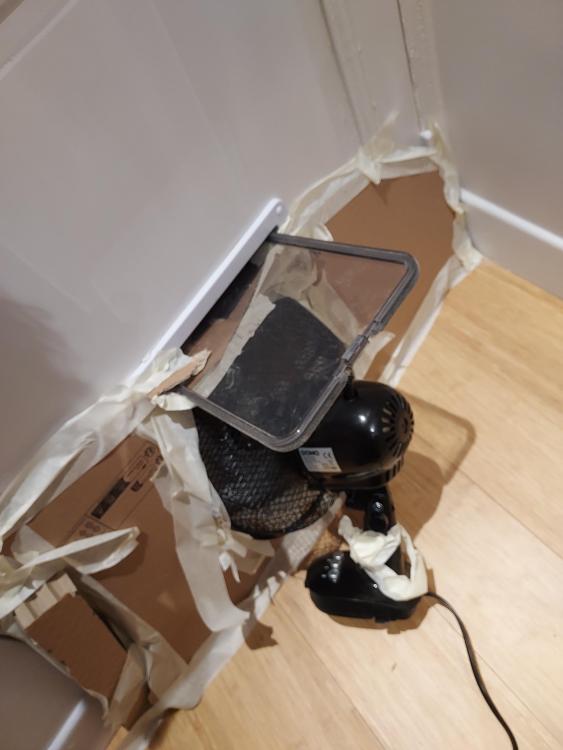
-
And how many hours should I wait? This is a medium-sized attic (whatever that means).
-
I have PIV (positive-pressure ventilation). The PIV installer told my contractor to cut a space (1cm or so) under each door so that the ventilation system could work. Makes sense, but: - the contractor also did that for the door leading from the inside to the garage/bike-shed (non-insulated and unheated, though not terribly cold on account of being surrounded from all sides and from above by rooms or the co-op corridor; its outside door is a thick wooden door); this is then a weakness in the insulation; - the door leading to the nook under the staircase was not cut in this way, and, perhaps because of this, that nook feels a bit musty (a bit of a concern since I'm storing the wine there). Do both of these choices by the contractor make sense?
-
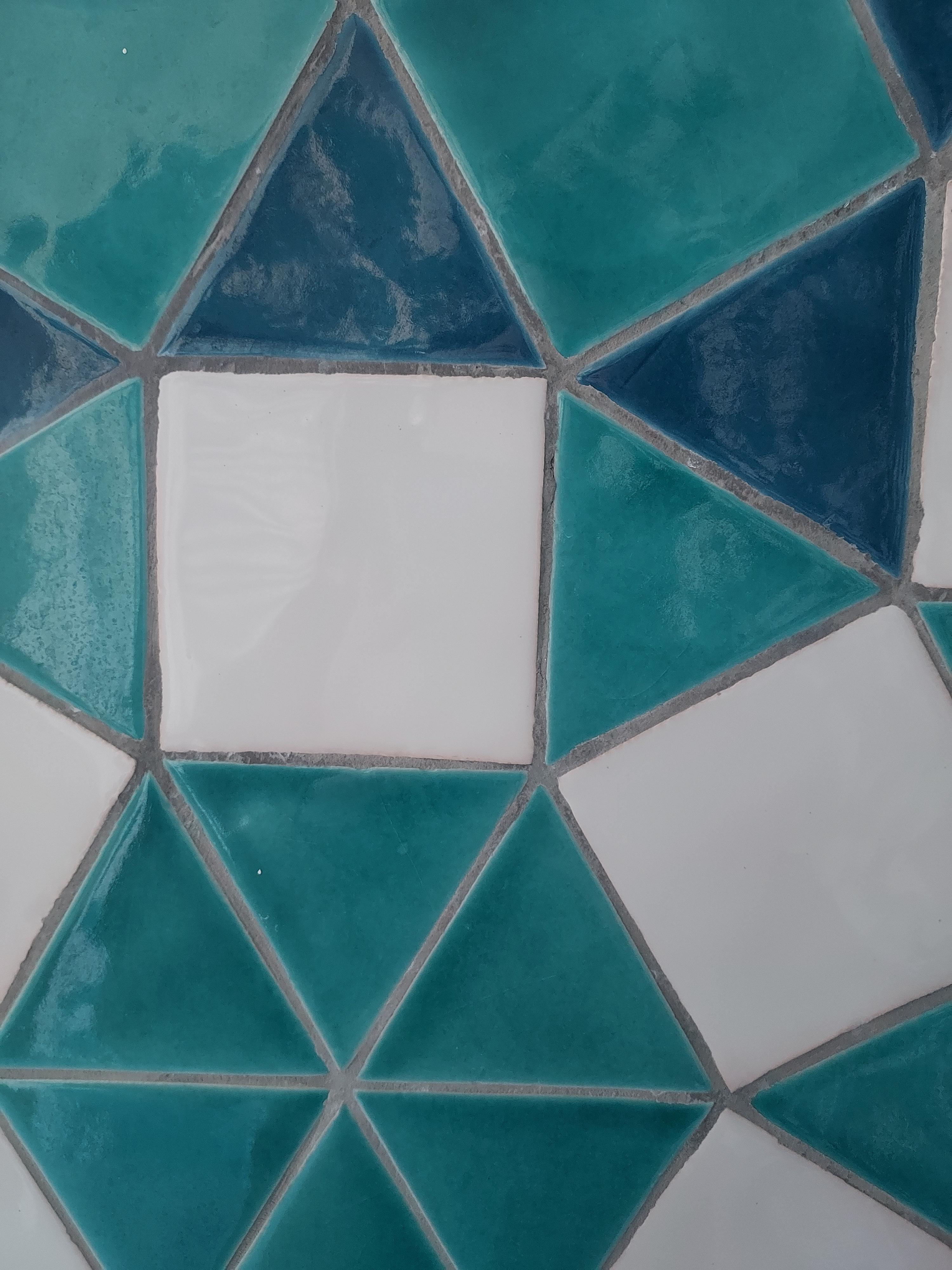
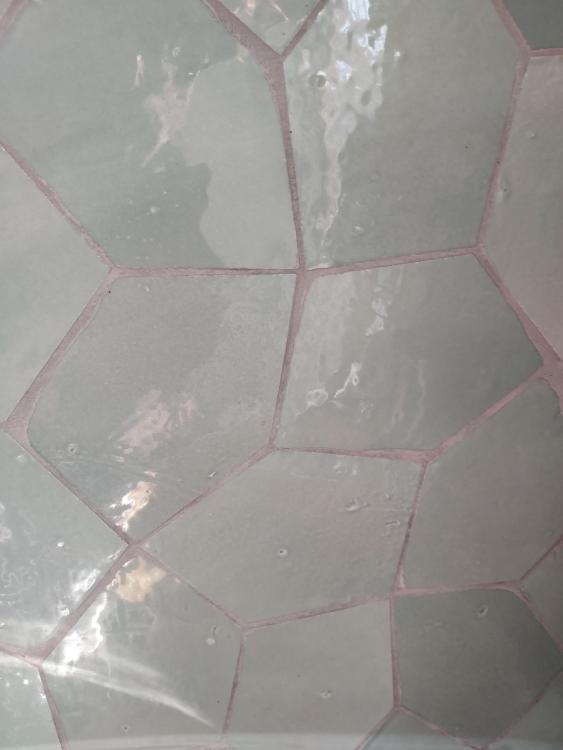
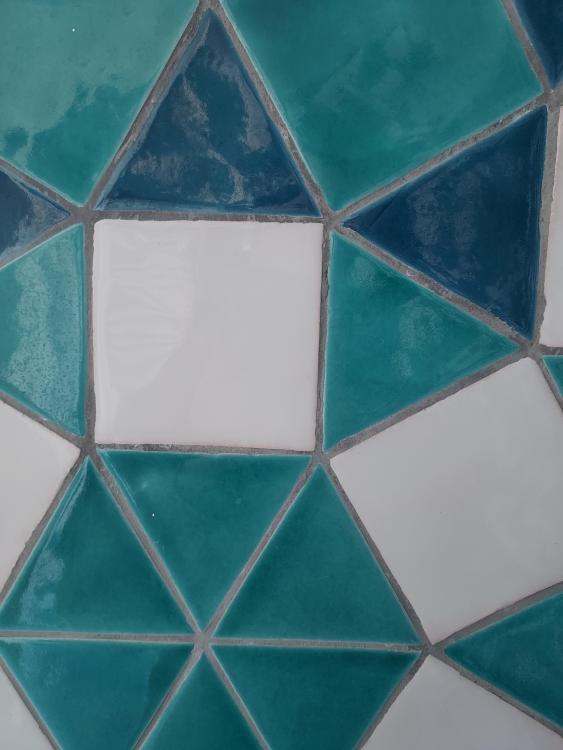
Here is the current state of affairs. It's pretty much indistinguishable from what it was when I looked closely a couple of weeks ago. There's some variation in grout coloring. What obvious problems can you see?
-
Ah, should I avoid it then? Or: should I use it in the shower but not in the kitchen?
-
Does that mean it has to be reapplied periodically? Or is it *also* a shield? Well, I am asking too late, but: are there alternatives?
-
Ah. What are the advantages compared to silicon? And should I use a hair dryer first?
-
OK, so a lower-temperature dryer is actually better? Also, what would you use to protect grout, instead of silicone, and why?