
NSS
-
Posts
1218 -
Joined
-
Last visited
-
Days Won
17
Everything posted by NSS
-

Total energy consumption per m2 per annum
NSS replied to NSS's topic in Energy Efficient & Sustainable Design Concepts
The obvious answer is, don't leave buyers to ask, force sellers to tell. If on sales particulars, alongside the the sale price, sellers had to declare the 'average energy cost per annum' and highlight that number in a colour coded box (green is good, red is bad type of thing), then people would soon start to take notice. -
Total energy consumption per m2 per annum
NSS replied to NSS's topic in Energy Efficient & Sustainable Design Concepts
Yep, and energy use will, for example, vary according to the number of inhabitants, their lifestyle, etc, but I merely think that the one number almost everyone will understand is one that gives them an indication of the money it will cost for the energy one home will use when compared to the next. That's what EPCs are supposed to do, but very few people even read them. As for my own motivation for projecting this cost per m2 per annum, it came in part out of a conversation in the pub with mates, trying to explain how much cheaper our house is to run than our previous property. That was a circa 190m2 house built in the late 80's. Our total energy costs there equated to more than double the kWh/m2a of the new house. There's still only two of us living in it, so it follows that the major difference in cost will largely have been due to the space heating cost (due to the relatively poor air-tightness and insulation). As for the AECB standard you mention, thank you (I think) but like the vast majority of Joe Public, certificates are of no particular interest to me, the piece of paper (virtual or otherwise) that matters is the energy bill. In short, I personally feel (and this is not a dig at any of you who strive for one standard or another) that the way to encourage more energy efficient homes is to sell the cost saving potential to buyers, not that it has passed some (to them) meaningless standard. -
Total energy consumption per m2 per annum
NSS replied to NSS's topic in Energy Efficient & Sustainable Design Concepts
I presume it would be a case of fitting an export meter, though the downside of that (if you're using more than 50% of what you generate) could be a reduction in FiT payments if you had the declare the actual export amount. -
Total energy consumption per m2 per annum
NSS replied to NSS's topic in Energy Efficient & Sustainable Design Concepts
Not so much those that couldn't give a toss, more those (policy makers and their advisors) behind these 'standards. Far more effective IMHO if you could just quote a total energy cost per square metre. For example, two newly built houses are built by two developers on the same street. House A is a £10k cheaper than house B, but they're the same size, same layout, same spec (in terms of finish), most would buy house A without giving a it a second thought. But if house A's energy costs are twice or three times those of house B (and that was clear as an energy cost per m2), maybe people would be more inclined to buy house B and, in doing so, encourage the builder of house A to up their game. -
Total energy consumption per m2 per annum
NSS replied to NSS's topic in Energy Efficient & Sustainable Design Concepts
Precisely. -
Total energy consumption per m2 per annum
NSS replied to NSS's topic in Energy Efficient & Sustainable Design Concepts
How the hell was that a pop at you? -
Total energy consumption per m2 per annum
NSS replied to NSS's topic in Energy Efficient & Sustainable Design Concepts
Which is understandable, but 99% of Joe Public couldn't give a toss about how efficient it is to generate the fuel they are using, only caring about how much it costs them their homes. Perhaps part of the problem in trying to convince people to demand more energy efficient homes is that quoting things like SAP, PHPP and EPC calculations go straight over the vast majority of heads. -
Total energy consumption per m2 per annum
NSS replied to NSS's topic in Energy Efficient & Sustainable Design Concepts
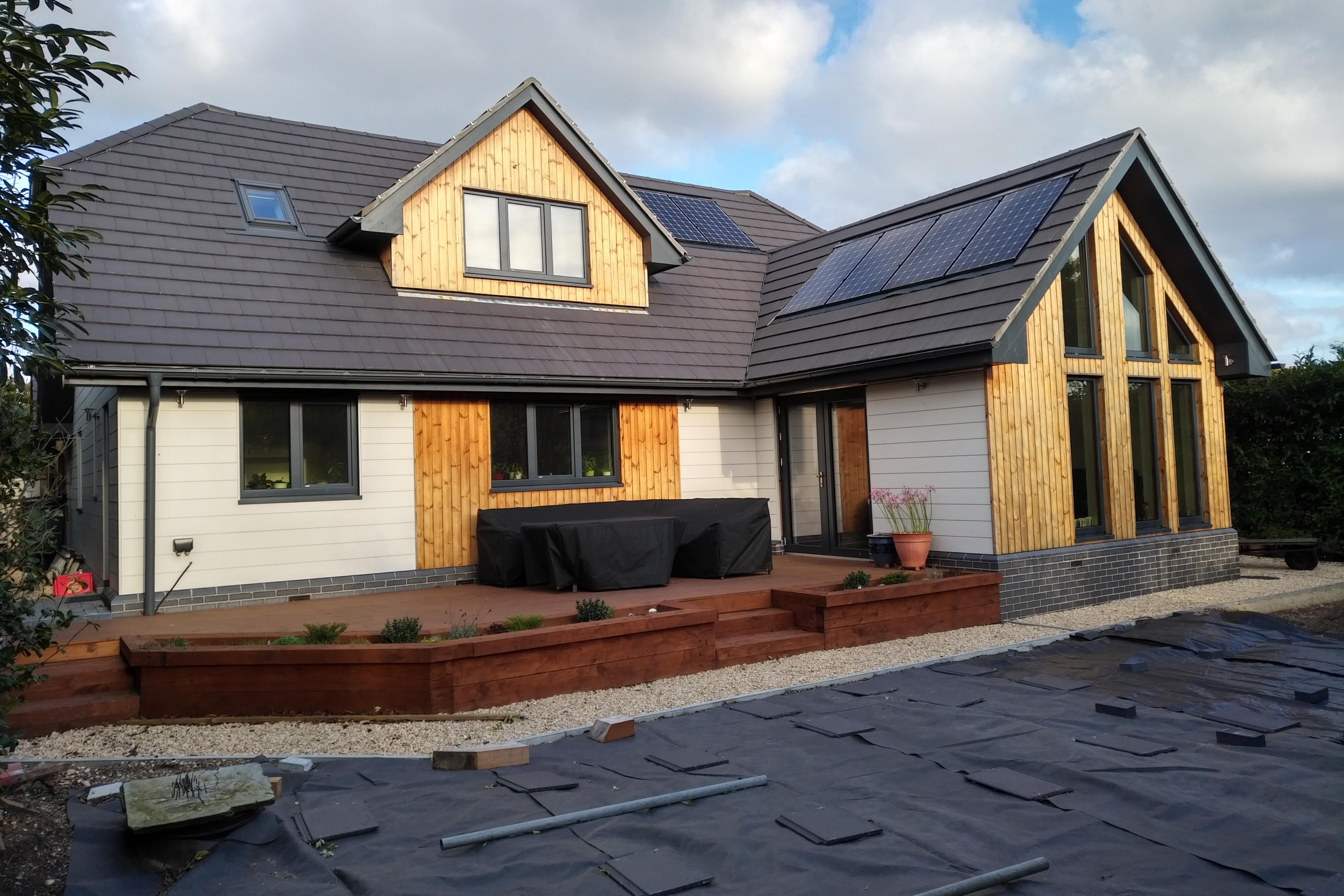
Form factor is pretty poor (irregular shape chalet bungalow with multiple gables/dormers). Walls, roof and floor all circa 0.14/0.15. Air permeability of 1.6m3/hm2, Paul MVHR and SageGlass electro-chromic glazing. No gas. -
Total energy consumption per m2 per annum
NSS replied to NSS's topic in Energy Efficient & Sustainable Design Concepts
No, not modelled it as PH was never a consideration, but pleasantly surprised at how little energy we appear to be using. -
Total energy consumption per m2 per annum
NSS replied to NSS's topic in Energy Efficient & Sustainable Design Concepts
Yep, I realised that. I'm talking TOTAL energy consumption (space heating/DHW/cooking/lighting/etc/etc) and my projected 40kWh/m2a seems to be correct. Even if I up the assumed use of solar to 75% of annual generation, the total only goes up to about 45kWh/m2a. -
Total energy consumption per m2 per annum
NSS replied to NSS's topic in Energy Efficient & Sustainable Design Concepts
Really? I'd better recheck my calculations as I reckon we'll be looking at a total energy usage of circa 40kWh/m2.yr -
Total energy consumption per m2 per annum
NSS replied to NSS's topic in Energy Efficient & Sustainable Design Concepts
Ouch! -
Not been in our new home for a year yet, but have been projecting forward our total energy consumption with the aim of establishing a measure for comparison. Found an interesting article on the OVO Energy site (https://www.google.co.uk/amp/s/www.ovoenergy.com/amp/guides/energy-guides/how-much-heating-energy-do-you-use.html) which is specific to heating requirement, but I wondered if anyone else has (or could) work out their total energy usage per annum as kWh/(m2a) so I can start to gauge how we compare. For the purpose of the calculation, I'm assuming we consume 50% of the solar power we generate (though it may be a little more than that) and adding that figure to the energy imported from the grid.
-
The tale of the sale of our old house
NSS replied to Jeremy Harris's topic in General Self Build & DIY Discussion
Seems there is a mechanism, a development completion notice, but it is seldom used and usually ineffective. Funnily enough, I'd heard that our local authority have issued such a notice recently against a development (a block of apartments) which has stalled without even having got out of the ground. I'll watch with interest to see if it has any impact! -
The tale of the sale of our old house
NSS replied to Jeremy Harris's topic in General Self Build & DIY Discussion
Okay, I thought they could specify a timescale, but maybe not. However, if they could it need have no effect on self-builders as they wouldn't be the ones holding back on builds to facilitate new planning applications and I wasn't suggesting a one-size-fits-all period for every development. -
The tale of the sale of our old house
NSS replied to Jeremy Harris's topic in General Self Build & DIY Discussion
But that's a different scenario to what you described in your previous post ("then letting demand (and price) build up before they built a few more."). And some of the blame for what you're now describing has to sit with the LA for not stipulating a defined period in which a development should be completed. -
The tale of the sale of our old house
NSS replied to Jeremy Harris's topic in General Self Build & DIY Discussion
That (on its own) doesn't make them "absolute bastards" IMHO, it's just sensible business practice. No business will manufacture or stock more goods than they believe they can sell in a given period, and to do so would potentially cause huge cashflow problems. -
We had a quote from one supplier who quite literally loaded all the appliance costs (circa £5k worth) onto the cabinet prices and listed the appliances as foc as they knew we wouldn’t be able to reclaim the vat. We didn’t go with them though as their price was circa £6k more than the route we went, even allowing for the vat saving.
-
The tale of the sale of our old house
NSS replied to Jeremy Harris's topic in General Self Build & DIY Discussion
You sure all you’re doing is sleeping? -
The tale of the sale of our old house
NSS replied to Jeremy Harris's topic in General Self Build & DIY Discussion
Oh, okay, the way you speak about the performance of the house I’d assumed you’d been living in the new one for a while now. If you spend a fair bit of time there already I guess it won’t make a huge difference to the way it reacts, although we do, for example, find cooking (in particular) has quite an impact on he indoor temperature. -
The tale of the sale of our old house
NSS replied to Jeremy Harris's topic in General Self Build & DIY Discussion
Bit of a random question, Jeremy, but have you still been living in the old house until now? -
The tale of the sale of our old house
NSS replied to Jeremy Harris's topic in General Self Build & DIY Discussion
Think I'd be concerned I'd pitched the price too low with that much interest so quickly, so agree the sealed bid approach may be best. As for using PB, we sold our last place using a sort of hybrid EA in so much that they use the same model as PB but are local only and staffed by people who have worked in traditional estate agencies in the area for many years. The advantage for us was they have great local knowledge and contacts. I incentivised them with a bonus payment if they exceeded our minimum acceptable price (they did) and they also did some of the viewings when we were unable to (at no additional charge). The net result was that we saved well over £4k on fees compared to a traditional agent, and the only noticeable difference was their office was in an industrial unit in a boatyard rather than on the high street. Would definitely use them again. -
Yeah, fun like watching paint dry!
- 34 replies
-
- 1
-

-
- first post
- summer house
- (and 1 more)
-
I was a planning engineer at VT shipbuilders 35 years ago. We used to load all the activity detail (task description, duration, trade, dependencies, etc) into a screen in Portsmouth which was linked by leased line to a mainframe in Tyne Regional Computer Centre. Once we were happy all the data had been entered, you pressed the go button and TRCC did all the calcs and then sent a file to Vickers at Barrrow-in-Furness where a huge plotter printed it out onto 4ft wide rolls. Three days later a big tube arrived by post with the printed PERT charts. We'd then paper these around the office walls, look for errors, correct these on screen and then wait several more days for updated printouts - and repeat ad infinitum!
- 34 replies
-
- 1
-
-
- first post
- summer house
- (and 1 more)
-
House Cooling ideas
NSS replied to mike2016's topic in Energy Efficient & Sustainable Design Concepts
And I should add, that's despite having multifoil insulation ?

