


JamesPa
-
Posts
1899 -
Joined
-
Last visited
-
Days Won
2
Everything posted by JamesPa
-
I think it probably is nearly that simple, but I might suggest that your algorithm will result in lots of unnecessary replacement so needs some refinement Many retrofit situations will have rads dating from before loft, wall and window insulation were upgraded, and the rads were probably oversized initially. I wouldn't be at all surprised if, closer to the truth, is that existing rads will be sufficient in many, perhaps most cases at say 55C flow temp. Bear in mind we are talking delta t of 5 vs 20, so the average temp of the rad does not differ as much as the difference in flow temps. Somehow a bit of refinement on your basic algorithm is needed (perhaps another experiment, turn up all trvs to max for a day, shut the doors, measure the temperatures?) But you are doubtless right that replacement by a local plumber will be cheaper than replacement by a MCS contractor.
-
Simple in the bulk of retrofit cases. In most retrofit circumstances gas=heating, electric=everything else. Ok, there might be a bit of gas used for cooking, but insignificant in comparison with the heating load and, by comparison with the errors with a theoretical calculation (see scattergram above, entirely negligible.
-
Thanks, I thought so, and way more accurate than any 'MCS' calculations I have no doubt. This is made up of overengineering unnecessary replacement of perfectly good kit profiteering The first is at least in part fixed by whole house sizing based on experimentation (and with it some other problems go away - eg buffer tanks in many cases). Methods to fix over sizing of rads still to be addressed. The second was the original thrust of this thread, we still need more discussion on this although @JohnMo has made very sensible suggestions and if we stop overengineering the size quite a lot of the unnecessarily replaced kit drops away (because it will be obvious that its unnecessary to replace it) The last will, IMHO, potentially be fixed by opening up the market to local plumbers and electricians, whose bread and butter jobs are 1-5K in size not 20K plus, and who, so far as I can see, are the only credible source of labour for volume delivery. I'm still waiting for @markocosic to comment on my response above and that of @JohnMo which were both triggered by his entirely valid comments on supply capacity and the somewhat disastrous effect the lack of capacity has on the market
-
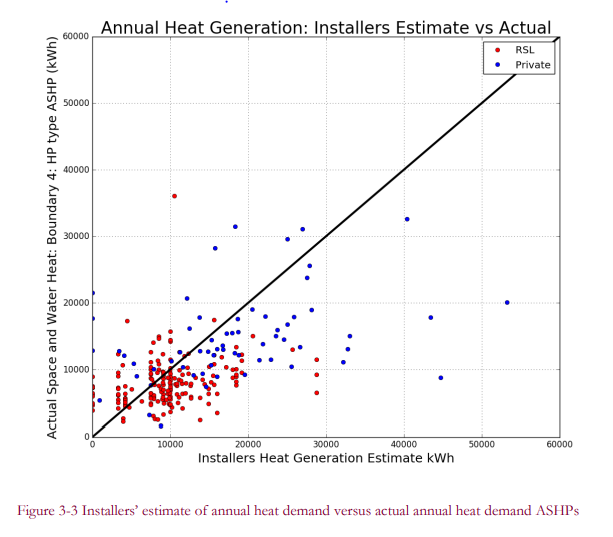
The above data shows that the installers usually overestimate the demand, by a significant, one might say shocking, margin. I must say that is also my personal experience. 16kW estimated by MCS surveyors (2 off), 10.5kW by me using MCS assumptions, 7.5kW actually measured. In a sense it doesn't matter whether they over estimate or under-estimate, the differences shown in the plot are too significant to ignore and have a major impact on system design. I feel it makes a good, possibly excellent, case for discontinuing the practice of doing the whole house sizing by adding up the room by room calculations. I accidentally pasted the wrong plot (the one I posted includes GSHPs), but the correct one (below) is not much different
-
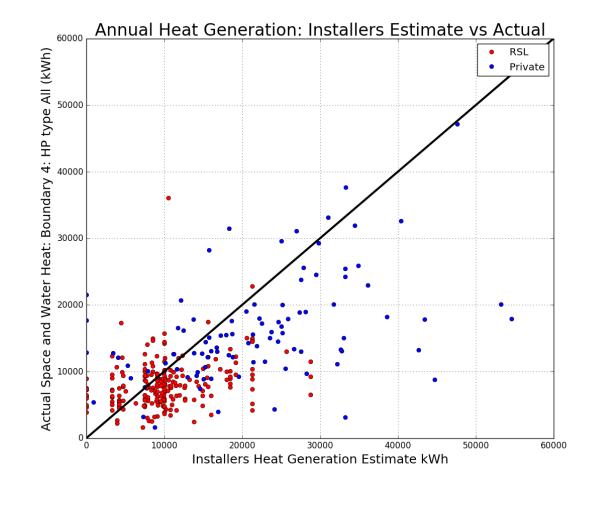
Actually there is ample evidence to suggest that a room by room analysis is not at all accurate. See this report https://assets.publishing.service.gov.uk/government/uploads/system/uploads/attachment_data/file/606834/Report_on_compliance_with_MCS_installation_standards_v32.pdf and in particular this graph My distinct feeling is that whole house sizing based on experimental measurement may be a much more accurate than trying to do the fabric calculations. Of course I believe the physics of the calculations, but there are quite a few real uncertainties and, if my personal experience is anything to go by, surveyors ignore too many important factors.
-
OK so we are beginning to agree, rather a lot actually 😊! The question then is, how to expand the supply? Personally I can see only one credible source of a large enough pool of labour which is also interested in smaller jobs - because its their bread and butter work - namely local plumbers and local electricians, who are currently completely excluded from the market. Thus two questions arise 1)What do we have to do to either ensure they have the skills, or subdivide the job so they can do it with the skills they have? 2)What changes to regulation are needed to alter the market so they are included not excluded? it seems to me that 1) comes down to three options a) train b) separate the job (so the difficult stuff (design and config) is done by a different set of people) c) dumb down Not sure which is best, most likely a combo It seems to me that 2) comes down to a) scrap MCS as a condition for government grants do we need to replace it with anything or can we rely on one of the existing bodies 9hetas, NICEIC etc), or just the market itself (local plumbers and local electricians value their reputation) b) scrap MCS as a condition for permitted development Does that just about cover it? Of course it may be that there still aren't enough plumbers and electricians in the country to cover the workload (unlikely, because they fit 1.6M gas boilers a year). That's a whole other problem which, if I were to speculate here on the reason, risks opening up another can of worms. However even if this is the case, opening up the market to local plumbers and electricians surely is a good start, in my humble opinion the only real option to get the volume needed.
-
Thanks, its pretty much where I started this thread but then I was largely (not entirely) shot down! Im not in a position to do anything about it directly, as I have no connection with the industry. But I can lobby MP and others, and so can other people, and if there were some sort of consensus about a) the objective and b) possible ways forward it might make a difference. In addition there are various people on this forum and others who do have a connection with the industry and if, by discussion, we can shift the thinking a bit then maybe, just maybe, things can get better.
-
Well at least some element of optimism has returned at last, thanks! Seriously! And thanks for the comment on MCS too, it feels, from interactions on this forum and elsewhere, that MCS is the root of many evils. So, back to the solution. I can readily believe that the design/assessment process can be automated/simplified. However the actual plumbing cant be (I dont think). Currently we replace much good stuff with alternative good stuff, causing much cost and disruption, how much of that is necessary, what would it take to make it unnecessary, what tests do we need to do to find out if the current installation is adequate? So can we get away in many or most cases with not replacing a)the DHW tank b)the cold feed to the DHW tank c)the primary feeds to the Central heating d)feeds to the radiators e)miscellaneous things like mag filters etc f)things that are anyway counterproductive like room thermostats (other than any in the HP controller itself), timers etc Some of the quotes I have received form our illustrious industry included replacing all of these except d, and one involved fitting a Nest thermostat (really?) My feeling is that the answer, in many cases, is that we could get away with not replacing much of this, sometimes with a small performance penalty, sometimes with none.. My fear is that the industry replaces them all in order that they can justify fitting the manufacturer supplied pre-plumbed cylinder which means that they have to know diddly-squat about the system that they are installing and can employ rookie plumbers to do the install. Am I wrong and whats the answer? Is it to separate out system design and installation (as we do with building - architects and builders are separately employed by the customer). Currently MCS expressly forbids this! Again ideas, preferably positive, on a postcard please.
-
All fair and all of which can be summarised as: who has the motivation to solve the problem we have to solve to be successful in replacing our heating sufficiently fast to achieve our climate goals? The reason for Government is, at least in part, to do (or have done) the things that are necessary but the market doesn't have a motivation to do, or alternatively to tilt the market is some way such that it does have the motivation to do those necessary things. So I think we know whose job it is. Oh well, shall give up now then? (PS, I don't want to nationalise HP fitting, my view is that the market needs to be liberalised so that local plumbers can engage, not be excluded as they currently are).
-
Well the actual plumbing is simpler than a gas boiler, and any ancillary changes, if they are needed, are local plumbers bread and butter. So I would say that they are already qualified to do the actual install. The challenge is the assessment of the requirement and configuration, although it really shouldn't be beyond the wit of a local plumber to understand weather compensation and and some of the settings to tell the HP what system looks like (at least to a standard no worse than the 'industry' is currently achieving, which, from the reports, doesn't seem to be particularly good). So I would reckon that a very good proportion could step up to the job with a bit of training and perhaps some triaging/simplification of the assessment and in particular basing system sizing not on calculation (which seems anyway, based on the report referred to upthread, to deliver rubbish results) but instead on experimental data (how much gas do you consume, or, give me your smart meter data?). Is it really beyond us to come up with a methodology that works in, say, 80% of situations and a local plumber can master. I think, if we conclude 'no', there will be a lot of local plumbers out there who feel extremely insulted, for good reason. I cant personally see a credible alternative delivery mechanism, even with your 30 year timescale, so Im not sure we actually have a choice.
-
On second thoughts there is actually an answer to this question - local plumbers. Typically one man bands or small companies. Its their bread and butter and many of them take pride in their reputation. However they are excluded from the market by the MCS/fly-by-night-special- purpose-company alliance and, because local plumbers have plenty of work anyway, they don't care. Furthermore because the MCS/fly-by-night-special-purpose-company alliance hasn't got a motivation (or, so far as they have published a roadmap) to scale up, local plumbers aren't under any threat in the foreseeable future, so aren't going to bother. Proposals for further regulation of the HP market were reported recently https://www.phamnews.co.uk/calls-for-a-legal-minimum-qualification-for-heat-pump-installers/, potentially further excluding the people who are the bread and butter of the central heating retrofit market. Not sure how that will help. So far as I can make out (somebody please correct me) the only credible delivery mechanism for £M1.5+ heat pumps per year is the local plumbing industry, yet they are excluded.
-
Quite so, as you say a lot of homes (myself included) have already done the easy stuff, the next step in the decarbonisation is ASHP, currently being made difficult, I would say impossible, by the industry. That doesnt mean that a continual focus on insulation isnt necessary, it is, but its just one part of the problem and here we are dealing with the other part. Oddly enough this is one area where govt seem to have got it about right. If your EPC recommends cavity wall insulation or loft insulation, you dont get a grant until you have done those. These are the big bang for the (disruption and monetary buck) interventions. Personally I would add double glazing which, although quite expensive, is relatively easy, but I can live with the govt's approach. Again spot on which is why I started this thread. An neither is the taxpayer going to subsidise it at scale. and there, I fear, is the rub. The installation industry is probably happy with the current high price, low volume, closed shop approach. The manufacturing industry does care, but would probably be content to ignore the awkward UK market and just serve the EU. Yes it reduces the volume a bit, but unlikely to be enough to dent their profits materially and anyway the UK will probably adopt different standards just because it can which causes them more hassle than its worth. So the upshot is we lag behind and undermine global efforts to combat climate change. Yet we like to regard ourselves as major influencers on the world stage. Great!
-
As you say an interesting read. The scattergram on page 44 is a stand-out message for me, basically showing pretty poor, one might say appalling, correlation between calculated and actual heat loss and a tendency (understandable given the scatter) to over estimate. Since this affects so many parameters in the system design, over-engineering has a major impact on many areas of installation cost and some impact on running cost, this is clearly a problem. Furthermore its one which, based on my personal experience, has not gone away. I had two full surveys done, both coming out with about 16kW. The one for which I requested full calculation details had ignored the fabric upgrades (which made a point to tell them about) and double counted room to room loss in the house total. I can only presume that the second surveyor did something similar. Making the corrections, but retaining MCS assumptions, gives a revised figure of 10.5kW. The actual measured is 7.5kW. Having said that I don't 'blame' surveyors entirely for the scattergram on page 44, ignoring fabric upgrades and double counting room to room losses is inexcusable, but there are clearly many un-knowable factors particularly in older houses which have been subject to multiple modifications, and it is almost inevitable that designs will err on the cautions side. I do wonder if there is scope for measurement here (and in several other areas where system design hinges on difficult to ascertain information). Annual gas consumption is known and, with smart meters, its pretty simple to crunch the data with average temperature/degree day data to get an experimental read out. As a bare minimum such measurements should surely form a 'sense check' on calculated values. However given the scattergram I do wonder if they should be the design basis for the whole house sizing, with heat loss calculations used only to size radiators. Its a shame that manufacturers dont yet produce 'range rated' ashps. Its clear that some do in fact, if you look closely at manufacturer data then clearly some lower spec models are simply the higher spec hardware with slightly different software settings. However so far as I am aware this isnt exposed to the user, unlike gas boilers where it is.
-
I have the Midea spec but it is too large to post here. However I got it from this post https://renewableheatinghub.co.uk/forums/postid/18936 Good Energy also told me I needed an EPC before they would do the survey. I just ignored this (so didn't get one) and they did the survey anyway. After recommending a 12kW Midea during the phone conversation and email exchange, post survey it became 2x12kW, comments on my 'journey' and why I regard this quote as silly upthread. I hope you have better luck, perhaps they just decided they didn't like 'my' installation so did a silly quote.
-
Fan Coil Units for use with a (cooling) ASHP
JamesPa replied to ProDave's topic in Air Source Heat Pumps (ASHP)
Thanks. We have friends with a place in italy, that might just help! -
Thanks. I was keen to read this in detail, then I looked at the date - 2017. That's a long time ago so I am not sure I would be prepared to rely on it.
-
My plumber always turns up with an electrician whenever there is anything other than like for like to be done. In terms of registration, MCS is the real problem I believe. Its appears to be an enormous overhead.
-
Fan Coil Units for use with a (cooling) ASHP
JamesPa replied to ProDave's topic in Air Source Heat Pumps (ASHP)
Im interested in where you got that quote. Ive looked at most of the FCUs online and these, or possibly the Mitsubishi Islim2 (which are also rebranded Italian units) look like the best but the price is putting me off! re "The supplier has offered valves to close off flow once they are at temp. Is this necesary? The controller will also stop the fan, so minimal heat will be coming out. The valve set is another £70 per rad" if it were me Id leave these out, it reduces system volume, adds cost and complexity and is, as you say, likely unnecessary. But others may have a different view! -
Isn't that why we need to get local plumbers engaged, currently it's a niche industry effectively closed to most of the people who today install 1.5M gas boilers each year.
-
So, do we have any responses to the above? In summary, for those who find the suggestions made so far unpalatable, what are the alternatives? We need to install about 1.5 million A2W or A2A heat pumps, instead of 1.5 million gas boilers, per year to retrofit our housing stock in about 20 years. Alternatively we need to install 1.5M units of some yet to be invented, unnamed technology (so I know which one I would put my bet on!). In 2021 we installed 42,000, even though the taxpayer contributed 5K to the cost of many of the installs. If people are to be persuaded to pay for them then the installed cost needs to be c4-5k. Please don't assume taxpayer subsidies are the solution, taxes are paid by the same people. So, unless the installers are going to work for free, which I doubt, and given that the pump itself accounts for perhaps £2K of the cost, how are we going to get from £10-25K per install to perhaps £4-5K per install, if we don't change the installation design methodology ? I reiterate that the principal argument against change seems to boil down to: 'Current installations don't achieve anything like the predicted results because they aren't very good. So we cant consider changing anything to make it cheaper, even though the product specs say its possible, because it might make them even worse than they are already.'.
-
Fair enough in some areas. But the UK de-industrialised from the 1980s on so there are many areas, with high density housing (and in total a lot of houses), that don't have waste heat to harvest. District heating is all well and good and also has a place, but its counter cultural for the UK ('an Englishmans home is his Castle') and there are no serious proposals for mass roll out. Meanwhile 1.6M gas boilers are installed each year in the UK, of which 1.4M must be retrofits (because we only build 200K houses per year). Every one of these is an opportunity lost for the next 20 years. Its now 2024 and we are committed to be carbon neutral by 2050, we can't afford to lose, every year, 1.4M opportunities to move in the right direction. If we wait for the perfect solution based on technology we don't have, we will lose the opportunity to find any solution. Currently it appears to be impossible even to discuss, let alone deploy, an imperfect solution. Engineering is about dealing with trade offs, not always finding perfection. Those who want and can afford a Rolls Royce can buy one, meanwhile the majority survive on something much less perfect, but still good enough.
-
Quite probably so (basically I agree with you. But the majority of our housing stock is not well-insulated airtight new build houses, its a retrofit problem. Hopefully the current plan to ban gas boilers in new houses from 2025 will hold., but the real challenge is the retrofit.
-
+1 +1 +1 again. The installation industry is responsible for the current difference between £2K and £10K-£15K (or even £20K actually once we take out the government grant). Let us generously suppose that heat pumps aren't quite mature and so come down to £1K or even £500. The installation industry needs to tell us their roadmap to get the cost of their labour plus the ancillary parts down, so that the total install cost is about the same as a gas boiler (let us say £4K). Alternatively listen to and critique in positive ways suggestions for reforming things, and stop taking government grants until it has (or at least is working towards) a roadmap to a solution. At the present time the principal argument (against change) seems to boil down to: Current installations don't achieve anything like the predicted results because they aren't very good. So we cant consider changing anything to make it cheaper, even though the product specs say its possible, because it might make them even worse than they are already. A cynic might say that the installation industry is comfortable with low volume, high price.
-
Very true - in fact the S curve is the pattern of everything BUT (could have used AND but I cannot be bothered) the S-curve is for a single technology I would buy that argument if the principal cost was the heat pump itself. But it isn't, it's the installation of the HP and in particular the associated changes. Are these going to follow the s-curve and if so why? If your assertion is true then the hp industry should be able to give us the roadmap.
-
In part I agree, although I'm not sure that the market discriminates against A2A). But it's a tough sell and won't suit properties with lots of rooms. Ideal for open plan I agree.
