


JamesPa
-
Posts
1899 -
Joined
-
Last visited
-
Days Won
2
Everything posted by JamesPa
-
Except for those who like it cool, but I suppose they could open the windows.
-
ASHP Modulation split dwelling
JamesPa replied to jamesdiyer's topic in Air Source Heat Pumps (ASHP)
Heat rises so, unless there is a fairly serious thermal barrier between the second and third floor, I don't think you will maintain much of a temperature difference and thus your whole house heat loss probably wont be that much less if you don't heat the top floor than if you do. There is a good argument that zoning really does'nt help much or even may hinder with ASHPs, because the whole house heat loss doesnt reduce much (the thermal envelope is still the same) but you have to turn up the flow temperature to compensate for the fact that you are essentially trying to heat the same amount with fewer emitters. With a long, thin, property then it might make sense, with a top floor you don't want to heat, its very doubtful that zoning will save anything material and it may end up costing you more. What sort of insulation standard is the house and how thermally isolated is the top floor? Most major manufacturers do give minimum outputs but often buried in technical data books which can be found but not always easily. Sometimes you have to ask their tech support lines. Those who dont should probably be avoided. -
Since it needs to be responsive to your guests, is a storages radiator a good choice. How can you know whether or not to charge it up?
-
Personally, if there is space, I would fit a small panel heater (IE electric radiator). That's way safer and less likely to get damaged than anything portable and easy for your guests to understand. You can get them with timers etc I think. I certainly wouldn't bother with infrared, your guests will complain that the bed or chairs are cold even if they are warm.
-
Im not sure its weird. Just some "chums" have influenced policy such that they can make out like bandits. Strangely, I find myself agreeing with you on this one. I fear that the Civil Service doesn't recruit enough people with an engineering background to challenge in a robust way what industry tells them, and very few MPs have any kind of scientific/engineering training. So on technical matters they are probably more or less helpless.
-
Well depending on the contractor you could probably do some yourself. Basically get the plumbing, DHW and electrics ready so that the job amounts to 'connect up the ASHP unit and commission it' (like connecting up a new boiler - only easier and no problem with gas safe.) The problem it of course to find a cooperative contractor, but some might be interested.
-
Agree, but the government doesn't it seems
-
Love that statement. It's a safe box that connects to electricity and water. Why does it need a whole special 'trade' body?
-
Indeed so. As I say the requirement for MCS applies only to installation under pd. Under express consent there is no such requirement unless the LPA add it as a condition.
-
Not sure what you are 'calling bs' on. MCS is required for pd, see the post referred to here if you can find any ambiguity in the source texts quoted in the post, please say. I would be delighted to be proved wrong but, sadly, can't see that will happen.
-
You have to look at the source legislation and source documentation, not to secondary texts. These are set out here I cant personally see any room for ambiguity, but if someone else can then please explain how. Note that the requirement for MCS applies to installation under Permitted Development only. If you install under express planning consent then it would not apply, unless of course your LPA made it a condition. In either case MCS is required to get the grant.
-
Correct, though you are not supposed to notice. Not sure its actually plumbers. Most regular plumbers are excluded because of the MCS overhead. I have a suspicion based on the installers I have interviewed that its, in large measure, special purpose organisations (you might call them 'grant harvesters') who have sprung up. Flashy salesmen, special offers if you sign today, 'Ill just phone my manager about that request for a bit off' etc, you know the drill. They then employ rookie plumbers to do the actual install, which is another reason why they will rip out as much of the existing installation as possible, so that the plumber doesn't have to think too much, which of course also increases the size of the job. These guys can only survive because of MCS and the grant. There are notable exceptions however, including Octopus but also many smaller organisations who are doing a good job of designing and installing effective and efficient systems. It wouldn't be fair to tar the whole industry with the same brush.
-
Agreed, so long as you add 'for an extension' to the second half of the first sentence.
-
Form the point of view of a consumer who has the capital resources you are of course right. But plenty of consumers don't have the capital resources and capitalism works best for the few if the few control the capital resources. So from the point of view of the suppliers a lease model is perfect. Look what has happened to software, music, cars, houses. Guaranteed annuity revenues are a capitalists dream. Leased heating is just another step down the road to the ultimate goal.
-
That's very plausible! Or they will go for a lease model. Or better still, the installation becomes simple enough, and the product cheap enough, that no subsidy is needed.
-
Only if they change the PD rules, which hopefully they will.
-
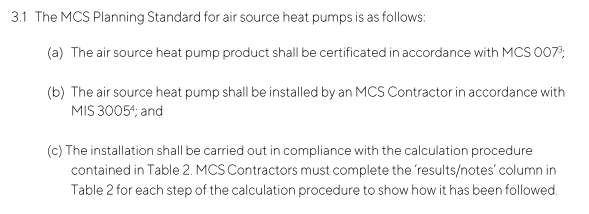
In this sort of discussion its generally best to go to source. The source (in England) is the Town and Country Planning (General Permitted Development) Order 2015 and specifically this clause https://www.legislation.gov.uk/uksi/2015/596/schedule/2/part/14/crossheading/class-g-installation-or-alteration-etc-of-air-source-heat-pumps-on-domestic-premises/made Clause G1 reads G.1 Development is not permitted by Class G unless the air source heat pump complies with the MCS Planning Standards or equivalent standards. The MCS Planning Standards are defined in MCS 020 as follows: That very clearly includes that it shall be installed to MCS standards by an MCS contractor. There are no recognised equivalent standards and, it seems to me that to be equivalent, it would need to include something like clauses (a) and (b) not just clause (c). Thus MCS becomes compulsory to benefit from PD rights. This is, IMHO, a scandal, as the installation standards have no effect on others and planning law is solely about the effect on others. If installation standards are required for heat pumps, they should be part of building regulations. Only 3.1c has any rightful place in planning law. However guess who wrote the 'MCS Planning Standards'? So if you wish to install without MCS, my reading is that you need express planning consent (in England at any rate)
-
....and if you self install (or have it installed other than by an MCS contractor) it isn't permitted development so you need express consent.
-
I'd go with that. For this to happen the industry needs to admit that the current method isn't good enough. MCS told me about a year ago that they sort of do accept this, but don't currently have an alternative.
-
That's certainly what the only guy who got my loss correct (in the sense calculated = measured) claims. He says that the MCS assumptions of ACH almost invariably lead to an overestimate of loss. He's done a fair few installs so presumably had evidence for this. My 1930s house, 30% extended, insulation part upgraded, double glazing, ACH=0.5 to get to calculated heat loss = measured heat loss, vs MCS assumption of 2-3ACH. I cant find any other explanation for the difference so I reckon that must be it. I have got mostly solid flooring over the original suspended flooring downstairs, the DG windows have no vents, and the only 'remaining' chimney is 'sealed' with a wood burner, the house is almost a perfect cube in shape, so there are a few reasons to think that ACH might be less than average and thus 0.5 ACH is at least plausible.
-
It's interesting to cross reference this to the heat pump threads on this forum. 5-6kW heat pumps are not uncommon and sufficient (or more than sufficient) for the space heating of many houses. People with houses that have a lower demand seem to be forced to make a trade off between efficiency of space heating at low demand, and dhw reheat times (assumes a tank). Same problem, different technology. Easier to solve with a lossy house than an efficient one. I'll still take that problem in preference to my 1930s solid wall build!
-
Agreed.
-
Measurements over a single day are intently suspect, because the heat capacity (sometimes called thermal mass) of a house is often in the same order as the steady state loss for 24hrs or more. So I would personally sense check this against a seasons loss or some other measure. That's not saying it's wrong, just sounding a note of caution before making a commitment.
-
Yes, and it would probably be sensible. However the current BUS rules prohibit this and, I suspect, many consumers, used to pressing a button and it works, couldn't cope with it. Which installer wants a call out because it's too cold. it's the same with dhw. The rules (if you follow eg MCS) demand that you design for a house full of teenage ladies (or gents) who shower for 15 mins at the same time each morning (or something close to that). Could we design for less luxury, of course we could. Would it make a material detriment to our life, of course not. But who wants to tell people that they can't have exactly what they want exactly when they want it? As a customer, my annoyance is that I am more or less forced to accept these 'norms', even though I neither need nor want them.
-
Since your house is low loss, that's believable if not immediately obvious. As technology evolves we need to remember that every day is a school day!

