


MoDo
-
Posts
48 -
Joined
-
Last visited
Everything posted by MoDo
-
TP1 and mortgage charge simultaneously
MoDo replied to MoDo's topic in Party Wall & Property Legal Issues
Thanks, that's helpful, I may submit the TP1 then myself and request for it to be expedited (with evidence). -
TP1 and mortgage charge simultaneously
MoDo replied to MoDo's topic in Party Wall & Property Legal Issues
Sorry is there a typo in your original message? You wrote it took 10 months - but did you mean 10 days!? That's not bad at all if correct. -
TP1 and mortgage charge simultaneously
MoDo replied to MoDo's topic in Party Wall & Property Legal Issues
Land registry claim 10 days if you expedite! 10 months is exactly the sort of delay we couldn't handle. Presume there was no mortgage involved in your case? -
TP1 and mortgage charge simultaneously
MoDo replied to MoDo's topic in Party Wall & Property Legal Issues
Thanks, that's very helpful, I didn't think of that situation. Must be more common than I thought if developments are typically sold off like this. Just have to find a solicitor that actually understands what needs to be done. Presumably doing TP1 and mortgage charge together precludes a DIY Land registry application. -
I've done my best to find the answer to this one. Both via Google and asking Ecology but can't get a clear answer. We're planning to build on land currently part of parents garden. They will gift the section of land to us and split the title/garden via TP1. Ordinarily we'd wait for the land to be in our name at the Land registry before applying for a mortgage. Then the mortgage lender can simply register a charge on the land which is in our names. Doing things this way however, could, it seems, take in excess of 6 months. Which we don't have. Could we instead submit the TP1 and have the same solicitor act for the lender (say Ecology) at the same time to register a charge and secure a mortgage? Or is a TP1 application not good enough for a lender to lend on?
-
Looked at a Gledhill and OSO Heat pump cylinder - the OSO has a similar sized coil, though exceptionally low heat loss per 24h. The Gledhill does have a much larger coil though like you say, though higher heat loss. Is replacing an anode a DIY job or is the plan for these enamel cylinders to last the warranty period and then fail?
-
At least there's no other impact other than the grant of not going the MCS route. Unlike with solar where potentially lucrative SEG is lost.
-
Thanks everyone, so it does seem MCS has become a get rich quick scheme for the installers. Shame really, at most you'd expect them to pocket the £5k grant instead of a typical lower margin, but in fact, it seems the situation is worse than that. I'm still keen on the Valliant Arotherm Plus which is a Monoblock so expect no glycol required, with Unitower. I've compared the heat exchanger size in the Unitower cylinder with comparable HP cylinder from Gledhill and seems to be within 0.06 m3 so seems alright? Valliant specs show a heat-up time of 125min which seems very decent. It also has a backup 8.7kWh heater (though I don't think this is used in the heat-up calcs as far as I can tell - as the pump itself can produce a flow temp of 75 degrees. This high flow temp is another reason I'd rather go with this unit (flow temp apparently achieved without backup heater). Valliant claim this higher flow temp means you can get over 300 litres out of their 180l cylinder due to blending down. This would be important for us as a family, one bath would potentially drain the cylinder at 50 degrees, so the ability to occasionally boost to 70 degrees to increase HW by over 100l is important. It also means a Sunamp could be added as they need 65 degree flow temp which is above the temp of most heat pumps. Finally the sound levels are also very low - important as plan to install Unitower in bedroom with heatpump on wall/flat roof opposite. Only downside seems to be the cylinder is enamel and not stainless - but something has to give! Apologies if this sounds like I work for Valliant (I don't)! Just trying to make an informed decision as simply don't have £17k in our budget for HP. Does sound from the advice above we can ignore the MCS installers and self-install + G3 plumber. Especially given the expansion vessel and all associated components are included in the single pre-assembled Unitower (if I've understood what's required for a functioning/safe system) should just be a matter of connecting the pipes and following the commissioning process. EDIT: Just to clarify too - the 7kW unit + Unitower is showing at £4999 or below online (before trade discounts) hence my shock at being quoted £17k to install.
-
Appreciate there is a heating dedicated section - but this query is purely on the cost aspect so assume this is the more appropriate place... Getting some of the smaller elements priced for our build such as the heat pump. Rather shocked at how much installers seem to want though. I'd budgeted £5-7k for the heat pump based on material cost of £5k, gov grant of £5k and installation cost including materials of max £5-7k therefore net cost of £5-7k. However had two estimates at £15-17k! I'm not looking at a complex system either. In fact, I doubt it gets any simpler than this. Heat pump to heat only ground floor UFH which will be installed by others and in situ. Pump and cylinder to be opposite each other (opposite sides of an external wall). Planning to use a Valliant Unitower which combines all internal elements in a single fridge sized unit (including HW cylinder). So installation would require fitting the outdoor unit (mains cable, flow and return) say half a days job, maybe a full day if I haven't appreciated the work involved. Should be similar for the indoor Unitower. So for £5k of equipment (and thats retail cost - without trade discount) plus a couple days work - how are installers expecting to make circa £10k profit for a couple days work? I'm minded to purchase the equipment myself, wire it - and bring in a G3 qualified plumber to connect the two pipes for HW to the Unitower. Shouldn't cost more than £300 labour like this. Have I massively underestimated the work involved, or are MCS registered installers simply taking advantage of the situation?
-
Thanks for that, will give them another try! Like your ingenious test method!
-
Thanks very much, we have 14m to the nearest house - so I may try them again. Appreciate your help.
-
@ToughButterCup Thanks for your detailed previous posts. Can I just ask which contractor you used for the raft and what your proximity to other buildings is? (T&C Vibro - although their website states VSC's "Installation produces very little noise and vibration, reducing disruption to the surrounding areas compared to traditional piling techniques." - They felt our site might be unsuitable due to proximity to other properties; that'd be a real shame as it does look like a good solution.)
-
Thanks, would you think the potential for cold-bridging of the piles is significant enough to consider a structural raft - which would mean finding a separate contractor for the works. Whereas MBC offer the foundation (insulated raft only it seems) along with their timber frame - thus reducing the possibility of timber frame contractor blaming the foundation contractor for any issues. Having one supplier for the lot is one of the main attractions with MBC. But I appreciate your point that a structural raft would be a better way to do it in this case.
-
Thanks, but do either of these avoid the cold bridging issue with MBC's insulated raft?
-
Thanks looks like a creative solution. So the piles don't tie in directly with the concrete - just support it from below? Did you use a local contractor for the job? Or was it an MBC job? (Sorry haven't had a chance to dig through your blog etc yet).
-
Would also be grateful for any opinions as to the significance of the piles affecting the thermal performance of the slab - is it a reason to avoid this foundation type entirely or is the impact minor and nothing to be concerned about?
-
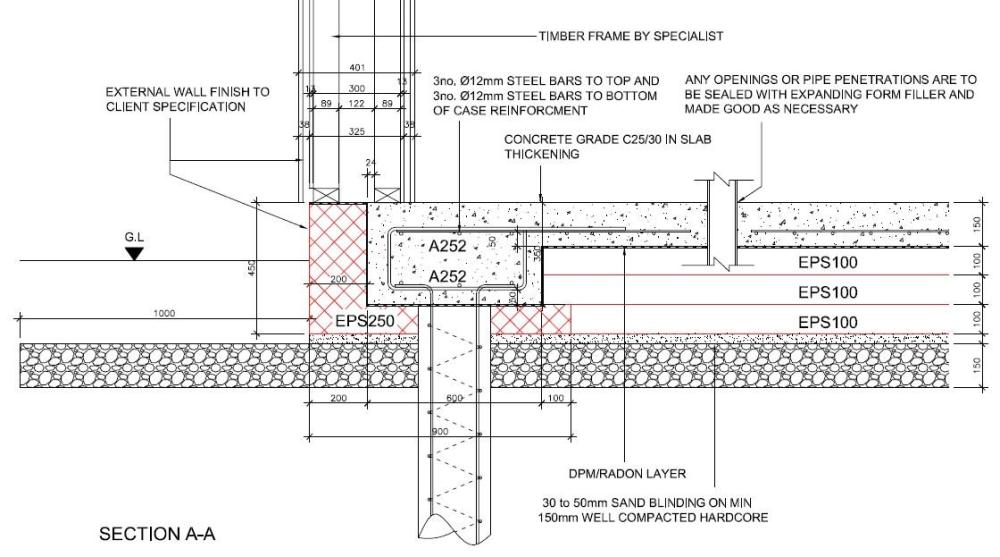
Was nearing a decision on timber frame supplier and drawn to MBC's package of founds and frame. However soil survey shows we needs piles and MBC have sent a general sketch of how they might implement piles with their insulated raft. I'm no engineer but to me it seems criminal to bridge the EPS with the piles as the drawing seems to illustrate. I'm told the area is small and thus the cold bridging isn't significant enough to negate the overall benefit of the insulated raft. Apparently they have done a few like this - is there anyone here with their foundation and piles? I recall @TerryE calculated the impact from rebar to the external masonry footing was significant but I guess that involved significantly more metal than the limited number of piles typically needed for a raft.
-
Concrete slab pour over winter months - recommended?
MoDo replied to markharro's topic in Foundations
Thanks, SIPS are a sandwich of OSB typically with a foam core - the whole panel is rigid and they slot together. MBC build a traditional frame (of individual panels) and fill it either on site or in their factory with dry insulation. Both have pro's and con's but quite different. -
Concrete slab pour over winter months - recommended?
MoDo replied to markharro's topic in Foundations
Could I ask which company do a SIPS and foundation package? I was only aware of MBC - but that's timber frame only. -
Solicitor Recommendations for access/right of way
MoDo replied to ChrisW's topic in Party Wall & Property Legal Issues
Hi @ChrisW did this issue ever get resolved? In a similar situation, where the road at the rear of a family owned house was sold by the council to a housing association. The family has used the road for as long as anyone can remember - including for vehicles as there is an old row of garages that they used to let out. We have planning granted to build in the garden, demolish the garages and intend to use the private road as we have done until now. We would still rather not approach the housing association for an easement (nothing in the deeds) even though we would likely get one eventually, because it would at the least cause a significant delay. I managed to get a quote for an Absence of Easement policy which I would be happy to rely on (though my solicitor, less so). However neither option solves the issue of making new connections under the road for utilities. So, if you did rely on an indemnity policy, do you have any feedback? Thanks -
Assuming you can repay the loan at any point, the future cost need not be an issue. However this loan ought to make builds possible that would not be affordable otherwise. I'm desperately waiting for this to go live (gov promised it would launch in the winter, well, they have two more days of that left). It should mean (confirmed by Build Store brokers), that your deposit can be increased by the value of the gov loan. For example lets assume a build cost of £350k. If someone has an £80k deposit and their income multiple would allow a £200k mortgage, for a total £280k this build is not possible. However with the gov loan this could be increased to £350k with the 20% deposit contribution, making it possible. At least this is my understanding of the scheme.
-
I think what struck me about the Viridian solution is that no trays seem to be required at all. Aluminium flashings around the panels keep the water out using the panels themselves. The Easy Roof looks very similar to the GSE. Clearly all are tried and tested solutions. All three brands seem to have some sort of Velux compatibility. I've also been wondering in terms of a self install (for a new build) which kit would be simplest to be installed by a roofing contractor (or DIY) - thus potentially avoiding having to get an MCS approved contractor to build half the roof alongside a roofing contractor. I can't see a clear winner really.
-
Long time lurker here picking an admittedly random point to join in! But I've been looking intently at the in-roof solutions for some time. I'd love to hear from someone who's used the Viridian in-roof solution as it seems to avoid the plastic trays GSE use. Whilst I'm sure the trays are made from a good quality plastic and designed to resist UV etc, eventually they must be susceptible to going brittle and cracking. The Viridian solution seems not to need a tray - but not seen and detailed photos of an install.

