PeterTweeter
-
Posts
30 -
Joined
-
Last visited
Everything posted by PeterTweeter
-
Hi Revelation I realise I'm a bit late to this party, but I've been browsing re. insulation. IMHO closed cell spray foam is a viable option. Throughout North America this is becoming the standard approach to retrofit attic roofs & cathedral ceilings. A variety of building science; government agencies have produced guidance about deep filling joist/rafter spaces. This is seen as the route to getting high R values ie low U values.
-
Hi - don't forget Simpson would love to sell you their screws - all those holes to be filled! Have you considered a palm nailer for driving twist nails?
-
Seamed metal roofing or catnic SSR2 advice required
PeterTweeter replied to ruggers's topic in Roofing, Tiling & Slating
SimonR I believe I've hit the motherlode, cos your roof makeup appears to be the answer to my dilemma. I'm 'designing' a TF extension to be topped by a 5m shed/skillion/monopitch standing seam roof. The constraints are that I want a pitch as great as possible (11deg) but I have little flexibility in how thick the roof can be without fowling on window openings above. So, unvented seemed to be the answer. My current idea/plan follows the scheme you've detailed. What you're describing is an unventilated ceiling. In the US & Canada, the use of closed-cell spray foam(ccSPF) is widespread & there are many examples of US & Canadian government guidance on good practice. All of this is in direct conflict with UK &, I assume, European practice ie warm/cold roof. So, the questions I have are: How was the sourcing of the spray foamers? Was it closed-cell? (I guess not since you included a VCL.) Over the pond, the feeling is that a VCL is counter productive. The foam forms the air barrier & keeps moisture away from the cold roof & any mosture that might be present can wick away back through the drywall. They also go for a vapour barrier paint - not too clear on this? What was your thinking about the multi-layer sheathing/battening? This seems excessive. By shear serendipity, I was in contact with Patrick last year re roofing & I beams. He is located not far from me, so I must set up a visit. Ideally I would like zinc, but as others have stated, this is so hard to source - though & have a local lead @£200/m2(ouch!). Any other advice/thoughts/guidance would be much appreciated. -
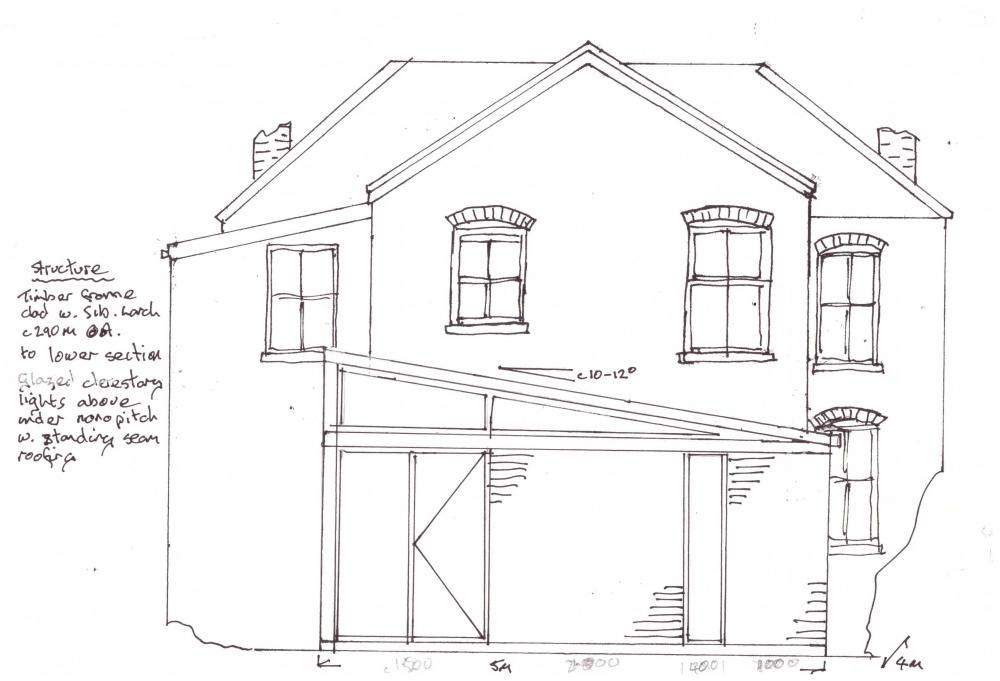
Russel, not sure what you're expecting - but this, kind of, represents our thinking - very blue sky! Cheers
-
Hi BuildHub (especially the timber framers). As it says, replacing the horrible conservatory that "(dis)graces" the rear gable end of our Victorian home is our next project. With over 50 years experience of house building and refurbs, we are finding this project problematic. All of these previous projects have been self-build, quite literally, with no involvement of professionals, ie architects & structural engineers - unless we consider my BIL - but let's not go there! The project is the removal of said conservatory and 'dropping' a nice timber-frame garden room in it's place. Simple, I thought, but though we have a good vision of this building we now need to work with an architect/designer to realise/enhance/improve our vision & detail the design. We don't know any architects and a stab at MyBuilder.com got lacklustre results. The next move is to put the project to Design for Me and see what occurs. So, my fellow self builders, can anyone offer any leads or advice as to how we secure this expertise BTW The space is W5.5mxD4.3m across a gable wall. Windows above limit the roof options, so the vision is: - a 2/10 transverse,monopitch roof, with standing seam zinc roofing (budget permitting); siberian larch cladding; floor to roof facade windows (in part); clerestory lights above and NO bifold. We know, very George Clarke/Kevin McCloud - but we have to start somewhere! Concerns: 1) Due to windows above, the roof needs to be as thin as possible & the ideal pitch is 2.5/10 (ie quarter pitch). I'm getting to grips w. moisture/ventilation & I'm taken by a US approach to fully seal the the space & sealing joints, etc w.PU foam. 2) Back in the day, framing was 4x2 studs; 50mm fibreglass; 1/2in ply sheathing & building(breather) paper! I'm leaning towards keeping it simple @ 140mm studs & appropriate(?) insulation. Bearing in mind this is an addition to an inherently leakig victorian structure, I can't see the need to get any more sophisticated. 3) Connecting the frame to existing brick? I've read threads re. differential settlement, but I don't think this is an issue. My inclination is to, somehow, connect by gasket/mastic. Any thoughts. Thanks for reading down to here, all contributions appreciated.