Ed21
-
Posts
77 -
Joined
-
Last visited
Everything posted by Ed21
-
That's good as it's It's mostly 1930's old lime plaster, with the odd bit of modern drywall, but that's easy to remove. Thanks for the reply
-
I've been asked to help replace about 4m2 of an exposed outside caravan wall. Inside is 6mm faced ply glued onto 2X1 studding and the thinnest of rockwool insulation that no way covers the whole area. On the outside it's got 9mm ply with a thick resin type stipple. None of this has any vapor barrier. It's easy enough to cut out and patch with new plywood on the outside, but was thinking at the very least to add some kingspan. Gap is 50mm, so to keep it simple, was thinking of 40mm board to allow a small 10mm gap. Question is would the gap be better on the outside edge or the inside one?.
-
I'm extending a shed base which needs some infill and also have a lot of old plaster from a few lath and plaster ceilings. Any reason not to chuck it in the mixer with some new cement as a binder and use it to fill in? it's got no load to speak of and once down will be under solid concrete.
-
Yep, IP65 plastic junction box, external glands/banjos with armour earthed along with the earth in the 3 core for continuity. The source and destination of the cables also have a separate earthing rod.
-
Cheers, reckon one of these will be man enough. https://www.tlc-direct.co.uk/Products/WA613C.html
-
Got what must be a simple question. I've got three SWA 3 core cables that are already fixed and run into a external waterproof box that now need to be joined. Just had a look on CEF and Screwfix and their are a lot of options, so what is the current/best fave for joining 3x 4/6mm single cables?
-
Help please for elderly lady who has plumber trying to cutting corners!
Ed21 replied to Nico's topic in Introduce Yourself
Depends. If it's a large tray this can get in the way of work especially if the wall has any mosaics/cutouts etc. Then it's easier to start above the gasket level and fit the base once done. Still need to make good the gap, but that's way easier to do in a small area than to work over the whole lot. However ................. In your case the prep and materials used are suspect and the heat vinyl adds another layer of mess. Given your description I'd not be happy at all with this. -
Once upon a time all I used was plywood, but since BS 5385 Pt 1 AFAIK not even marine ply is ok I'd be VERY happy to be proved I'm wrong as have a job coming up where marine ply would work much better than other options.
-
Not a fan of Mapei after a duff batch of adhesive caused no end of hassle plus £££'s. I was planning to use Dunlop GX500 flexible grout, not used it before. Wondered if there was anything not so much waterproof, but more water resistant than others
-
I've been using Dunlop CF24 Flexible Tile Adhesive, so that should do the job. Any recommendations for a decent waterproof grout?
-
It's two chunks of 3x2 timber edge on built up to act as a spacer/batten to fix the frame of a shower cubicle to. Not got a lot of choice as the whole lot has already been fitted (not by me) with frame fixers. I was toying with the idea of using some plastic profiles to cover as the shower frame is white anyway, but elderly relatives and they want it tiled to match the rest.
-
Quick couple of questions If new wood has been water-sealed, would that stop any adhesion from tile adhesive? And If yes would the likes of BAL primer work on top of a sealer? Ed
-
They are only 200 x 250 ceramic and no more than 7-8mm if that.
-
The Mapei was used the day it was bought, no chance for frost from my end. It had almost a granular consistency and the tiles were clean with no dust etc. Once fixed they started to peel off the wall after about a month, so had to be replaced. This caused a considerable amount of hassle, hence the reluctance to use ANY Mapei products again. Sure it might have been a one-off, but that one-off caused mega £££ to put right Then the A200 stepped in and under exactly the same circumstances just did the job.so well that on a recent remodel where the door was moved, some tiles had to be taken off with a chisel on a SDS drill they were so solid Reason for ready-mix is access is very limited due to covid prevention protocols, so needs to be in, do a section of wall and then out quick until the next (allowed) time. No qualms about mixing, in fact I'd use this normally https://www.selcobw.com/products/sealants-adhesives/tile-adhesives-grouts/dunlop-cf-24-flexible-tile-adhesive-white-20kg Circumstances are a bit messy hence ready-mixed and why the question (still unawnsered) is how RX3000 compares to A200
-
Pre-pandemic I was having a lot of fun with some duff Mapei Ultimate Waterproof tile adhesive that might as well have been flour paste for all the good it did. After removing the mess, redid with Bostik A200 Power Showerproof which did a vastly superior job I'm now about to start another much larger job tomorrow and so looked up to find that 10kg is now £23. With a 3mm bed I'm going to need at least 5 maybe 6 of those so over a ton on adhesive. Online I've checked out that Selco do 15kg of Dunlop RX3000 Waterproof for just £17. So not wanting to get burned twice how does Bostic A200 compare with Dunlop RX3000? Could really do with a quickish awnser if anybody knows, as Selco opens at 6.30 am
-
Temporary Stairs - Cut and Join two Halfs
Ed21 replied to NewToAllOfThis's topic in General Construction Issues
I've built a few open plan and it's easy. Last one I did was in a tight spot and in the end was built using 140mm x 48mm PSE due to the rake needed. If you have room and an less aggressive rake the treads can be wider. . Measure accurately first then mark it all out on the floor (usually outside). That gives the main length and whatever width of step you want. Then it's just a case of working out the angle and number of steps to get the timber order right. All cuts clean on a chop saw and to fix treads, bit of a scrap wood jig to ensure the angle and holes are right and drill two holes for each step, counterdrill a shallow hole and use wood bolts into the treads. Bolthead gets sunk in and if it's less permanent some plugs cut from scrap glued in and made flush makes the bolt heads go away. I also whacked a glued dowel in there as a just in case but TBH didn't need it. This can be made and assembled outside or anywhere for that matter so moving around or in bits to get in in place is easy. Takes a couple of hours and a cuppa to measure and work it all out and once the wood has arrived a day if that to make.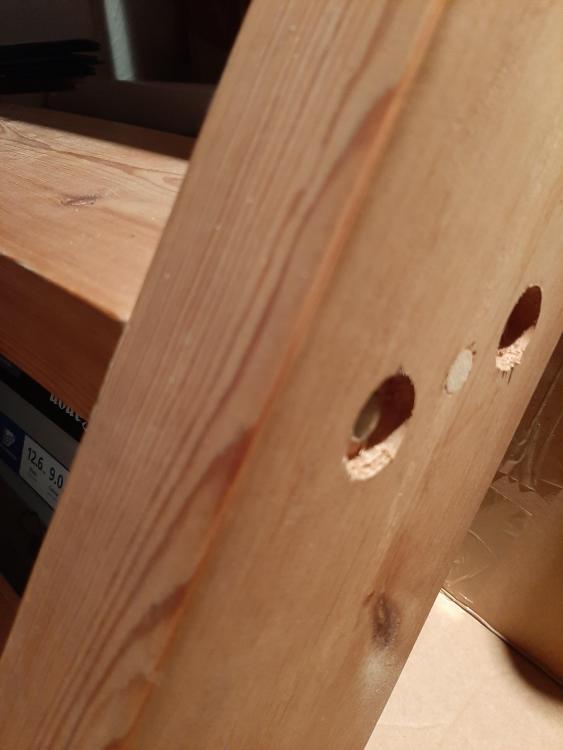
-
That's good because I'm 3 sheets in already The barrier is solid and what gaps into the voids are very small, mostly caused by packing to make the wall level. I''m seriously OCD when it comes to that ? Thanks to all for the replies.
-
Yes already have services in and extra battens for rads, so scrub #3. Foil and joints etc. are already fully taped so don't see any need for yet another barrier, so that cuts out #2. Which brings it back to a different version of the same question. Are low emissivity gaps meant to be sealed or left open?
-
Lol, why are insulation configs so confusing ? I've followed all advice I can find that says seal the room on the warm face of the insulation. The battens are on top of this to create an air gap before adding the plasterboard. The "void" is on the warm side, so if it's not sealed air is from inside the room, which is most likely going to be warm. The latest fly while searching the answer to the above is this site that suggests doing away with the void altogether. http://www.superhomes.org.uk/resources/internal-wall-insulation-1/ With the batten size fixed now, I could actually do this, add 25mm and still have about an 8-10mm gap between Insulation and plasterboard. So the options are 1. Whack the plasterboard on and be done with it. 2. Add another vapor barrier on top of the battens, seal whole wall again and fit PB. 3. Stick 25mm in the voids and tape the lot creating another vapor barrier (but with reduced gap) The annoying bit is by now I could have done any of the above, but no point if it's wrong Ed
-
Hi All, Quick and quite urgent question as I'm just about to do the job. I've been warm battening the inside of a cavity-walled bungalow with 50mm Celotex which is fully sealed against wall, ceiling and floor. The battens though do have the odd gap around the outside edges that even when plasterboarded may let warm air in the void. So the question is does this need to be sealed? It's really if the void is meant to be ventilated or if it's meant to be sealed. Ed
-
Just thought I'd update this. Although the whole lot was being covered the non-insulated part just looked wrong, so I ended up doing the lot
-
So the plumber did it wrong and it's against the by-laws, Surely the first response is to get onto the plumber for him to put it right gratis.
-
Yes it's 50mm Insulation then 25mm battens and plasterboard on top of that. The walls are dry-lined/battened anyway, so the step isn't an issue just means a slightly thicker batten. Current plan is to use a sheet of 25mm which will give 1.2m along the wall and 18mm battens on top with 43mm battens on the non insulated bit to give a level wall. Skirtings are all off so the additional depth would be 25mm. The 1.5m, is a good bit of info, so reckon 1.2m full sheet is a good compromise
-
Quick question. I've been adding 50mm internal Insulation using the warm batten method and have added an extra bit on the internal perpendicular walls to deal with any breakthrough from the outside. In some cases there is not much wall left uncovered. The wall the other side is another heated room, so only thing I can think of it helping with is any cold rising through the wall from below the floor or would such insulation (on both sides) prevent the wall from warming up and making things worse. is there any advantage or disadvantage to just doing the last bit as well and just cover all walls? Thanks in advance Ed
-
An existing loft conversion, done a few decades ago. What Insulation there is not great and not sure what nasties i'll find when I start to remove. Not looking at doing much with it other than use for storage, so the insulation is more a tidy-up and a plus for the rest of the house than anything else. .