Adsibob
-
Posts
3604 -
Joined
-
Last visited
-
Days Won
10
Everything posted by Adsibob
-
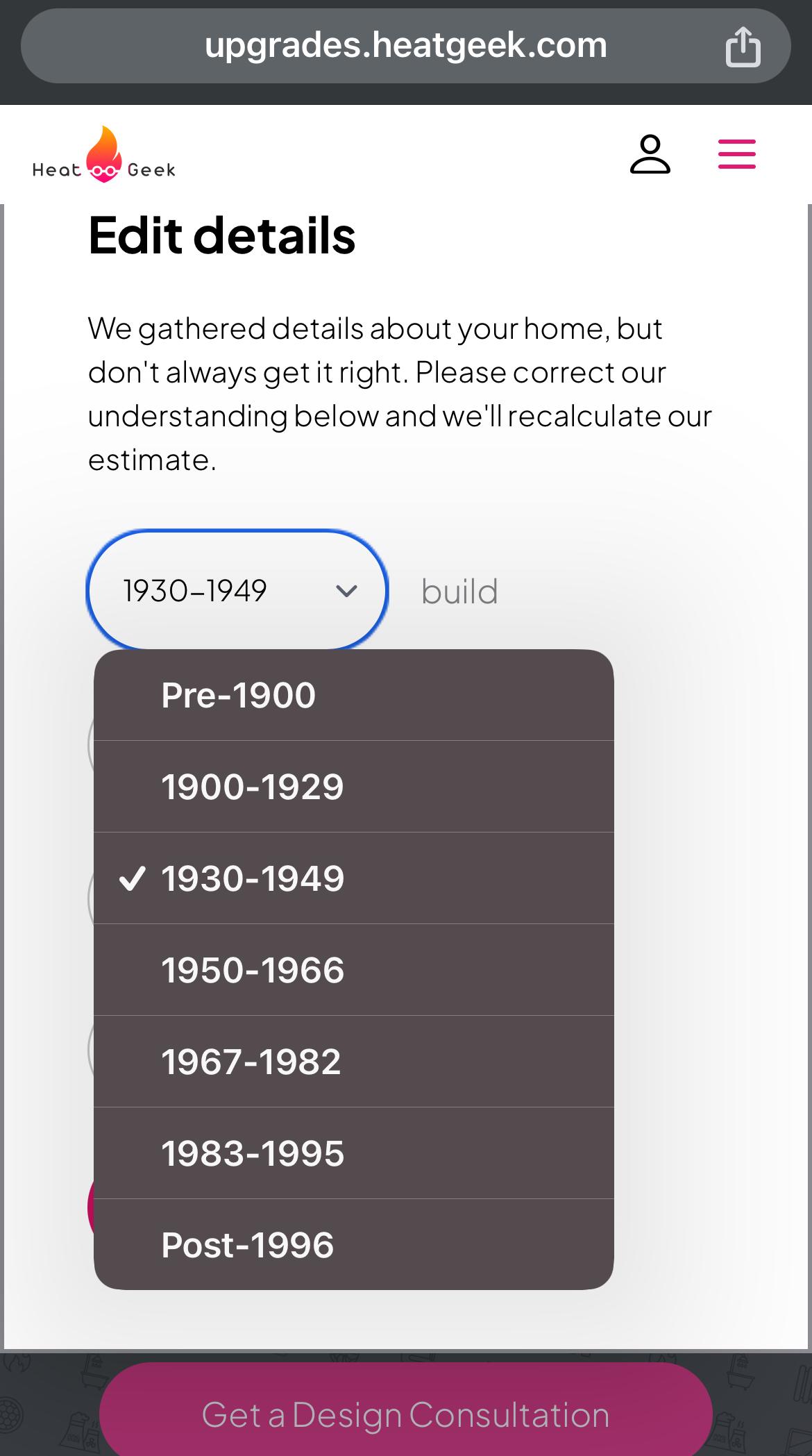
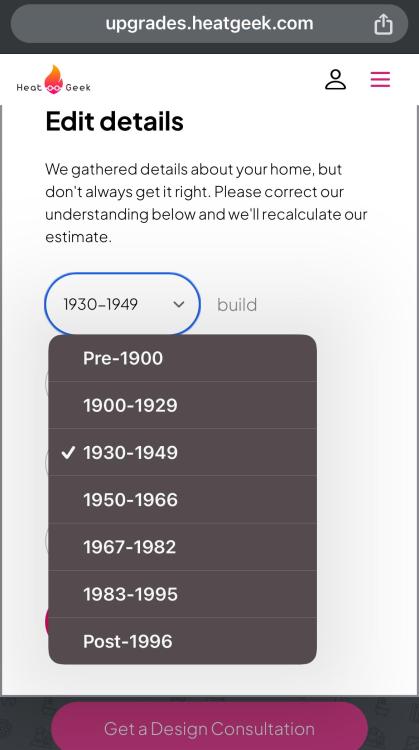
A few people mentioning this on the forum. Went for a surf on the interweb to check it out, hoping to find some informative articles to better educate myself so I can follow the thread I started on the intricacies of my own heating system, but ended up getting sucked in to what must be a sales pitch to spend money on a a design service. Two questions: 1) is Heatgeek.com any good for learning enough about heating engineering to not get scammed by an engineer; and 2) which of these: is most similar to my house, given I took a 3bed 1930s semi, chopped the back and top off it, added a new roof and loft conversion and 2 storey rear extension and covered the whole thing in about 40mm of K7 EWI plus silicone render. Is the average of a 1930s house plus a 2020s house, a 1975 house?
-
 That’s a good way to think about it. Just checked the figs now and there is almost a 10C difference between the inlet temp of 11.2 and the supply temp of 21.1. Not sure what outside temp is as I’m not home so don’t have all the figures available - the brink online portal just gives you those - but it’s probably about 9C.
 -
Update: I closed the bypass, and now it’s running much more efficiently, adding about 7.3C to the outside air temp of 13C. I think the temp parameters on the “auto” were set incorrectly. What settings do you put on your auto mode?
-
How to measure the remaining HW in an unvented cylinder
Adsibob replied to Adsibob's topic in Boilers & Hot Water Tanks
So if that’s the ideal, what is stopping me implementing that? Is it the 2 towel heaters being on their own zone? If so, couldn’t I have some sort of diverter that diverts water from the loop which heats the cylinder to the towel rads when needed? Towel rads are used for maybe 15 min at a time, twice a day at the very most. -
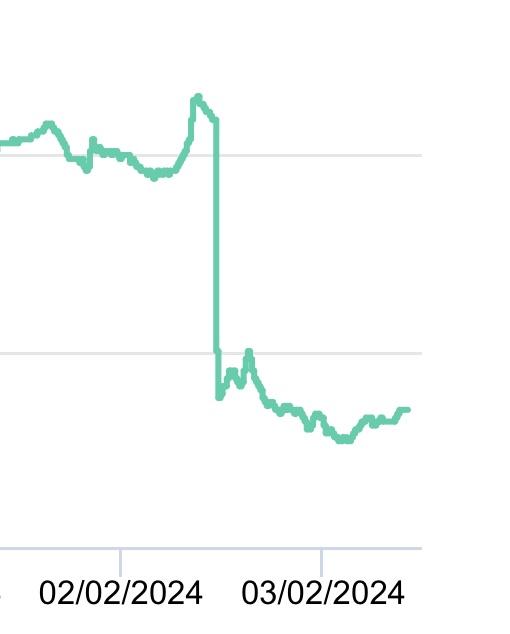
I don’t think so. Looking at the graph between these two intervals on the x axis, which I assume represents 24hr midnight to midnight, it doesn’t look that way:
-
Bypass is currently set to auto. Other options are open or closed, which I always found confusing. Presumably “open” means it bypasses the heat exchanger, sobering which shouldn’t be happening in winter, is that right? If so, I could change it to “closed” to see if that stabilises things. The filter was last changed 46 days ago, when I put a brand new G7 filter in. It’s possible I put it in the wrong way around as I remember finding the labelling confusing… I’m in a fairly high pollution area (medium to low for London, but that’s still relatively high), so maybe it’s due a clean.
-
How to measure the remaining HW in an unvented cylinder
Adsibob replied to Adsibob's topic in Boilers & Hot Water Tanks
@SimonD, re @JohnMo’s suggestion above, I’m a little confused by your comment: Or are you talking about something else? Wouldn’t the 4 pipe system give me two temperatures: high for heating the cylinder and the two radiators and low for the UFH? -
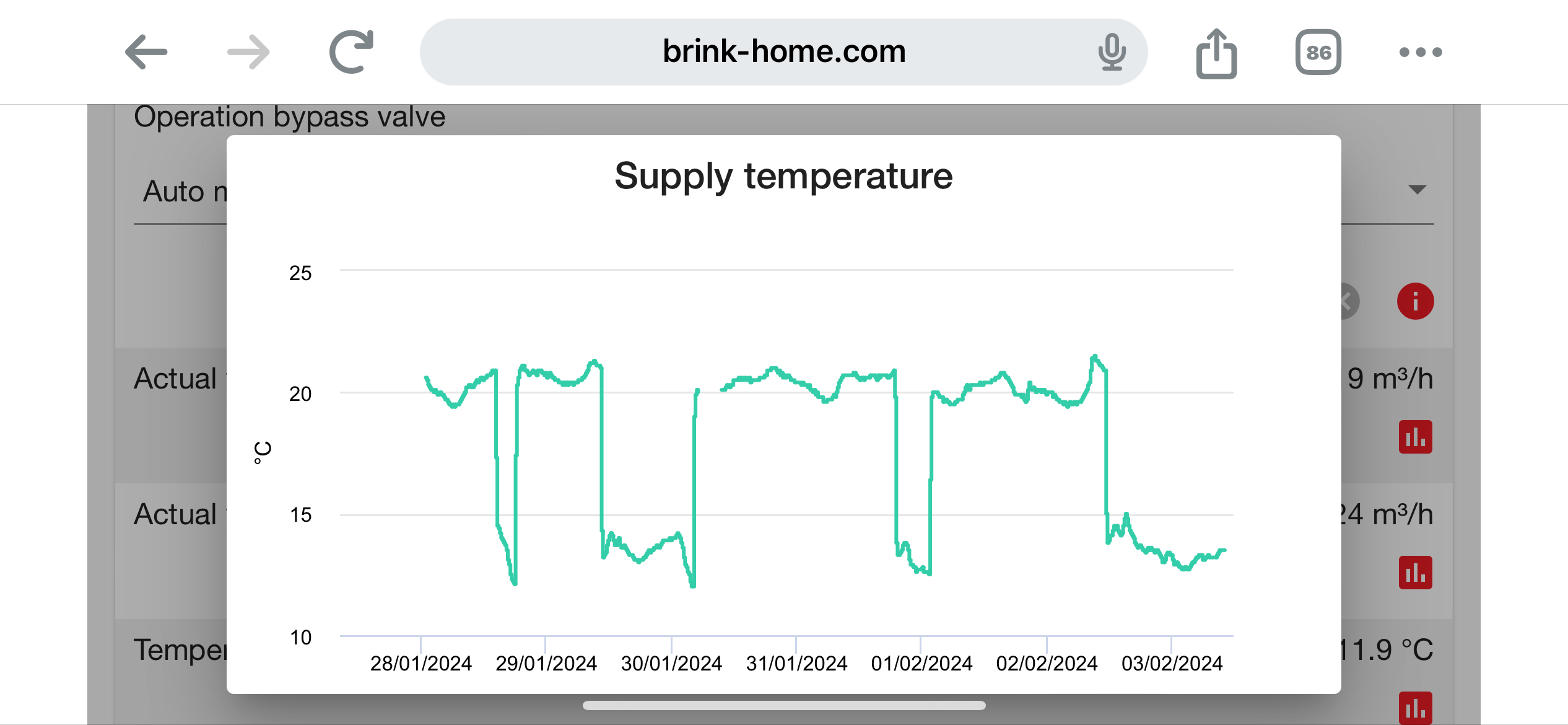
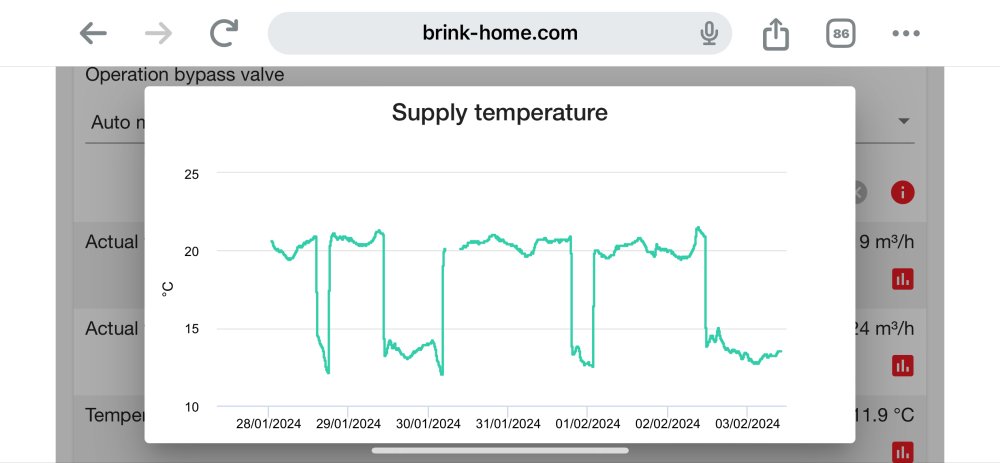
I’ve not had my Brink flair unit connected to the internet for the last 9 months or so, but managed to get it back online about a week ago. I can’t remember exactly what temperature graphs I was getting for the supply temp previously, but I don’t think there was as much variance as this: Does that look right? There is currently a 1.7 degree delta between outside air temp and supply temp. Is that the only amount of heat I’m recovering? Not sure how relevant this is, but airflow is set to about 220m3/h
-
Plus one. There is an Austrian manufacturer which is known for making heat pumps that last decades: https://www.ochsner.com/en/
-
How to measure the remaining HW in an unvented cylinder
Adsibob replied to Adsibob's topic in Boilers & Hot Water Tanks
Actually, this is just more Tado marketing crap. Looked into reviews of the early start feature and seems pretty dumb. Reviews quite poorly on the Tado community forum. -
How to measure the remaining HW in an unvented cylinder
Adsibob replied to Adsibob's topic in Boilers & Hot Water Tanks
It’s a tricky one, on the one hand, I like the simplicity of @JohnMo’s idea, but at the same time I was coming around to the features of WC. I guess I will ask the engineer I enventually go with to design and price both options, then I can consider pros and cons. Query whether a half way house might be to go with JohnMo’s idea, but with one modification: leave all tados installed, set them all to 20C when we are out for the day, 21C when we are in for the day and 18C at night. Then pay their stupid £3 a month subscription for something they call active start, I think, which is a sort of approximation of weather compensation. It takes weather forecast data for your postcode and triangulates this against the responsiveness data on your heating and heat loss data of your house, and then uses all that data to predict when it should turn on and off your heating to achieve the target temps you’ve set. Far from perfect, but might be a good compromise. -
How to measure the remaining HW in an unvented cylinder
Adsibob replied to Adsibob's topic in Boilers & Hot Water Tanks
Thanks @JohnMo. So that I can understand the basis of this recommendation, can you please explain: What the volumiser would do which the LLH can’t do? Is Volumiser another word for buffer tank, or are these completely different? Why you think I don’t need a big secondary pump? -
How to measure the remaining HW in an unvented cylinder
Adsibob replied to Adsibob's topic in Boilers & Hot Water Tanks
Interesting. Your construction is very similar to mine, in that I'm 1930s semi, with some cavity walls where we've extended at the rear. Only difference is my insulation in floors and loft and EWI. My house is a bit bigger than yours and our gas bill was also about £6 a day for December. But we don't cook with gas, as we have induction. Do you have MVHR? What was your actual kwh usage for December and where in the country are you based? -
Okay, so north first floor wall it is. The next question then is do I have to run a wire from there to my boiler, or is there a wireless solution? My boiler is connected to the internet, so I would hope there is a battery powered wireless solution which can speak to it, although I guess that would be very annoying if there's an internet outage. Radio communication might be best.
-
So I've read all twelve articles on the forum that mention wc in the titles, and apart from a brief reference to putting it on a northern facing wall, in the shade, there wasn't much discussion of what impact a suboptimal placement would have on a gas system boiler. I'm considering upgrading a badly designed Viessman Vitodens 200W System boiler setup and one of the things I'm considering is adding wc. Options for placement are as follows: If performance is significantly enhanced by placing the sensor on a north facing wall, then the only north facing wall I have is the north side of my first floor rear extension. This is mostly in the shade, but will get some sunshine in summer, towards the end of the day, for a couple of hours. I think in winter it is completely in the shade, but will double check this weekend. I have is a south facing wall which is the alleyway down the detached side of my semi detached house. Because our house and the neighbouring house are fairly tall (about 10m each at the apex) and because the alleyway isn't too wide, my side is about 90cm wide and my neighbour's similar, so maybe 190cm with a fence between them, the alleyway will probably be in shade for two thirds of the day. But in summer, the middle third of the day could last for 6 hours or so, which could throw off things significantly. That south facing wall is also where my wood burning stove's inlet pipe is. How about locating the sensor just inside the pipe, i.e. just the other side of the vent cover of the pipe. In that way it is in the shade, but might not draw air in when the stove isn't being used, so might be a problem. It might draw a lot more air in when the stove is being used, and not sure if wind chill can affect sensor readings. Maybe a bad idea. That south facing wall also has a plastic white gas meter cabinet attached to it, which is significantly bigger than the gas meter. Could the sensor go in there, or would the plastic box heat up like a greenhouse in the sun? Could the sensor go underneath that white box? Fun and games.
-
@mrklawuk did you ever manage to get your Tado to speak with your Viessmann? I have a Vitodens 200W and tado thermostat, but it seems they can only speak binary to each other (on/off).
-
How to measure the remaining HW in an unvented cylinder
Adsibob replied to Adsibob's topic in Boilers & Hot Water Tanks
I see Tado is listed second on a Viessmann article entitled "Which smart thermostat to buy: a buyer's guide". I think I will be preparing a letter of complaint asking them to compensate for the £1200 I spent on Tado garbage, though it's confusing because apparently there are "European" models, whatever that means these days, that are compatible with opentherm. It really is quite shocking that the article concludes with the following (my italic emphasis) conclusion, which completely ignores the incompatibilities between most of the thermostats mentioned and the modulating features of some Viessmanns: Which smart thermostat to buy So there you have the top-rated smart thermostats currently available in the UK. But how on earth do you pick one? It’s best to consider what exactly it is you want the thermostat to do. Do you want to be able to control multiple zones, save money on your bills or keep an eye on issues and problems? Your choice of thermostat will likely depend on which of these things is most important to you. It’s likely that you also have a budget in mind, so price will be a contributing factor. Finally, it could also depend on the type of system you already have. Typically, the ViCare thermostat will work only with a Viessmann boiler. If you’re a British Gas customer, you may be able to get a discount on the Hive thermostat system. But you may wish to avoid the Hive if you want to control a heat pump, for example. -
How to measure the remaining HW in an unvented cylinder
Adsibob replied to Adsibob's topic in Boilers & Hot Water Tanks
@Lofty718, the figures you posted for your boiler look impressive. How big is your house? What type of construction is it? What is your average monthly usage in winter? -
How to measure the remaining HW in an unvented cylinder
Adsibob replied to Adsibob's topic in Boilers & Hot Water Tanks
Yes, this is true. You can see them on the previous page of this very thread. -
How to measure the remaining HW in an unvented cylinder
Adsibob replied to Adsibob's topic in Boilers & Hot Water Tanks
Thanks everyone for all the help with this, it really is appreciated. A couple of points of clarification / feedback: I’m really keen for the towel rads to have fairly high temp serving them when they are switched on. This is because we ONLY use them to heat towels, so they really only come on for short periods. Maybe 20 min at a time once or twice a day at most. I simply tell Alexa “switch radiators on for 20 minutes” and she does the rest. It works really well. We do not need to use these to heat the bathrooms themselves, we can do that with UFH. This would have been a good idea, but I don’t have an easy way to retrofit that. I think my towel rails are water only ones, and one of them is mounted on tiles in a wet room area. Getting new ones and supplying them with electricity will be expensive and disruptive I imagine. I am much more relaxed about doing disruptive work in the utility room where the boiler and LLH is, and in the MVHR and cylinder room in the attic, and even where the manifolds are, as all of those spaces are hidden away from view and they are service areas really, rather than places with a lot of aesthetic expense. Clearly pumps use electricity and I’m keen to save that too, but I query how much electricity is really consumed by all these pumps, given the manifolds aren’t all on all the time. I estimate we are running 3 of the 4 manifolds for about 3-5 hours a day on weekdays and 8hr a day on weekends, and one manifold (the top floor one) for 3-4 hours, once or twice a week. There are obviously lots of issues with my current setup, and the number of pumps is one of them, but it’s not high up on the list. -
How to measure the remaining HW in an unvented cylinder
Adsibob replied to Adsibob's topic in Boilers & Hot Water Tanks
Thanks for this @Lofty718, but just to flag that I do also have two towel rads on their own zone, which will always need hotter water than the UFH temp water, but presumably they could be heated by the same water that heats the system boiler? -
How to measure the remaining HW in an unvented cylinder
Adsibob replied to Adsibob's topic in Boilers & Hot Water Tanks
Are you saying it's possible they do modulate Veissmans after all, they are just not certified as such? -
How to measure the remaining HW in an unvented cylinder
Adsibob replied to Adsibob's topic in Boilers & Hot Water Tanks
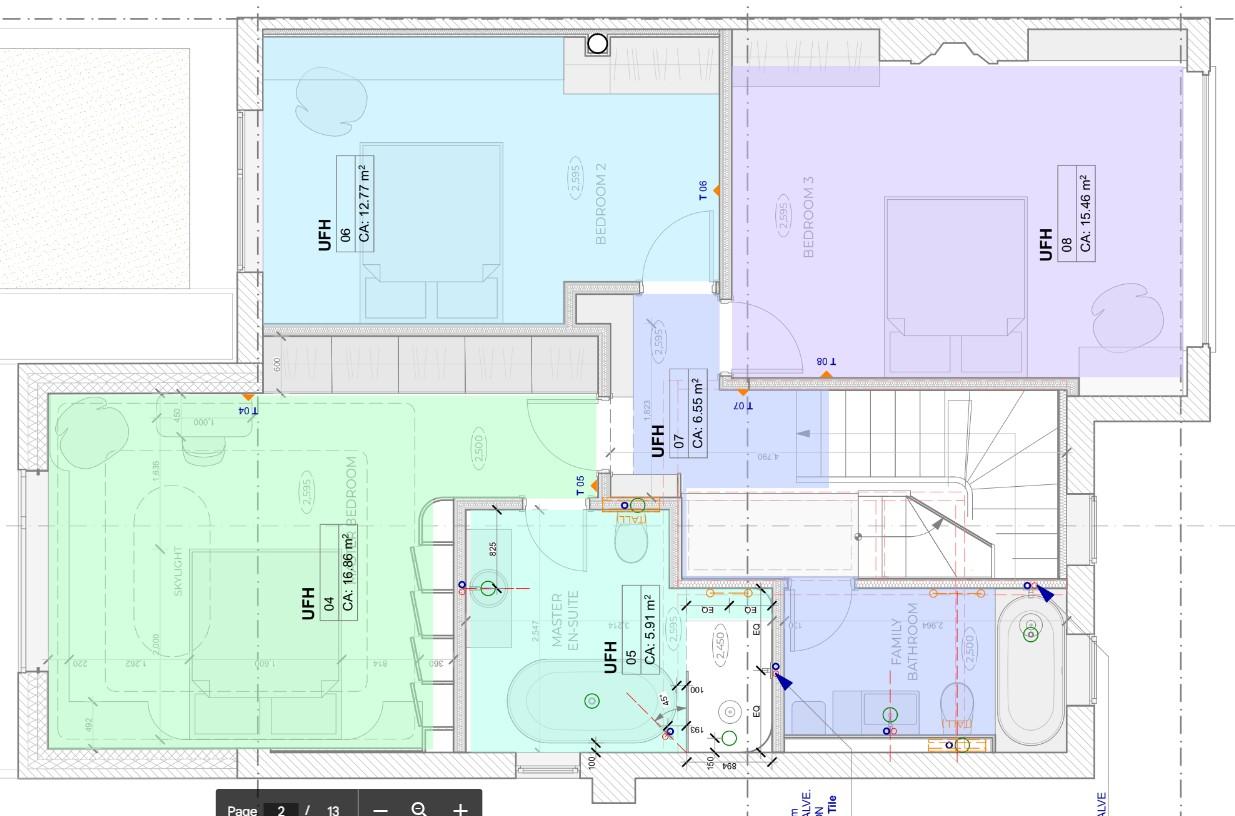
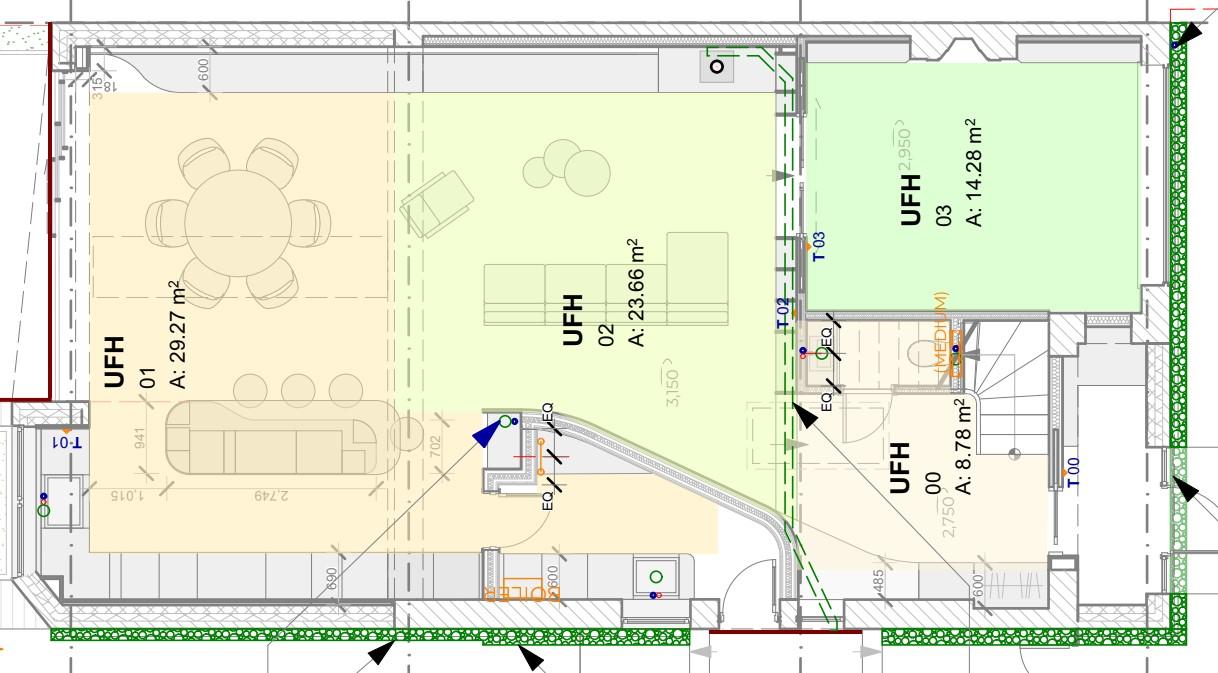
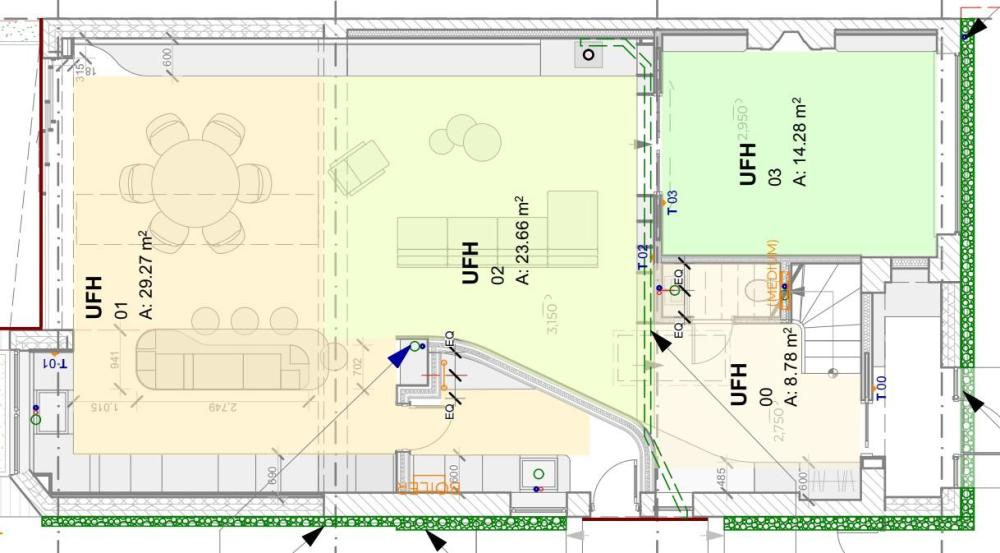
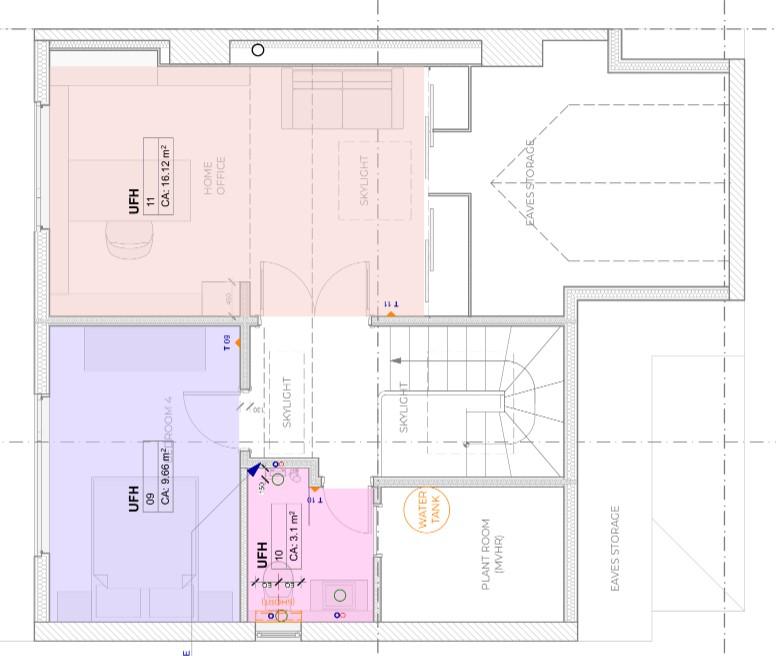
I have pasted below the plans of my house which show the different zones. Under each plan I have noted details of the construction, as these aren't always accurately set out on the diagram. GROUND FLOOR (4 zones) There are 4 zones on the ground floor shown above, each with its own overpriced and misrepresented piece of junk tado thermostat. When you look at the above ground floor plan, the two thirds of the ground floor to the right is original construction, solid brick walls, upgraded externally with 40mm of EWI Kingspan Kooltherm K7 and a layer of silicone render on top of that (shown in green). There is a mistake in the plan in that the rear extension forming the third of floorspace to the left of the plan, show the EWI extending all along the flank wall, but in actual fact only about half of that extension wall is covered in EWI and render, the rest is brick. We have 2G windows throughout. The rear extension has large sliding doors which are West facing, and there is also a large 2G window above the kitchen sink that is west facing, so plenty of afternoon/evening sunshine. Whereas the front of the house is east facing so gets morning sun. The original house was a 1930s semi, with the Northern side (top of diagram) being attached to the adjacent building. Funnily enough, they have had their front elevation done with the same EWI we have, using our builder after they saw ours. But only the front. Our front room (UFH zone 03) rarely needs any heating. I think part of the reason is the neighbour's EWI, but the other reason is that room, as well as UFH zone 00 is raised upper ground floor (about 210mm higher), with much more concrete under the 100mm PIR floor insulation, onto which the UFH pipes are tacked. FIRST FLOOR (5 zones) The hallway and family bathroom are the same zone. Orientation is same as described above, so UFH zone 7 is getting morning solar gain, whereas zones 04 and 05 are getting evening solar gain. Zone 04 also has a fairly large skylight. Not much solar gain for the ensuite bathroom or family bathroom, as windows are small. The entirety of the external walls of the first floor are covered with the same EWI buildup as described above, despite this not being shown on the drawing. SECOND FLOOR (three zones) This is a loft conversion so largely a modern construction, but the side walls and front wall (top and botoom and right) are mostly original construction from the 1930s, with only the dormer cheeks being new. There is a combination of wood fibre insulation and PIR backed plasterboard in the roof build-up, but it still only just passed building regs as we didn't have space to put more in. We went for wood fibre to increase decrement delay. The three skylights in the roof give quite a bit of solar gain. Our adjoining neighbour has also done a loft conversion, so we get protection along the northern wall, which is all adjoined by their house. On the eastern wall (right) and parts of the southern wall (bottom) we have the same EWI. The house is VERY airtight. I haven't done a test, but the detailing was pretty good and builder was good about using Tescon Vana tape on all windows and doors. CONTROL/ZONING So as you can see, I have a whopping 12 UFH zones, each with their own Tado. Then there is a 13th zone, just to control the two towel rads we have on the first floor. These are simply switched on and off by a command to alexa to switch on a smart plug. I have the Tado extension kit to control the HW cylinder in the attic space. There are four UFH manifolds in total: two on the ground floor (one for zones 00 and 03 which are on the upper ground floor; and one for lower ground zones 01 and 02) one on the first floor one on the second floor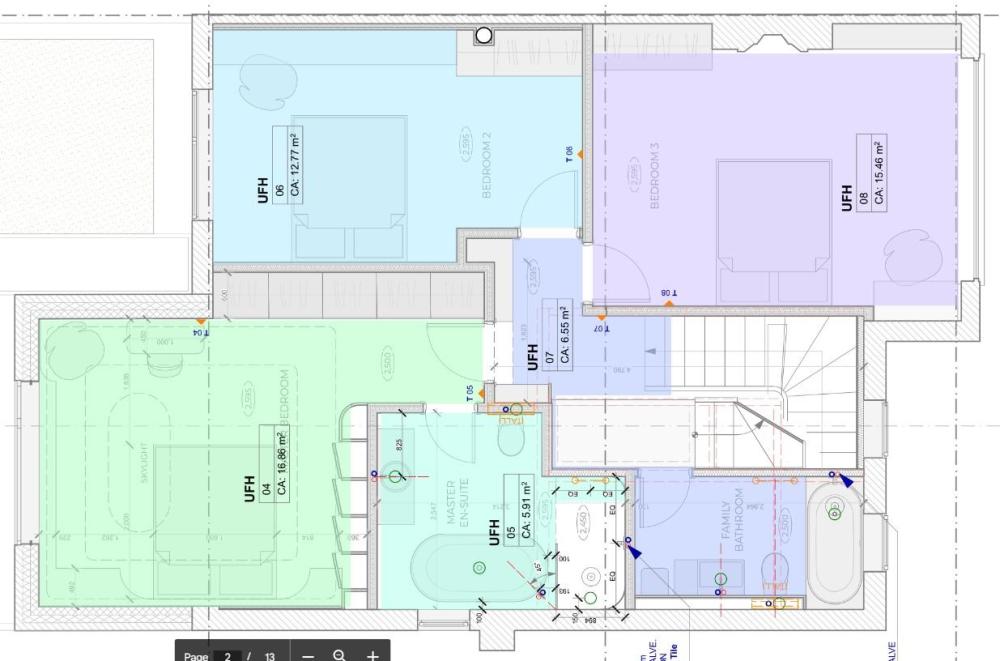
-
How to measure the remaining HW in an unvented cylinder
Adsibob replied to Adsibob's topic in Boilers & Hot Water Tanks
Thanks, I will do this and report back. -
How to measure the remaining HW in an unvented cylinder
Adsibob replied to Adsibob's topic in Boilers & Hot Water Tanks
Well, I think they are stretching the interpretation of “compatible”. I’d hardly describe it as “compatible with all Veissman boilers” when there is actually very limited functionality compared with other fully functional thermostats.