Omi
-
Posts
77 -
Joined
-
Last visited
Everything posted by Omi
-

Ouch - Timber frame price up £4,600 between design and manufacture
Omi replied to Haylingbilly's topic in Timber Frame
Hi everyone, what's the price trend on timber at the moment? Our project was last requoted at the peak back in May so wondering whether it's worth asking for the quote to be updated again. Our current quote is still valid for when it goes to manufacture. What we don't want is for it to come back even higher... -
We are getting close to starting the groundworks on our build and had a couple of questions: Where the water mains comes into the property: we are planning to have this come into the small plant room in the under-stairs space. This would seem to be logical as the DHW cylinder is going to be directly above that space on the first floor. Are there other considerations we need to keep in mind? Mains pipe requirement. Scottish Water requires a barrier pipe for the run from the existing mains to the boundary box as it runs under the carriageway. However, the service line from the boundary to the house is also currently specified as a barrier pipe. Possibly as a safeguard as a section of it passes through the driveway. Is it really necessary to have this final stretch as a barrier pipe as well? Barrier pipes seem to be mainly required for brownfield sites where there may be ground contamination present but the one we are building on is greenfield (previously farmland). Would be good if we can avoid having this final stretch as barrier pipe as the piping and fittings seems to be about 10x more expensive than the regular MDPE variety. On that note, would a 32 mm barrier pipe take a regular 32 mm stopcock? Appreciate any feedback from the collective wisdom and experience of this forum ? Thanks!
-
I had noticed that but it also doesn't explicitly prohibit it ?. Not going to keep pressing the point if the installer (who is Burley authorised) is happy.
-
Having spoken to two HETAS installers over the phone, the vertical duct doesn't seem to be much of an issue - at least in this part of the country! I proposed the following which has a flat channel duct going up to the joists and then connecting to a fairly long 100 mm duct out to an external wall vent on the rear elevation: I asked at least 3 times to confirm. The supplier we went to see in person didn't bat an eyelid. He's happy as long as there is a way to get fresh air to the stove which will be a Burley 5 kW room sealed unit. There's still quite some time to go before we're ready to go ahead with the install but at least have a quote in place.

-
@Adsibob - thanks for the very detailed response. Beggars belief that balanced flue systems like the Schiedel or Poujoulait with similar lengths of intake/exhaust are seen to be okay but not something with a shorter vertical run that you had been talking about. Out stove is situated directly underneath the flue so at least that part will be a nice straight vertical run. Think I'll need to call around and start speaking to some installers to find one willing to work with our constraints. Really hoping to avoid further SE changes as we're expecting our building warrant in the next couple of weeks with a view of breaking ground towards end of July.
-
@Adsibob - wondering where you eventually got to in this saga? We do not have the MVHR related issues but are rather confused around how best to route a direct supply line from the stove to the outside. Out stove will sit against an internal wall so a duct directly though the wall wouldn't be an option as seen in the floor plan below: My first thought was to take the ducting up the void of the internal wall and then running it along the joists to an external vent. The flue is at a height of 8.2 m while the vent would be at a height of 2.6 m. However, reading some of the previous comments, this may be problematic? Although this seems to suggest that it should be okay: https://www.stovesonline.co.uk/stove-ventilation.html (See "Positioning ventilation for a stove"). But maybe that only applies when the whole room is vented rather than ducted? The other alternative I understand is to run a duct in the floor but I'm not entirely sure how this would work? The floor construction we have is: If we run the duct along/under the floor slab, where does it come up again? Would it be inside the house itself, before being ducted out to the external wall? Obviously Option 1 (ext. vent via joists) would be preferable due to simplicity/flexibility but if we must go with option 2, I'd like to understand how it works as it would have to be built into the construction plans pretty early on. Thanks!


-
We're thinking just a simple up and over canopy door. Opening is currently 8' x 7' but will be increased to accommodate the factory fitted steel frame.
-
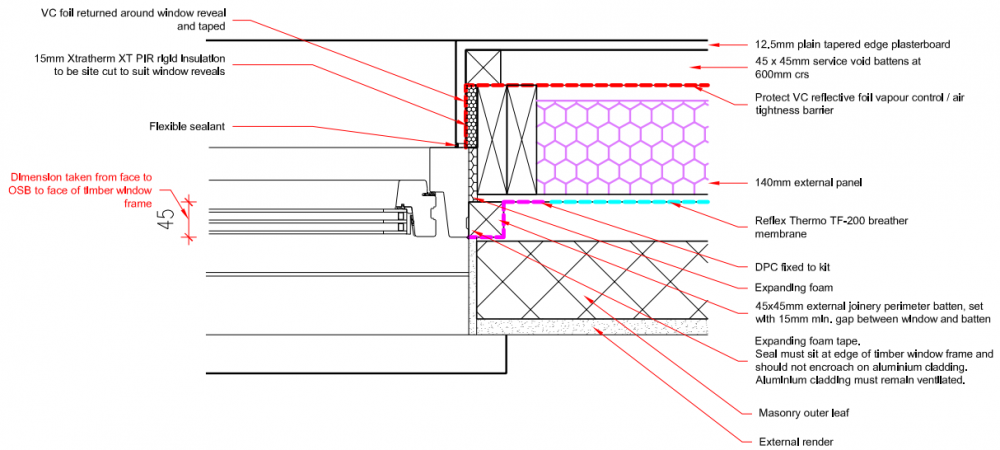
Or is it a better approach to have the frame fitted to a pinch timber/batten (rather than directly to the blockwork) the same way that the doors/windows are fitted to the main house?
-
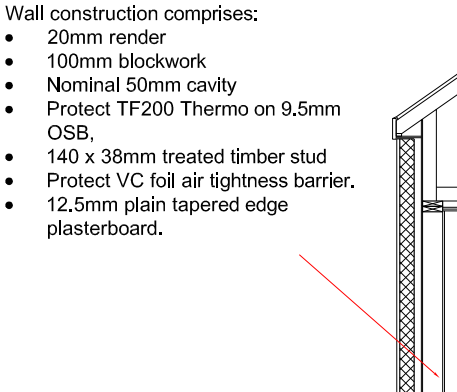
We're in the process of finalising our garage designs (timber frame with blockwork external leaf) and realised that the designer has specified openings which match the door size but did not take into account the frame width. This got me thinking about how the frame would actually be fitted. The wall construction is: My thinking at the moment is that we'll fit the metal frame direcly to the blockwork before applying the render extenally and then plasterboard to cover up the cavity and timberframe behind the frame (inside the garage). Does this sound about right? Anything I need to watch out for? Thanks!
-
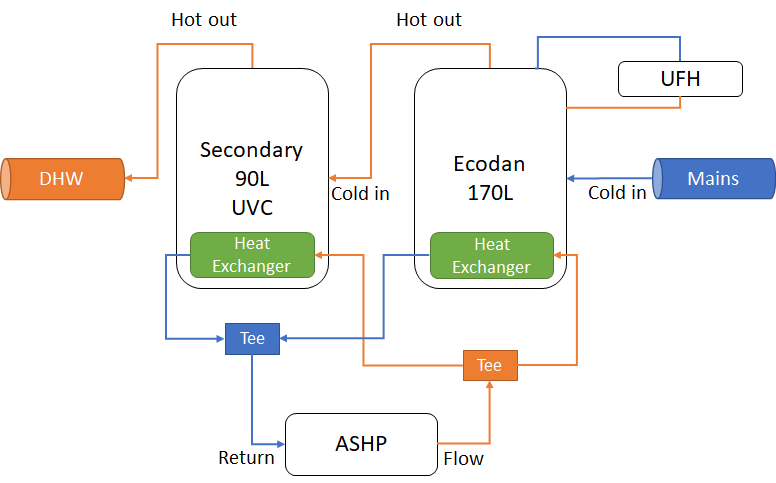
Nevermind - getting late in the evening ... I guess the coils can be in series as well?
-
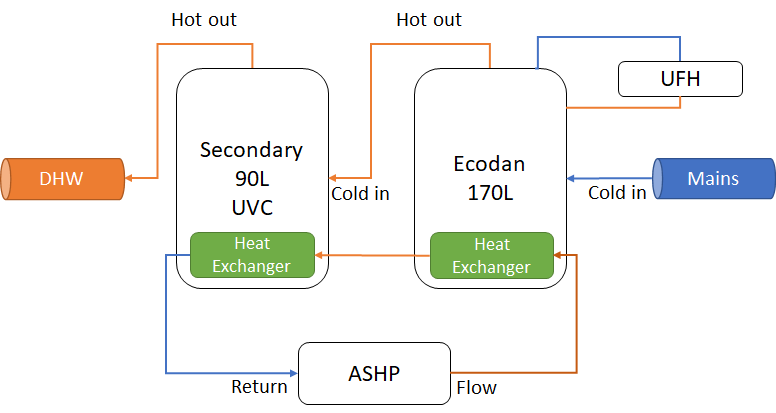
Might something like this work? No idea whether the ASHP can be connected to two UVC coils in parallel though ...
-
It's a dual-zone (DHW/Heating) cylinder so I imagine it is able to maintain them at different temperatures? It looks like a pretty complex piece of kit when compared to a "normal" indirect UVC: https://les.mitsubishielectric.co.uk/products/heating/domestic/cylinder/ecodan-ftc6-monobloc-pre-plumbed-standard-cylinder The white box is some kind of controller and there are separate pumps for the primary, DHW, and heating circuits.
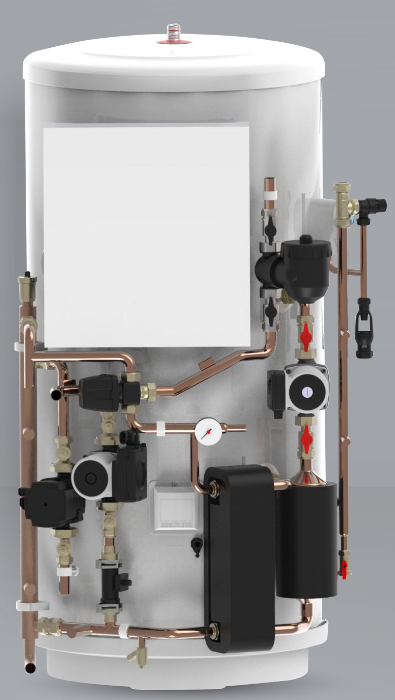
-
Maybe not - yes, physically it will fit but at least the ones I've seen seem to be only for DHW? The ecodan cylinder provides both DHW and heating circuits (UFH).
-
Unfortunately, no. I had been playing around with a model of the understairs cupboard which shows that it should be possible to fit in a 210L cylinder but the piping to/from still poses a challenge: The supplier mentioned that they could fit a 170L in the half-height space under the stairs so I was thinking of maybe combining that with a smaller (90L?) UVC. If it goes in series, I guess the hot water outlet from the ecodan cylinder would go into the cold water intake of the smaller cylinder with its hot water outlet servicing the actual demand? I guess the problem here is keeping the water in the second tank warm? Thanks.
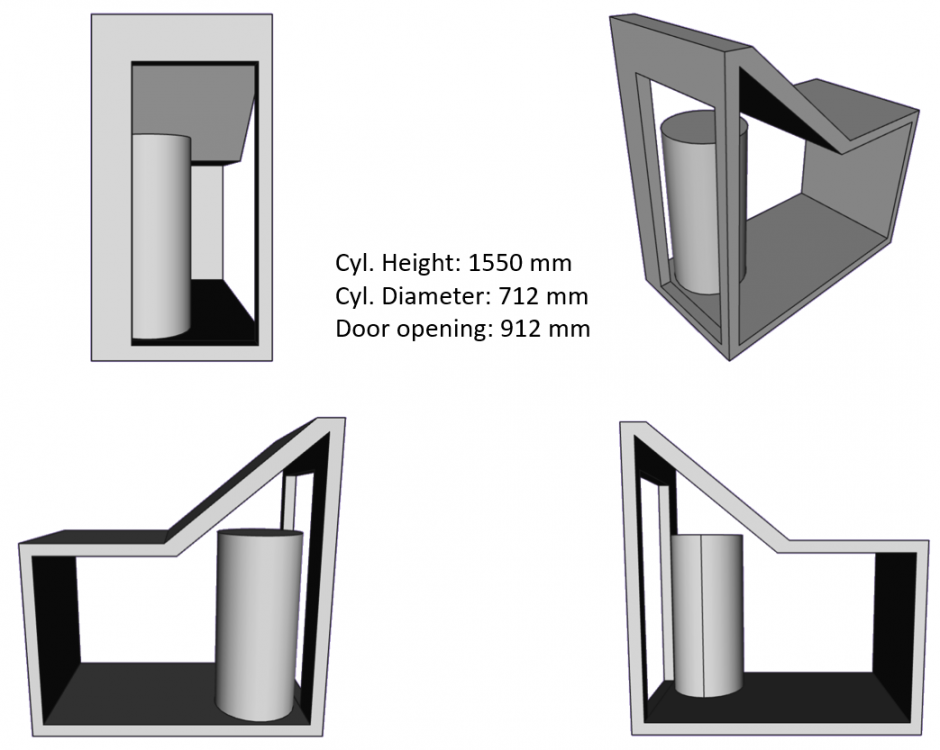
-
Thanks - good to hear that it might be possible.
-
@Nickfromwales - any suggestions regarding the original question? If I wanted to go with 2 cylinders rather than the sunamp kit? Thanks! They are but they contain an immersion heater for a weekly boost to 60 ℃+ to kill off any bacteria.
-
Hello, We are installing an ASHP system for UFH and DHW but have a bit of a challenge fitting in a reasonably sized cylinder. The space allocated for this is under the staircase but that's obviously presenting some height challenges. Speaking to the supplier, they think a 170L cylinder will fit given the height constraints but I was wondering if it's possible to have secondary tank in parallel to increase the overall capacity of the system? I have asked the supplier the question but haven't had a response yet. A quick search on the web shows that it's definitely possible for traditional boiler systems but wondering if anyone has done this for ASHP systems? We're looking at the Mitsubishi ecodan ASHP + preplumbed cylinder systems and the cylinders look pretty complicated with quite a bit of electronics on them. So I'm wondering whether it's possible to have the ecodan cylinder as the "primary" with another 3rd party cylinder as a "secondary"? Thanks for any advice on this.
-
Problem averted - apparently the efficiency of the ASHP was not factored in. With that included, it's now passing with "flying colours"... apparently... Many thanks for the suggestions nevertheless.
-
Sadly we're already there - getting services in cost us around £23k more than we had anticipated ...
-
@SteamyTea - our budget is already overstretched so trying to avoid adding on further cost as much as possible. The ground floor area is roughly 110 m2. Would additional floor insulation end up costing more than a 1kW PV system?
-
@A_L - it's the timber frame company that's dealing with the SAP assessor so we don't have direct contact. I've asked for the draft calculations so that I can see what has been assumed but haven't got it yet. @nod - it's part of the building warrant package that we get from the timber frame supplier so we're not engaging/paying directly.
-
Hello, We're preparing the SAP assessment for submission to building control and have been told that we are failing the carbon emissions target by a small margin. The assessor apparently cannot pinpoint the exact reason but has suggested adding on a 1kW PV system to compensate. I'm finding it hard to believe that nothing can be changed in the house design itself to meet the target. While I wait for the draft calculations to take a look myself, what are the typical factors that affect carbon emission and the strategies to deal with them? Thanks!
-
Good to know - thanks!
-
? I'll put up an ad for elephants in the local papers...
-
Brilliant, thanks @Redoctober!