


daunker
-
Posts
70 -
Joined
-
Last visited
Everything posted by daunker
-
Steel Barn conversion - metal composite roof
daunker replied to jen and mark's topic in Barn Conversions
I like the look! It was just its a real panic of mine to have the internal/external crossover. So glad to hear doesn't seem to be so much of an issue. Did you manage to put much external insulation on them - I'm reckoning if in a block wall you could only get the outer face - not the internals of the I which would have been blocked right up to it? But reading your post again looks like you managed to get all the way round the steels - which is interesting. Yes I'm class q too - bit of a headache!! Good idea on the central pillar -will be doing the same. I think I'm going to put insulation under the rafters but does mean losing height. Yours is looking fab - good luck! The mvhr systems I've seen I thought required drop ceilings and ducts to all rooms - but your vaulted ceiling is exposed - am I missing a trick for how to do it? -
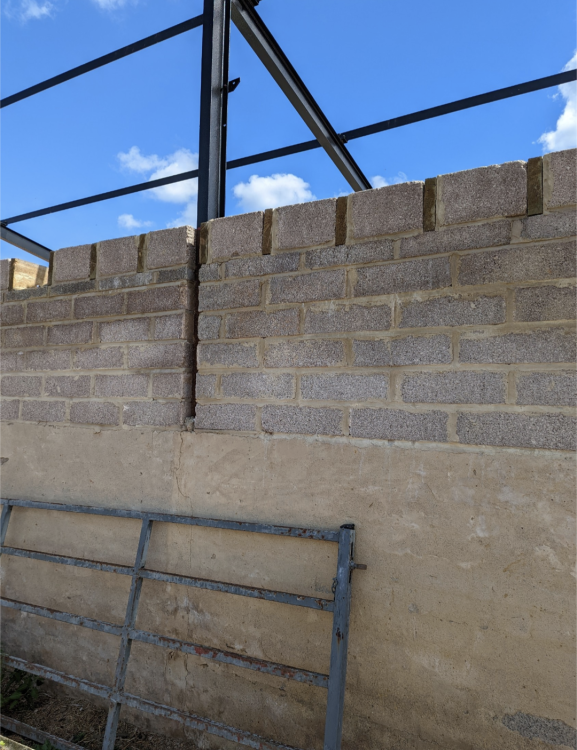
I'm about to start converting a block built milking parlour. Will be building internal walls with cavity from existing block, they will have dpc and the floor will have dpm and insulation then screed. However, there is an existing wall running centrally that I would like to partially keep. But it doesn't have dpc in it. Is this going to be a problem, is there anything I can do to it. I'm primarily concerned about damp, but not sure if any other problems, they are solid 140mm blocks laid flat if that makes a difference. Only a couple of courses from ceiling so would save me a job if I didn't have to take down, but perhaps be safer to start again?
-
I'm converting a steel portal frame milking parlour, the blocks have been laid flat on one exterior wall for strength. Currently has dropped ceiling and roof sheets off. I want to carry block to full height. Do I need to continue laying them flat or can I switch to conventional. Lower blocks are all 140mm too, but either way was wanting to go to 100mm. There will be cavity and interior block wall. If I can switch or 100mm laid conventionally is there any reason not to up the insulation in the wider cavity, was going to use pir boards
-
Steel Barn conversion - metal composite roof
daunker replied to jen and mark's topic in Barn Conversions
Very cool! You are well on with it, looks great! But I presume the stanchions are outside the insulation on the perimeter of the build? Are you going to leave the internal stanchions exposed, I guess no point in insulating them given the rafters are all exposed anyway. Looks an amazing space!! Be transformed once screed is down! -
Steel Barn conversion - metal composite roof
daunker replied to jen and mark's topic in Barn Conversions
How did you decide on doing the insulation in the end? I've seen your other posts saying the roof is on, but couldn't find reference to what you did. I'm just starting out on one, and was hoping to site the insulation between rafters with just a strip on the lower face that would have been exposed. -
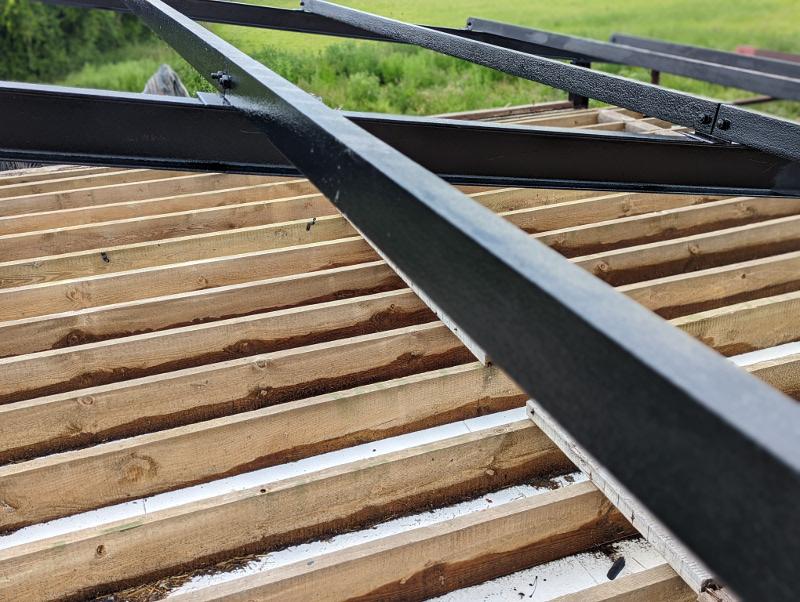
I am converting a steel frame barn, it is single storey and plan is to have vaulted ceiling - it is single pitch roof. Ideally I would put insulation below the steels, but once I build up insulation on floor height will be restricted on one side of property. So my hope is therefore - to sit insulation between the I rafters, and on the lower "exposed" face of the rafter to fix 50mm (or more) strip of insulation to break its contact. The steel beams have existing angle irons above - to which ply and zinc roof will be attached. Ceilings are to be timber due to likely cracking in wind load with plaster (Structural Engineer). The span between rafters centre to centre (and stanchions) is 4.5m. Span between Angles is 1.4m. The rafters have 130mm space in the I, so it would kinda be perfect for insulation. Just am not sure how it would be possible to support fix insulation and ceiling there with such wide spans. In my head I was visually celotex but perhaps there is something different/lighter/smarter that could occupy this gap, and maybe fixing (after a ventilation gap) to the underside of the ply for Zinc would work? Have thought about insulation above rafters (timber joists in between the I), however this keeps the steel within the thermal envelope at this point, but it leaves this zone as it bridges to the outer wall, which is outside and creates significant area for heat loss. Have attached photo- steels painted with zinc phosphate - timber rafters below support dropped ceiling supported on block - but this is being removed.
-
I rang them today actually (hadn't seen this topic), they gave me my reference number and the same spiel you got. They said that 4 weeks ago they were dealing with claims from the end of January, and so he said it was reasonable to think they were processing claims from end of February now. Mine is end March... not yet assigned. Yours might be now? Apparently as of 1 month ago the staff are all back in the office which he said should help significantly due to paperwork burden more efficient in office etc... If anyone else has any insight would be welcomed... it's a long old wait!
-
Thanks Mark, is structural engineer the go-to guy for this, or could I get advice from elsewhere? The slab was built to good spec, and was done mid 90s but is not reinforced. We are heavy clay here, but I don't know what is underneath the slab, there is a corner I could excavate would that help?
-
I have a steel portal barn for conversion for conversion to house. The external walls and steels are to be retained. The slab has a fall on it (used to be milking parlour), I presume I would be ok to build inner cavity wall, and internal walls on a sloping pad? Or do I need to do something about this. I hoped building walls on it and then I could level it with something prior to dpm and makeup of insulation and screed on top. However in the other half of building the foundation steps up about 5". I would be keen to lower to match as this side would otherwise be v low and have a step in house. However here the external wall 6" block is built up on the slab I'd like to cut and remove. Is it possible/realistic to cut and break this out- with the external wall remaining in place and then tie in to new foundations? I have asked structural engineer but he's away this week, and wondered if others on here had come accross. Thanks!!
-
Thanks very nuch. Any drawbacks to sealing it, is there a good product? As it's in situ I'll only be able to do the front face. Will it stop leaching on its own accord, or is that a very slow process. Any advice on cleaning will rain and sun bleach and wash it or is there a recommended cleaning agent. Sorry for all questions thanks @nod. I'd not heard of it before or I'd have not put up untreated, I thought all the coatings were to colour preserve from sun bleaching (which doesn't overly concern me)
-
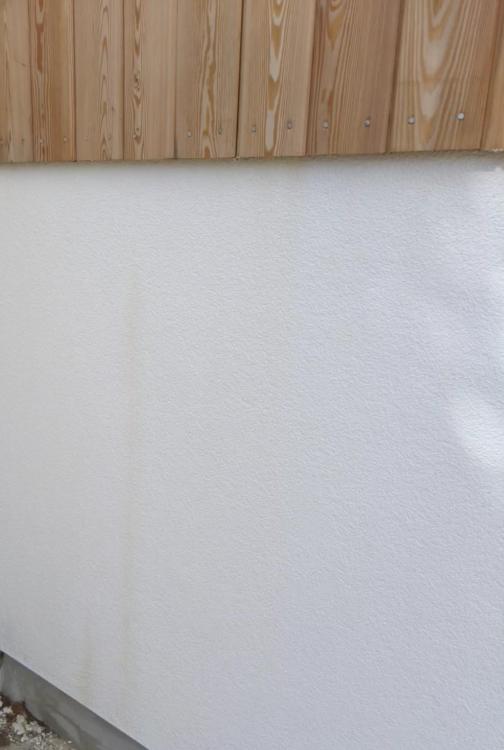
I have untreated Siberian larch cladding and just had the renderboard below rendered a couple of weeks ago. The larch was put on in April. Anyway just had some rain and seems like the water running down the cladding is staining the new render below. This is only after two rainy days... Really worried how this will look by end of winter? The rendering is thin coat system. Is there anything I can do to stop this happening, and secondly to clean if presumably I can stop it.
-
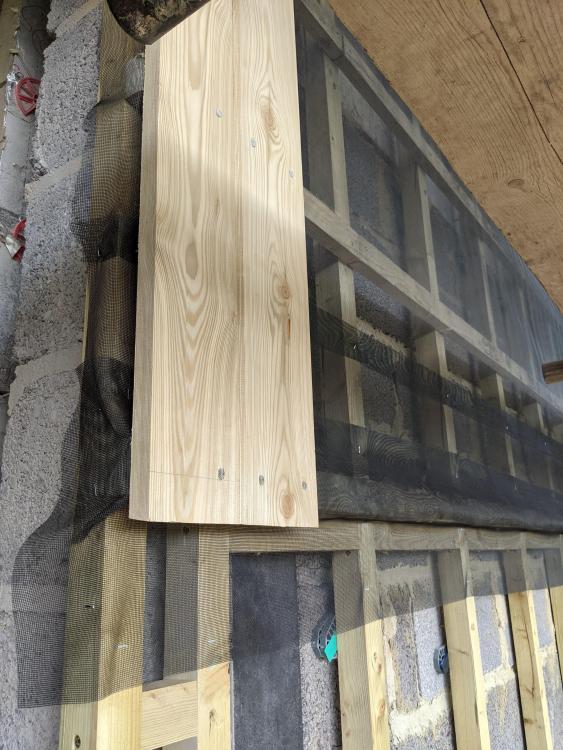
The reveals are only screwed on so easy to replace. To get this right by the sound of it I need to: 1. Replace silicon around reveal and window edge with expanding foam tape. 2. Between window frame and blockwork where currently there is expanding foam, to make weatherproof with? 3. Recess the reveal top and sides and oversail the cladding. Left the carpenters to it- as they've done cladding a number of times before. Sorry I am mistaken I have found some photos of install.. pleased to confirm it is counter battened think it is just the bottom timbers at base of cement board that had holes drilled for the ventilation/drainage.
-
-
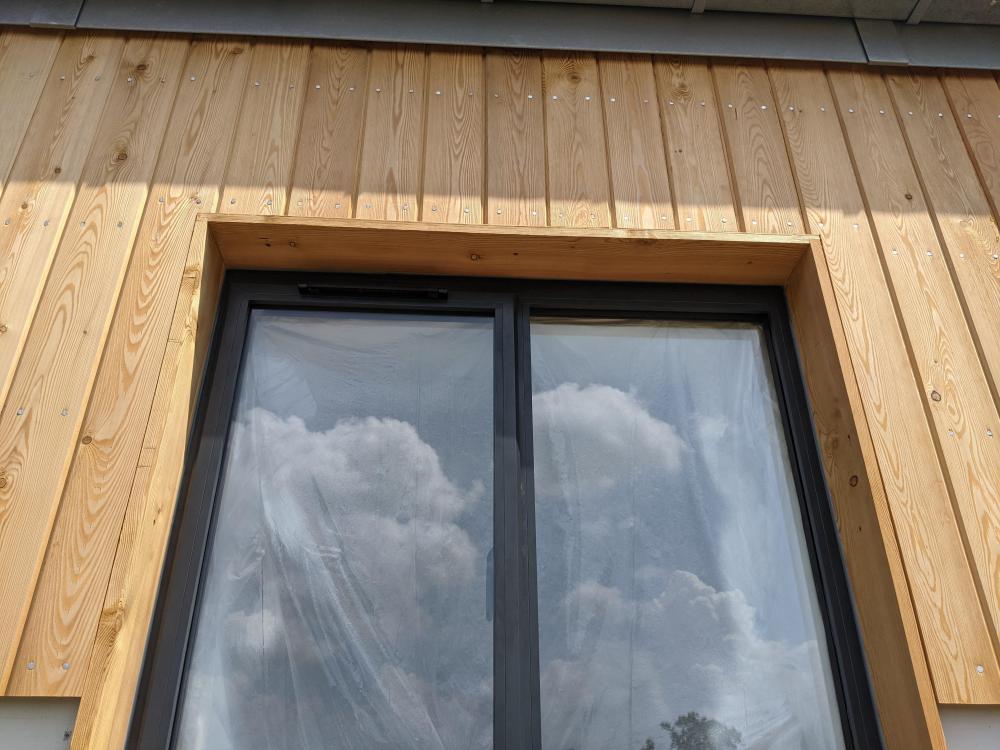
I've Siberian larch cladding and reveals, but now it's up I'm concerned water could run down the cladding, particularly the grooves and hit the reveal where it might track back towards the building and window. Just wondered what my options are here, I do have extra larch, so could have it oversail the head but was also thinking I could put drainage holes in the reveal or could plane back the reveal so that the cladding is further out Or could fit a metal drip (zinc as per roof) above the reveal or any suggestions/recommendations very welcome..!
-
Thank you everyone, really appreciate the responses! ?
-
Hi! Like many my windows are massively delayed. The plasterboard is going up but the plasterer doesn't want to skim any walls with window or door openings at all, because he says it will be impossible to get the reveals right, and also if the skim stops short it will be hard to patch in later and get a smooth finish, and will also be v likely to crack along join. I'm sure he's right but just wondering what others have done in this position, as I'm keen to press on with as much else as possible, decorating skirting flooring etc. Are there any hacks?
-
Vaillant ASHP non RHI Install possible?
daunker replied to daunker's topic in Air Source Heat Pumps (ASHP)
It's paying the full cost now and then getting reimbursed over 7 years, it will take a few years to be in a better financial position. I would rather save the money now if it was £3-4k as I have a more pressing cash crunch than I would have in a few years time. I take your point, but without going into it, in my situation I also might not be eligible for rhi. So just exploring alternate options. -
Vaillant ASHP non RHI Install possible?
daunker replied to daunker's topic in Air Source Heat Pumps (ASHP)
Thanks so much for coming back so swiftly, I have read a few topics of self installed, but they were using older models and also a few years ago. I guess my question was if I don't use an MCS accredited rhi installer- what level of competency is required for install. Is it something a good say oil central heating installer can turn their hand to? -
Hi! Long time lurker. Midway through build at the moment, and ASHP quotes are coming in super expensive - they are also coming in at different sizes! And generally don't seem to know much about what they are selling. So I am wondering is it possible to avoid the RHI altogether and go for a self/plumber/heating engineer install. I've watched the Vaillant youtube videos and it rather looks like it is plug and play. So a plumber and electrician used to heating systems should be able to do it? I'd probably rather a cheaper up front cost than receiving the RHI over 7 years- provided it is a reasonable saving. So far, I've had a 14kW, 13kW and a 5kW recommended... The house is single storey, built to building regs (wall 0.24 floor 0.1 roof 0.15 u values) with not excessive windows. I suspect air tightness isn't great, and the ceiling is vaulted so a bit of extra volume there, but I just can't understand why two such massive ASHP are being spec-ed. Also the quotes are fairly wild. I've downloaded @Jeremy Harris v helpful calculator and put in my figures, getting a heat loss of just around 5000W @ -10 degrees outside and 20deg C inside. To my mind that shows heating requirement, and bearing in mind outside temp of -10 for the calculation, surely a smaller say 7kW Vaillant would be more than sufficient? I'd also like a 300l cylinder, as it is a 4 bed, albeit one shower is electric. I can pickup the Vaillant easily enough, and it seems very capable unit. Surely the install cost can't be £6-7k, or that complicated? The youtube videos make it seem that it is really just connections that need to made to get it going...


