


MortarThePoint
-
Posts
2294 -
Joined
-
Last visited
Everything posted by MortarThePoint
-
I'm still pulled in two ways on this. If I could be certain they were installed correctly, I think I'd go with the Knauf Dritherm Ultimate fibre batts as they are more 'normal'. Blown beads could give a possible future purchaser concerns since there have been horror stories associated with their retrofit use. I like the labour saving of the blown beads and the fact that it wouldn't need the constant monitoring of how the insulation is installed that fibre batts would require. That said, if they mess it up on the day of blown bead install then it would be a nightmare. These decisions often come down to minimising the downside rather than optimising the upside. Maybe that sounds a big 'glass is half empty', but you don't get giddy about your cavity insulation being slightly better than it could have been, but you would get sick of it being a lot worse.
-
Garage/Workshop Fantasy Time
MortarThePoint replied to MortarThePoint's topic in Garages & Workshops
I watched the US video below that talks of locally thickening to 6", ie 150mm. As we are having an insulated floor I'll need to double check though. https://www.bendpak.com/car-lifts/concrete-floor-requirements/ https://www.gregsmithequipment.com/2-Post-Lift-FAQ-Concrete -
A moderate saving then, but worth having
-
Everywhere they were supposed to or coming out and making a mess? Good to hear some positive experience with the product.
-
I've seen videos of installers tweaking the glue recipe, so it doesn't seem an exact science. Voids and or settlement are concerns and you wouldn't be able to see if they had happened.
-
I guess so, but brickies who make no concessions to the the approved installation method wouldn't save much time if not fitting them.
-
I was surprised, but the beads installed seem the same price as just the material cost of fibre batts.
-
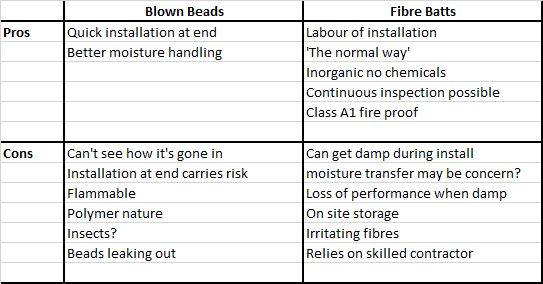
Well I thought I knew exactly what we were going to do for cavity wall insulation years ago, but just before placing the order for the fibre batts I (re?-)discovered blown beads (Ecobeads). I don't know if the Ecobeads have got better in the last 2-3 years since we decided on Knauf Dritherm Ultimate 32, but they look quite attractive. I got some quotes and the price for Ecobeads installed is essentially the same as the Dritherm material cost. I'm finding it difficult to make up my mind now. Some pros / cons: Kingspan did a white paper on fibre batts and, whilst they have a commercial interest in knocking full fill insulation, they do make some good points. I haven't seen many sites, but I don't think I have ever seen people installing fibre batts as set out in their BBA documents. Outer leaf first, snot boards and properly orientated batts. I have seen loads of YouTube videos of clearly skilled brickies who don't follow much of this and if you look carefully are dropping and leaving snots on the batts. I don't want to be a nightmare for my brickies breathing down their necks and insisting they work in a way they don't normally, but I'd want fibre batts installed as per the BBA certificate as otherwise there can be a loss of performance even if not an actual damp problem. There were loads of bodged blown bead installs for retrofit, but I'd expect that is due to narrow cavities as well as other unsuitability issues. I don't like the thought of them and any future work could mean beads blowing about for years to come. I also worry about insects living in them as I have seen that with PIR insulation. There is also a lot of faith in that one day of install. If the installer is a joker then you're stuffed whereas a more gradual install can be understood and rectified much more easily. We're building in East Anglia so it's the best part of the country for fibre batts, but still. Blown beads feel like a no brainer for large cavities (e.g. 200mm or more) but I'm not so sure for us (100mm cavities). Your help and experiences please making this decision would be massively helpful.
-
Bit late to the party here, but our Structural Engineer specified Kingspan GG300 for our garage as it has higher load bearing It has Compressive strength = 300 kPa (at 10% compression) https://www.kingspan.com/gb/en-gb/products/insulation/insulation-boards/kingspan-greenguard/kingspan-greenguard-gg300
-
Garage/Workshop Fantasy Time
MortarThePoint replied to MortarThePoint's topic in Garages & Workshops
Thanks, good timing to have he input as we haven't poured yet so still an option to change. -
Are you sure they count as an AAC block? They aren't foamed concrete, but are an aggregate block. The aggregate is foamed/aerated though: "Expanded clay nodules are produced by sophisticated pyrogenic technology whereby geochemically specific clay is expanded in a rotary kiln at high temperature." but it claims to be "Class 1 aggregate as defined in BS 5628 -3"
-
I'm thinking of swapping to Fibolite blocks. When I first heard of them they sounded a bit 'high tech' for my reasonably traditional approach to the superstructure. I was also wary of cracking concerns having heard of it associated with other thermally performant blocks. Whilst Fibolite blocks help with U-values, the absolute requirement in my mind for the blocks to perform their structural role and I'm not wanting to make any sacrifices there. I'm sure like all self builders, I want my house to still be standing in a couple of century's time ?. What do people think, does anyone have anything to say against Fibolite blocks?
-
They're leaving some gaps in the blockwork like this. Will be harder in the 140 blockwork mind you
-
Surely shouldn't need to bother the Structural Engineer for this as the lintels are only 600mm long?
-
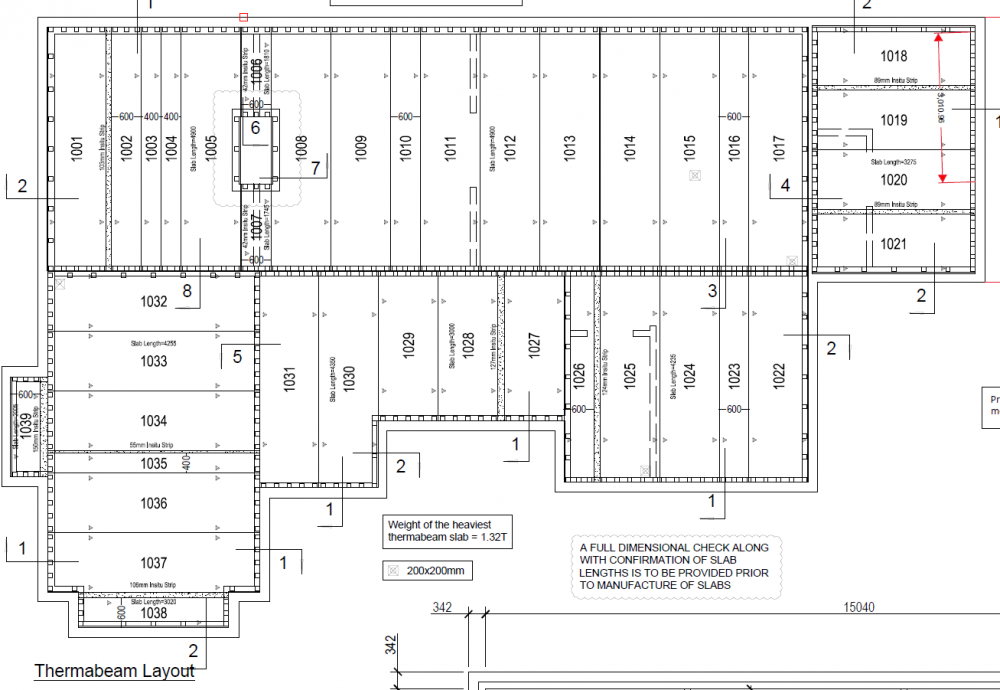
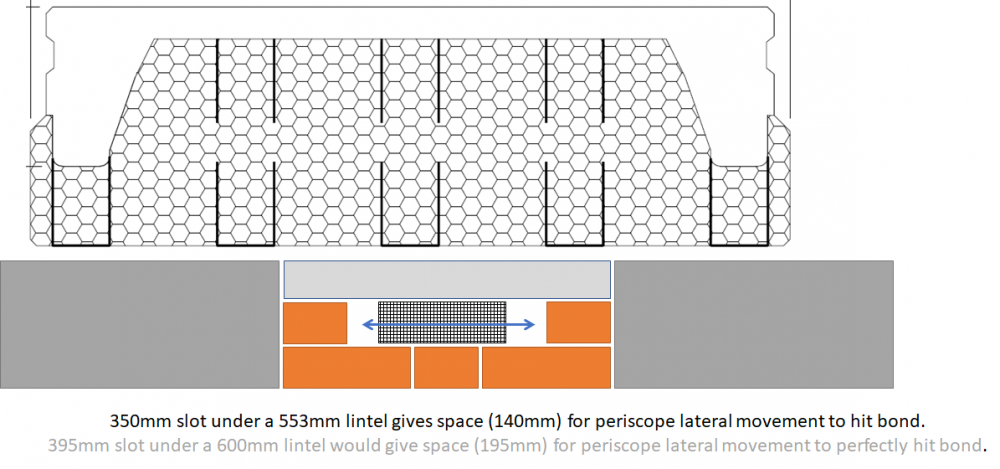
I have asked them for a detail for this a number of times over the last few months and only had words back "Support is required at bearing level above the opening for the vent." I take that to mean there must be a lintel. The sides have pillars to and whilst in theory you could plan them not to clash (as 600 c/c) that could easily go wrong and present a bigger problem that is only discovered late in the game when the slabs are being fitted (all in a day)
-
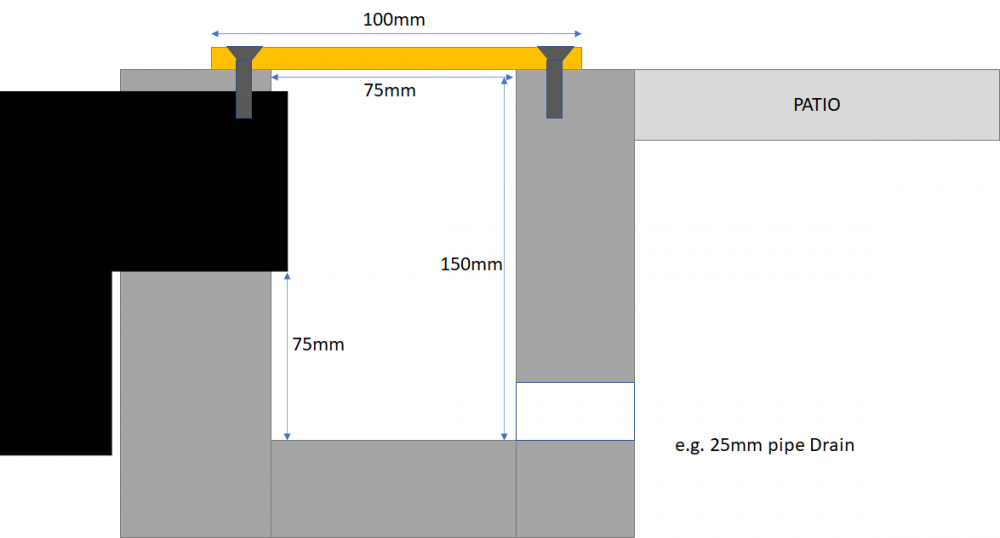
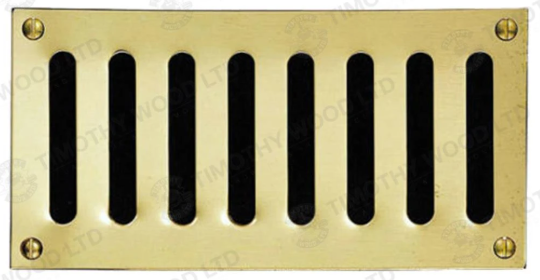
Not sure what the correct forum protocol is here (new thread or use old one) but I am facing a similar issue. Is it not possible to have the vent sunk down in a box with a horizontal grate over the top as long as the box can drain? Obviously it would be a problem if the drain pipe blocked and the top was open to rain. We are working out how to get vents in to our porch whilst having level access. The porch has a roof. I'd like to keep the ability to have a level patio at the back too don the line. There are lots of vents along that elevation so... There'd be mesh under the brass vent plate shown screwed over the box.
-
We're using a slab flooring product that has support pillars moulded in that have to bear on something. Cavity concrete fill comes up 200mm then there is only one more blockwork layer until the floor slabs.
-
Your probably right, but they need to be linteled anyway
-
Working out the bond:

-
Will be good to use if I mess up by bond calculations ? What ducting did you use with that?
-
Nice ideas. I think I'm trying to get them on bond and putting them in a 350 or 400mm slot to allow adjustment.
-
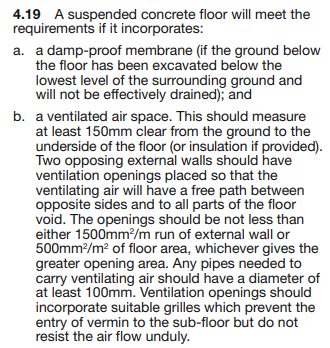
Building Regulations Part C says that for "SUSPENDED CONCRETE GROUND FLOORS MOISTURE FROM THE GROUND" But sets no c/c requirement
-
Well it pays to be looking at the most up to date documents. NHBC had changed their wording since 2011 (I've added the highlight):
-
I'm intrigued. Are you just testing your pipes are watertight? If drainage they shouldn't see any real pressure unless blocked should they. There are worse days to have had a soaking on
-
Drainage lintel strength and bearing
MortarThePoint replied to MortarThePoint's topic in RSJs, Lintels & Steelwork
It's not block and beam but a slab based flooring. It would be bearing directly on the lintel of the inner leaf and chances are only one of the two.



