Thorfun
-
Posts
4891 -
Joined
-
Last visited
-
Days Won
36
Everything posted by Thorfun
-
Did you use plastic back boxes in your house? Or galvanised steel? I don’t remember reading either way on here.
-
Cheers. I want to stay away from the plastic boxes. Just don’t like them! Had a new build before this self build and the tabs broke off and didn’t seem like they’d last.
-
Yep. Don’t worry, I am definitely shopping around. I’ve found that T&E at SF is really cheap when compared to electrical outlets and even online sellers. So I’m stocking up.
-
I will ask him tomorrow. I always feel guilty sending him a message this late at night but the lovely folk on this forum are around at all times of the day.
-
I’m up to about £500 so far so could be a nice little saving. im sure LAP and Appleby are known brands and not own brands though, right?
-
I've got a 10% off voucher for Screwfix so I'm filling up on bits for our electrics first fix. Got the Prysmian cable in the basket and now looking at back boxes. on the advice from @ProDave I have a 25mm service cavity and so a 35mm back box will fit perfectly in it with the plasterboard. so..... LAP at £0.51/double box https://www.screwfix.com/p/lap-2-gang-galvanised-steel-installation-boxes-35mm-10-pack/88287 with a bulk buy or Appleby at £0.58/double box https://www.screwfix.com/p/appleby-2-gang-galvanised-steel-knockout-box-35mm/42695 with a bulk buy I know we're talking pennies here but at the stage I'm at they all count! is the Appleby a better back box or is there no real discernible difference? I will be labouring for our electrician for first fix so need to be suitable for a special boy but I don't want to pay the extra £3.50 or so for the Applebys if there's no benefit. but I will also take the responses to this question on to the single back boxes for network ports so the savings could increase. damn....I feel really cheap even posting this question! 🤣
-
I'm kind of loathe to put them outside to be honest as we're surrounded by trees and anything that's outside for more than 5 minutes gets spiders on them making webs! plus, I don't really have anywhere out of direct sunlight to put them that doesn't spoil the external facade of the house. even if I built a shed for them we have hornets, wasps, bats, spiders that like to nest in our existing shed so, again, kind of loathe to do it.
-
don't worry....I've been wrong many many times before
-
I'm sure you'll get it right this time. 🤞
-
I have enough space in the comms room to fit my proposed expansion plans near the CU. space is tight but I can make it work. I've sent an email to the supplier to ask for assistance and am awaiting a response. I'll chase it up soon if I don't hear anything back. it just seems such a waste to have a long cable carrying electricity back and forth between the batteries in the garage and the CU in the basement. that's why I thought having the batteries next to the CU would be best. but, it appears that those potential inefficiencies won't manifest themselves and so I guess my decision comes down to safety and convenience! good point about the concrete wall storing the heat though. I hadn't considered that.
-
thanks. the electricity is converted to AC by the PV inverter in the loft so I don't have to worry about that apart from the upsizing of the cables. the plant room for my electrics is pretty much a cupboard. it's about 1.7m x 1.4m and will also have my Loxone cabinet, CU and network/server rack in it. so that room will get warm but it has an MVHR extract in it and 3m high ceilings so I'm hoping that the warm air will rise to the ceiling and get extracted! plus it's underground so will be cooler than elsewhere in the house. then again, maybe the garage is the best place for it, just not in the cupboard. I've got loads of space there. ahh man....I just don't know and I've so many other things to think about as well. this self-building malarky is tricky when you're winging it! 😂
-
our meter is 25m from the plant room in an external cabinet on the boundary so I hope I don't have to run the CT back to the meter! will speak to the electrician about it next week when he's here.
-
thanks Nick. so I'll forget inefficiencies, that's one headache down. the garage is attached to the house and is timber frame whereas the basement is concrete. from a safety perspective would it be better in the basement rather than garage or am I ****** either way if they combust?
-
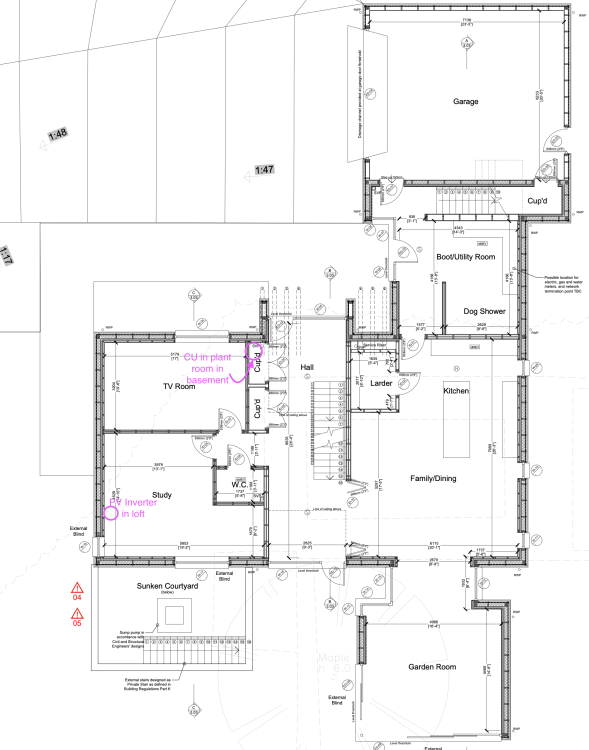
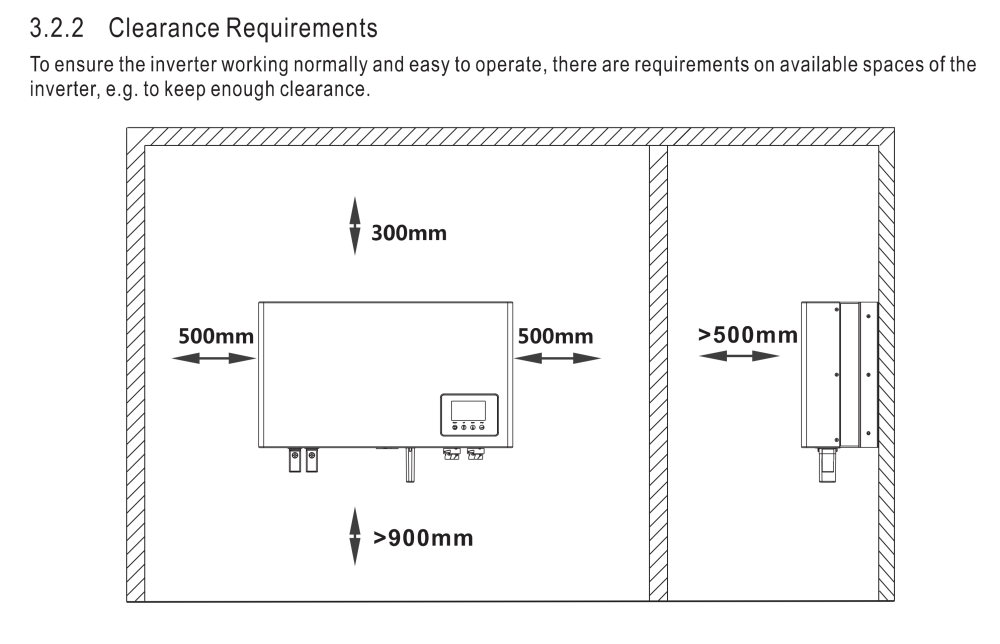
as the title says 'where do I put my battery storage?'. I have a few options and I want to ensure I choose the best place for safety, performance and expandability. I have a LuxPower Squirrel POD inverter and 2 x Greenlinx 3.2kWh batteries at the moment but plan to potentially add more batteries and another SQPOD in the future to expand the system. The batteries are LFP(LiFeP04) cell type (which I believe is the safer of the Lithium Ion battery chemistry) and are IP54 rated. the inverter is IP65 rated but the instructions say to not expose to direct sunlight, rain or snow. so basically if installed externally to keep it covered. Below is a plan of the ground floor of our house. I have marked up the location of the PV inverter in the loft and the CU in the plant room in the basement which is approx 20m cable run from the PV inverter. I was originally going to put the SQPOD and batteries in the Cup'd in the garage but was concerned about the loss of efficiency running all that way from the PV inverter and then back to the CU in the basement. Also it's quite a small cupboard and the MI instructions for the SQPOD states the following clearance requirements so it might be a bit tight: I could put it in the garage which has a lot more space but, again, surely some massive inefficiencies for running the cable that distance. so, now I'm thinking of putting it in the electrics/comms plant room in the basement so it's next to the CU. but I'm now worried about safety and the potential for Li-Ion fires. the basement is built from waterproof concrete and has B&B above which will, eventually, be covered in a 50mm liquid screed. Am I worrying about nothing and is that the best place for it? I could, I suppose, build a shed for it externally but that seems a little excessive and also how will the temperature fluctuations of the outside world affect the performance of the system? the basement should be a constant temperature and even in the recent heatwave it never got above 23°C and we haven't even finished the insulation/airtightness yet. any comments on this please?
-
LSZH SWA cable is cheaper than PVC...am I missing something here?
Thorfun replied to Thorfun's topic in Electrics - Other
yeah. cheers. plant room is in the basement so it's surrounded by concrete. I think I'll be ok with the cheapest option there. thanks for your help on this thread. it's really appreciated. -
LSZH SWA cable is cheaper than PVC...am I missing something here?
Thorfun replied to Thorfun's topic in Electrics - Other
that all makes a lot of sense, thank you. yeah, our SWA is basically around 90% - 95% in the ground. 1m above ground in the cabinet and, at most, 2m in the plant room, then around 24m - 25m under ground. -
LSZH SWA cable is cheaper than PVC...am I missing something here?
Thorfun replied to Thorfun's topic in Electrics - Other
if it was your place would you spec LSZH over PVC regardless of the cost? -
LSZH SWA cable is cheaper than PVC...am I missing something here?
Thorfun replied to Thorfun's topic in Electrics - Other
and interestingly for the 5-core SWA the PVC is cheaper than the LSZH. it just makes no sense to me. 😭 -
LSZH SWA cable is cheaper than PVC...am I missing something here?
Thorfun replied to Thorfun's topic in Electrics - Other
I spoke to our electrician and he has done the voltage drop calculations and concluded that 25mm SWA will suffice which is great. he also said that although we officially only need a 16mm earth he’d just go 25mm because of the poor earth loop at source we have. he's suggesting 25mm 5-core SWA now so that I don't have to run a separate earth. still doesn't answer my question about LSZH vs PVC though! 😉 -
yeah, sorry. I know the PWs do work in a power cut (I believe you're referring to the Gateway) I was more asking about requiring DNO approval for 2 x PW2. as I thought that just some installer saying they will limit export wasn't enough for the DNO. which @Dan F has confirmed is required. again, sorry for my error. I know they don't export, that wasn't what I meant! I meant that even if you told the DNO that the PW2s were isolated they still need approval from DNO. I know that my proposed PW2 required to be part of our G99 application.
-
you can get 2 x PW2s installed for £16550! wow. that's a good price. I was quoted £9500 inc VAT for one. I'm definitely no expert but I would've thought that with the PWs having the ability to export the DNO wouldn't like that and does that also mean that you can't use them in a power cut? if not, have you considered DC batteries instead of the AC PW2?
-
https://www.ebay.co.uk/itm/333714806299 can't get much better than this stuff. £8.75 a can from this seller on eBay is where I got mine.
-
Choosing an architect for a low energy (passive?) new build
Thorfun replied to WisteriaMews's topic in Surveyors & Architects
I think that you're favoured architect you have a good working relationship with using an external consultancy for the Passive House work is actually a good thing! I'd much rather a professional admit when they don't know something and get someone in that does than try and muddle through and wing it. knowing your limitations and when to ask for help is a great trait and I applaud the architects for taking that approach. -
if you don't go the Tesla PW route you could get 2 x Squirrel Pods and 25.6kWh battery storage for approx £14k +VAT (parts only and approximated by doubling a quote I had for a 12.8kWh system). that will give you 7kW charge/discharge rate which is better and cheaper than 2 x PW2s. 😉
-
we have friends that did just this as they had a silver membrane outside the TF which would've been visible through the open cladding. they spoke to the manufacturer of the membranes who said it was ok to do. if you're going this route then speak to the relevant manufacturers to make sure their products are ok in this situation.