


JulianB
-
Posts
85 -
Joined
-
Last visited
Everything posted by JulianB
-
Old Cottage Restoration + Extension Project
JulianB replied to JulianB's topic in General Self Build & DIY Discussion
Yeah…it definitely isn’t for the faint hearted…and hopefully it won’t be our downfall! We do intend on addressing all issues with the cottage at the same time; stripping back walls to bare stone, installing French perimeter drains, upgrading windows, floors etc. What we’ve tried to exploit when proposing this extension is the lay of the land; from the front to the back of the cottage, the land falls away quite significantly (and continues to fall passed our plot)…the existing extension (which sits on the back of the lodge) is higher than outside ground level by up to a metre, and already incorporates a 1metre drop in FFL relative to the original lodge. Our plans are to bring that FFL in-line with the lodge, which buys us an extra metre prior to looking for that additional storey beneath. We will then excavate half of the rearward elevation, to a depth of ~1.7m which will get us to the underside of the floor slab (granted trench foundations will be deeper than this by quite a bit). The footings of the cottage are 0.95m in the two test digs I’ve performed, which would leave us with a further 0.75metres. Our SE has spoken about excavating part of the internal floor space of the lodge to avoid the need for the underpinning to also be retaining, however we are still working on a solution which wouldn’t result in the front wall needing underpinning. At present the underpinning will span just over half of the rearward elevation (~5metres) and slightly round the corner of that portion of the lodge, which isn’t too bad. Most of the new extension should be above ground (to keep tanking to a minimum). The proximity of the trees doesn’t help either…but then again all these factors are what enabled us to buy the cottage at a price we could afford. -
Old Cottage Restoration + Extension Project
JulianB replied to JulianB's topic in General Self Build & DIY Discussion
Morning John! Yep, PP obtained to convert into the scheme on pg1 (subject to the Building control drawings). We're still waiting for the building control drawings to get accurate quotes from the builders we have approached, however they have given us very rough estimates to get us to shell afterwhich point we will most likely take over...we'd also be looking to tackle the demolish and a few other aspects ourselves... -
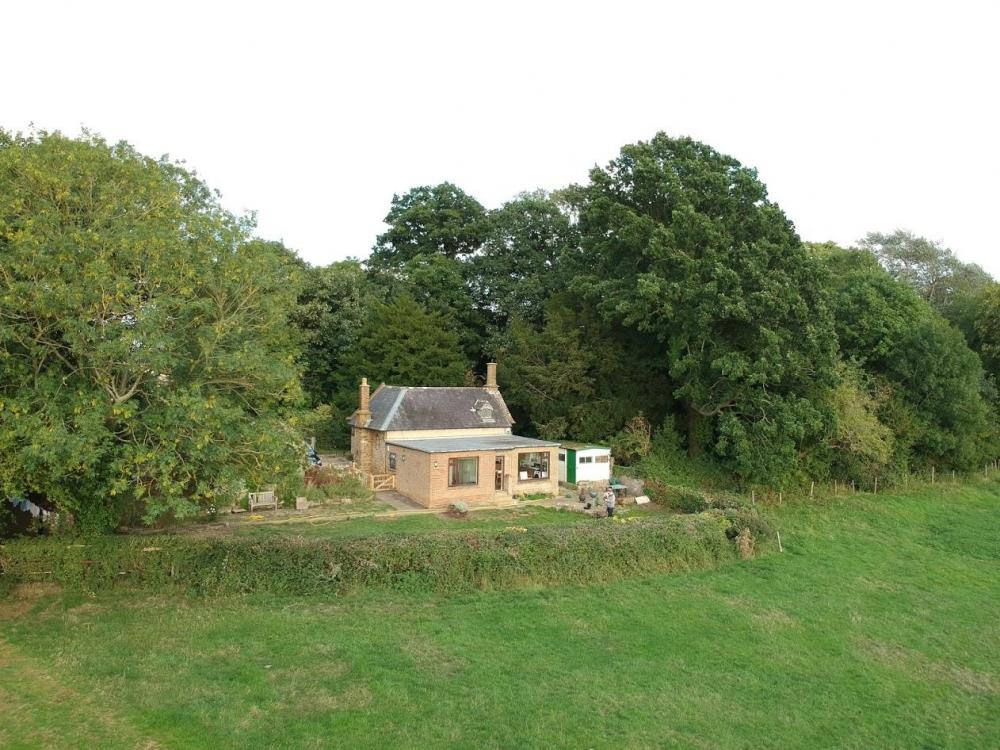
Thanks for that! On E7 it does sound like a worthwhile route to top up with immersion...Are people using any particularly smart controllers on their immersion to take into consideration factors such as outside air temperature, as presumably passed a certain threshold it pays you to top up the final delta T with ASHP rather than immersion? Interesting point re. newer showers...very odd that anymore would design in something like that! I would be keen on exploring solar PV, but I'm not sure that we have the budget for it at the moment, and we're in a conservation area + listed building so I'm not really holding my breathe (plus we've got a few trees around us...see attachement..photo taken from the west). I would happily take 3.5-4 CoP... I don't suppose you have any recommendations on ASHP brand/model...as I'd be keen to have a look at some sort of COP vs flow temperature chart to begin to understand their relationship (although I don't suppose they are 'real life' numbers, once you factor in your particular annual temperature/humidity trends?)
-
Old Cottage Restoration + Extension Project
JulianB replied to JulianB's topic in General Self Build & DIY Discussion
i thought there was a maximum depth of 0.75m that a field drain could be...if I can go to 1m and not have any adverse affects from the cattle it would be brilliant! Only other small issue is that there will be a festival (Fairport) on 1st a year so maybe a coupe of caravans, although I could probably lay along the boundary line to avoid the chances of traffic... -
Thanks for that! I've read that anything above 45degC really penalises an ASHP's CoP - I'm thinking to either use it as a buffer and then use an additional source to get it to the typical 60 odd degC, or potentially contemplate DHW @ 45degC (I've read that some have no problem with this temperature?) ...legionnaire disease aside
-
Old Cottage Restoration + Extension Project
JulianB replied to JulianB's topic in General Self Build & DIY Discussion
Thanks, I ll have a good look through the regs. My only concern re the cattle if we weren’t able to purchase some one off him would be the cattle traffic (hoof traffic?) compacting the ground and leading to issues with the drainage field ? -
Old Cottage Restoration + Extension Project
JulianB replied to JulianB's topic in General Self Build & DIY Discussion
Thanks for that. What dimensions would you like me to include...the current distance from septic tank to our nearest boundary is 7 metres (east on drawing). Yes I would tend to agree that there would be no space what so ever for an infiltration field. I've had a chat with the friendly farmer and he seems open to the idea of striking a deal to place a drainage field in his land...however there are cattle around for most of the year, so that seems like a dead end. Not sure what sort of floor area a bore hole occupies, but thinking this could potentially be an option? Only other thought that pops into my mind is us actually buying some land of the farmer (if he was willing) and then place a drain field on that...from chats with afew suppliers, it seems anything from 50-100m^2 would be needed -
Evening All, Thought I'd revive this topic as I'm looking at sizing my ASHP! I've used JHarris's workbook to estimate the heat demand for our old cottage with proposed extension (I've weighted the wall U values from each type of wall construction to maintain the book's simplicity). I've assumed that I'd be able to get to an ACH of 2.5 (or better), and am targetting internal temps of 21degC. Based on minimum daily OAT stats, it looks like Jan will be the greatest CH demand. Using the same methodology as pg1, this gives me a 6kW ASHP requirement, without any safety margin, or any overhead for DHW (& assuming the ASHP is on for half the day). The question is, what should I be apportioning to DHW, given that currently I have no other means of heating this up (other than the immersion?). Also could I ask if it is common place for people to hook their ASHP up to a storage tank, which would then feed either CH or DHW, and avoid the unit switching on and off more regularly? I also quite like the idea of circulating the UFH at specific times of the day to help exploit solar gain in parts of the house. Any suggestions on units people have found to be reliable / good performers would be greatly appreciated! Heat loss through the year, using Met Office historic climate data for the location January February March April May June July August September October November December Mean daily OAT for each month (deg C, from Met Office) = 4 4 6 7.6 11 13.8 16.4 16.2 13.6 10.2 6.6 5 Mean daily delta T (deg C) = 17 17 15 13.4 10 7.2 4.6 4.8 7.4 10.8 14.4 16 Mean minimum daily OAT for each month (deg C, from Met Office) = 1.3 2.4 5.2 4.3 7 11 13.9 13.2 10.4 7.5 4.3 3.7 Minimum daily delta T (deg C) = 19.7 18.6 15.8 16.7 14 10 7.1 7.8 10.6 13.5 16.7 17.3 Days in month = 31 28 31 30 31 30 31 31 30 31 30 31 Mean OAT daily ventilation heat loss energy (J) = 2807805 2807805 2477475 2213211 1651650 1189188 759759 792792 1222221 1783782 2378376 2642640 Mean OAT daily ventilation heat loss power (W) = 780 780 688 615 459 330 211 220 340 495 661 734 Mean OAT daily fabric heat loss power (W) = 1818 1818 1631 1481 1163 901 658 676 920 1238 1575 1725 Total daily heat loss power for average OAT (W) = 2598 2598 2319 2096 1622 1231 869 897 1259 1733 2235 2459 Minimum OAT daily ventilation heat loss energy (J) = 3253751 3072069 2609607 2758256 2312310 1651650 1172672 1288287 1750749 2229728 2758256 2857355 Minimum OAT daily ventilation heat loss power (W) = 904 853 725 766 642 459 326 358 486 619 766 794 Minimum OAT daily fabric heat loss power (W) = 2071 1968 1706 1790 1537 1163 892 957 1219 1491 1790 1846 Total daily heat loss power for minimum OAT (W) = 2975 2821 2431 2556 2180 1622 1217 1315 1706 2110 2556 2640 Monthly heat energy input (kWh) for average OAT = 1933 1746 1725 1509 1207 887 646 667 907 1290 1610 1829 Monthly heat energy input (kWh) for minimum OAT = 2213 1896 1808 1840 1622 1168 906 978 1228 1570 1840 1964
-
Old Cottage Restoration + Extension Project
JulianB replied to JulianB's topic in General Self Build & DIY Discussion
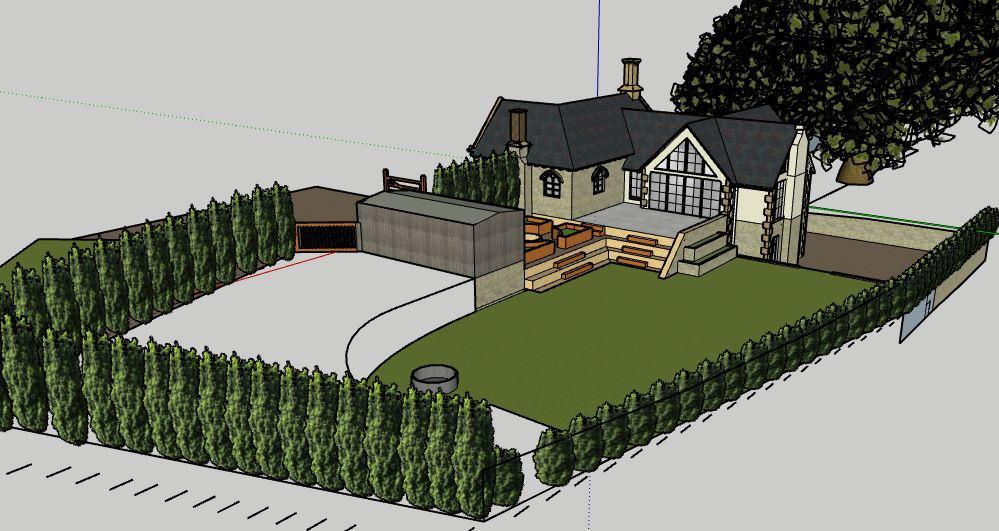
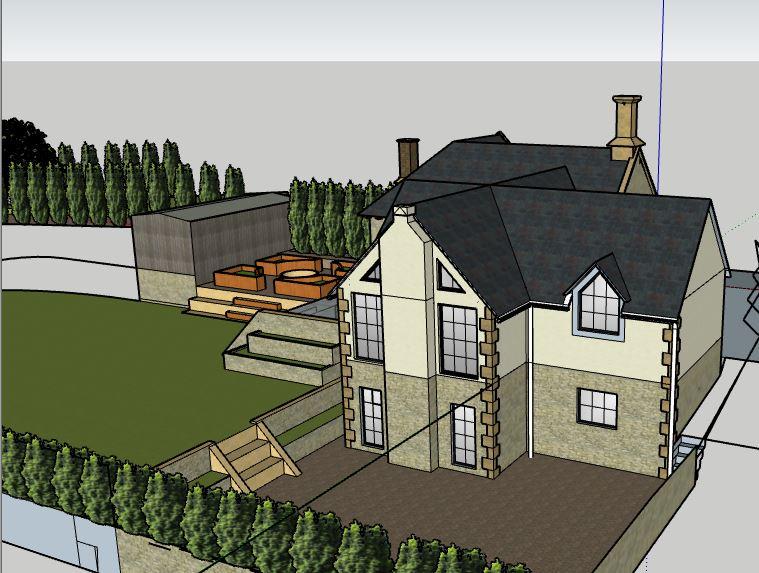
Presto! I've attached some really rough Sketchup screenshots from the last time I played with the external landscaping to give you an idea of the level change...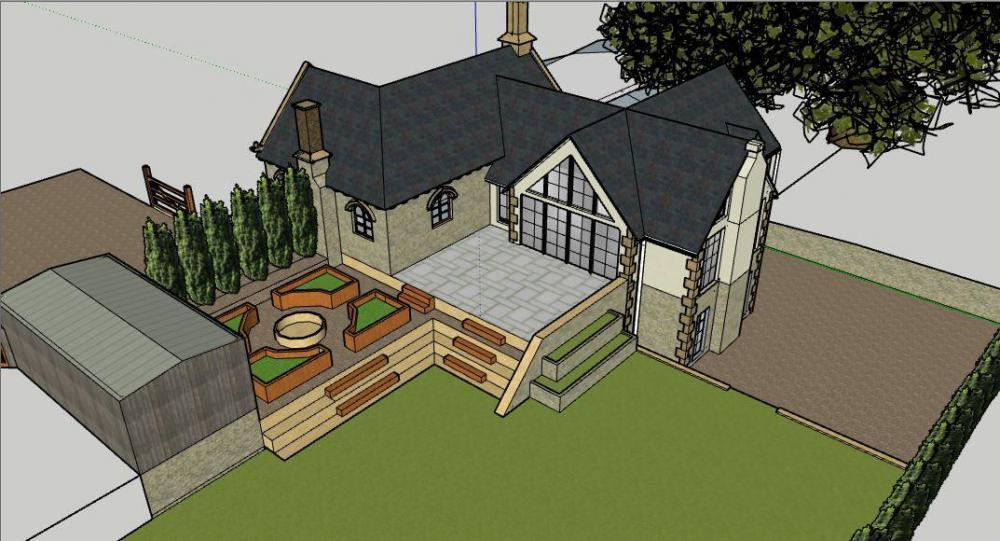
.JPG.ded32eedf86774242f2b585711881a8c.JPG)
-
Old Cottage Restoration + Extension Project
JulianB replied to JulianB's topic in General Self Build & DIY Discussion
The reason i didn't really do a great deal of investigation was because the new extension will be lower than the current septic tank soil pipe run, and hence we would have to look into pumping sewage up a story. If we bite the bullet and re locate it to the other side of the garden, it can be sited lower and remain gravity fed, whilst also be upgraded to a sewage treatment plant and hence not have any issues in the future should we ever decide to sell. -
Old Cottage Restoration + Extension Project
JulianB replied to JulianB's topic in General Self Build & DIY Discussion
Hi Dave, I can see the direction it heads off to, but nothing above ground to give any real indication! It's pretty close to our boundary and looks like it goes off to an adjacent farmer's cattle field...potentially a soakaway or drain field, but it is very old (previous owner who had the property for ten years before us also had no clue!). Our new system will be roughly within 10 metres so should be considered part of an existing system. Thanks for the advice! What sort of maintenance and safety issues are we talking about re. reed bed if you don't mind me asking? We've submitted an application for some advice from the environmental government agency, hopefully they'll keep the soakaway option on the table. -
Old Cottage Restoration + Extension Project
JulianB replied to JulianB's topic in General Self Build & DIY Discussion
Thanks! One other question I had when going through your blog actually...what did you think of the reed beds for the drainage discharge? We're installing a sewage treatment plant do not have space for a drainage field. There is not watercourse closeby, and we're wondering wether getting a permit to discharge into a borehole would be the best solution, or potentially opt for something like the reed beds if they don't take up too much space, leave odours etc? -
Old Cottage Restoration + Extension Project
JulianB replied to JulianB's topic in General Self Build & DIY Discussion
Charlie Luxton was your architect?? I've seen every episode of 'Building the dream' so I feel I know him pretty well now hehe! In my old house I had installed a limcrete and Glapor sub base floor, finished with the original flag stones which really worked efficiently in combating any damp issues (to put it into perspective the adjacent neighbours couldn't leave furniture in the same position for too long because of the damp patch it would create on the floor!). Did you say you put a layer of wood fibre board under your concrete slab? Did the slab run all the way to the walls or did you leave a ventilation gab? I might need to research UFH & limecrete compatibility again as I can't remember there being major concerns but I could have forgotten! Your ach/hr of 1 is VERY impressive! Can I ask what type of house it was and if you have any pictures into the level of detail you went to, to achieve that sort of result? Any tips would be greatly appreciated! Ah yes...I had actually book marked this blog and gone through their various blog posts...interesting Diasen product! I was surprised that they only offer it in spray form by a contractor, but it definitely sounds hopeful! They seem to suggest that it took exceptionally long to dry out, which might have contributed to the condensation and mould they were seeing in areas. Definitely worth a thought! -
Old Cottage Restoration + Extension Project
JulianB replied to JulianB's topic in General Self Build & DIY Discussion
Agreed solid walls doen't perform as well as modern superior materials, but the only point I was trying to make is that if taking your example of 3 ft wall is equivalent to 150mm of PIR when dry...as soon as you've completed sealed up your internal living area and put a great demand on those walls to manage moisture, the wet solid stone wall will perform worse than the original 150mm PIR estimate (By what factor I don't know?), so depending on how much insulation you've added you might not be a lot better off? together with the potential acceleration of the rate of deterioration of the stone walls themselves from being saturated for a greater portion of time? On the other hand if you go with something like a wood fibre board which has a lambda of 0.038W/m.K, you can continue to build on that thermal efficiency, without loosing any of that theoretical 130mm PIR equivalence, whilst also keeping everything pearmable? -
Old Cottage Restoration + Extension Project
JulianB replied to JulianB's topic in General Self Build & DIY Discussion
This same issue had crossed my mind and I thought about an external lime render, or potentially some breathable layer prior to this render, however I don't believe the conservation officer will let us touch the external walls on the lodge! -
Old Cottage Restoration + Extension Project
JulianB replied to JulianB's topic in General Self Build & DIY Discussion
Could I ask if you do anything to tackle the risk of Legionnaires’ disease by storing your DHW @ 45degC. If I understand correctly this means showers and baths are still comfortable, but do flow rates take a hit as one typically is able to mix in more some cold water to hit the desired temperature when storing at say 60? That does make sense in my mind, as you have maintained the ventilation aspect and upped the drainage ability of the ground immediently underneath. Could I ask what you've done to the walls? Your wall build up sounds very much like what I might be looking to do, together with french drains...Could I ask what persuaded you to steer clear of limecrete this time round? any pics of the project? -
Old Cottage Restoration + Extension Project
JulianB replied to JulianB's topic in General Self Build & DIY Discussion
Yes I understand that…I’m referring to the bottom of the solid stone wall, not the internal floor. The fact that you’ve basically removed the ability for the floor/ internal walls to breathe to help regulate the moisture in the ground/earth would naturally result in the base of the wall having to do more work…which means a wetter wall…granted you can’t see that moisture because you’ve put up a barrier. Therefore thermal performance of the solid wall drops, and implies that you have to rely on more of the internal insulation you line the walls with to prevent heat loss? Essentially you sacrifice U value of the wall and rely on the box you’ve made within the box? -
Old Cottage Restoration + Extension Project
JulianB replied to JulianB's topic in General Self Build & DIY Discussion
Thanks for the reply! I understand where you’re coming from, but in my mind I’m still thinking that this would be the wrong approach for the fabric of the house. Here’s my argument: · The bottom of the solid stone wall will still be sitting on wet ground which I can never get away from unless I unpin the entire lodge. The more you remove the ability for the internal floor and walls to breathe (with your proposed method) the greater the moisture levels within the walls · Lining the internal walls with a high level of insulation will pull the dew point inboard, potentially between the wall and insulation, which further raises the moisture content of the walls. Granted that you would not be directly impacted by this moisture as you’ve (hopefully) fully sealed the living space with the barrier, but I presume this would nonetheless reduce the thermal performance of the stone wall, not to mention structural integrity over time (granted a very long time)? My thoughts on the other hand are to dig the floor up and pour limecrete with integrated UFH (and breathable covering); I’m on the fence on whether to batten internal walls and use some form of permeable thermally efficient material, whilst also incorporating a ‘breathable’ airtight membrane… This would similarly pull the dew point inwards, however I’m hoping to manage this through only using breathable materials, together with the MVHR. It would be great if we had U values for solid stone walls in both a dry state and a sopping wet state (as a worst case) to begin to put some numbers to both methods? -
Old Cottage Restoration + Extension Project
JulianB replied to JulianB's topic in General Self Build & DIY Discussion
Good bit of info re. 45degC being suitable for DHW...wouldn't that imply that the majority of ASHPs would still operate within their favorable COP for DHW needs? I've had a quick play with JHarris's Heat Loss Calculator and it does highlight the considerable amount of glazing we are incorporating! Due to the listing status and conservation area, we are constrained to certain heritage range aluminium windows, which don't seem to get much lower than 1.5W/m2.K. My U value break down, together with areas / volumes looks something like this: Wall U value = 0.17 W/m2.K Floor U value = 0.19 W/m2.K Roof U value = 0.18 W/m2.K Average window U value = 1.4 W/m2.K Average door U value = 1.5 W/m2.K Internal wall area = 94.40 m2 Internal roof area = 131.00 m2 Internal floor area = 92.00 m2 House total internal volume = 364 m³ Total wall and roof heat loss area = 225.40 m2 Total window area = 35.52 m2 As a result, the net heat loss power comes in at: Heat loss versus outside air temperature Difference between room and OAT (deg K) = 0 5 10 15 20 25 30 Ventilation heat loss energy (J) = 0 142042 284084 426126 568168 710210 852251 Ventilation heat loss power (W) = 0 39 79 118 158 197 237 Wall heat loss power (W) = 0 80 160 241 321 401 481 Window heat loss power (W) = 0 249 497 746 995 1243 1492 Door heat loss power (W) = 0 12 24 36 48 60 72 Roof heat loss power (W) = 0 118 236 354 472 590 707 Ground floor heat loss power (W) = 210 210 210 210 210 210 210 Fabric heat loss power (W) = 210 669 1127 1586 2045 2504 2963 Total heat loss power (W) = 210 708 1206 1705 2203 2701 3199 These calculations also assume that the old part of the house is consistent in construction with the new, which will naturally drag it down further! I will have to have a good look through a few ASHP specs to see which fits the bill together with MVHRs. Whilst the Genvex Combi does sound like a very good bit of kit, my better half has warned me against taking away her UFH! -
Old Cottage Restoration + Extension Project
JulianB replied to JulianB's topic in General Self Build & DIY Discussion
Thanks for the info... What sort of CoPs do EASHPs achieve relative to ASHPs? Am I right in assuming an EASHP would replace the role of an MVHR (I.e. EASHP would also provide some form of ventilation?). Do you run your showers and baths at 45C?? I have thought about skirting heating, but struggle to see how there will be enough surface area in the rooms I am interested in as there will be a kitchen taking up a good portion fo wall area etc? -
Old Cottage Restoration + Extension Project
JulianB replied to JulianB's topic in General Self Build & DIY Discussion
Thanks for the advice! Sounds like that may be off the list too then! Now just to find a suitable heat source for the DHW... -
Old Cottage Restoration + Extension Project
JulianB replied to JulianB's topic in General Self Build & DIY Discussion
Evening All, It’s been a while since my last post… The good news is that our planning application has been granted against all odds, however it did require us to conjure up enough interest in the village to get it ‘called in’ and decided at committee level (6 in favour, 5 against!). They have placed a number of conditions in our path which are likely to drain more out of the budget and slow us down somewhat, but we’re still smiling! We’re now in the process of drawing up the necessary details to satisfy building control, and we really ought to be finalising our heat energy supply. I haven’t yet attempted to calculate the energy demand of the house (from JHarris’s spreadsheet), however I was under the impression that from a CH POV, ASHP should present us with a good improvement from our current oil fired boiler setup. We intend on integrating UFH in both the old and new part of the house. That said, the new part of the house is an upside house…i.e. upper level will be for living and lower for sleeping…I’ve seen UFH installed over floor joists (for the 1st floor living), but am keen to get people’s opinion on it? With regards to DHW, my wife and 2 children (& counting) enjoy their long showers/baths, and I’m aware that above ~45 degC, CoP plummets w.r.t. the majority of ASHPs? I have also read about people using the ASHP to supply the DHW tank with water @ 45degC, and then using an alternative source top up the remainder to get to say 65degC? Solar seems to be a popular option, but given our proximity to mature trees, seems an unlikely candidate? Wind however is something we do have a great deal of (the good kind!); being situated on the top of a valley, we really do get fairly good gusts on most days, but I haven’t yet grasped whether this is a viable / realistic route for the domestic market, and particularly given that we are in quite a sensitive area in terms of focal points (& our pockets aren’t deep!). Would using the grid to top up the remainder of the DHW needs be a viable option, or would we be better off scraping the whole idea and sticking with a more modern (& hopefully more efficient) oil fired system? Any advice would be greatly appreciated!- 74 replies
-
- 1
-

-
- cottage
- resoration
- (and 3 more)
-
Old Cottage Restoration + Extension Project
JulianB replied to JulianB's topic in General Self Build & DIY Discussion
Thanks John...I do see your point; I can understand the principles of completely sealing the walls and floor as one entity, and hence not being vunerable to any moisture external of this membrane. My only concern would be tthe need for greater internal insulation, as a result of the floor/walls having higher mositure contents as a result of the impermeable layers, and hence performing less efficiently (from a thermal point of view). I'm currently reading the old house eco handbook and the authors refer to this scenario in particular (I'll post a photo of it tonight...). Also, I had gone to see a barn a while back which had been tanked about a metre and a half up the walls together with the floor slab (not sure how well they were tied in...); what I did notice was that the tanking had actually blown off the walls in large sections, creating gaps of about 10mm...quite worrying (although potentially linked to some other problem I didn't spot...) Thank you Ferdinand...I had briefly heard about the issues involved with de-commissioning fireplaces - will definitely give that a good read and take notes as I wouldn't want to create any more issues than I already have on my plate! One of the chimneys actually runs externally to the house, which I thought might be a bit easier to deal with from a thermal losses / maintaining ventilation within the stack POV. Could I ask what GBF stands for by the way? I can't see how I'd ever get around the fact that the base of the solid walls are in direct contact with the earth, and would naturally draw moisture up them from time to time? Am I mising something? I can see why people find it a lot easier to flatten and start from scratch! Thanks John! The sole reason PV comes to mind is in order to heat the DHW to an adequate temperature without bankrupting me. I haven't had time to estimate the CH requirements of the proposed house / spec, but I've seemed to come across quite a few comments on ASHP and degraded COPs at DHW hot water temperatures (I haven't looked at the larger units and what their COP characteristics are like at high temperature demands / low temperatures & high relative humidity to get a worst case scenario). Any ideas for alternative methods of heating DHW? Thanks everyone! -
Old Cottage Restoration + Extension Project
JulianB replied to JulianB's topic in General Self Build & DIY Discussion
Thanks for the comments...that's actually a good point re. trees....I find in the mornings we are generally shielded by the trees to the front of the house but by midday we get a some direct sunlight. Limecrete would only be incorporated into the old part of the house - my fear is that going for a concrete floor would divert more moisture to the base of the solid stone walls? I am letting my wife down slowly re. the wood burner - there is something cosy about lighting a wood burner on the weekend, but that could equally be because we are used to colder houses and hence welcome the blast of heat they offer...if we do hit a better thermal efficiency and maintain a more comfortable temperature throughout the day, we may find that a wood burner would only over heat ourselves! -
Old Cottage Restoration + Extension Project
JulianB replied to JulianB's topic in General Self Build & DIY Discussion
Thanks for the info; all makes perfect sense. I don't suppose you've got some photos of the seal profiles etc (no rush!) Thanks Julian


.JPG.ded32eedf86774242f2b585711881a8c.JPG)